Showing posts with label Eileen Browne. Show all posts

Monday, 23 November 2020

Now We Are One! Picture books for one-year-olds by Lucy Rowland

Last year, when my son was still teeny-tiny, I asked the mums in our NCT group which books their babies were particularly enjoying. I wrote about their answers for Picture Book Den.

Recently, our children celebrated their first birthdays- a big milestone, which perhaps felt even bigger given the very strange year we've had- and I thought it would be nice to catch up with the mums and babies once again.  This time I wanted to find out which picture books they are enjoying NOW WE ARE ONE! 

Of course, most of the babies still like board books with their sturdier pages (for enthusiastic hands), and novelty books with their flaps, textures, buttons and sounds, but some of the babies are starting to branch out into more traditional picture books too.

Answers included the classics: 'Guess How Much I love You' by Sam McBratney and Anita Jeram, the rhythmic 'We're Going on a Bear Hunt' by Michael Rosen and Helen Oxenbury, 'Goodnight Moon' by Margaret Wise Brown and Clement Hurd, 'The Tiger who Came to Tea' by Judith Kerr, 'Not Now Bernard' by David McKee and the ever-popular 'Peepo' and 'Each Peach Pear Plum' by Janet and Alan Ahlberg.

But there were also some picture books which were either less familiar to me or which took me by surprise but are, never-the-less firm favourites with these one-year olds.  

My own son, Benji, enjoys:

'The Flying Bath' by Julia Donaldson and David Roberts.

My sister gave us this one, as her own son had enjoyed it so much. It was not a book I'd come across before but, with its minimal text and simple bouncy rhyme, Benji loves following the journey of the flying bath as it travels around the world helping animals with their water-related problems.  I think he enjoys the repetitive refrain- 'Wings out and off we fly, the flying bath is in the sky!' I like the soft colours and patterns used in the illustrations.


Grayson's mum said: Grayson loves Oi Dog! by Kes Gray and Jim Field I think it's the bright, bold colours and the funny voices that I do!


 Poppy's mum said: 
Poppy likes 'So Much' by Trish Cooke and Helen Oxenbury.

Flora's mum said: Flo really likes 'I want my hat back' by Jon Klassen.  

Teddy's mum said: Teddy's favourite is 'Chu's Day' by Neil Gaiman and Adam Rex

Joseph's mum said:  Because I read it almost every day over lockdown, Joseph likes 'What the ladybird heard on holiday' by Julia Donaldson and Lydia Monks. It's also my favourite of the trilogy! 


Ralph's mum said:  Ralph really likes non fiction picture books. He also has some lovely non-fiction 'Hello World' board books by Jill McDonald. He likes Solar System, Weather and Backyard Bugs. He really loves the bright and colourful illustrations and frequently after we've finished reading it, he will pick it straight up so we can read it again! There is a central text to read and then extra little facts for when he is older.

Holly's mum said: Holly likes 'Ten Little Fingers and Ten Little Toes' by Mem Fox and Helen Oxenbury. She will give us kisses at the end of the book so that makes it my favourite to read to her! 

Archie's mum said: Archie loves 'Handa's Surprise' by Eileen Browne.  It's a definite favourite! We have a story sack version of it and he loves playing with all the different fruits and the animal masks!

So there we have it- top picture book picks as chosen by our one year olds! Which picture books do you recommend for this age group? 


Friday, 14 June 2013

Converting The Picture Book Attic, by Pippa Goodhart


In recent years there’s been a trend for converting house attics into proper rooms.  What had held dust and rats, water tanks and junk, have become studies, en-suite bedrooms, artist’s studios, and more.  Well, I think it is time to do the same thing for picture books.  There is a similarly lovely big expanse of room that is often under-used in picture books, and that’s the endpapers.  We’re missing an opportunity if we don’t use them. 

Endpapers are exactly that; the paper at the end of each book, joining cover to content.  That’s their job.  Most endpapers are left as bare white paper, and useful for old-fashioned library Return Due Date stickers to be stuck to, but that’s about all.  I’ve noticed how often it is the blank endpapers of library picture books which get scribbled on by small children.  Are they trying to tell us something?  “Use this space!”  And some picture books do.


Korky Paul cleverly hands-over the endpaper artwork to children.  These pictures of Winnie the Witch and cat Wilbur with dinosaurs are by Park Jung-Eum and Park Ji-Eun, aged seven.  They are wonderfully bold, dramatic and fun pictures which must give children a pleasing can-do feeling in knowing that people of their own age can have good work published. 


Jo Empson uses the endpapers in Rabbityness to give a kind of rabbit wallpaper of different rabbit poses; very attractive, and an appetiser for the story to come. 


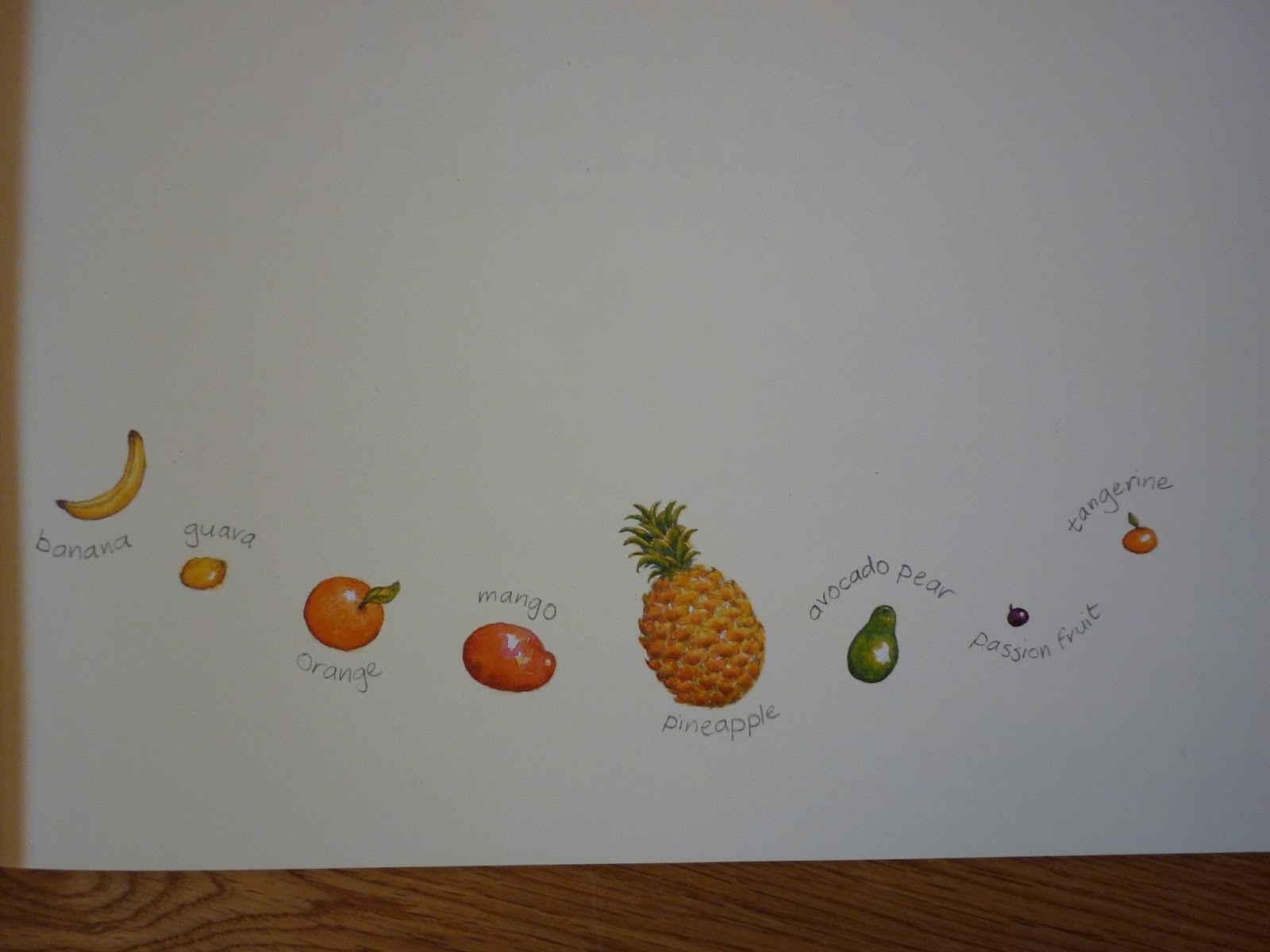
Eileen Browne uses the endpapers for Handa’s Surprise to show and name fruits at one end of the book, and wild animals at the other end, adding interesting lessons to what is already one of the best picture book stories ever.


My You Choose and Just Imagine books have illustrations crammed with images but have little text.  I was a child who found reading hard, and was always relieved to find a book that didn’t demand much reading.  But there are children who relish new words to read.  So we’ve used the endpapers to list hundreds of words, offering a kind of treasure hunt game for those who like reading the words (they all name things to be found in the pictures), but placed in the book so that they are not a necessary part of the book experience if reading words isn’t something you enjoy. 


Helen Oxenbury’s  beautiful pictures on the endpapers of Farmer Duck are glorious.  Nothing ‘childish’ about them, and yet I’m sure that children sit and absorb and lot from them, both for their beauty and for what they reflect from the story.  At the start we see the farm landscape in winter; bleak and harsh.  By the end of the book that same scene has blossomed into warm colourful summer.

I’ve just asked my editor if a new book that is (hopefully!) on its way to publication might have a board game on its endpapers. 

There are so many way in which endpapers might add to picture books.  They might add information relevant to a story, for example with a map of where the story takes us, or non-fiction information relevant to the fictional tale.  They might add a game or an activity to complement a story.  How about a recipe or a quiz, instructions on how to make a paper aeroplane, or black and white pictures to be photocopied or traced for colouring in?  Or simply add decoration to make a book more beautiful. 
 
When books are fighting for sales against so many other attractions, an extra ‘room’ in a book might just make it a winner.  What other examples of extending stories into the endpapers have you found, or can you think of?