Showing posts with label children's books. Show all posts

Monday, 15 May 2023

Let’s talk about authenticity by Nadine Kaadan

The annual CLPE survey, which is funded by Arts Council England, launched in 2017 with the key focus of determining the extent and quality of ethnic minority characters featured within Picturebooks, Fiction and Non-Fiction for ages 3–11 published in the UK. The fifth Reflecting Realities report was published in November 2022. Annual reporting shows an increase in the number of children’s books published featuring a minority ethnic character from 4% in 2017 to 20% in 2021.

The percentage of books published with a main character from a racially minoritised background has risen year on year but remains extremely low at 9% in 2021.

We invited Nadine Kaadan to reflect on championing inclusive representation in the UK based on her own experiences. 


When I moved to London in 2013, we thought it would be for around a year. My husband said to me “When the conflict ends in Syria we will come back” and we both truly believed that. We never imagined the life that we would build here, and here we are, 10 years and two children later. 

I was told, to my dismay, that publishing a children’s book would be almost impossible here. There were only 3% of children’s books published that featured BAME characters. I thought my chances were close to zero, but I wanted to try. I feel so grateful that Lantana Publishing picked my stories, and my journey started with them.
 
As sad as it was to be forced to leave my country, writing and illustrating children’s books was my way to process what was happening, and still is. It’s the thing that has helped me the most in directing my grief and anger at what was happening in Syria.

I’ve been lucky enough to write books about my experiences, both through my own eyes, and the eyes of the children I knew. 

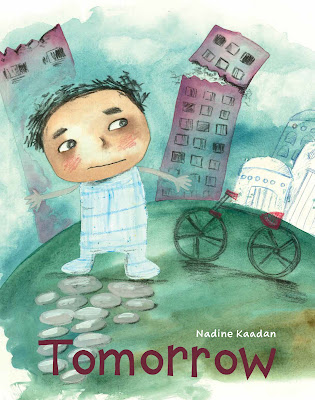
‘Tomorrow’ is based on my life during the war in Syria, watching how children reacted (including my niece) and seeing the confusion in their eyes. I really felt the need to bring that story to life. 


Most recently, I’ve been able to collaborate with other writers and illustrators: Ada Jusic, Ramzee, Sonya Zhurenko, and Marie Bamyani to tell our real life stories to help children understand our experiences. 


During my 10 years in London, I have watched the children’s book industry grow and mature, especially when it comes to diversity and inclusivity. It is wonderful to see more and more authors of colour getting published, with so much more awareness of the importance of more inclusive children’s books.


However, it’s sad to still see such a lack of authenticity within the children’s book market, and so much cultural appropriation. The subjects of Syria, war and seeking refuge particularly tug on my heart strings.

I wonder why authenticity isn’t at the forefront of the industry’s minds? Why aren’t we seeing more writing of people’s own stories? Why are there stories by authors that are not part of the culture they’re writing about? Stories about things they have not experienced, such as war? It is great that there is more exposure and awareness being sought.. but isn’t it important that what’s being read is authentic… coming from real life experience?

Editors and publishing houses seem to be trying to solve the issue of diversity by simply hiring an author of colour, but we are not a monolith. Our cultures and experiences can be so vastly different and they are not interchangeable. I also do not believe that hiring sensitivity readers solves this issue either. In fact, I think it adds further to it.

I really feel that where there is a story about war, cultural diversity, or disability, we really need authenticity - people telling their own stories in their own voices. No matter how much research has been done, our own voices bring real depth and truth to any story; because only we can bring real life memories and cultural identity to the characters and the plot.
 
That being said, I have also read some wonderful books, that are truly authentic, which I have found extremely inspiring and empowering. My son’s bookshelf is full of these books! Three of our favourites are:

‘That’s not my name’ written and illustrated by Anoosha Syed
 A story that comes from the author’s own experience of people mispronouncing her name.


‘Wonderfully Wired Brains’ written by Louise Gooding and illustrated by Ruth Burrows
A wonderful book about the world of neurodiversity, coming from the author’s own life.

‘Chicken in the Kitchen’  written Nnedi Okorafo illustrated by Mehrdokht Amini
Nnedi brings her beautiful Nigerian culture in this fun filled adventure of an Anayago during the yam festival.


Nadine Kaadan is from Damascus, Syria, now living in London where she completed her Masters in Communication Design in Kingston University, and a Masters in Art and Politics at Goldsmiths University. Nadine is passionate about championing empowered and inclusive representation in children’s books. Her work with young refugees was featured in a BBC short film under the title ‘Writer Nadine Kaadan Helps Syrian Children Understand War’, and CNN Connect the World  program among others. 
She is the 2019 winner of the Arab British Centre Award for Culture, and was nominated for the Asian Women Of Achievement Award 2020. Find out more at https://www.nadinekaadan.com/ 

What's your experience of inclusive and representative books for children in the UK? Do you have books you would like to recommend to other readers? Share with us.

Monday, 8 April 2019

Meet the Relatives, by Mini Grey


Today’s post is about all things insect. So: grit your mandibles, flex your feelers and close your compound eyes, we’re going in…


Meeting the Insect Face


 In 1665 Robert Hooke published a perspective-changing book of pictures, Micrographia

Looking through a microscope he could see further than anyone ever could before, and he showed us this tiny world of everyday things made enormous and wonderful, with huge fold-out pages. People were amazed by Hooke’s book – Samuel Pepys stayed up all night marvelling at it.
The everyday pest is revealed as beautiful; the flea is ‘adorn’d with a curiously polish’d suit of sable Armour’ and ‘multitudes of sharp pinns, shap’d almost like Porcupine’s Quills.’ 

Hooke also draws the mind-boggling face of a fly. And we find the insect face is hard to love.
The face of a fly
 It doesn’t map that well onto the tetrapod look. It’s those mouthparts. The flea has at least a nice moustache - but then - HELP! - it has a pair of legs growing out of its chin. Segments, exoskeletons and too many legs are also not ideal for building our empathy with arthropods. 

It is basic human behaviour to feel disgust at insects – no doubt due to instincts of self-preservation against contagion. Lots of insect life cycles are frankly disturbing – especially the parasitic wasps. Most of human history has been a battle against innumerable critters out to infest you & contaminate YOUR FOOD. 

Here are some sketches of flies in my garden and young locusts and cockroaches at London Zoo.
But how does it feel to be an insect? Does it feel like something to be an insect? Some research seems to indicate that bees may experience different emotional states – emotions are useful for instigating behaviour – and it appears that dopamine plays a role in bee decision-making – as it does for us. It could be that emotions are essential for creating all behaviour so all animals that have behaviour are experiencing emotions – so life feels like something for all of them. 

No-one is a mindless automaton. 


As fellow organisms on the Great Tree of Life, insects and us are related, but our branching apart is very distant. The Last Common Ancestor of us & insects was something Pre-Pre-Cambrian, something that maybe lived between 600 and 700 million years ago, and we share with it the invention of bilateral symmetry.
a Kimberella
No-one has found that ancestor yet, 


so here is a Kimberella who might have been a bit similar, looking like a cross between a macaron, a sea-slug and a toasted cheese sandwich.

Picture Book Insects


So, who has crossed over the human-insect divide (that empathy chasm) and involved insects in their picture books? Here are a few of my favourites. Do tell me yours!


Ant & Bee

I remember having these little books when I was small. I found the small size and relatively large text quite exciting, especially as some words would be picked out in red. Here is Ant tucked up ill in bed.
Here are some incredible geometrical cakes from when Ant and Bee go shopping.


Tadpole’s Promise by Jeanne Willis and Tony Ross


from Tadpole's Promise

Where water meets willow two creatures meet. Using the page fold to show the intersection of air and water, amphibian meets insect and both must metamorphose. 

I am so glad that, as a mammal, I do not have to undergo this sort of utter transformation. 


Du Iz Tak by Carson Ellis

Insecty creatures find a shoot and tend it, building an extravagant plant house which gets beset by spider and bird, flowers and eventually wilts.  

from Du Iz Tak? by Carson Ellis

from Du Iz Tak? by Carson Ellis

Character sketches by Carson Ellis
 Like tadpole’s promise, the cast of insects are caught in the cycles of nature and changing seasons, but these ones end with new beginnings and lots of new shoots sprouting. 

 The insect ones speak their own dialect but you can pick it up…I think they may be using bad language on this page:

from Du Iz Tak? by Carson Ellis

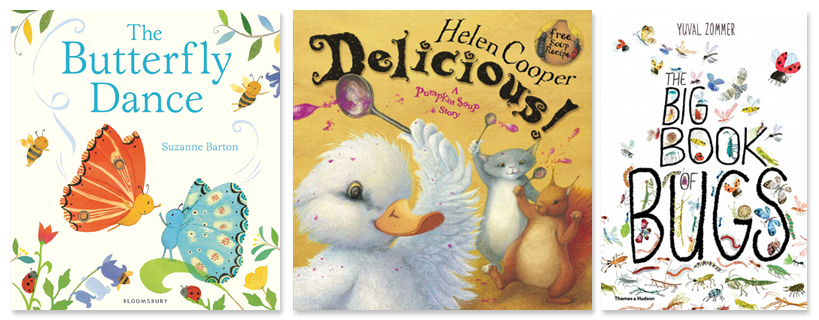
Here are some more beautiful insects: a buzzing meadow garden from Suzanne Barton’s Butterfly Dance,

from The Buttefly Dance by Suzanne Barton
a humming insect Soup Kitchen from Helen Cooper’s Delicious,
From Delicious by Helen Cooper
 
and the most friendly-and-engaging-ever critters here by Yuval Zommer.
artwork by Yuval Zommer


Garden Quest

On holiday on a Greek Island I found this magnificent beetle & handsome grasshopper.

What would they say to each other? What adventures could they have? 

I imagined them going on holiday to Mount Zakynthos, perhaps eating a large Greek Salad washed down with an unwise amount of Ouzo and then an ill-fated boat trip…

I wondered about a story for them; perhaps Grasshopper could be Don Quixote to Beetle’s Sancho Panza.  
Maybe a Quest that takes place all in one garden, with the tiny insects travelling from one end to the other, beset with adventures and dangers.
Garden Quest - from Mini's sketchbook
Well, as often happens, this didn’t really seem to work. 
But then I was asked to make some pieces for the John Radcliffe Hospital Audiology Department. The idea was to make something engaging and distracting for young patients, with lots of details to spot on repeat appointments. So I tried to turn Grasshopper and Beetle’s Garden Quest into a picture-story for a wall. I thought I could make panoramas of a garden world full of minibeasts to spot. Playing around with tracing paper I wanted to make something multi-layered.

It turned into three panoramas which really go from right to left down a garden (the opposite way to a book).
Grasshopper and Beetle find a label for El Dorado honey on the compost heap.
They take it back to their home in the grass then go in search of it,
discovering a honey picnic under the trees.
Critters under a broken pot
Grashopper and Beetle's meadow home
Questing

El Dorado honey attracting attention

Insectageddon

Nowadays there is grim news about insects from lots of fronts. There has been widespread loss of pollinating insects across Britain in the last 40 years. Insects are also at risk from shrinking habitat ranges due to climate change. There are shifting baselines and clean windscreens.
Beetles at the Natural History Museum, Oxford

Are we pulling out the Jenga bricks from the web of life? The tower gets rickettier, but it still looks like a tower until…crash! – one too many bricks has gone. It seems so much minibeast life is unmeasured, unrecorded, unknown. And that’s the stuff on land – what about the invisible areas we don’t even think about – under the ground, under the sea – ploughing either of those up is wrecking a world that is already there.

So what is causing the disappearance of insects? 

The causes, it seems, are: habitat loss, pesticides and climate change. What can we do about this? We can share our world with the wildlife in it! We can protect habitats: someone already lives there! We can set aside agricultural land margins and park margins for wild plants, as in this new law in Bavaria.We can treasure what we already have and make more. Edges and hedges and big trees are particularly good habitats…verges, parks, motorway margins, front gardens – all are opportunities for an edge habitat.
We can make our edgelands into mini wildernesses, mini jungles. 


 This book, The Garden Jungle by Dave Goulson, is about exactly that: the wildlife that lives right under our noses, in our gardens and parks, between the gaps in the pavement, and in the soil beneath our feet. It is published later in the year and I can’t wait to read it.  
The more minibeasts you know, the more you see, and the more you care about. 
With climate change we are in danger of a great global biodiversity simplification – losing specialists and gaining generalists. Climate change squeezes the range of animals as they migrate towards the climate they are used to – generally heading north then hitting the end of the range as they run out of habitat.


We can make it easier for creatures to move by increasing & joining habitats – all those edges we already mentioned. But the utterly brilliant thing is that increasing our nature by reforesting and rewilding is one of the most effective ways of reducing atmospheric CO2 - nature can be our climate-change crash mat  - but it’s also so much more – what an amazing win-win policy using more nature as a solution to our climate problems would be. Last week scientists and activists called for action on CO2 through natural climate solutions, through defending, restoring and re-establishing forests, peatlands, mangroves, salt marshes, natural seabeds and other crucial ecosystems. Here George Monbiot explains how to avert Climate catastrophe by rewilding.

We also can tackle the carbon dioxide in other ways: at the moment it is essentially free to put CO2 into our atmosphere. This is an enormous injustice and a robbery from young people and future inhabitants of earth. Putting a clear price on carbon would change this.


Meet the Relatives

In September last year, the House of Illustration ran a month’s challenge. It was linked to John Vernon Lord’s exhibition there.
(John Vernon Lord is of course the inventor and illustrator of that classic insect book The GIANT JAM SANDWICH!) 

In 2016 John had done a teeny drawing every day for the entire year and they were all on show. The challenge was to do a teeny (1 inch to 3cm) drawing a day for September. (Here are the winners.)

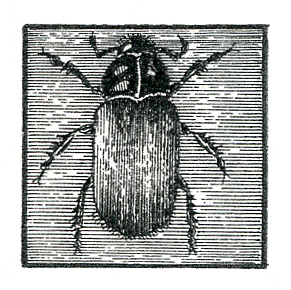
I particularly liked John’s insect drawings, I think partly because they’re life-sized. Here are his lovely beetle and fly.

by John Vernon Lord
by John Vernon Lord
 
I wondered about doing a month of 3cm square drawings of insects.

At the Natural History Museum at Tring there’s a wonderful collection of insects in cases. All have been impaled on a pin and labelled, in that classic insect-collecting way. Here are some of my sketches of the Tringsects.


I wondered: what if the label, instead of saying ‘Periplaneta Americana’, said ‘Uncle Bert’? Could the insects start to become individuals you could care about?

So here are Captain Peacock, Mrs Henderson, Priscilla, FV Heffenfurter and Matilda. 


And here are all the relatives.


Lastly, a few links...