Showing posts with label creative writing. Show all posts

Monday, 15 May 2017

Step-by-step Picture Book Writing in Layers • Natascha Biebow


Betty Crocker's Rainbow Surprise Inside Cake - writing in layers!
In my writing and teaching, I have recently begun to play around and reflect on the process of creating a picture book in a different way. 

Picture this:


Have you ever tried drawing something and been frustrated that it doesn’t turn out quite like you intended? 

Uh-huh, I hear you nod.


Have you ever watched someone drawing something and admired their apparent ease? Like this!

Yes, I hear you nod.


But is it easy?


If you look closely at this process, you will notice that it’s a question of layering – starting with the outline, very sketchy, with a light touch of the paintbrush or pencil. Then, the artist adds more shape, a bit more texture, rubbing this bit out, adding that bit there, playing with the idea. Slowly, the general shape begins to emerge! 

from ART90OP's from youtube.com/acrylicpaintingtechniques

It’s usually not a question of starting out with a fully-formed piece of work and trying to edit that because, frustratingly, well, you can’t START with cake. 
 
You have to put in all the ingredients – and you have to first decide WHICH ONES? – and then lovingly bake your picture book story so it rises and is light and fluffy and just right for young readers. 


If you try to start with cake and keep fussing, adding new and interesting toppings, it may LOOK marvelous . . .


. . .  BUT if the cake isn’t right in the first place

 it will never work. 


Coming back to our artist’s process:


First, the artist sketches out the idea with a light touch, testing it out in the space, finding its shape.
from ART90OP's from youtube.com/acrylicpaintingtechniques

You can try pacing out your picture book into 12-14 spreads. 
Look for a way into your story, find a strong hook. 

Next, the artist adds stronger, darker lines and details to define the initial sketches. 


from ART90OP's from youtube.com/acrylicpaintingtechniques
Make sure you have an opening that hooks in the reader and an ending that bookends the opening and gives the story a satisfying conclusion, a twist or that 'aw' factor. Check your plot doesn’t read like a list, with everything having the same weight, that there is a clear climactic turning point. 

Now, the artist adds colour and texture, in layers – look how it’s added depth! 

from ART90OP's from youtube.com/acrylicpaintingtechniques

Check your characters’ motivations. Make sure readers will care about your protagonist. Add voice. Make it the story only you could have written or illustrated.


Then, the artist stands back and observes. He adds the final touches.  


from ART90OP's from youtube.com/acrylicpaintingtechniques

At last, ta-da! The result is a picture that sings, that speaks to its audience.

from ART90OP's from youtube.com/acrylicpaintingtechniques


Watch the artist at work! 

Creating picture books is a frustrating business. Not only do you have to have that singular commercial idea, but it has to be written with voice, style, pace and emotional depth to leave the reader with a feeling of satisfaction, a laugh, a tear, an ‘aw’ moment.  


Many of my students are frustrated at the fact that it doesn’t all come together at once, that you can’t edit something that isn’t yet on the page. And this is just it – you must first sketch it out and play with the idea, like the artist. THEN you can add layers, erase, add and shape and depth.


Annoyingly, when you stand back – and you must read your work aloud and try to be objective, like a reader – you notice things that must be edited further and changed. And when you make these changes, often new things unravel. Argh!


Once you have a working draft, it is time to add in the texture, the final toppings, the ta-da! to give the story pizzazz and make it really shine.


Here, a good technique is to go through and look carefully at each word. Use the highlighter revision technique. Read it aloud again.

But working in this way is rewarding and gives the creator permission to experiment, to start with a sketch and PLAY around a bit before investing time and effort in fine-tuning their work. See all those multi-coloured Smarties in the Rainbow Surprise Inside Cake (below)? Go on, have a play, taste a few even, and figure out the heart of your story cake – the nugget of your story before rolling up your sleeves to add the rest of the layers.


________________________

Natascha Biebow
Author, Editor and Mentor

Blue Elephant Storyshaping is an editing, coaching and mentoring service aimed at empowering writers and illustrators to fine-tune their work pre-submission.  Check out my small-group coaching Cook Up a Picture Book coursesNatascha is also the author of The Crayon Man (coming in 2019!), Elephants Never Forget and Is This My Nose?, editor of numerous award-winning children’s books, and Regional Advisor (Chair) of SCBWI British Isles. 

Monday, 26 September 2016

Picture Books: Theatres of the Imagination By Timothy Knapman

Unlike many people in my line of work, I didn’t grow up wanting to write for children.  Don’t get me wrong – I love my job and I love my readers – but I started writing picture books only after years of doing other kinds of writing.  I mention this partly because there are times when I feel like the woman in the song – who wanted to go to Birmingham but they’ve taken her on to Crewe – and partly because some of the things I learned on the long and winding path to where I am now have proved very useful to me and might be a help to others.

The theatre (especially the musical theatre) was my first love and I often think of picture books as little toy theatres.  Open one up, and it’s like the performance is about to start.  There’s a sense of anticipation: you’ll have to concentrate, but you know you’re going to have fun – and anything can happen.  Remember Max in his bedroom as the forest grows in Where The Wild Things Are (my favourite picture book of all time)? It always looks to me like something that’s happening on a stage.


The forest grows in Max’s bedroom in Where The Wild Things Are, by Maurice Sendak
Tintin – another great love of my childhood that has endured to this day – is different.  A bit more sophisticated perhaps, for slightly older readers and certainly faster.  Think of the mixture of angles, points of view – the wide shots and close-ups – on a page of a Tintin book, the fast cutting, the snappy dialogue: that’s not theatre, it’s cinema. 

A page from King Ottakar’s Sceptre by Hergé
Though in some ways, it’s true, writing a picture book can be like writing a movie.  As with a movie, the writer is the first person on a project.  He or she has often had the original idea and works up the script alone, or with the help of an editor, but it’s the people who join the project later – the illustrator especially – whose work is most immediately apparent to the public.  They are the movie stars, they are the ones who attract the audience, who give the story its face.  Julia Donaldson apart, most people would be hard pressed to name a picture book writer; it’s the illustrator’s style that most often makes them take a book down from the shelf.  Who wrote Casablanca? I know, because I’m a writer.  It was Julius and Philip Epstein, with Howard Koch.  All dead now and none of them exactly household names even when they were alive because people remember Bogart and Bergman instead and that’s as it should be.  It means they were enraptured by the story; it means the writers did their job well.

Two thirds of the writers of Casablanca
Because in all forms of drama – and I’m including picture books in that category – story is king.  Of course you should have an eye-catching premise, interesting locations and vividly-drawn and entertaining characters.  But if they aren’t all serving a story that grips your audience from the beginning to the end, you will be punished in the theatre with coughing, programme rustling and that strange squeaky noise you get when restless bottoms shift in tip-up seats.  Picture book stories are shorter than most plays – the works of Samuel Beckett excepted – but children are even harder to please than theatre audiences, and not wont to mince their words when they’re bored.

So take note: the secret of a good story is telling your audience the right things in the right order at the right speed.  Tell them too much or too little and they’re lost.  Tell them things before or after they need to know them, and they’re confused.  Tell them too slowly, and they’re bored; too quickly and they’re dazed.

How do you know if you’ve told your story successfully? I hope you get better with practice, but – again, as in the theatre – your last collaborator is the audience.  We have previews so we can try a show out in front of an audience, and if there are things the audience doesn’t like or can’t understand, we change them.  So try your story out – with children of the right age, ideally – and listen to the advice and feedback from your editor.  It’s their job to let you know if the story you’re telling is coming across or not. 

But how do you come up with a good story in the first place? I get my ideas in all kinds of ways.  My first book, Mungo and the Picture Book Pirates (illustrated, like its successors, by Adam Stower), was inspired by my reading a bedtime story for some kids, and them asking me to read it “Again!” each time I finished.  After five or six readings, I found myself wondering how much more tired than me the characters in the story must be.  After all, I’d just been sitting in a chair, saying words; they’d been living the story – battling pirates and fighting sharks and all sorts.  So what would happen if a boy read his favourite book so many times that its hero became exhausted and went on holiday for a bit?

Mungo and the Picture Book Pirates by Timothy Knapman and Adam Stower
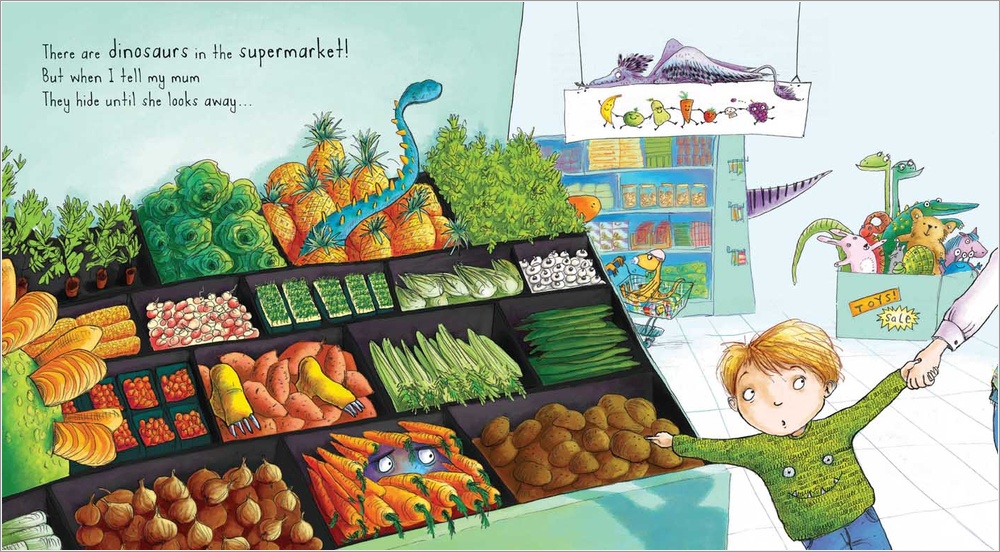
If that seems odd, I got the idea for my book Dinosaurs in the Supermarket when I was watching a gory Stephen King horror movie called The Mist.  That’s about a bunch of monsters that come out of a mysterious mist to devour some small town Americans in a supermarket.  It’s not, perhaps, a situation that many people would associate with entertainment for small children but I loved the way it mixed the extraordinary with the everyday – and that is a staple of picture books.  So my monsters visit the supermarket too, but with mischief, not massacres, on their minds.

Spot the difference? Dinosaurs in the Supermarket by Timothy Knapman and Sarah Warburton, and The Mist movie poster
There’s another way in which picture books are like the theatre: they’re written to be read aloud, to be performed That doesn’t mean you should go overboard with oratorical flourishes and Shakespearean fireworks.  Most mums and dads reading your books to their kids won’t be buddng Oliviers.  But, providing it’s doesn’t get in the way of the clear telling of the story, a rich verbal texture can be great fun so treat yourself to the occasional tongue-twister sentence, or poetic image.

And there are other theatrical tricks you can borrow which will enliven your tale.  The premise of Dinosaurs in the Supermarket is that a boy is the only person who can see a mischievous gang of dinosaurs that’s making a mess in a supermarket.  Every time the grown-ups turn round to look, the dinosaurs hide.  But Sarah Warburton, the brilliant illustrator, leaves lots of little clues in the pictures so that the children reading the book can see what the grown-ups in the story cannot. 

The result? The readers end up pointing to these clues and crying out “It’s behind you!” They’re reading a book, but they might as well be at the panto.

Dinosaurs in the Supermarket by Timothy Knapman and Sarah Warburton
How many Stephen King inspired dinosaurs can you spot?
I hope this is a new way of thinking about picture books, and I hope it helps next time you start to write.  Of course, writing picture books can also be like many other kinds of writing - writing jokes, writing songs, writing poems…

But that – as they used to say on Jackanory – is a story for another time.

Sunday, 14 June 2015

Exploring Story Cubes - Lynne Garner

In my last post I discussed how you can use a Story Sack to enhance the reading experience of your child. This month I've decided to write a follow-on post about the glory of story cubes.

They're a great addition to any story sack and can be used in a variety of ways, all of which help children meet some of the EYFS goals. For example:


  • Personal, Social and Emotional Development: making relationships (bonding over play) and building self-confidence 
  • Communication and Language: speaking and listening skills
  • Physical Development: small motor skills (throwing the cubes, holding a pencil)
  • Expressive Arts and Design: being imaginative

So what are story cubes?

Story cubes are small cubes that contain images, these can be used to help you create a story, poem, work of art, anything creative really. You can purchase them or you can make your own. If you prefer to make your own you can create a cube from card (there are loads of templates you can download from the Internet) or up-cycle some old wooden play bricks. Once you're armed with your cubes and are ready to experiment with them here are a few ideas to get you started:

If you choose to purchase a set (typically they come in sets of nine cubes):

Group game - Create a story version one: Throw all nine cubes and each person picks one cube. Decide who goes first and that person has to start the story using the image from their cube as inspiration for their part of the story. The next person then has to add to the story using the image from their cube. Continue in this way until everyone has had a turn. If there are a small number of players e.g. 3 then each person can pick three cubes and use one cube per go until all have been used.

Group game - Create a story version two: Give each player the same number of cubes. Then taking it in turn each player throws one of their cubes and carries on the story from the previous player using the image they've just thrown as inspiration for their section of story.

On your own: Throw the cubes and arrange in a line. Following the sequence of images to create a new story.

Notes

  • You don’t have to be literal with the images for example if a rainbow is thrown there doesn’t have to be a rainbow in the sky. Perhaps someone is singing ‘somewhere over the rainbow’ or someone is wearing a rainbow coloured top. 
  • You may wish to record the results of your 'game' so the story it not lost. 


Homemade story cubes: 
You could create a story cube based on a story you've recently read with your child or make a set and use the ideas above. However if you choose to base your story cube on a story you've read then these ideas may be helpful:

What happened? Throw the story cube. Using the image that lands face up to discuss that part of the story. Was it funny? Was it sad? Was it scary? What happened before or after that part of the story?

Rearrange the story: Throw the cube and use the outcome to rearrange the story you’ve read. Perhaps the goodie loses and the baddie wins. Perhaps something the character was afraid of is no longer afraid of. Perhaps something they were bad at they are now fantastic at. You can then explore how this would impact on the story.

I hope this has given you a few ideas for using story cubes and you can see the benefit of adding these to your story sack.

If you decide to experiment with them please do let me know the outcome. 

Regards

Lynne 

My writing eCourses starting soon:

Wednesday, 20 May 2015

Adapting fairy tales - the Little Mermaid by Abie Longstaff


Rewriting fairy tales is always a challenge.

I like to bring the world up to date, to help children engage with the story better. This might include tackling gender, class and diversity issues, as well as making the characters dress and behave in a more contemporary style. Whatever your aims of adaptation, you still need to make sure the story retains enough of the flavour of the original to allow children to identify familiar themes and characters.

The latest Fairytale Hairdresser book - the Little Mermaid - had an added element to tackle. The original Hans Christian Anderson story is very dark and many people are not familiar with the ending. The tale is about sacrifice for love and has strong themes of moral 'goodness'. Anderson's mermaid chooses to swap her tail for legs, even though every step she takes will be like 'treading upon sharp knives'. In the end, she fails to win the heart of her prince and is given one last option to avoid becoming foam on the sea: kill the prince. The Little Mermaid refuses, and instead she throws herself into the ocean to meet her death.

Unsurprisingly, the Disney version has a different ending. In the 1989 film, Ariel and her prince fall in love and she is made a human permanently by her father, King Trident.

Like Disney, I wanted to steer clear suicidal mermaids, but I felt uncomfortable with the film's message of 'change for the one you love' so I spent a long time thinking through what I wanted to say. Why is the mermaid unhappy the way she is? Should she become a human permanently? Should the prince become a mermaid?

In my story (spoiler alert) the little mermaid finds she misses her tail. She returns to being a mermaid and she and her prince (Marino, a diving instructor) spend half of their time in her (underwater) palace:


and half the time in his:


You can read the original Little Mermaid tale here.

The Fairytale Hairdresser and the Little Mermaid is available from Amazon here or Waterstones here and also in independent shops like this one.

Sunday, 12 October 2014

Let’s play! Some fast and fun writing games to try.


Moira Butterfield
 
I’m in the midst of writing something that’s pretty off-the-wall at the moment. I hope it’s funny. It’s meant to be, and to do it I have to get into a different mindset away from my everyday concerns. 
To get into ‘anything goes’ mode I need to free up my thinking, so I’ve made a list of quick writing games to try at the beginning of writing sessions. I thought you might like a list, too, to have handy whenever you fancy a bit of writing play. I think of it as taking a lovely warm cleansing brain shower! Use the games to kickstart any kind of writing, from picture books upwards. Tailor them to suit.

In general the idea is to chuck away what you’ve written as it’s for pure fun, but if you decide you’ve hit on something, then good luck!

Add your own suggestions and favourites in the comments section and I’ll then create a document of creative writing games that we can all share as a writing resource in the free download section of this blog. When it’s ready we’ll tweet about it on @PictureBookDen.

I’ve found some of the game suggestions online. A couple I’ve experienced in workshops and a couple I’ve made up for myself. I haven’t tried them all yet, so I’ll be working through them and perhaps tweaking them a bit. I’ve not put them in any particular order, but I’ve given them my own names.

As a rule of thumb I reckon that none of these should take longer than it takes to sit and drink a cup of coffee. 
*
Story photobomb
Grab a magazine or a catalogue that you’ve got lying around. Open it and select a photo (do this really quickly - no going through the pages and making involved decisions). Now write one paragraph of story about it (for any age you like, depending on how you feel). Stop after 5 minutes (you could put your phone alarm on to stop yourself). 

*
Snake eats bus
Write down the numbers 1 to 12. Now quickly write the name of a character by 1. Then write a plot sentence by each number, taking this character onwards. It doesn’t have to be good because nobody is going to see it. It can be as mad as anything. That’ll be all the more fun for your brain. Here’s one I’ve just started quickly for the blog, as an example.  
1.snake 2. eats bus 3. bus keeps driving 4. snake has to go where bus goes.      

You get the idea. 
 *
 Brain takeover
Open a book or a magazine. Choose a simple everyday word (point at one randomly with your finger). For just a couple of minutes at most write down lots of other ways of describing that word, and gradually just let yourself go off in any direction. Go as off-the-wall as you want. I’ve just done one quickly, and I began by pointing to ‘no one’. 
No one, nobody, no person, nix persona, lots of twos, all alone, no humans, hold on, there’s an alien, does that count? so if someone said ‘there was nobody there’ but there was an alien were they lying or not? 
I went an unusual way and ended up with a fun idea for a sci-fi short story (which I will probably never write but who knows).  
*
 Head yoga
This exercise comes from a psychologist, to encourage ‘thinking fluency and flexibility’ apparently. Maybe we need to keep exercising our brains this way to keep them flexible, hence my title. 
Begin by choosing a four-letter word. (The example I saw was IDEA). Now write three or four sentences using the four letters as word initials. Eg: 
I Don’t Enjoy Apricots
If Dogfish Eat Apples
Interview Didn’t End Angrily
India Elephants Dawn Attack  

Then swap for another four letter word. It doesn’t matter one bit if your sentences are nonsense. It’s the word association that’s the brain-stretching part. 
*
 Eureka writing
Varying the words in a given phrase can bring about exciting problem-solving  breakthroughs and once led to a man inventing an entirely new type of food (a microwaveable egg cube). Or so I read in Thinkertoys. A handbook of creative-thinking technique, by Michael Michalko. His book is about solving problems using creative thinking, but I’ve adapted the idea to make it purely for fun. 

Write a simple sentence or find one from a picture book. Spend a little time substituting new words for the key words in the sentence. Do it fast. Here’s one I just tried: 
a teddy loses a hat
a dog finds a hat
a hat finds a dog
a girl finds a dog
a girl finds a hat
with a teddy in it 
I think I’d be happy to do this all day! It’s oddly soothing and it could go anywhere. The sentences could get longer or you could start a new sentence. It's your game!
*
Describotron
Quickly choose a noun, any noun. Spend five moments writing one word to describe it, thus:
Door - big door, blue door, rotten door, ancient door, metal door, cold metal door 
Don’t give up if it gets hard, Just allow yourself to go a bit crazy:
jelly door, talking door, lizard door 
(No idea where that lizard door came from!). 
*
I’m little and I like…
Make quick lists of three things you loved as a child: 
Food
Smells
Places
Toys
Pieces of clothing
Activities 
Mmm, I’m thinking of the smell of clean sheets that billowed all day on the line…

*
 Alphabonkers
Write the letters of the alphabet down. Then write a word by each letter that’s as silly and as personal as you like (it’s for you, nobody else). I’ve got one on my wall that says g for gaullimaufry!  It was created by Peter Chasseaud at his Tom Paine Printing Press in Lewes, Sussex, and I've got it on my wall, handprinted on lovely handmade paper. Here it is for some inspiration.