I don’t know about you, but I’ve never had much time for
the kitchen sink. By “kitchen sink”, I
don’t mean the sink-shaped thing you find in a kitchen with taps, plughole and
draining board attached. I’m a writer,
after all. I drink tea. Lots of tea.
From mugs. Mugs that need –
eventually – to be hosed down and scraped clean so they can contain yet more
tea.
No, I mean naturalism, realism, whatever you want to call
it: the attempt to create in art a faithful replica of the surface detail of
real life - the sort of thing “kitchen sink” novelists and playwrights such as Alan
Sillitoe, David Storey and John Osborne were doing in the 1950s.
 |
| John Osborne’s “kitchen sink” drama “Look Back In Anger” – though perhaps it’s better described as an “ironing board” drama |
I admire the skill, of course - and the compassionate and campaigning impulses behind it - but a bit of me is always thinking: why should I go out to see a play about alcoholism, despair, poverty and unemployment? I can get all that at home.
(I feel much the same about 3D movies. Why should I pay extra for a 3D movie? I get
3D all the time! Life is in 3D! It’s
2D that’s the novelty! But I digress...)
As a child, I was always drawn to the strange, the funny,
the macabre – in short, the weird. I loved
Doctor Who and Star Wars and Monty Python: aliens, robots and Terry Jones
showing his bottom. So when I started
writing for children, of course, it was the fantastical, the odd, the bizarre,
that I wanted to write about.
 |
| The anxiety of influence: Terry Jones’s bottom |
And children are the perfect audience for fantasy because not only do they spend a lot of time in their own imaginative worlds, they are also untouched by the deadening effect of experience: the knowledge that things simply “aren’t like that”. In a child – especially a child of picture book age – however much they might protest that some things “couldn’t happen”, there is a residual suspicion that, you know what, they just might. The barrier between the real and the imaginary isn’t as clear, or as strong, as it is in grown-ups and so the potential to get lost in a created world is much greater.
It’s the haziness of that barrier that was the subject of
my Mungo books. In each one, Mungo is
reading a different kind of story and then something goes wrong.
In Mungo and the Picture Book Pirates, for instance, he reads his favourite book so many times that the hero becomes exhausted from having to repeat his acts of derring-do so often and goes on holiday. Without the hero to stop them, the book's villains start to take over the story, so Mungo has to jump into the book to save the day - and the book.
 |
| Mungo saves the day |
But just because anything can happen in a picture book – anything a writer and illustrator can imagine, anyway – doesn’t mean that anything should. I think total fantasy – fantasy that is completely unanchored in the details of lived experience – doesn’t work because it’s arbitrary. There are no restrictions and it’s restrictions that create good art. For fantasy to captivate the reader – especially if that reader is a young child – it needs to rub up against the solid fact of the real world in some way. It’s that friction - between our world and the fantastical one - that strikes the spark of a really enjoyable story.
A writer has two ways of using fantasy. She can either set her story wholly, or
mostly, in a made-up environment – what I am calling The World of the Weird – or by she can introduce fantasy elements
into familiar settings – what I am calling The
Weird in the World.
In general, The World
of the Weird stories appeal more to children who are old enough clearly to
delineate between the real and the fantastic, and who are therefore able to enjoy
the detail of the imagination with which the stories are told. Just think of the geekish glee with which
fans of Harry Potter seize upon – and argue about – the minutiae of JK
Rowling’s wizarding universe. Part of
the pleasure of her brilliant books comes from finding in them a place that has
been so completely imagined by the writer that you can imaginatively occupy and explore it yourself.
 |
| Hogwarts – a fantasy world full of imaginative detail |
(It’s easier to do that sort of thing in books – where the writer has more space and time to lay out every detail of her world – than in, say, movies. The reason why George Lucas’s Star Wars saga began in the middle – with “Episode Four” of a supposed six-part story – was so that he wouldn’t have to explain how everything in his “galaxy far, far away” worked. Because movie-goers were coming in halfway through the story, Lucas reasoned, they would just have to pick things up as they went along.)
 |
| Tolkien and Lewis |
The level of detail in the imagined world is important here. Rowling spent years constructing hers, so did JRR Tolkien, whose Middle Earth exerts a similar fascination for its fans. Compare that with Tolkien’s friend CS Lewis. He jerry-built his Narnia books from pre-fabricated fantasy elements – Greek mythology, King Arthur, Christian allegory and the 1,001 Nights. I don’t think is a coincidence that the Narnia books inspire far less immersive geekiness than the Middle Earth books – or that they are aimed at younger readers.
Because younger readers aren’t interested in fantasy
worlds in the same way as more mature readers are: for one thing, they’re not old enough to enjoy
the imaginative detail. They want a
story they can navigate without having to learn the rules of an alien world
first.
 |
| “It went thataway!” The Kiss That Missed |
Of course there are plenty of picture books that are set in imaginary places, but the picture book writer isn’t inventing an internally consistent other world that the reader can explore. Instead, she is more often than not portraying our world dressed up in funny clothes. Take David Melling’s wonderful The Kiss That Missed. It may look like it’s set in a world of castles, knights and dragons, but we don’t need to know about any interesting or innovative “rules” this world might have because they’re not important. This is a sweet, domestic tale, a clear metaphor for something that happens in our world, somewhere or other, every bedtime. A busy father (in the story, the king) has been too preoccupied properly to say goodnight to his child (the prince). His loving feelings (the runaway kiss) are true and powerful, but he has been too busy with other things to express them properly.

The most common kind of World of the Weird picture book is the anthropomorphic animal
story. From Aesop to Mr Toad and on,
animal stories aren’t about animals or their world; they’re about us. One of my favourites, is Martin Waddell’s Farmer Duck, illustrated by Helen
Oxenbury. Not only is it about things
that young children will instantly recognise – unfairness, and the need to put
things right – it’s even a version of another animal story that is, itself,
really about our world: George Orwell’s Animal
Farm. (Check out the last
illustration, where the once put-upon duck is now in charge of the farm. You’ll notice an imperious pointing of the
wing: like the pigs in Orwell’s story, the duck is now the oppressor.)
 |
| Meet the new boss, same as the old boss. |
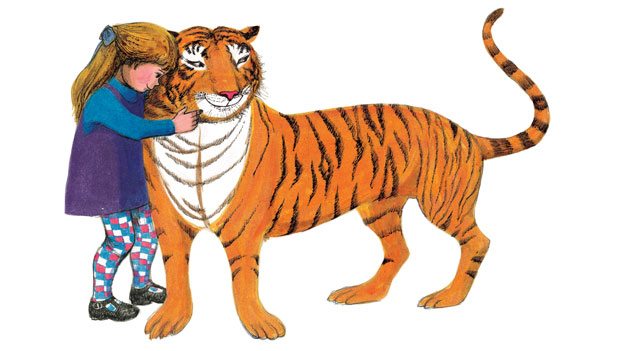
For all these reasons, I think fantasy works better in picture books if the stories are of the Weird in the World variety. Like their World of the Weird counterparts, they can involve animals. The most famous is probably Judith Kerr’s The Tiger Who Came To Tea. But there’s a difference. These are not always metaphorical stories. Kerr herself has been very clear that the tiger – who consumes all the food and drink in a suburban home before disappearing, never to return – is not in any way a representation of Hitler, whose rise to power forced her to emigrate from her native Germany. The pleasure of her tale comes not from “decoding” it, from working out what she "really" means, but simply from its oddness.
 |
| The Tiger Who Wasn’t Hitler |
Weird in the World stories often use the juxtaposition of real and fantastic for comic ends. Think of the elephant you can’t take on the bus in Patricia Cleveland-Peck’s book, illustrated by David Tazzyman. Or Not Now Bernard, by David McKee – a funny, but very dark depiction of parental preoccupation in which a monster eats a neglected child and is unthinkingly pushed into taking his place by a mother and father who are too interested in other things to notice.
 |
| Monsters, children – what’s the difference when you're trying to read the paper? |
Sometimes, picture book characters will pop in and out of fantasy worlds. The most famous is Max, whose temper tantrum carries him “through night and day, and in and out of weeks, and almost over a year, to where the wild things are”. But it’s the domestic details that bookend the story – the mischief of one kind and another at the beginning, the supper that’s still hot at the end – that makes his journey interesting. By contrast, the arbitrary dream logic of Maurice Sendak’s subsequent In The Night Kitchen renders that story random and inconsequential.

Ten years ago, I wrote a book that was an attempt to mix
a Weird in the World story with a World of the Weird one.
Guess What I Found in Dragon Wood was inspired by a picture the
illustrator, Gwen Millward, had made. It
was a beautiful study of a boy and a dragon, playing together in the boy’s
room. The two were obviously friends but
Gwen couldn’t find a story there.

My suggestion was that, instead of the dragon being in
the boy’s world, the boy should be in the dragon’s – at least to start
with. So the book is told from the
dragon’s point of view, and is all about his new discovery: a strange and
magical creature called a “Benjamin”. We’re
in a weird world all right – the dragons eat worms and stinky fish, and go to
school to learn how to sit on a volcano – but there’s something weirder still
in that world: one of us.
Seeing the Benjamin through the dragon’s eyes, I hoped my
young readers would understand (even if it was only without realising) how odd
and fantastical – how weird - our
world is. And I hoped the story would
help them enjoy the closely imagined fantasy that we call “real life”.


 I'm away on holiday so I thought I'd send you my post in visual form.