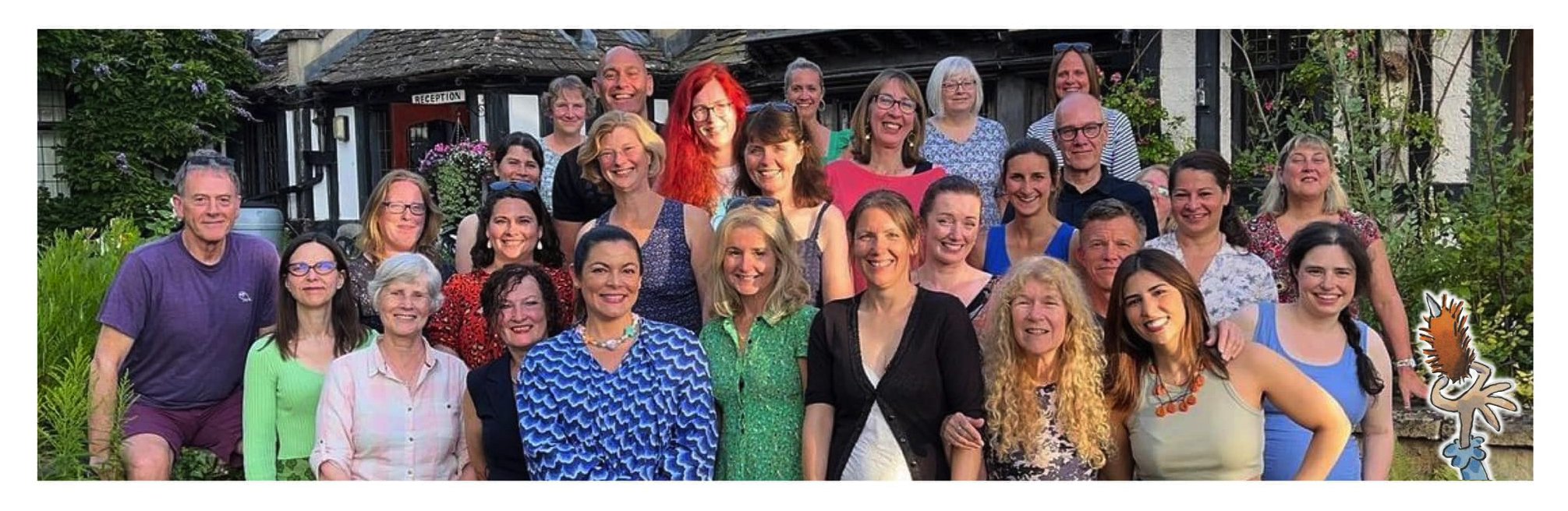
Spot the
five Picture Book Denners! -Pippa Goodhart (back left) and Garry Parsons (second from right, second row) -who led the
sessions; Clare Helen Welsh (third from left, second row), who co-organised it; Natascha Biebow, joint Regional
Advisor of SBCWI British Isles (second left, third row) and me (with red hair behind Natashca's shoulder) (c) Tito Berredo.
After a long pandemic break (the previous one had been in 2019),I was keen to try and stretch the benefit as long
as possible beyond the actual retreat. Whilst the place looks lovely
(c) Clare Helen Welsh
(c) Clare Helen Welsh
as someone
who doesn’t picture things, I don’t get to close my eyes and relive the lovely
gardens or misshapen old rooms like some people (I’ll take their word for it)
do. My three big takeaways from the weekend (other people will have come away
with other ones, I know) which I was keen to smuggle home so I could incorporate
the retreat life into my own were:
PLAY
TUNING
INTO YOU
ACCOUNTABILITY
PLAY -I was
already trying to get into the play mindset before I left for the retreat and
even packed my Michael Rosen Play book to get me in the mood:
(c) Michael Rosen
And there was
plenty of it there. It was particularly relevant in the Picture Book Den’s very
own Pippa Goodhart’s sessions on different forms of picture book. We discussed
concept books, interesting use of flaps, holes, books where the pictures are
doing something quite different from the text (my favourite kind)… And we spent
time playing around with ideas of our own.
I’ve always
loved picture books that do things a bit differently, especially wordless books
and those with few words. And I feel like I’ve been given permission (or given
myself permission) to go back to a form I’ve always loved reading and writing.
Pippa’s examples of different books that played with form, or where pictures
play a particularly crucial role -and crucially, which publishers might be
interested in them- really sparked ideas… including going back to old manuscripts
of mine that I’d abandoned because they were a hard sell…
Books bought for research post retreat for potential new projects!
Books from home that fit with the themes/concept/style I got excited about at the retreat
And more.... Who doesn't love a retreat that gets
you excited about your own bookshelves again?
and Pippa's and Nick Sharratt's You Choose, one of my all-time favourites. I've lost two copies so far (the first, my children loved so much that one of them cut it up to use the individual pictures) and the second, I've used in schools so much with reluctant readers that I've mislaid it and need to get a third copy... I would encourage everyone who knows children between the ages of one and seven (though my children used it way beyond seven) to have a copy of this book...
TUNING INTO
YOU
I’m not
great with yoga. I find it really hard to do the breathing at the same time as
moving, and I find following any kinds of instructions pretty difficult so it’s
usually a frustrating experience for me. But we had our resident yoga
instructor/fellow author/illustrator, Gary Fabbri, there and for
those of us who wanted to (and I did want to give it a go) we started our days
with yoga before breakfast.
(c) Imogen Foxwell
Whilst I struggled doing the actual movements and
breathing the first day, I loved that we were doing something outside and communal,
but quiet, to start our day. The second day, Gary went for a simpler session, particularly useful for writers and
illustrators who sit for long periods of time. And I loved it! In the evening,
we did a yoga meditation (yoga nidra) where we set an intention, a question we’d
like to ask ourselves relating to our writing/creating or our lives. Whilst I couldn’t
do the imagery side of the meditation, I entered into the spirit of it, got
hugely relaxed with the gongs, and allowed my unconscious mind to do what it
wanted. The outcome? A semi-interesting answer to my own question to myself (about
my current work in progress) but something else, too. It brought to mind a manuscript
I’d written paying homage to another book many years ago but that couldn’t be
published at the time (for copyright reasons), so I’d changed it and changed it
until it was hardly recognisable. But now, seven years later, I suddenly remembered
that I’m free to go back to my original one! And I’d completely forgotten its
original form until that session!
Keen to build
on the ‘trusting your own mind and body’ and allowing your mind some time and space
to flourish, and bearing in mind that I had really enjoyed the early morning yoga,
I decided to start doing something I’d not done for years when I got home:
waking up at six o’clock to write. It’s absolutely the best time of the day for
me to write (but I’d somehow managed to ignore that) and I enjoy it way more
than I enjoy writing at other times of the day (I ignored that, too). It turns
out that my inner critic prefers a lie-in and just doesn’t show up at that time
of day. I don’t get out of bed, I’m often not 100 percent awake, I sometimes
don’t even put on my glasses so it’s not even in focus, and I’m just happy to
be creative and let it flow.
The final
take home was about ACCOUNTABILITY. I already have an accountability partner with
whom I meet once a week on skype -and this year she was at the retreat, too. When
it came to writing our postcards to ourselves for six months’ time at the end (we
all write down on a self-addressed postcard what we hope we’ll have done on the
writing/illustrating front in six months’ time and then the organisers -which
included Picture Book Den’s Clare Helen Welsh!- collect them in and send them
to us in six months), we addressed them
to each other rather than ourselves so that the other person will hold us
accountable to what we’ve said we’ll do by that time. But the accountability didn’t stop there. On
the way to the station, I was chatting with a few retreatees and we were talking
about experimenting, playing and being less precious about our work and how we
should just get more written, quickly. And we decided that we’d each commit to
writing (and in some cases, illustrating) two really rough stories per month
with a monthly deadline and online meeting the next day. They would have to be
new stories each month (no editing and resubmitting the same one) and we wouldn’t
critique them but we’d all have a quick read before we met and say one nice
thing about them -but no critiquing). The idea is that if we get less precious
about our writing/illustrating and our ideas then we’ll free ourselves up and write/sketch
quicker and that at least some of our new ideas will be ok. We’re not thinking
we’re going to create 24 good stories in a year -but there might well be some
good ones in there that may never have happened were it not for this new
process.
And keen to
merge this new (or re-remembered) trust with play, I’ve been committing my
morning writing slot to new story ideas whenever I have them so that I am being
playful every day first thing in the morning. If I actively want to work on my
current (serious) work in progress at 6am, then that’s fine but priority goes
to being playful with new ideas. What it means is that I’m no longer feeling like
I have to finish X before I can even think about any other projects,
which takes away some of the positivity about the current work in progress. Now
I’ve created what feels like magic free time (six till seven), I can do
whatever creative projects I feel like in that time and I’m feeling more
enthusiastic about all my projects because I’m feeling creatively
fulfilled by playing every morning!
I even did
some (relatively) early morning outside writing on holiday in Orkney just recently, including sitting on my mum’s grave
overlooking Scapa beach
and at the beach
where I came up with an idea which will be one of my 'two a month' rough stories I'll try out
at Scapa
at Weyland Bay at the end of my mum and dad's old road
After getting
a little nervous last week that I was losing my taste for the early mornings
before discovering I actually had covid and my body just needed a lot of rest,
I’m excited to start back again in a couple of days’ time. Although I’m better
with quiet than I was before the retreat (which means I’m having more
interesting thoughts and ideas, too), I still play birdsong as I write, but that
all feeds back into recreating the retreat early morning soundscape anyway.
It's a retreat I'll remember for a long time (huge thanks to organiser Paul Morton, who spent months preparing. It was great to meet fellow 'Denner, Garry Parsons at last, and it was great to be in the company of loads of lovely and interesting creative people). I know everyone will have come away with different 'take homes' but here's to listening
to ourselves, being accountable and having fun!
If you have
any tips or stories about being more creative, getting more done or trusting
yourself in your creative practice, please do share them below in the comments
section. Thank you!
Clare is
a children’s author of more than 35 books and is now on a mission to have a
playful year of writing…
Write it on
your heart that every day is the best day in the year. He is rich who owns the
day, and no one owns the day who allows it to be invaded with fret and anxiety.
Finish every day and be done with it. You have done what you could. Some
blunders and absurdities, no doubt crept in. Forget them as soon as you can,
tomorrow is a new day; begin it well and serenely, with too high a spirit to be
cumbered with your old nonsense. This new day is too dear, with its hopes and
invitations, to waste a moment on the yesterdays.
Great words
from Ralph Waldo Emerson, but how do we possibly keep this positive -and preferably
creative, too- as writers and illustrators in
the new lockdown?
This isn’t a
blogpost full of my amazing lockdown secrets of success. Like many people, I’ve
barely coped with much of it. But I asked a few friends, writers and children
what had helped them, and I’m determined to steal anyone’s suggestions if they work (I’m
hoping you might leave what’s working for you in the comments). So here are some tips from others -and me- which I hope might be useful.
And after
one of those difficult days, when we feel we could have done it very
differently, we can at least wake up the following morning and “not to be
cumbered with my old nonsense of yesterday”…
Someone recently introduced me to Dan Siegel (a clinical professor of psychiatry at UCLA)'s Window of Tolerance. It's the optimal zone of arousal in which each of us is able to function and thrive (see the diagram below). Environmental changes (amongst other things) can push us out of that window into hyper-arousal or hypo-arousal, and for many of us, we've been pushed into one or other (or both) in response to the fear surrounding the pandemic. There's a useful, short article on people's Window of Tolerance in relation to the current pandemic climate: you can read the article here
And there's a really clear video (though six minutes’ long) on what a window of tolerance is and how to
get back into your window here:
Pre-covid, I think I had a reasonably large window of tolerance within which I operated in quite a calm, effective way:
Relatively large window of tolerance
During the pandemic, that window has shrunk considerably:
considerably smaller window of tolerance...
Many of us
would like to get our larger windows of tolerance back and here are a few of
the ways we might do it…
BE KIND TO
YOURSELF
Just to
make clear, being positive or productive doesn’t have to mean our usual level
of positive or productive. It might just be more than you’ve managed in a
while, or better than yesterday, or just anything at all… It’s important to be
kind to ourselves and others and to remember that for many of us (see the red writing):
I really
find that letting go of days that haven’t gone well (a la Ralph Waldo Emerson)
has helped. Fellow PB Denner, Natascha Biebow says on being kind to yourself: “You might
not be able to write or illustrate as much as you'd like during these times,
but maybe you can read or snatch a moment to daydream ideas whilst doing a
chore. Often, I find myself challenging my brain to solve a plot problem or
figure out another story quandary in the minutes before I fall asleep.
It's something!”.
Take those somethings!
YA author, Olivia Levez, provided lots of
practical tips for staying positive but also says: “On days I’m feeling a bit low, I
coddle myself as if I’m my own child, with snuggly blankets, hot water bottle
and cosy socks, my comfiest clothes, an indulgent bath”. Things she avoids:
waking up to newsfeed, catastrophising, being relentless with goals, tasks,
targets, and things that help: listening to birdsong, saying, ‘I’m feeling x’
instead of ‘I’m x’, writing negatives on one page of a journal and turning them
into positives on the other. And when fellow PB Denner Jane Clarke’s creativity “goes awol, I turn to jigsaws until it
returns”.
One of our Christmas jigsaws, and we did finally find the missing piece (in case it was bothering you)...
Be kind. We need to have basic needs met before we can feel as creative
as we might want to. In these extraordinary times, many people's safety and other basic needs are not being met and we may not always be able to
create as we would like. But in case you’d like to try…
STRUCTURE
Most people
mentioned how having a structure helped them. One child always writes down what
she plans to do the following day before she goes to bed. She writes it on a
fresh piece of paper each night, rather than in a notebook, so that each piece
of paper feels like a new day (very Ralph Waldo Emerson!).
YA author, Olivia Levez, also finds that: “structure helps. I curate my day to give plenty of treats between writing sessions: yoga, hot chocolate and biscuits, a walk with a friend.” One of my daughters and I have started going out for a half-hour walk
before coming home for school/work and it’s lifted our spirits and started the day feeling energised and ready for it.
I've been surprised, but really pleased, to find that this first week of school lockdown has actually been productive. I’ve been struggling to feel motivated for a while
now, but with the children working hard in their rooms all day with live
lessons, I’m actually finding it easier to be focused than when they were at
school last term. Not wanting to slack off whilst they can’t has really
motivated me.
WORKING
TOGETHER, REMOTELY
Our local
SCBWI group used to have a write-in once a week. We’d meet together somewhere
(usually at mine), and just write together. Clearly we can’t do that anymore
(although the children have been a bit of a proxy for that), but it’s possible
to recreate it to some extent online. Early on during the first lockdown, I did
some online write-ins with fellow picture book writers from my local SCBWI
group. We’d log in on zoom, say hello and what we were planning on writing, and
then just write. I could look up and see them writing away and they could see
me. Sometimes it’s easier to stay writing when someone can see what you’re
doing! After a bit writing slump, I think I’m ready to start doing it again. If
you haven’t tried it, it’s worth a go…
CONTACT WITH
OTHER WRITERS
Jane says “I live on my own and online meetings are keeping me going… [and the]
meet ups with fellow authors and children’s poets keep creativity ticking over
as we set each other small writing challenges every week”.
Every time I
meet online with other writers I remember how much it sustains me. In a normal
year, I’d see writers in person most weeks, have monthly local meetings, weekends
away in small groups of writers I know well, and in bigger groups of writers I
know less well. These events are such an important part of my life. I live with
three teenage children whom I adore, but spending proper time away with adults
is so important, and surrounding myself with writers is great for writing but
also for the inspiration and energising. I forget so quickly how important it
is (because I’m thinking of practical day-to-day things for the family) but
talking to other writers on video calls regularly, whether it’s one to one or
in a group is a great way to feel positive. And I know we still have to wait
for it, but we’ve started talking tentatively about writing weekends away later
in the year when it’s ok again. It’s still a way away but just talking about it
makes it feel real and gives us something to look forward to.
Online SCBWI nonfiction conference which was really stimulating...
ACCOUNTABILITY
Natascha says: “I've recently re-connected with my critique
group and we've decided to make each other accountable by meeting every month
and sharing our work. Having a friendly group or even just another person to help
you focus and spur you along is very encouraging. (If you don't have a critique
group, I'd recommend joining the SCBWIfor a supportive and welcoming
community)”.
Like
Natascha, making myself accountable to someone else really helps me keep going.
I’m very fortunate to have a brilliant accountability partner, fellow picture
book author Rebecca Colby, and we meet weekly online. We’re discussing
something that’s really important to both of us, and I always come away feeling
more inspired, even if I’ve not got much done.
DIFFERENT WAYS TO BE CREATIVE
Maybe have a go at a different
kind of art. Children's author Mo O'Hara says: “I have discovered that writing books is not my only way
to be creative. I’ve written poems and songs and loved it! I’m also
allowing myself to be interested in exploring drawing and crafts
too. I’ve always been too scared of being terrible to try but
thanks to extra time in Lockdown and the ‘Zero f***s ‘ to give attitude that
comes after 50 I have decided to let myself have a go even if it turns out I am
terrible. Who will ever know?!!!”
EXERCISE
Most people
I asked talked about exercise, including yoga (both online and alone). I’ve
just started my first ever online yoga course and even though I never ‘got’
yoga before, it’s working for me now. If you’re like me and need more
motivation than normal, you could try doing it with a friend (it really helps
that mine’s run by my sister-in-law and I know some of the other people doing
it).
I also copied
my accountability partner and got an exercise bike with a laptop table on it
which means I can cycle during our accountability sessions, phone calls or watching any
zoom events that don’t require my looking or sounding professional
I have yet to learn the art of looking calm and professional whilst pedalling...
And I copied
my sisters and got a fitbit! Prior to the first lockdown, I’d hardly done any
exercise (apart from countless school runs for years) in twenty years, so
that’s definitely something positive I’ll take from this… (I’ll take all the
positives where I can!). And we’re even doing some Just Dance (which I’m
terrible at but is lots of fun).
NATURE
Most writers
I spoke with talked about the importance of nature for them.
Mo O’Hara
says “I am making myself go for long walks” (note the making myself. It’s the same with me. I have to make myself because
I don’t generally want to. That’s where structure works for me. Anyway, Mo
continues:
"Connecting with nature is a
great way to re-centre yourself… I had no idea there were soooooo many
parakeets in London parks!!!!”
Surely no parakeets here, Mo?
But look more closely...
There really are!!!
I also discovered the same in my local park in Birmingham (where do all those parakeets come from)?!
(anyone else reminded of
Cockatoos, here?)
(c) Quentin Blake, Cockatoos
Jane also goes for regular walks: “seeing nature continuing
and even flourishing through all this is uplifting”.
This tree on our terraced block never fails to lift my spirits
When we had
snow on Friday morning of last week, we knew it might be our only chance so we
left the house in the dark and took the sledges to a local park and the children sledged quickly before coming home, eating breakfast and starting school at 8.45am.
We’re
snatching moments more than we would have done because we need that buzz to
keep us going. One of my children met up for a five-minute snowball fight (socially distanced, of course) with her school friend and neighbour during breaktime. I love the spontaneity for joyful activities and it’s a
brilliant reminder to me, too, to enjoy unexpected things.
a random sundial on a walk...
And
specifically thinking of creativity, something that’s quick and structured (it
happens every day in January) which is great for boosting creativity is:
STORYSTORM
I’ve been
doing Storystorm and its predecessor, PiBoIdMo (created by the wonderful Tara Lazar) for years now. If you’re
struggling to feel creative, there’s a daily blogpost that
encourages you to come up with a new idea every day. I've not started properly yet this year (unlike other years) but I’m hoping that this
blogpost will encourage me to practise what I preach. I read my first
Storystorm post of the year today (Day 10 as I write) - and not only did it get me
thinking creatively –which is nice, I came up with three ideas, and the topic
of the post was so relevant to what I’m writing today. It’s just what I needed
to hear, with Kirsten
Pendreigh finding joy in the journey. She was talking about process over product and I'd urge you to read the post. It’s just what I needed to hear.
If you’re
looking for other ways to get motivated (or re-motivated with your story) and
you’ve been questioning the point of it in this current climate, listen to this
short video by Teri Terry, who wrote to herself in the first lockdown to get
her back into it:
READING
Mo O’Hara talked about an
unexpected positive of covid insomnia: it gives her more time to read! “I’m
getting through my ‘To Be Read’ pile much faster because I’m reading more late
at night”. But has anyone
else been struggling with reading? I was,
massively–at least until a couple of weeks ago.
I’ve been
really distracted, and wanting distraction (with background noise on all the
time). Reading didn’t feel distracting enough, and it was too quiet. So a couple of weeks ago I
started with distracting noise in the background, and tried reading again. The
joy of writing picture books is that reading picture books is part of the job,
so I started by reading a few picture books, then a few more, and within a few
days, I was reading children’s novels again, and nonfiction, and a week later,
I’m reading Victor E Frankl’s Yes to Life (In spite of everything) which feels extremely relevant at the moment:
Yes to Life (In Spite of Everything) Victor Frankl
And the
distracting noise? It only took about five minutes before it go really annoying
and I was ok to read in silence. Last night, I put on a yoga Spotify playlist,
and that was a great background to reading when I didn’t want silence but
wanted something calm. If you’re struggling with reading, I’d really recommend
it. It’s helping, creatively, too.
SMALL THINGS
We can look
for the small things that make it a bit easier. I’ve bought a really cheerful
furry blanket cover for my bed so my work space –which is my bedroom- looks
less like a bedroom. But it also doesn’t look like an office. I’ve taken out
the desk, and put in a small sofa and some plants so it feels really calm. And
it helps!
I’ve also
discovered the calmest place in the house –in my daughter’s bedroom:
It's an egg chair that she's filled with blankets and cushions, with fairy lights around it and surrounded by a blanket to block out most light!
And my
lovely daughter has kindly allowed me to sit in it and read/reflect.
It has an instant calming effect and I love it
We want to
be within our window of tolerance so we can cope with everything that’s going
on around us, but also so we can flourish and be creative and help others
navigate these difficult times. I hope that some of these suggestions are
helpful in expanding your window –if it’s shrunk like mine certainly has- and helping to bring you back into it when you’re pushed out. I’d love to hear what works
for you –and any tips you have so please do leave a comment if you can.
Be kind to
yourself. This too shall pass. x
Clare is the author of over 35 books, including eight picture books. Her website is www.julietclarebell.com.
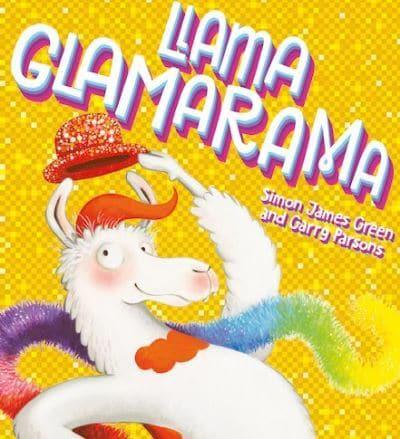
Llama Glamorama (Simon James Green and Garry Parsons, Scholastic, 2020)
Back in the 2016 post I looked at about thirty picture books which were great for encouraging empathy in young children, but what I
didn’t find was a single fictional picture book (looking like a typical picture
book) that specifically looked at consent. There were lots of recommendations from
other people in the comments about excellent picture books encouraging empathy
but the only ones about consent were very educational and formal-looking. The
final comment was from my agent: ‘Let’s discuss’. And we did (I was already plotting and scribbling).
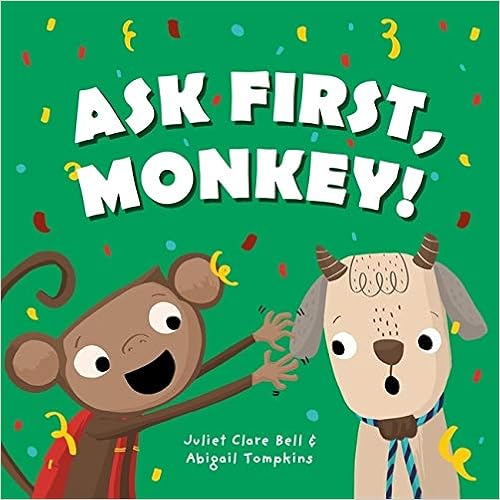
Cut to four years later, and ASK FIRST, MONKEY! illustrated
by Abigail Tompkins and published by Jessica Kingsley is here. It’s a book I was
extremely keen to write (because I couldn’t find what I was looking for) but
also extremely nervous. I’d love to hear from other writers and illustrators
who are trying to create, or have created, picture books on tricky issues with
the issues you faced, but in case it’s of help to anyone, here are the some of
the issues I tried to grapple with…
ANIMALS AS CHARACTERS
Clare Helen Welsh posted here just last week about using animals as characters in picture books. It reminded me that this is my only
published book to date that uses animals –and it’s for a very specific reason.
Clare’s last point about using animals is that reason: safe spaces. Using
animals as characters creates a little bit of distance for the child reader so
that we can tackle tricky subjects in a gentler way.
(c) Juliet Clare Bell and Abigail Tompkins (Jessica Kingsley Publishing, 2020)
and whilst some like Monkey's tickles...
others don't:
(c) Juliet Clare Bell and Abigail Tompkins (Jessica Kingsley Publishing, 2020)
There are wonderful examples of using animals as characters, including one of my
favourites
Debi Gliori’s beautiful No Matter What about love and death.
(c) Debi Gliori
This doesn’t mean that we should always shy away from
tackling big issues with human characters. In fact, I very deliberately used
human characters in a book about death and dying (Benny's Hat, illustrated by Dave Gray)
(c) Juliet Clare Bell and Dave Gray
but for the subject of consent, I knew I wanted to use
animals and I was really inspired by Ed Vere and his books, like Grumpy Frog:
(c) Ed Vere
and others in that style, like Morag Hood's I Am Bat:
(c) Morag Hood
and Steve Antony's Please Mr Panda:
(c) Steve Antony
HUMOUR
Who is your book
aimed at? If you’re genuinely trying to get a message across to a specific
audience, it’s really important to honour that audience and create something
that will appeal to them (and not just the people who will be reading the book
to them). If there’s a really important point you want to get across, and you
can do it with humour and compassion, a child may be more likely to take on
board that message. If you're writing with a specific audience in mind, it doesn't mean that the book is not for other readers, too, but it really helps you focus on the best style for the story.
In ASK FIRST, MONKEY! I was aiming the story at children who
have not yet grasped, or not quite grasped, the concept of boundaries and consent
(Monkey in this story). I wanted for these young people to find Monkey funny and relatable –and not to be judging him. Consent needs to be taught and Monkey hadn't been taught. He's still going to have fun after he starts practising consent -and so will the reader. And the fun will not be at anyone else's expense. I really hope that by using humour,
young children will learn alongside Monkey and recognise themselves when he
gets it wrong and not feel shamed by their own actions but see a new way of
behaving.
SIMPLICITY
I love picture books that manage to do things apparently
simply. So often, they’re by author-illustrators
like David McKee's classic, Not Now, Bernard
(c) David McKee
and of course Ed Vere, Morag Hood, Steve Antony, above, and Mo Willems, etc.
I was really keen from the start for the book to be speech
only. This makes it easy to act out (at school or at home), you get even more
of a sense of character, perhaps, and it’s simple, with fewer words. Dan Santat pulls it off brilliantly with his The Cookie Fiasco:
(c) Dan Santat
(you can watch it being acted out with all the voices, here)
But there’s a certain amount of pride involved in letting go
of what you think would be funny and clever, versus what you think is right for
the story. My original name for the book was
Tickletastic Funky McMonkey Does Not Want An Ice Cream!
I loved Don’t Let The Pigeon Drive The Bus
(c) Mo Willems
It was a really fun and funny title and I wanted my book to be fun and funny, and what
better way than a funny, long title?
Well, clearly there was
a better way. The ice cream element of the story was dropped very quickly after
my agent, James Catchpole, thought it wasn’t relevant enough (I was
disappointed for a few days but he had a good point). Funky was dropped when
the publisher pointed out that Funky means smelly in American! McMonkey, well
that was too similar to a fast food chain, it turned out… and so on. I even
called one draft Tickles, Pies and Spinny Surprise (though the story changed
again after that)... It took a long time to get to it simply being called Ask
First, Monkey! It was simple and to the point but I fought against it (mostly with myself)–because of
pride. Wasn’t that too obvious? Too in your face? Too preachy? Not funny?
Fortunately other people who know the business better than I do were there to
do their job. This book came from a very strong desire to help young children
who don’t yet get boundaries and consent, get it, and to grow into adults who get
it. And that can mean taking a strong dose of getting over yourself to get it
into the hands of those you really
want it to get into the hands of.
Launching a book during summer 2020 is a strange (and often
deflating) thing as many writers and illustrators know. I was looking forward
to going into schools and doing lots of sessions with animal puppets (and
singing?!) to look at consent and boundaries in a fun, and safe, way. There
will be a song eventually but it’s been put back by a few months because it’s
hard to travel and work with the singer-songwriter at the moment, which was
disappointing, but it’s still going to happen. And I still hope to do some events with Abigail Tompkins, the illustrator who captured the expressions that were so critical to a speech only book so well. Consent is a subject very close
to my heart and we’ll get there with all the accompanying visits/songs/events
eventually.
But it’s not all bad –my daughter and her friend have been
able to make a stop motion animation of the story, using toys we found on
holiday in Orkney. Here’s the fruit of their labours:
If you're having trouble accessing the video, please clink on this link:
The book was written before the Me Too movement, but picked
up by a publisher after. With the massive and very welcome emphasis on consent
in the past few years, this means that there are now a few other picture books
on consent either just coming out or soon to be out, which I’m very much
looking forward to reading.
Which picture books do you think work really well
for dealing directly with a tricky topic? Please let us know in the comments
section. Many thanks, Clare.
Juliet Clare Bell is a children’s author of more than thirty
books already out or in press. In a former life (before children) she was a
research developmental psychologist.
Hello and welcome to the Picture Book Den in these very uncertain times. This post is here to point you in the direction of lots of wonderful picture book readings and activities to enjoy and engage with whilst you're at home (or at school). I had planned to check out what was available online for children, families and educators, and then post them up individually here... and then I found this, from our very own former Picture Book Denner, Jonathan Emmett, and Caryl Hart:
When I talked with Jonathan Emmett, award-winning picture book author and former Picture Book Denner, he said: "The Picture Book Author Events Online facebook page is a spin-off from Caryl Hart's Author Events Online listing page... Although we set up the page with the intention of sharing book videos for children of all ages, after a couple of days it became apparent that so many authors and illustrators were planning to share videos it would be a full time job creating new posts and responding to messages... so we agreed to limit the page to new videos and livestreams created by traditionally-published picture book creators. We’d like the page to be a one-stop-shop for stay-at-home families with picture book age children and hope that that it will inspire others to set up similar pages for other age groups such as middle grade and YA". Jonathan asked Chris Haughton (author-illustrator of the amazing Oh No, George!) if he could make an image for the project, and he did!
(c) Chris Haughton (2020) Caryl's page also tells you which events are coming up daily:
Ed Vere's how to draw (every Wednesday and Friday)
Chris Haughton's weekly story time (Wednesdays at 5pm BST)
and many more, including Jonathan and Caryl's own weekly live sessions.
I'm not going to link to everything here because Jonathan and Caryl have done the hard work to put it together so please, please use their site. You won't be disappointed.
A few others well worth watching, include Mo Willems' daily doodles...
and
Draw along with Emily Gravett on Thursday April 2nd and Thursday April 9th at 11am BST
I'm in a very lucky position at the moment where I've got lots of books on the go and lots of deadlines with publishers so I'm trying to juggle working long hours with three children at home. What it means is that I will have missed some of the wonderful picture book events/resources that writers and illustrators have posted. Please do share your favourite online picture book resources for children (rather than writers in this instance), whether they are your own, or someone else's from online) and let's make it as easy as possible for children, wherever they are, to access all the wonderful picture book resources available online.
Sending love to everyone. Happy reading, listening and doing as you stay inside...
And to you all picture book writers and illustrators out there, Jonathan says that if [you're a traditionally published picture book author and/or illustrator and] you’d like your video to be shared on the page, you can contact him using the “Send Message" button under the page header, but please check that the video is eligible under their Sharing Policy first. https://www.facebook.com/AuthorEventsOnline/ (and make sure you've got permission to record yourself first. Here's some guidance from Caryl:
(and in case anyone hasn't heard, to keep you going whilst you're inside, I'd highly recommend PE with Joe (Wicks) at 9am BST Monday -Friday -or watch a recording of them anytime. It's half an hour of exercising along with millions of people, all at the same time and it's great for morale. It's for children and adults, young and old, fit and not so fit. As a writer, I spend a lot of time sitting and although I am pretty sedentary, this has got me enjoying exercising in a way that almost nothing has in many years. We all need to keep our spirits up. Try it!)
Please help us and parents/families wanting to look at picture book readings/demonstrations/drawing sessions online by letting us know about your favourite (and/or your own!) online picture book videos and resources in the comments. Many thanks, and stay safe x



.png)
.png)
.png)
.png)


.png)
.png)
.png)
.png)
.png)