Showing posts with label Polly Dunbar. Show all posts

Monday, 21 December 2020

Our Personal and Picture Book highlights of 2020

2020- What a challenging year it's been! I'm sure many of us will be glad to see the back of it and will welcome 2021 in with wide open arms! 

But we at Picture Book Den wanted to use our final post of this turbulent year to shine a light on some of the positives, some of the rays of sunshine that we've noticed amongst the darkness. 

We've chosen our personal and picture book highlights of 2020 and, as always, we would love to hear some of your highlights too. 

Lucy Rowland:

Picture book highlight: Rain Before Rainbows, written by Smriti Halls and illustrated by David Litchfield.


"Rain before rainbows. Clouds before sun. Night before daybreak - a new day's begun".

This picture book is a perfect partnership of beautifully written, lyrical text and gorgeous illustrations and is all about finding optimism in the darkest of places. A perfect picture book for this year where rainbows have shone from so many people's windows as a sign of both hope and of our gratitude to all the key workers fighting this pandemic. 

Personal highlight: For me, 2020 has been about finding my feet as a mum and watching my tiny baby grow into a cheeky, playful one-year-old.  While lockdown was somewhat intense at times, (my husband was working 12 hour day and night shifts) I look back at it now as an incredible bonding opportunity for me and my son and I feel lucky we had this moment when the world stood still. 


Clare Helen Welsh:

Picture book highlight: While We Can’t Hug, written by Eoin McLaughlin and illustrated by Polly Dunbar.


"They could not touch. They could not hug. But they both knew that they were loved."

From Eoin McLaughlin and Polly Dunbar, the makers of The Hug, this picture book is such an accessible and age appropriate way to tackle the trials of our times. The characters in the story find out that there are lots of ways of showing people they love them… while they can’t hug. It’s heartbreakingly beautiful and wonderfully simple. I’m certain this text will have helped many families in 2020, particularly at the beginning of the year when social distancing was strange and new to us all. It certainly helped me!

Personal highlight: My personal 2020 highlight has been working as a full-time author. Leaving my much-loved teaching career has meant that I have had more time to spend with my family and to immerse myself in the picture book world. Some of you may know I’ve been running a seven week online picture book course for Write Mentor, and I’ve managed to squeeze in five this year! It’s been wonderful connecting and working with like-minded people and the wonderful writers that join are a huge part of its success. I’m excited that I’ve also been asked to be Write Mentor’s Picture Book Writer in Residence 2021. I’ll be creating video and text-based content to support writers who love picture books as much as I do. So, all in all, lots to be thankful for and lots to look forward to.

Pippa Goodhart:

Picture book highlight: Wow! It's Night-Time, written and illustrated by Tim Hopgood


This board book has gloriously beautiful pictures of life at night observed by the owl at a time when 'we are tucked up in bed'. Weather and creatures and stars are all felt and noticed, and as dawn arrives the owls fall asleep ... just as you hope your child will be after you've read the book. The back endpaper reveals that the book is also a counting one, and there are one mole, two foxes, three rabbits, four bats, and so on up to ten stars to spot and count. 

Personal highlight: The choice of book is a clue. Just as the world closed down, we had the joy of a new life in our family. Grandson Samuel lives not far away, and I'm able to give 'informal childcare', pram walking and lap jumping and gurning to elicit grins. And sharing his first book experiences. He is very much 2020's personal highlight. Workwise I've been lucky. School visits have gone, but online teaching writing for children via Cambridge University has grown hugely. I long for more time to do my own writing! Wishing everyone a happy end to this year, and blossoming into a better world next year.

Jane Clarke:

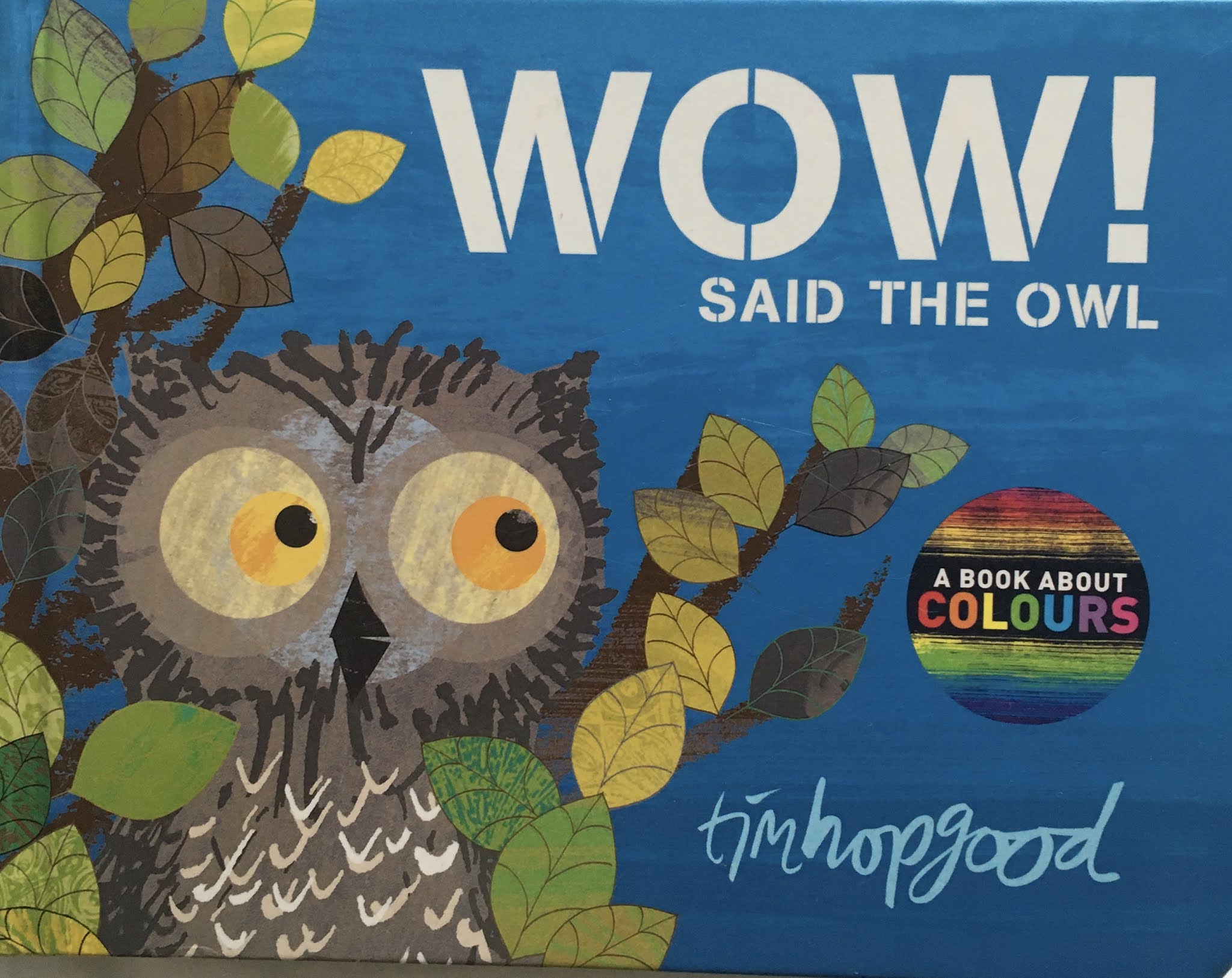
Picture book highlight: Wow! said the Owl, written and illustrated by Tim Hopgood

There seems to be a bit of a trend here, Pippa :-) This beautifully, but simply, illustrated book is all about Owl's joy and wonder at the natural world he sees when he stays awake all day. I've read it over and over and over to my four little granddaughters this year, (2 personally, and 2 in the States, via Skype). It's resonated with me every time, reminding me of the solace I've found in nature this year.

Personal Highlight: Well, it's been a teeth-gritting year, but (touch wood) loved ones have stayed afloat, and I've been able to keep myself relatively sane and busy with lots of walks and online yoga as well as writing.  My heart goes out to those of you who have not been so fortunate. My personal picture book highlight is seeing Lucy Fleming's illustrations begin to come in for  A Small Person's Guide to Grandmas – to be published by Walker Books – and being able to dedicate it to the fab 4 who inspired it.

Natascha Biebow:

Picture book highlight: Old Rock (is Not Boring), written and illustrated by Deb Pilutti

This year, I've attended a lot of nonfiction craft webinars and I'm on the lookout for books that will inspire my own writing. What struck me about this picture book was the voice and unique point of view. The story is told by the rock, an inanimate object, and it immediately draws readers into the (true-ish) story of his life. Is it boring? Well, rock seems to sit in the same place all day long and he never goes anywhere. Has he even seen the world?! Beware of assumptions, though! Young readers will be surprised and delighted by the quirky adventures rock has really had in his lifetime - because, of course, rocks are around for a really long time (some cool lessons in geology and history here!). Old Rock challenges his friends' expectations - we can't judge people by how they look, and indeed tell whether they are 'boring' or anything else just by looking. Like rock, we are all special and each have unique experiences. Plus, sometimes, it's just nice to stay in one place for a time and enjoy nature – not boring, just 'being'.


Personal Highlight: It's been a tough year to be creative, with so much unexpectedness, worryingness, juggling and far-awayness from family and friends. My personal highlight was winning the Irma Black Award, voted for by children all around the world, for my debut nonfiction THE CRAYON MAN: THE TRUE STORY OF THE INVENTION OF CRAYOLA CRAYONS in the Spring, and recording the acceptance speech in my garden with my son's help. I am reminded of the beauty of nature's colours, the wonder of our world and inspired to keep going by the children who need our stories. I have been lucky enough to do some virtual school visits and connect with family via techonology. It's kept me going, even as I try to write new stories.

Monday, 14 September 2020

CHATTER MATTERS: Picture books featuring characters with SLCN (Speech, Language and Communication Needs) by Lucy Rowland

During the school holidays, I noticed a few people tweeting to ask for recommendations of picture books that feature characters with Speech, Language and Communication Needs (SLCN).  Unfortunately, they weren’t always able to find exactly what they were looking for.

Children with SLCN are, I believe, quite under-represented within picture books and yet it is estimated that the prevalence of DLD (Developmental Language Disorder- where children have severe and persisting difficulties with their understanding and use of spoken language) is approximately 7.5% (Norbury et al. 2016).  Therefore, in each UK classroom, it is likely that there are, on average, two children who have DLD.   Usually there are also other children within the class who have communication needs as a result of different diagnoses e.g. ASD, Learning Difficulties, Down's Syndrome. 

Last week, ‘Wanda’s Words Got Stuck’ (written by me and illustrated Paula Bowles) was published by Nosy Crow.

As a Speech and Language Therapist, this book is very close to my heart.  It is dedicated to the brilliant NHS Speech and Language Therapy Team in Lewisham, where I used to work.  


'Wanda’s Words Got Stuck' isn’t about any one particular communication diagnosis.  Our little Wanda could have Selective Mutism? Or perhaps she has DLD and, therefore, has a reduced vocabulary, finds it hard to understand verbal information and struggles to express herself in sentences? She might have a Stammer- her words get stuck and don’t come out easily? Or perhaps she is just very anxious and feels shy about talking in class? 

Either way, I wanted to write about a character who finds talking tricky, who finds words sticky. And I wanted to write about how talking is not the only way to communicate and make friends. 

‘Some words are meant well but come out all wrong.

Some are important (and ever so long.)

Some words can be brave (even if they’re just small)

And sometimes you find you don’t need words at all’. 


I also knew that I wanted to write a blog post focusing on characters with SLCN in picture books but, I have to admit, that I couldn’t initially find very many! So I do have to say a big THANK YOU here to the twitter world and to everyone who responded to my call for help with their brilliant suggestions.  I haven't been able to include every single book here but thank you so much.  I really enjoyed researching them.

Talking is not my thing! by Rose Robbins

'The autistic sister in this sibling pair is non verbal, but she finds plenty of ways to communicate and have fun with her brother. Although she can't talk, this little girl understands everything, and has plenty to say, and lots of ideas. Through body language, drawing pictures, making gestures or using flash cards, she is able to contribute to their life together. Her brother and granny are able to understand her whether she needs help or is helping them!'

This is a lovely book highlighting alternative methods of communication. 


What the Jackdaw Saw- written by Julia Donaldson and illustrated by Nick Sharratt

'The jackdaw wants all his friends to come to his party, but when he calls out his invitation the animals just touch their heads. Why won't they answer? And what do their actions mean? Luckily a brown owl can help him with the puzzle!

This book about friendship and sign language was created by Julia Donaldson, author of The Gruffalo, with a group of deaf children in a workshop organized by the not-for-profit organisation Life & Deaf which helps deaf children to explore their identities through poetry, film, performance and art.'


The first time I read this book I knew I had to buy it.  I gave it to the Hearing Impairment Specialist in our Speech and Language Therapy Team. It's really great to see sign language being celebrated within a picture book.

Penguin- by Polly Dunbar

'This is the story of Ben, who couldn’t be more delighted to find a penguin friend inside his present. “Hello, Penguin!” he says. Penguin says nothing. Ben tickles Penguin, pulls his funniest face, puts on a happy hat, sings a silly song and does a dizzy dance ... but still Penguin says nothing. It isn’t until a passing lion intervenes that Penguin finally speaks – and, when he does, Ben discovers that some things are worth the wait. '

I love this picture book! It's a real classic and reminds me of some of the children I have worked with who can be so quiet and shy until you find the key (communication method, motivator, relationship or subject matter) that unlocks their voice!


I Talk like a River- written by Jordan Scott and illustrated by Sydney Smith

'When a boy who stutters feels isolated, alone, and incapable of communicating in the way he'd like, it takes a kindly father and a walk by the river to help him find his voice. Compassionate parents everywhere will instantly recognize a father's ability to reconnect a child with the world around him.'


This book isn't out until September but it looks absolutely beautiful and I have heard very good things about it! I thought the illustrations by Sydney Smith in 'Town is by the Sea' were stunning and these look totally wonderful too.  It is so important that children who stutter are able to see themselves and their experiences represented within the books they read.

Another recommended picture book, featuring a character with a stutter, was 'A Boy and A Jaguar' written by Alan Rabinowitz and illustrated by Catia Chien.


Boy- written by Phil Cummings and illustrated by Shane Devries

'The king’s battles with the dragon were always mighty and loud. Boy lived in silence and couldn’t hear the fighting. But Boy could see the fear around him… and how everyone would be much happier without it.'


A picture book featuring a boy who is deaf.  Unfortunately, I was not able to source this book from my book seller in the UK, but a few different people recommended this one and highlighted it as good for exploring communication breakdown.

El Deafo by Cece Bell

'El Deafo is a funny, deeply honest graphic novel memoir for middle graders. It chronicles the author's hearing loss at a young age and her subsequent experiences with a powerful and very awkward hearing aid called the Phonic Ear. It gives her the ability to hear--sometimes things she shouldn't--but also isolates her from her classmates. She really just wants to fit in and find a true friend, someone who appreciates her, Phonic Ear and all. Finally, she is able to harness the power of the Phonic Ear and become "El Deafo, Listener for All." And more importantly, declare a place for herself in the world and find the friend she's longed for.' 


The Bear who Stared- by Duncan Beedie


'There once was a bear who liked to stare... and stare... and STARE.

Bear doesn't mean to be rude, he's just curious but too shy to say anything. But nobody likes being stared at and it soon gets Bear into trouble. Luckily a goggly-eyed frog helps Bear realise that sometimes a smile is all you need to turn a stare into a friendly hello.'


Perfect for children who have difficulties knowing how to initiate conversation and play.  Sometimes the children I worked with just needed a bit of support to know how to join in and make friends. 

Duncan Beedie's new book 'Oof makes an Ouch', which I bought for the purpose of writing this blog post, is also about communication and has a lovely section about some of the behaviours that we sometimes see when children don't yet have the right words to communicate their emotions. 


I go quiet by David Ouimet

'I Go Quiet is the exquisite story of an introverted girl, struggling to find her place in a noisy world. Through the power of books, creativity and imagination, she begins to see possibilities for herself beyond the present, to a future where her voice will finally be heard.'

A book for older readers, the words read 'When I speak, I'm not understood. So I go quiet.'  This reminds me so much of some of the children I worked with in a specialist Language Resource Base in London. It is vital that there are books like this highlighting the difficulties that some of these children face. 


For this blog post, I also explored picture books which use alien characters as a way of dealing with those feelings that children with SLCN often experience- of not understanding, of not being understood and of not belonging.  These books are also good for exploring other methods of communication.  For example, use of non-verbal communication such as gesture, body language and facial expression.  Some of the books that fall into this category are:  

Krong by Garry Parsons 


The Cow Who Fell to Earth by Nadia Shireen (which I also treated myself to as part of the research for this blog post and it's great!) 


Beegu by Alexis Deacon


Of course, picture books don't have to use alien characters to explore these themes.  Chatterbox Bear by Pippa Curnick is the tale of Gary the Bear who is a real chatterbox until he finds himself on an island full of birds, who don't speak 'Bear', and must learn to communicate in other ways. 


All the Ways to be Smart written by Davina Bell and illustrated by Allison Colpoys

'Celebrates the myriad ways for kids to be smart--being empathetic, artistic, athletic, and inquisitive.

A tender, funny, and exquisitely illustrated picture book celebrating all the unique and wonderful qualities that make children who they are.'


Whilst this book does not explicitly feature children with SLCN, I wanted to include it because it has SUCH a wonderful message.  The children I worked with often focused on what they struggled with, what they couldn't do.  Some of the most important work that their therapists and specialist teachers did was to support them to focus on and celebrate their individual strengths.  This book reads....

Smart is not just ticks and crosses,
smart is building boats from boxes.
Painting patterns, wheeling wagons,
being mermaids, riding dragons...


I really hope that the books discussed in this post can be shared and enjoyed with children who, for whatever reason, are struggling to find their voice. 

Please do comment below with any suggestions of books I have missed. I would love to find more picture books featuring characters with SLCN.  Thank you.


Wanda's Words Got Stuck

written by Lucy Rowland

illustrated by Paula Bowles

published by Nosy Crow.

Tuesday, 24 February 2015

Why I don't edit 'proper books' for grown-ups -by Katie Cotton


 Our guest this week is Katie Cotton, an editor and author of children's picture books. She began her career at Templar and she is now part of the children's team at Frances Lincoln in London, where she is obviously working on some fabulous picture book material! Her blog is a reminder of the passion and enthusiasm to be found on the editor's side of the fence.


I'm quite often asked why I want to edit picture books. Sometimes − if I think the question is a thinly veiled "Why don't you want to edit 'proper' books for grown-ups?" − this irritates me. Sometimes, if the question occurs during an interview, it instantly makes me nervous. However, I always find the question interesting.

There are many reasons why I want to work in picture books. There's a magic in the interaction between the text and the pictures. I'm addicted to the 'turn of the page' moment and, of course, I believe that we need to create wonderful books for children that help them understand, and live in, the world around them.

However, the main reason is that in any reading experience, I'm looking for that indescribable moment when something is expressed so beautifully that the hairs on the back of my neck stand up, and this moment − for me − occurs in picture books more than any other genre. 

It could be the moment  when Polly Dunbar's penguin says, 'Everything!', or the moment when you see Shaun Tan's red tree, or the moment when the hungry caterpillar becomes a butterfly. These moments might (if you're anything like me) actually make you want to cry a little bit, but they do that because they make you feel something important, something true.
Polly Dunbar's penguin says 'Everything!', from the picture book Penguin.

Shaun Tan's red tree, in The Red Tree.

 I'm incredibly lucky that there are many, almost equally wonderful, moments in the job of making picture books. One is when you see a piece of art, perhaps at an illustration show or on an agency website, and you just know that it will be an incredible picture book. This was the case with David Litchfield, whose image of a city stopped me in my tracks.

David Litchfield's image of a city.
In the middle, when you're knee-deep in the process of making the book, there are also great moments. In early meetings I always ask authors what they think their book is about. If they could sum it up in a couple of sentences, what would they be? One of the best examples I've heard is Levi Pinfold's Black Dog, whose blurb sums it up perfectly:
'This is a story about being scared. It is also a story about not being scared. It depends on how you see things.'

The cover of Black Dog by Levi Pinfold.
Often, at the beginning of the process, authors can't sum up their book in this way. They might just have an image or a thought in their mind that they want to explore. Or they might have an idea of what the book is, but six or seven months down the line it may have morphed into something different, as books are sneaky things and have a habit of making their own views heard. 

This is all fine and a valuable part of the process; it's completely true that some of the best picture books take the longest time to make. But one of the best moments is the moment when it becomes clear what the book is going to be. It might occur when a character is drawn in a different pose, or during a discussion on the phone, or simply when a crucial sentence is written. Those 'That's it!' moments are worth their weight in gold.  
  
David Litchfield's debut picture book, The Bear and the Piano, will be published this September, and what a stunner it is too. Both of us, and my colleagues at Frances Lincoln, can't wait, for of course that's another amazing moment: having the gorgeous finished book in your hands. 

Tuesday, 19 February 2013

Chicken or Egg? by Polly Dunbar

'Where do you get your ideas ?' is the first question I am asked, as an author and illustrator. The second is the eternal 'chicken or egg' question: which comes first, the words or the pictures?  I'll try to answer here. 

I am fascinated by the third element in the making of a picture book - the special space between the words and pictures into which a child is invited to fill the gap with their own imagination. If allowed, the reader plays an active part in the story, breathing  their own life into it;  when this happens successfully it's like a tiny explosion in the mind.

These little explosions can trigger all sorts of responses: they can be shocking; they can make you laugh; they can be intriguing. The important part is reaching a conclusion all by yourself rather than have it spoon-fed by the author.

Jon Klassen is a master of balancing words and pictures and leaving us a gap. Here is a picture from his new book THIS IS NOT MY HAT, with a fish that looks very much AWAKE - brilliant!

Because the ending isn't spelled out, the reader has to work out what happens to the narrator fish without being told. The ending you come to in your own mind might be hilarious or horrifying or perhaps it's a completely different ending to the one the author intended; it doesn't matter, what matters is the huge pleasure in getting there with your own imagination.


My first published book was a series of cartoons about being a teenager. I was interested in the work of Gary Larson - I loved the way he combines a picture that tells you one thing and a line of text that tells you another: bingo...something absurd...an explosion...usually of laughter! 


So I started writing/drawing my own cartoons - which turned out to be very good training for writing picture books. It's an exercise in paring down what you are trying to say to its absolute essence, allowing the words and pictures to come together creating a friction or a vibration, like forcing two magnets together that don't want to meet. Synergy.


An example of the connection between words and pictures is cleverly done in a series of HCBC adverts, putting different words with the same picture. It is startlingly effective - to have one's mind prompted into making so many different associations to the same picture, making it look or 'feel' different each time.


This power between words and pictures is for me what makes picture books so special, why they have a magic that is hard to capture in animation or apps. I'm all for telling stories in different ways using different formats - pictures that move and dance and sing, with buttons to press and things that squeak. Although I love all this, there is infinitely more pleasure in making those pictures dance and sing in one's own mind, to feel those synapses snapping to make it come to life in a way that is unique to you, giving power to the reader.

With my very first picture book 'FLY AWAY KATIE' I had decided I wanted to be an 'author' as well as an illustrator.  I set about writing a story that was about 4000 words too long, getting myself into a terrible muddle describing everything that was happening, how the character was feeling on each page. One day I sat down, threw out all the words and just drew the story in a series of pictures...and there I had it. I added a few words to help the story along and left it up to the reader to decide how Katie was feeling.


So back to the 'which comes first' question, writing or drawing? Capturing ideas and turning them into stories is an elusive business; the essential elements, of words, picture, idea, never seem to be in the same place twice.  I doodle in my sketch books, images, phrases anything that has caught my attention. Sometimes if I'm very lucky a drawing cross-fertilizes with another image or a phrase, and the juxtaposition of two things will create a spark and lead to a story. My book PENGUIN started with this sketch of a toothy penguin and the words 'bit hard very hard on the nose.'


The beauty of being an author/illustrator is that you can prune your own words and let the pictures do the work. Very young children are visually literate and can read body language far earlier than they can read words.  On this page in Penguin, I could have described the tantrum that Ben was having, but I didn't need to - , the pictures are enough.


At the end of the book Penguin says 'everything'  in pictures alone. At first my editor and I were a bit worried that readers might flounder on this page, with no words to guide them through the story. But rather than leaving the reader stumped, it gives the child a chance to be the storyteller, to bring it to life in their own words. 


Children's authors don't have to illustrate their own work, they just have to invite the illustrator to dance with them, being careful not to tread on their toes. I'm doing this dance at the moment with my Mum, Joyce Dunbar. She has written a text called PAT-A-CAKE BABY. Mum wrote some words, I did some doodles. Mum wrote more words and we danced chaotically, not sure who was leading until we learnt the steps, and now we're nearly ready to invite people to dance with us.

It doesn't matter which comes first, the pictures or the words, so long as when they come together you can hear an unexpected and wonderful fizzing in the mind of the reader.


To find out more about guest blogger, Polly Dunbar,


Monday, 9 April 2012

Persistence with a capital P, by Malachy Doyle

Three things you need to be a successful(ish) picture book writer:

1. Talent
2. Persistence
3. Luck

Talent: You've either got it or you ain't. Assuming you have it as a starting point, you can then learn, you can try things out, you can be inspired... And the harder you work, the better you get.

Luck: Stumbling upon a stupendous and original idea. Landing it on the right desk at the right time.

But it's number two, Persistence, that I want to riff on today.

Persistence means writing and rewriting, rewriting, rewriting, until the story finds its form, until it REALLY TRULY WORKS. I still have the evidence in my files to show that I printed out no less than one hundred and eighty seven different versions of my first picture book story, Owen and the Mountain, before I came up with the version that nailed it, and that Bloomsbury (the 24th publisher to see the story, but don't tell them that!) took on.

Persistence means believing in a story if it's really good, despite your friends, or your agent, or any number of publishers saying it doesn't quite work. If I think something's good enough, but haven't managed to sell it, I bottom drawer it. Then every few months (or years) I pull it back out, give it a good shake, and if I still like it enough I think about whether it's worth having another go at finding it a home. I keep an eye and an ear out for new publishers, new editors, new trends, new opportunities, and if I think I have a story that seems to fit, I go for it.

And so, of my five picture books due to be published in 2012, the average length of time since I originally wrote them is TEN YEARS.

February: Collywobble (Pont), written 2010
April (?): Cillian and the Seal (An Gum - Irish language only), written 2003
May: Little Chick and the Secret of Sleep (QED), written 1998
June: The Snuggle Sandwich (Andersen), written 1995
September: Too Noisy! (Walker), written 2005.

All but the first, Collywobble, were kicking around for ages until they found their true form and a publisher who believed in them. The Snuggle Sandwich was one of the very first stories I wrote - recently I did a trawl of my back catalogue and said to my agent 'Of all the stories I've written that we never managed to sell, this is my favourite.' So I injected a bit of freshness into it, including a new punchline and title, and she went out and sold it.


A friend of mine, Liz Weir, can beat even that seventeen year wait. Liz, one of Ireland's very best storytellers, has a picture book coming out this year that she originally wrote all the way back in 1985!


So never say die, say I. Believe in yourself, believe in your stories. And if they're good enough, and you're persistent enough and flexible enough, they'll see the light of day. They really will.

Anyone else got any good examples of persistence paying off?

And, by the way, if anybody wants to find out more about how to become a top-notch picture book writer (or/and illustrator), you could do a lot worse than to come on the week-long Arvon course Polly Dunbar and I are tutoring at Totleigh Barton in Devon in June. Our guest reader is ex-Children's Laureate Anthony Browne. It's going to be good!