Showing posts with label The Kite Princess. Show all posts

Friday, 10 April 2015

Bringing the picture book retreat experience back home by Juliet Clare Bell

I’m just back from a wonderful week away writing in the middle of nowhere in Yorkshire. 


(The only downside, I had a Kate Bush ear-worm all week...)

It was fantastic for recharging my batteries and writing, but possibly the best part of it was time and head space to think about writing and how I can change what I do at home in order to write better.
Here are some things I’ve learned…

[1] Computers
Until now, when I’ve written, I’ve always used a computer. It’s my default. If I’m going to work, I open up my computer. I type faster than I write and I’ve got really used to writing straight onto computer. But for a picture book, with very few words, how much does that actually matter? After spending way less time even within sight of a computer on retreat, my default when working on picture books from now will be with my laptop out of sight. I’ll use it when I need it.

[2] Facebook
I had over a week without looking at Facebook. Did I miss the thing that I feel compelled to check many times a day whilst writing at home? Not one bit. Because the vast majority of my Facebook friends are children’s writers and all of the groups I’m in are children’s writing based, I’ve tried to trick myself in the past that there’s more of an element of work about it than there is. So, I have now banned myself from Facebook during the day, during the week. I’ve given myself permission to check it in the evening for a maximum of half an hour if I really want to. But since I’m way more drawn to it when I’m struggling with some writing and want a quick distraction, I think I may be about to have a much more casual relationship with Facebook.

[3] Writing big –and messy
I love using lining paper to get ideas down onto but I can go months without doing it sometimes. Not any more. I bought rolls of wallpaper lining paper to the retreat –and I used it. Lots of it. It feels like such a happy, creative way to work.  


One of the best uses I found for it was for ten-minute brainstorms, where you take an idea for a picture book and then just brainstorm –big- for ten minutes, setting a timer, and then stopping and moving onto the next one. It’s like speed-dating for ideas. You realise very quickly if you might be onto something. I’ve done it before with hour-long brainstorming sessions for each idea, but what I found on retreat was that I probably got almost as much out of a ten-minute session as an hour-long one, and certainly, it’s an easy, fun and -now even quicker!- way to work through all those hundreds of ideas (think of all those PiBoIdMo ideas generated every year!) that in my case at least, rarely go beyond the initial idea.

[4] Type 2 fun…
My daughter has recently started referring to Type 2 fun to describe something that you’re really satisfied with after the event, but you don’t necessarily enjoy it wholeheartedly at the time. She was talking about an adventure course in a forest, high up. She really wanted to do it with her friends but doesn’t actually like heights –definitely Type 2 fun.

Whilst I was away, I decided to take apart the process of how I create a picture book and divide the stages into Type 1 and Type 2, with a view to seeing if I could make the process as fun as possible. It was really useful -and quite challenging…


                Type 1 fun: the bits I enjoy when creating a picture book (at the moment):

Brainstorming  -it provides instant visual gratification (since I don’t do the pictures, I have to get my visual gratification where I can!); it feels really creative; there's no censoring; it's empowering; messy; stress-free, and slightly magic (at the end of a short session, you’ve come up with loads of ideas that didn’t even exist just ten minutes before)

Research - (often only a small amount is needed in a fictional picture book, but I’ve needed to do loads more recently as I’ve done more non-fiction) it's fascinating; I learn loads; and there's the exciting challenge of getting it across in a really lyrical and accessible way

Structuring – turning the free and easy brainstorming into something that works within the many constraints of the picture book form

Questioning my characters –discovering their motivations; getting to know why they’d do certain things and how they feel about what’s happening. I am inherently nosy (I used to be a psychologist and I’m fascinated by people, including characters). Until now, this has often happened after the event, where I go back over drafts and ask those questions and discover new things about my story’s characters. Although I will still do that at a later time, I’m now incorporating it more into the structuring of the book)

Critiquing –I do a lot of critiquing of other people’s manuscripts, both professionally and as part of critique groups. It turns out I really enjoy critiquing my own manuscripts as if they were someone else’s. It’s very freeing. What I’ve also discovered works well for me is taking other people’s critiques of my manuscript, reading them carefully and then doing a full critique of my own manuscript. The points that fellow writers made which I really agreed with are all incorporated into my own critique, but in my own words

Making rhymes work well

                
                  Type 2 fun –the bits I’ve discovered I’m not enjoying so much at the moment

Starting the actual writing – for whatever reason, I’m finding this bit stressful at the moment.

Writing –although this challenges my notion of myself as a writer, when I thought about it carefully, I think that I’m not massively enjoying the writing part at the moment. When it all flows and it feels Zen-like, I love it, but too often at the moment, there isn’t that flow and it doesn’t feel so good. A fellow picture book writer and good friend of mine said last year that she doesn’t actually enjoy writing her picture books. I was shocked –she’s completely dedicated to it, and I thought that we were really different in that respect. But I think she was just being more self-aware than me, and just saying what it’s taken me an extra year or so to realise of myself.

Actually making the edits once I’ve done the self-critiquing


So what can I do to make the writing process a more enjoyable one based on those realisations?

I need to re-remember that writing is way more than the actual act of writing the words. I enjoy so many of the other parts of writing, and I want to maximise the Type 1 fun bits and minimise the Type 2 bits. So I can fully justify spending plenty of time brainstorming and structuring before I write a single word of the actual manuscript –and that’s still writing. And since I don’t like starting, I need to make the writing part of the first draft really quick. Where I can, I need to get a first really, really rough first draft done in a single sitting. That way, I only have to start once for each project. This doesn’t necessarily mean I’ll be completing a picture book more quickly, but it does mean that the bits I struggle to motivate myself to do are a much smaller part of the whole process.

And I haven’t written a rhyming manuscript for eighteen months, which I definitely need to rectify.

My decision to use a computer less means that I’m going to print out manuscripts more. In the last couple of years, I’ve written whole manuscripts through to final edits without once printing the story out. Now, I can do a lot of the final editing straight onto paper, which it turns out, is a nicer process (who knew?).

And actually, just getting on with it and doing it quickly means that I’ll get into better habits and some of those Type 2 activities may well move back over to Type 1 ones.

A writer friend of mine said recently “Writing doesn’t always look like writing”. It’s very true, but without having the option of Facebook during the day, more of the things I'm doing now that aren't physically writing are genuinely part of the "writing doesn't always look like writing" writing.

Use positive distractions. I know that I need to distract myself sometimes and Facebook has often been my distraction of choice, in the way that chocolate is my snack of choice if it’s in the house. But I know that I’m much better off having healthier snacks easily accessible and not having an unhealthy alternative available. My post-retreat healthy option distraction is a (non-story) book. I’m keeping it near me when I write, and if I really need a quick procrastinating dip into something, that’ll be it.

[5] More writing outside (Whoops, that last point was so long I forgot I was doing a list!)- I really enjoyed the opportunities I had to work outside –researching, brainstorming, structuring and actual physical writing by hand. 


It wasn’t often warm enough to be stationery outside for long but when it was, I was out, even when I had to be in several jumpers, a coat, hat and scarf and woolly fingerless gloves… 


I need to do that more. And now with less emphasis on my computer, I can –and will- do that.


[6] Make the most of the stillness. I loved it in the morning when I wrote before having spoken to anyone or listened to anything on the radio etc. I used to do this at home by getting up at 6am and getting an hour in before anyone woke up. And I’m determined to go back to that again, having reaped the benefits of the stillness of it on retreat.

[7] Recognise that this all happens in real life. I was able to go on retreat for a week but in real life, I have three amazing and highly distracting children who need to be loved, fed, played with and taken to, and collected from, school every day. I need to make all these changes within my real life and be more efficient whilst I’m working so that once they’re home, I’m theirs alone until they go to bed. More efficient includes using a separate (A4 hardback unlined) notebook for every project I do from now on, so I don’t lose any of my thoughts because they’re in one of twenty or thirty notebooks that are on the go at the same time.

I’m starting a reflection journal so I can work out what’s working well and what could work better. This is so useful for best practice, particularly with school visits, but I think it’ll be good for writing, too. And I think that keeping my computer out of view means that I can be much more present in work and life (and I hope it’ll help my children to grow up not thinking that on-line life is more interesting than real life).

And finally, I’ve found a way to recreate the retreat experience as closely as possible one day a week, when the children are not here. I will have a computer-free day where I don’t actually speak to anyone at all, in person, or on the phone or online from when I wake up until I pick the children up from school. No radio, no internet, no opening up a computer, no voices at all apart from my characters’. 

I made a plan whilst I was away and it still looks completely doable now I’m back. I’m going to stick to it. I’m going to take more risks and make more mistakes, and though I’ll make myself do some Type 2 fun every day, I reckon there’s going to be an increasing amount of Type 1 fun on its way.


A story, brainstormed, structured and written as a really rough first draft, mostly outside, and not going near a computer until I'd handwritten THE END, and all in one day...


Thanks to fellow writers, Ali and Annie, for a fab week.

What about you and your writing? Which parts of the book creating process are currently Type 2 fun for you?


Sunday, 3 November 2013

Quentin Blake, Picture Book Ideas Month (PiBoIdMo) and interesting facial hair. That’s right: it’s the inspiring month of November, by Juliet Clare Bell

It’s that time of year again: for some, it’s an opportunity to grow interesting facial hair

Nice

for several hundred of us, it’s the annual British Isles SCBWI Conference, with Malorie Blackman and Catherine Rayner for starters...

and for many hundred of us picture book writers throughout the world, it’s
PiBoIdMo 13! Yay!

November has turned into a month I get childishly excited about. And Tara Lazar’s PiBoIdMo (where you have to come up with 30 ideas for picture books in 30 days) has a whole lot to do with it. Since it’s all about inspiration and good habits for being creative, I’m going to talk about inspiration here. And where better to start than with my favourite illustrator (author and illustrator of my favourite adult book –Words and Pictures, and illustrator of one of my very favourite picture books, How Tom Beat Captain Najork and His Hired Sportsmen), whom I met/saw for the first time last night (a long held ambition of mine)? It's the one and only...

QUENTIN BLAKE

Photos taken by fellow groupie, Dave Gray.

In the presence of great greatness...


The lecture was brilliant. He talked about the illustrations he’s been doing ‘beyond the page’ in the last ten years or so, on buildings, art gallery and many different hospital walls and on buses for education projects (his book Beyond the Page, is beautiful and is always on my desk for inspiration...).

An illustrated book bus in Ghana.

So how does this fit with PiBoIdMo?

Well this year, I want to try specific ways of coming up with my picture book ideas as well as just writing down ideas that come to me in the course of a day.

So where do you go looking for ideas?

...from pictures

Not surprisingly, I’ve been thinking about pictures today. In bed this morning, one of my children, apropo of nothing, started talking about how the Paul Klee picture on the wall made her think about a story, which she proceeded to tell me.

This prompted my youngest to imagine a story coming from the other picture in our room...
Picture from the cover of One Hundred Years of Solitude

So one place I’m looking for ideas this month is in pictures –wherever I can find them. On walls, waiting to be hung in our new office, from notecards, in Quentin Blake and Shaun Tan books, the children’s (as always)....

...from books

This year, I’m going to practise what I preach. I teach writing picture books and it’s been too long since I’ve gone through my favourite picture books and tried to capture the essence of what it is I really love about them. Often, there's really interesting use of metaphor, as in Not Now, Bernard, by David McKee. I'd really like to play around with this more for this year's PiBoIdMo ideas... Quentin Blake talked about this in the lecture, using the example of The Story of the Dancing Frog, and how he was using a metaphor for bereavement but that he could just have easily had the main character learning to play the cello instead.


I love the idea that as an illustrator you can choose the metaphors you use in picture books partly based on your desire to draw that particular thing (he didn’t say that specifically in this example but he’s talked about it in other books before). As an author who doesn’t illustrate or know who the illustrator for my stories are going to be until after I've written them, it’s a slightly different game but I’m going to look at themes I’d like to explore and come up with visually different metaphors and see whether that leads to fresh story ideas.

... exercises I do in school visits with children

I’m going to...
make up silly stories on the hoof the same way I get children to do collectively in school assemblies and see if any germs of ideas for something more substantial come (I’m the character in their story. Someone in the audience chooses what I am –it can be anything at all; someone else chooses a name; then what I most want to do in the world –or beyond- that day; what’s getting in my way, etc.. Because it’s all done quickly by different people, no one thinks about it much or feels self-conscious);

...play the name game that inspired Don’t Panic, Annika! where you come up with characteristics of a character based on their name, using rhyme or alliteration. And when you’ve got those characteristics you work out what needs to change by the end of the story in order to make it satisfying/funny etc.;

...play the What If? game I play in the classroom where we look around at the room, or the playground and turn ordinary objects or scenes into something quite extraordinary by saying: this may look like an ordinary whiteboard/wall display/teacher, but what if... (and similarly with objects taken from a bag).

And I’ll be reading Tara Lazar’s blog daily and follow the exercises that the guest bloggers suggest.

Basically, I’m going to allow myself to play for a month.

Do more creative pursuits that aren’t writing

This month, I’m trying out a local close-part harmony group. I joined a choir for one concert about twenty years ago but before that I’d not sung collectively since being in school, and although I love singing with the children, and in the shower, I’ve not done anything since. Again, inspired by Quentin Blake, as a non-drawer, I’m going to do five minutes of drawing each day throughout November just for the fun of it. And I’m attending the first in a series of traditional arts storytelling workshops, run by local storyteller, Graham Langley . And, since the death of my mother earlier this year, who was a prolific reader, and whose inscription is in many of the books that I have, I’ve started reading novels again in a way that I haven’t for almost twenty years. I do actually feel as if something has reawakened in me (so thanks, Mum, for that).


Different writing environments. Writing alongside others...
If you’re a member of SCBWI and PiBoIdMo etc., writing really isn’t the lonely occupation many think of it as. There’s such a huge, welcoming community out there. But a lot of it is online and this year, I’m arranging to do more writing alongside others. It started with a writing retreat last year where a fellow picture book author, Rebecca Colby, and I booked a cottage for a week and just wrote, usually in our own beds during the day, and then in the evenings, sitting together at the dining room table. We were joined for a couple of days by another children’s author (Addy Farmer), and it was an incredible week.

Whilst it’s extremely hard to get away for a week, I was really keen to try and replicate something of that communal environment, so from this month, once a month, our local SCBWI is going to host a free day-long write-in in the fantastic new Library of Birmingham...


where anyone can come along and write/sketch for the day together on their separate projects.

The children's section of the library, where all artwork, including the prints on the beanbags, is by Laura-Kate Chapman, who illustrated our last picture book, The Kite Princess!

I’ve also recently moved into an office over the road from our house, with another children’s author and fellow SCBWI-er, Leila Rasheed, which is brilliant. It’s freed up loads of space in our respective houses and has provided us with a fantastic working space. And from January, we’ll be running fortnightly day-long write-ins in one of the large meeting rooms there where writers and illustrators can come and write/illustrate for the day.

As always, November is going to be a busy month (especially in the run-up to the conference where I organise the mass Friday night critique with seventy-plus critiquers) and this year I’m also writing a commissioned book for which I’m doing loads of really interesting research/interviews at the moment, but that’s the joy of PiBoIdMo. It doesn’t actually have to take much time at all. You just need to do it every day and get yourself into good habits (and this year, I've actually bought index cards and a box to put them in, which is an exciting if unusually organised step to have taken). To finish with the wonderful Quentin Blake again...

“I don’t wait for inspiration. I’m not, in fact, quite sure what inspiration is, but I’m sure that if it is going to turn up, my having started work is the precondition of its arrival,” (Words and Pictures, p100).


Inspiration enough.

Happy November.

Do you have any PiBoIdMo tips or hints? Please leave them in the comments section below -and have a fruitful month.

Juliet Clare Bell is currently researching for a picture book based around the Cadbury chocolate factory and Bournville in Birmingham, which so far has been extremely interesting and very tasty...

Saturday, 4 May 2013

Writing can wait. On the death of my mum and her influence on me, creative and otherwise by Juliet Clare Bell


My mum, taken by my sister, Stella Bell.

Shortly after posting my last blog (and two days after we’d been chatting about it), my mum, Margaret Bell/Storr died very suddenly and completely unexpectedly. She was well and happy, but she’d broken her ankle five weeks before, and, unbeknownst to us all, she’d developed a blood clot which went very quickly to her lungs. She’d spent part of the morning with my dad and brother and part writing more of her work in progress, a middle grade novel about a girl in the Second World War –a version of which she’d emailed to me less than 24 hours before she died. She had been on a creative roll.

She’d always been creative. She drew, painted and wrote –stories for her students, to fit their level of English but also their level of interest and understanding; beautiful, often rhyming, notes to us when we were children; stories for her grandchildren, and for the past five years or so, she had been a fellow member of the SCBWI (Society of Children’s Book Writers and Illustrators). She was also writing short stories for adults and lots of poetry, both of which had had recent success.

As someone who relied on her sharp mind for writing, painting, reading and conversing, getting dementia (like her own mother) was her greatest fear. It is a real comfort that this never happened. As for breaking her ankle? Well, she couldn’t do the thing she hated –housework, but she could absolutely do the things she loved, whilst being looked after by family and friends: write, read, paint and spend time with people she loved. She sounded happier in the last five weeks than I can remember –ever.

It’s not a huge surprise I’ve ended up writing. My parents’ sharing of their love of stories started before birth for me. The Juliet in my name is straight from Shakespeare. After watching Zeffirelli’s Romeo and Juliet whilst heavily pregnant with me, they decided that if I were a girl, they’d call me Juliet rather than Clare as they had previously chosen. The fact that I came out looking more like a long, scrawny orang-utan than the beautiful Olivia Hussey led to the current confusion with my name (always called Clare but with a different first name...hmmmn ...


More a Clare than a Juliet?

and only my brilliantly bonkers Shakespearean-loving parents could have made the decision to name my eldest brother Andrew Michael Bell even though they were always going to use Michael because ‘if his initials had been MAB [rather than AMB], people would have teased him’ (because of the tiny midwife fairy, Queen Mab, spoken of by Mercutio, also in Romeo and Juliet...?!). Stories were central to their lives and ours.

They read and sang to us every night, were genuinely enthusiastic about our own writings and could quote reams of poetry and Shakespeare willy nilly. (As a teenager this could be excruciatingly embarrassing -my biggest teenage rebellion was to hate classical music and choose not to do English A Level. There wasn’t much else to rebel against. Either side of being a teenager, it was great.)


My mum never shied away from telling us sad stories. I particularly remember Orpheus and Eurydice, which I agonised over as a child, and also the story of Lot’s wife being turned into a pillar of salt, which I turned into a slightly odd, superstitious game on my way to school. And the songs they sung to us at night! ‘I heard the curlew crying far, but I never heard my baby-o...,’ or ‘Ah my Geordie will be hanged in the golden chains, 'tis not the chains of many...’ (and many other Joan Baez songs). The songs and the stories and the storytelling were beautiful. The language of sad is often extremely beautiful. And they instilled a love of language in us. For the Christmas before I turned six, they gave me The Green Children, written by Kevin Crossley-Holland and illustrated by Margaret Gordon, a really old East Anglian story.


It’s sad. Very sad:
“One dark day, when the ground was like iron underfoot and the shifting skies were grey, the green boy threw up his hands and died.”
But they didn’t just give me the book. My mum sewed me Green Boy and Green Girl, which I still have now. And the dolls’ faces reflect the sad story. I cuddled them pretty much every night throughout my childhood as if I could somehow change the story and save Green Boy–which I did, for the doll at least. Green Girl and Green Boy are still alive and well thirty six years later (even if Green Boy’s tunic has recently been removed by a small child...).


(You won’t see the pearl tears that she also sewed on to their faces, because I unpicked them when my own children were old enough to start asking questions about it...)

And of course it wasn’t just sad stories and songs–there were also a lot of funny and silly ones –and run-of-the-mill every day ones. But it’s the sad and the funny/silly ones that I’ve remembered the best over time.

So I grew up with stories and poems (and music and pictures) all around me. Some of my siblings were more taken by the music and the pictures, and I guess I’ve gravitated more towards the stories and writing. And I keep finding her inscriptions in the various books that I’ve naturally turned to for comfort in the last few weeks –including poetry, which we both loved. She may have died, but she’s certainly still around. And we’ll each find her in slightly different things and places...

But there’s something much bigger that my mum and dad gave me, the most important thing that any parent can give a child: unconditional love.


My mum and dad and me

Unconditional love from parents remains with you no matter where you go and what you do and its strength is immense. In my mid-twenties, I was attacked on my way home one night, and I was lucky to come out of it alive, and largely physically ok. Even when it was terrible, I still knew that I would get through it and that things would be great again –and that was from an unshakeable knowledge that I am completely loved by my parents. And it’s the same now –even when things feel almost unbearably sad as they sometimes do (or I’m just gutted that I can’t tell her something- like, that there’s a picture book of Pride and Prejudice out-with photos of knitted characters –which she’d have loved...

or that I’ve just received a Korean version of The Kite Princess in the post even though I didn’t know it had been translated...


or that the forthcoming Taiwanese version of Don’t Panic Annika! that she periodically asked me about actually came out almost a year ago but the copies never arrived from Taiwan... or most of all, that my five-year-old, the youngest of all her grandchildren, has lost her first tooth, -I know that things will be great again and I will always have the most precious thing that my mum ever/always gave me: love. My mum doesn’t have to be here in person for this to affect everything that I do and the way I experience things. That bit doesn’t die. And it’ll pass down through the generations –through her six children and fifteen grandchildren, as we sing our own children to sleep with the songs she sang (the happier ones at least!), read to them, love them...


Our mum will help us get over her own death...

If you haven’t read Debi Gliori’s wonderful picture book, No Matter What, then you’re in for a treat when you do.


It’s about exactly that: the unconditional love of a parent for his or her child –even after death (you need to read the UK version rather than the US version which has all references to death removed). My mum really liked it, as did many of her children and grandchildren, and it felt completely appropriate to put a copy of the book in the grave with her. Our new copy has been read countless times by my children and me since she died. It’s a beautiful, comforting read. And the love that pours out of every word and brushstroke of that book is a lesson for all picture book authors and illustrators. It feels like she's captured the words of the Joan Baez song, East Virginia, (or The Aching Pains song to my family) which my parents loved, where Joan Baez sings:
"Just the thought of you, my darling,
sends aching pains all through my breast"
This is how my mum and dad described the feeling of overwhelming love for your children when you creep into the bedroom at night and watch them sleeping. It's so true.

I’ve not written or edited a single word of a story since March 12th. I have no appetite for it at all. It seems to belong to another time entirely. But I know that I’ll probably feel like it again at some stage. In the same way that I couldn’t read more than a couple of sentences for a whole year after I was attacked (I simply couldn’t remember the start of the sentence, let alone, the paragraph), and then I went back and finished the PhD I was writing, I am likely to find head space to write stories at some stage. Even writing this blog post has made it seem closer.

And when I do, I know there’ll be a little bit of my mum in it...

I want to end with Nat King Cole’s Nature Boy, with my favourite phrase in a song:

“The greatest thing you’ll ever learn is just to love, and be loved in return...”

I’ll be up in Orkney when this post comes up –with my dad and in the place my mum loved so much. We’ll sort out some paper work, work on setting up a project in my mum’s name, talk, cry, laugh, walk around some of her favourite places, and most of all, love –and be loved. The writing? As Abie showed in her recent blog post, that can wait.


Us, freezing, but happy, on an Orkney beach in August (2004)

There’s a small PS. Since writing this blogpost (a couple of days in advance because I'm off to Orkney), I’ve actually written something for a story. Not much, and completely related to the events of the last two months, but the outline of a story, and some phrases –in one of my mum’s notebooks, alongside some of her own writing and notes from a conversation we had about doing writing workshops with children. There'll certainly be some aching pains in the writing of it, but I think it will be comforting, too -whether it stays as something just for me, or not. Cheers, Mum. x


My mum's recently started notebook, which I'm now using as my own.

Juliet Clare Bell www.julietclarebell.com

Wednesday, 19 September 2012

Whose story is it anyway? Collaboration in Life, Launches and Books (or Question: How do you get from a song about roller skates to The Kite Princess? Answer: With help) -by Juliet Clare Bell


The Kite Princess has finally come out, three-and-a-bit years after it began its life.

It’s been a long process and I want to talk about the collaborative nature of writing –not because I’m going to do a Gwyneth Paltrow Oscar speech...

"...and I'd like to thank my granny and my cat and the milk man.... and... who wants me to stop talking and get on with reading the book...?


"...Oh ok, then..."

but because I think it’s important to appreciate how we arrive at things. It’s great to acknowledge all the people involved. It’s also useful to debunk the myth that we do it on our own, as it then frees us up to make the most of everything and everyone surrounding us.

Ok, perhaps that doesn't extend to STEALING your daughter's own picture book (but it is very good...)

First the bit about the book. Then the launch.

People are often surprised to find that writing can involve a lot of people. It's not always the lone writer, scribbling away in isolation. For me, at least, it involves/is influenced by, lots of people (including the sleeping four-year-old with his feet on my legs as I write this in bed in the early morning...).

The characters in the story behind The Kite Princess story…

It started with a name… I got an advert through the door for a local card company. On one side in fancy writing it said Cinnamon Aitch. I (mis)read it immediately as Cinnamon Stitch and had that frustrating moment when I realised that someone else had got there first. Cinnamon Stitch would have been a great character –I instantly loved the name, but I couldn’t possibly steal it from a local company. I read it again. It was Aitch, not Stitch! I could have Cinnamon Stitch for a character! (Thank you Cinnamon Aitch for using that font. And the connection between the two Cinnamons is even sweeter now that I’ve discovered I know Sarah –co-founder of the company- as a mum at my children’s school.)

Cinnamon Aitch with Cinnamon Stitch...


So Cinnamon was born. And she already had an emerging character, but no story –yet.

Enter Addy Farmer, friend and SCBWI member extraordinaire, who’d arranged a series of talks/workshops with people in the writing industry. (Have I ever mentioned SCBWI before? Hmmmn. Note for anyone wanting to write or illustrate: join it.)
(Addy's the dead glam one, third from the right, along with her fellow Notes from the Slushpilers)

I immediately signed up to one with Tessa Strickland, co-founder and Editor-in-Chief of Barefoot Books, in June 2009. Towards the end of the talk, someone asked her if there was anything that she was particularly looking for at the moment. Tessa responded really specifically (thank you, Tessa –and note to writers, it is well worth asking this question):


She would really love a companion book for Portside Pirates (which was sung to a vaguely familiar tune)- an exciting story, to a song, about a princess.

I quickly dismissed the idea (I couldn’t imagine writing a princess story and anyway, whilst we were chatting, I'd just agreed to send her something else). But over the next few days I thought some more. Why not write one with a difference -where the feisty young heroine wanted to free herself from all the constraints of being a princess? At this point, Cinnamon Stitch came to mind –she’d be feisty –and stitching her way out of her situation…? The name fit…. And setting the story to just the right song (it would have to be in the public domain; shouldn’t be too well-known but still recognisable)? What a great challenge...

I loved going through loads of songs to decide which might work best (I’d done something similar for our wedding, where I’d put old poems that I’d always loved to various songs that were now used as hymns). I pored over nursery rhymes, traditional songs, including the ones my Irish father used to sing to me at bedtime as a child. I’d considered and dismissed ‘A Frog He Would a Wooing Go’, along with countless others, but a friend suggested it independently as we chatted with our small children crawling around the floor (thanks, Nicola Smith), so I reconsidered and decided that this was the one, and I got writing, a week after the meeting.

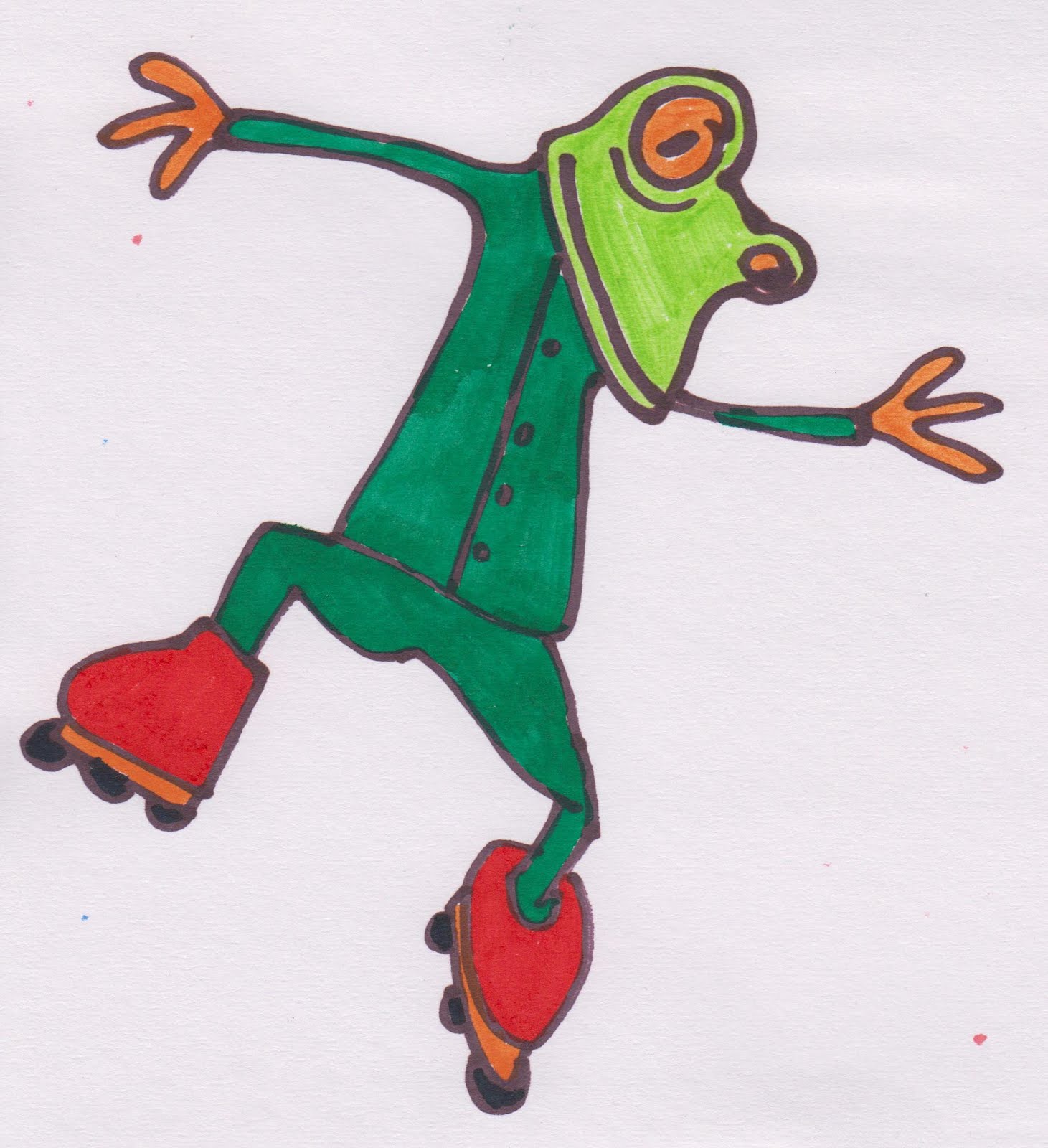
Cinnamon Stitch became a song about roller skates to the tune of A Frog He Would a Wooing Go:
(I love the internet: I put in 'roller skates' and 'frog' and found a picture to copy. Badly. The proper one is (c)Julos)

It was such a jingly jangly frock (‘Hey, ho’ says Roly), It was such a jingly jangly frock,
But if they’d known why, they’d have had such a shock! (With a roly poly gammon and spinach, ‘Hey ho!’ says Anthony Roly.
She joined all her friends at the great Palace Gates/ They all worked together and made... roller skates!
This really was such a magnificent scene, /Until they were spied by the King and the Queen,
Poor Cinnamon knew that they’d make such a fuss, /Instead, they asked “Please could you make some for us?”
They’re all happy now and they’re less stuffy, too,/They went for a skate and their world grew and grew…

(An extract from the original manuscript I sent to Barefoot)

I sent it to Tessa in July and she got back to me in August, saying she liked the story but that two things needed to change (only two?). First, the refrain needed to be made personal to the song. So:
With a roly, poly gammon and spinach,
‘Hey ho!’ Says Anthony Roly.

Became
From her royal bows to the tips of her toes,
Hey ho! She longed for freedom.


Not too hard, but what about ditching the roller skates (which Cinnamon had made sneakily under everyone’s noses, with tools sewn into her dresses) for something more dramatic?

I had fun trying out other possibilities – making a sail for a boat? galloping into the wind? floating off in a home-made hot air balloon…? It was the balloon that made most sense to me... I’d briefly considered a kite but had just as quickly dismissed it on the grounds of health and safety (would they let me have a child floating off on a kite?) and a vague memory of an old Iain Banks novel. But then:


Mark knew a good idea when he’d had one, and soon I’d turned it into my idea (it’s hard to incorporate new ideas until they feel like your own) and began the rewrite.
I rewrote and sent the manuscript to my great critique group and critique partners (who are always part of the collaboration. Fortunately I had American, as well as English, critiquers, who could help me with cross-continental rhyming issues, since it would need to be suitable for both markets –

which ones rhyme for you?
I removed the plait (I had wanted her to snip it off and use it for a kite string), made some more changes and sent it back. Barefoot liked the story/song and in January, 2010, I signed my first ever book contract for what was now called The Kite Princess (and thanks to my newly found agents, Celia and James Catchpole who were also now part of the mix).

My children posting off my first ever book contract.

Yippee! (as Cinnamon would say). I started to learn the song on my guitar –I’m an almost complete beginner so it was taking a while...
(and no one but a dog with a tennis ball for a foot could bear to listen)...
but I wanted to be able to sing it in schools…

Anyone who has read The Kite Princess will know that it is not a song. A few months after signing, it was decided that there’d be more possibility for sequels if it weren’t a song, so it was back to expanding, rewriting and resending to my critique partners.

The bit that most readers of picture books think is the truly collaborative part is probably the least. As Malachy Doyle said in a recent Picture Book Den post, authors and illustrators very rarely work together and everything goes through the editor or art director. So without ever having had any contact with her, Laura-Kate Chapman started work on turning my manuscript into our book.

Early sketches of Cinnamon (c)Laura-Kate Chapman

(c) Laura-Kate Chapman

(c) Laura-Kate Chapman

(c) Laura-Kate Chapman

When a picture book is done well, it ought to feel like it’s been a collaboration between author and illustrator –and I hope ours does. It is, of course, also the work of many people at Barefoot, including Sarah Morris, so huge thanks to everyone involved there. And an enormous ‘YIPPEE!’ to Oscar-nominated, multi-award-winning Imelda Staunton, who narrates the story in the accompanying CD. It’s fantastic to have her read this alongside her recordings of The Gruffalo, her performances in Harry Potter (scary Professor Umbridge) and numerous other films and plays.
Imelda Staunton recording The Kite Princess for the accompanying CD.

But of course the involvement in a book also includes the readers/potential readers. If it gets read lots, borrowed lots from libraries and bought lots from shops, online and real, then everyone who buys and borrows it will be collaborating in Cinnamon’s fate.


Who knows, we might yet get to write/illustrate/read about her new adventures currently playing about in my head but desperate to pour onto the page to be brought to life beautifully by Laura-Kate Chapman.


Is the excitement or feeling of achievement dampened in any way by knowing that lots of other people played a part in it? Does it feel less like my story because other writers had suggestions about it that I took on board? Do I feel like a fraud because my husband was the one who came up with the idea of it being a kite –which is of course so central to the story now? Absolutely NOT. As a writer, you get ideas from everywhere and you’re the one who sifts and considers and decides what goes in and stays out. And crucially, you’re the one who writes it. I love life and that we are inherently social creatures and that we affect and are affected by other people, all the time, in millions of ways. And having other people influence -in whatever way- how I tell a story (and vice versa when I critique other writers’ stories), just means that when something works out and gets published, there’s an even bigger cause for celebration. And more people to celebrate with.

(c) Laura-Kate Chapman.

So onto the celebrations!

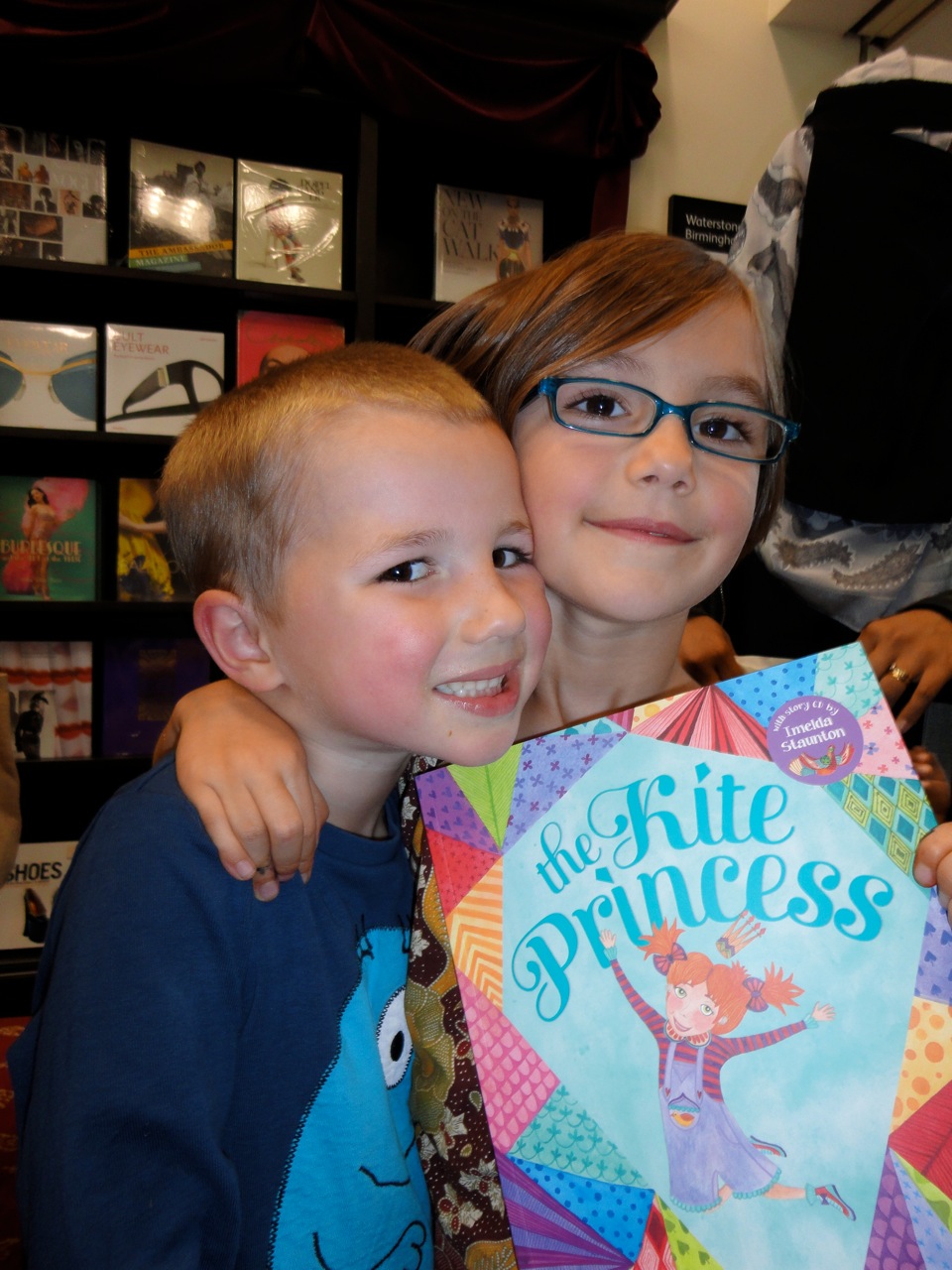
Huge thank yous to the people involved: the fantastic staff from Waterstone’s in Birmingham, particularly Chris, the deputy manager, provided the venue, set everything up, stayed way beyond closing time to sell more books, were extremely helpful and lovely and cleared everything up at the end. Crucially, for me and for my SCBWI critique group, they also provide us with space every six weeks for our critique group to meet -so they’ve played a significant role in my first two picture books, both of which were critiqued in the very space where the launch was held!

Half of my body appears to have disappeared... (half of) the man who made it happen. Chris, deputy manager, hidden in the background.

Lauren Guthrie of Guthrie and Ghani, a local and online haberdasher’s in South Birmingham, made a wonderful cloth kite with the children.

This will be flying high in the children’s department next week alongside copies of the book, thanks to Ben (head of the children’s section).

Laura-Kate Chapman, the book’s illustrator, whom I’d never met until the launch itself, drew beautiful pictures with the children of people, kites, owls, monkeys and all sorts of other weird and wonderful things.


‘She looks so fancy!’ said one of my children, in awe, after she'd met Laura-Kate. They are not used to seeing their mother looking young, glamorous or ‘fancy’.

And not forgetting a certain small, wonderful six-year-old who took the bold step of reading the book in front of everyone. And who better to read the book than my very own Cinnamon Stitch who loves to get dirty...

and climb... (Warning: don't try this at home... Unless you're a spider)


(Now I know why my children insisted on my wearing ‘the dress that you can hide under’ as opposed to the one that I'd actually bought for the launch...)

Sadly the video of Esther reading the book didn't come out -it was a fantastic reading- but I'll post a new video of her reading it when we've made it.


And of course, a launch wouldn’t be anything without the amazing people who come to it. Everyone who turned up brought something special, unique to the event, and everyone gave up doing something else in order to be there.


It was a wonderful night and one that I’ll always remember. And many hands made light work…

Thank you -for reading and to everyone who was involved in the book and the launch, including those who stepped up and took photos when the two photographers weren't able to come (Candy Gourlay, Donna Vann, Margaret Bell, Joolz Richards, Mike Safo). Huge thanks to Rebecca Colby -my long time critique buddy, and to my Birmingham critique group. I'm going to stop before I start blubbing... I love you all....

Click on the links for tips on how (not) to write a rhyming picture book; editing your manuscript and making the most of feedback. I'm also doing a picture book writing workshop as part of Birmingham Book Festival on Saturday 13th October. www.julietclarebell.com