Showing posts with label eyes. Show all posts

Monday, 5 November 2018

Looking into the eyes of picture book characters.

Garry Parsons takes a closer look at how illustrators render the eyes of their characters.


 Julia Sarda from The Liszts written by Kyo Maclear.

Recent conversations about characters' eyes have left me in a spin. 
It’s clear that some people have a preference for how characters' eyes are rendered - and why wouldn’t they? You may have a preference yourself. You may prefer just dots, or you might prefer ovals with dots. 


This Is the Way to the Moon by M.Sasek


There are dots, then dots within circles, then circles with dashes, then ovals with dots, and ovals with dashes, then almonds with lids and lids with lashes and lashes with dots and a lot more variations too tricky to describe. But the closer I looked the more compelling it became. 

 But it is not only individuals who have preferences. 


Gentleman Jim by Raymond Briggs


Apparently, book markets across the world have differing collective preferences on how eyes should be rendered, some favouring dots, others preferring dots within circles, for example, which may leave you with a conundrum if you aim to sell your books in more than one country.  


The Journey by Francesca Sanna


We all know that the co-edition market is important for book sales and book longevity. And what a joy it is to receive copies of your work translated into Chinese, Estonian or Swedish! But does the shape of the eyes have an impact on what sells abroad? 


Emma Chichester Clark from Have You Ever Ever Ever? written by Colin McNaughton


Supposing we were to jot down a list of criteria for a picture book to generate enough interest to secure those vital sales abroad, how far down the list would the shape of the character’s eyes be?  
And if individual countries, or even continents, do have a preference, then couldn’t the sales team just tot up the figures and request that the illustrator give the character the eyes appropriate for the market they want to sell to?  
“Is that a half circle and a dash or would that be a dot with a lash for Scandinavia?” 
“No, wait - it’s dots for Japan and circles for South America, please!” 


 Angela Barrett from Anne Frank written by Josephine Poole


It seems that it’s not quite that simple to appeal to everyone, sell to the whole world and cover all the bases, but the conversations I was having seemed to imply that there might just be a happy medium to accommodate  a healthy majority (if not everyone) somewhere in between a half circle and a dash perhaps, something that could satisfy almost every cultural requirement. Can you supply the holy grail of character eyes that appeals to pretty much everyone, please, Illustrator? 


Garry Parsons from Hey! What's That Nasty Whiff? written by Julia Jarmen


So exactly what shaped eyes should you do? And does it really matter anyway? Surely the story and the overall feel of the book is way more important than such a small detail. After all, we are talking about something as simple as a dot or a dash.  

I’m back in a spin.


 The Cat in the Hat by Dr Seuss


Reaching for the bookshelves, I browse through the variety of eye shapes to look at techniques illustrators have employed at different times to convey the eyes of their characters. 
From the 1960s to the present day, the spectrum goes from the realistic to the wildly bizarre, but mostly, in essence, they are all variations on dots or dots within circles to some degree. 


David Roberts from Tyrannosaurus Drip written by Julia Donaldson


There are now lots of picture books spread all over the desk and floor. 
Within this pile of books I noted that some illustrators alternate between dots and circles from one book to another, not sticking to one method throughout their career, but moving back and forth and chopping and changing technique. In one book a character has dots, in the next the eyes have circles, and then in another book by the same hand we are back to dots again. I even surprised myself, when I noticed how my own characters have switched and swapped between dots, circles and half circles over time, too. 
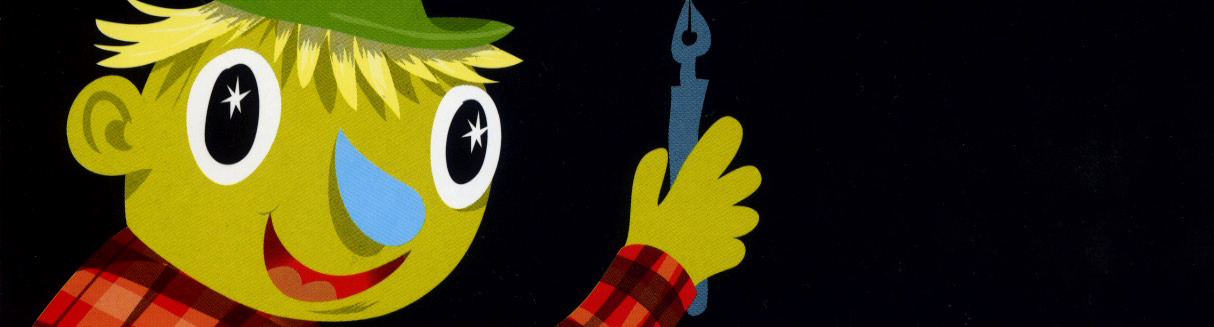

Other Goose by J.Otto Seibold 


There are illustrators who use the same eye shape throughout a whole book for multiple characters, and some who vary this. In some books animal characters are adorned with the same eyes as the people they converse with, and in others they are not. Sometimes animals and make-believe characters are given distinctly different eyes to their human counterparts, and then in some, human characters have dots and their human companions have circles on the same page. Some characters appear to flick between the two (in the blink of an eye) with the eyes changing from dots to full round circles to express, shock, horror or delight and then returning to the mildness of dots again.


Bruce Ingman from The Runaway Dinner written by Allan Ahlberg


I hoped I might identify fashions or trends for eye shapes within this pile of books in front of me, but there were always contradictions and alternatives. Obviously my quick study has been confined to just one collection of books. I’ve not explored the archives of the British Library or studied the bookshelves of other countries, but one thing that is clear is that these eyes are not just dots, circles and dashes, seen in isolation. They have to be viewed as a whole. The rendering of the eyes is embedded in the nature of the character and within the style of the illustrator. To separate the eyes out from the rest of the whole now seems like a ludicrous notion. Would we then have to have a similar conversation about noses? A tick or a curve, a blob or a point...?


 Ingrid Godon from Hello, Sailor written by Andre Sollie


So, where to leave this ramble about eyes, be they dots or be they circles? Back in the place where picture books belong, I think. On a shelf where there are no rules and where the impossible can become possible through words and pictures combined. And where no one, it seems (even though we may try) can predict the ingredients of a worldwide bestseller.


 Sara Ogilvie from Detective Dog written by Julia Donaldson


So, if you find yourself feeling conflicted over a detail like dots or circles, maybe it’s best to forget whom you are trying to please and just let your characters decide for themselves.

                                      
     We're going to end on a quiz!  
      
     Can you identify who the illustrator is by the eyes alone?
     Answers will appear in the comments section on Tuesday evening. So there's no peeking!


Garry Parsons is a children's book illustrator.

See more of Garry's illustration here.
@icandrawdinos on Instagram & Twitter

                                                                                ***


Saturday, 21 November 2015

Looking at the illustration of eyes in children's picture books - Paeony Lewis

Four talented professional illustrators have helped enormously with this blog post on the illustration of eyes. Huge thanks to Jonathan Allen, Penny Ives, Bridget Marzo and John Shelley. Without you, my musings would have been paltry!


From Where the Wild Things Are by Maurice Sendak
Imagine if those monsters looked directly at you…
Eyes may take up only a tiny part of an illustration, but they say so much and it’s vital to get them right. Have you noticed how Max's monsters in  the classic Where the Wild Things Are never look directly at the reader? How scary it would be for a child if they did look at us!


Eyes can have such huge impact, regardless of how minimal the illustration.  In This Is Not My Hat, part of the story is told through tiny changes in the eyes of the big fish. From the story text we know the little fish steals the hat of the big fish and thinks he won't notice. However, although we're not told anything in the text, through just the eyes of the big fish we see him wake up and discover his hat is gone and obviously he wants it back.  It’s stylish and very effective. 

Four excerpts from the pages of This Is Not My Hat by Jon Klassen (Walker Books, 2012)

With just a few strokes of the pen or brush, really subtle emotions can be seen in eyes. In No More Yawning! (I'll admit it's by me!), the illustrator, Brita Granstrom, portrays an emotional scene between mother and daughter with the barest of marks. I won't say what's happening - can you guess the emotions? The answer is at the very bottom of this blog post.

Excerpt from No More Yawning! by Paeony Lewis,
illustrated by Brita Granstrom (Chicken House, 2008) 

In this image from  No More Yawning! Brita's watercolour illustration reflected the words of the story. However, sometimes this isn't the case. I often smile when there's the need in a story for the text to say one thing and the eyes of a character tell us something else. The interplay of words and illustrations can be such fun. In the example below the eyes show us that the zebra's words are said with resignation. Given a choice the zebra wouldn't do it again, but he wants the moose to be happy (rather like a parent and child!).

From Z is for Moose by Kelly Bingham, illustrated by Paul O. Zelinsky (Andersen Press, 2013)


So why have I been looking at the eyes of characters in picture books? Although I'm an author and definitely not a professional illustrator, for a few years I’ve been studying art and in class next week I'll be sketching and painting two characters from one of my stories. It was this that got me thinking about eyes.

I knew I didn’t want realistic eyes for my characters. Instead, should I use small dots or big dots? Should they be round, oval, square or just lines? Or how about big eyes with pupils as these can be really expressive?

Excerpt from Pom Pom gets the Grumps by Sophy Henn (Puffin, 2015).
These pandas have very expressive eyes.
Owl and Squirrel have big eyes in
A Bit Lost by Chris Haughton
(Walker Books, 2010)

At first I thought I’d use big eyes as they seem popular. Human babies have big cute eyes. This appealing trait is reflected in manga and anime, the Powerpuff Girls and Bratz dolls, Teletubbies, Muppets, Elsa and Anna in Frozen, Mickey Mouse... Etc, etc.! Nobody ever said: “Oh, what lovely small eyes you have.” Instead, we might use eye makeup to make our eyes look bigger and more attractive.

However, if having big expressive eyes were a prerequisite for picture books then that doesn’t explain why beady-eyed mice, bears and elephants are also popular characters, or why many illustrators use small dots for eyes. So maybe I should consider dot eyes too. Ho hum, I think I’ll talk to some professional illustrators. They’ll know much, much more than me! To begin, here's a lovely introduction by Penny Ives...

Penny Ives


Two little black ink dots and there we are: a pair of eyes.

But move the dots closer together, up or down or round by the ears and everything changes.

Enlarge them to the size of saucers or miss one out and we have a spaced out pussy or my cat Fozzie who sadly is minus one eye these days.


Simple cat eyes   © Penny Ives, 2015


To achieve the right look for both the cat in the red suit and Miss Austen, and all eyes in the right place, I used the method outlined below.


The Red Suit  © Penny Ives
Miss Austen and the Penguin  © Penny Ives, 2015


First draw a circle.
Put two dots on small pieces of tracing paper.
Move them around over your circle.
Voila!
A face with eyes!
Or you can use Photoshop of course!

But it's amazing what two ink dots can do.


Jonathan Allen


The eyes are the window to the soul, etc, etc. As far as drawing eyes goes, I subscribe to the 'circle with a dot in it' approach. What I call ‘Beano’ eyes, after the comic of that name. I don’t go for the single dot approach because for me it is too limiting and emotionally distant. I have no argument with artists like Quentin Blake and Margaret Chamberlain who use the dot method, but it doesn’t suit me. It’s ‘Beano’ eyes for me every time.

I prefer the way the 'circle with a dot in it' method delivers a range of subtle emotions and describes personality. My drawings are all about facial expression. Take that away and you don’t have much really. The eyes are the point of engagement for the viewer.

For an incredibly crude and simple representation of the ‘human’ eye it is amazingly versatile in what it can express, (along with eyebrows and the mouth). The shape of the eye, the size of the dot and its position are the crucial things. Even subtle variations of these can change the emotion an expression carries. This subtlety means that you can move away from the generic Happy or Sad expressions and into expressions that say things like “I know you think that’s funny, but actually it upset me but I’m trying not to show it.” Or “I’m not supposed to be here but I’ll act innocent and see if I can get away with it.”
Here’s a very quick illustration of the same face with just the eyes changed to ‘illustrate’ my point. Sort of.

Dog eyes © Jonathan Allen, 2015

John Shelley


I sometimes use sweeping point-of-view changes in picture books,  sometimes changing from panoramic views to close-ups. This makes the drawing of eyes a bit awkward, dots work well at distance but for me are a bit too sparse for a close-up. At what point do you change a dot eye to a more fully formed one for the same character, and is there an interim stage? 

Dot eyes used in advertising
on ski train in Japan, by John Shelley
For many years I drew fully formed eyes with whites, pupils, irises, etc., whenever possible, only using dot eyes for figures at a distance. For middle-ground figures this would be a black dot pupil, with a grey line defining a rounded upper eyelid giving space for the whites of eyes, though for close-ups I’d paint the iris, pupil and lids. I was happy with this, though sometimes the white of eyes became too prominent in the mid-ground and I remember Klaus Flugge (publisher) told me how much he hated 'Disney eyes'. I had to be careful my figures didn’t always carry a permanent expression of surprise, and always avoided 'goggle-eyes' as you often see in American animation. When I started doing a lot of advertising in Japan my figures in my more graphic ‘commercial’ style became much simpler and I almost always just used dots for eyes. 

Above and below:
I've just finished painting my latest book (Japanese publisher, 2016):
Yozora o Miyage-yo (Let's Look at the Night Sky), illustrated by John Shelley.

A combination of dots and dots within eye whites were used in this book.

Nowadays I use a combination of developed eyes or dots, it depends on the detail in the project. I draw fully formed eyes for non-fiction historical work like Stone Giant or Will’s Words, but for character-based picture-book fiction I’m turning more to just using dot eyes, though I still show eye whites for closer and mid-ground figures, the definition being shown just with paint rather than drawn eyelids. However I still have that problem of what to do for close-ups. I think if I were to do a book with small figures throughout, I’d probably just use dots. Howerver, the more panning and close-ups there are involved, the more uncomfortable I am with just using dots.


Doddles from sketch book, © John Shelley

The other thing is the positioning of eyes on a face. In Japan I learned quickly about 'Hello Kitty' - it’s the baby-face effect where facial features are lower on the head and the eyes are slightly apart. This appeals to our innate attraction to baby faces. It’s everywhere in Japan and is pretty well a formula now. Use sparingly! I like to doodle in sketchbooks using different proportions and positions of  the facial features. It’s so much fun to push the proportions to see what you come up with - they may not be ‘attractive’ figures, but they're definitely full of character.


Bridget Marzo


Of all subjects to do with illustration the question of eyes is closest to my heart.

For me it’s not so much about the ‘how’ - the styles - fashions for representing eyes which range from the realistic to the round or dot eye.

Much more important is the ‘why’ - the intention of the characters in the story or the purpose of the book.

For stories it’s the direction of the gaze, where the characters are looking, that matters. It can even be a device to prompt a story. Sometimes I’ll doodle two characters and play with eye direction. Giving a direction to a gaze by placing a dot in one corner or another of a eye socket is a key way to create a relationship between characters or reveal their view of the world. Actors know this. Follow a gaze and see how a character connects, or not, to others or to what they are doing. This is how Tiz and Ott first came to life, as I explored the way they reacted, or not, to each other.


When I run character drawing workshops for children and adults I’ll suggest a ‘quick draw’ recipe which includes drawing simple circles for eye sockets. The fun comes at the end when we add the dots for pupils in a specific direction. The characters come alive and it is as if you can read their thoughts. Are the characters making contact with each other or not? Is a character avoiding eye contact for some reason? Perhaps they are feeling shy, exasperated or guilty. Or are the characters literally 'seeing eye to eye'? 

Give the eyes a direction and it may lead your characters in a direction through a story.

____________


Again, huge thanks to  Jonathan Allen, Penny Ives, Bridget Marzo and John Shelley. Please click their names to find out more.

Now I must decide how to illustrate the eyes of my two characters. It's time to experiment!


From No More Yawning!
by Paeony Lewis, illus by Brita Granstrom
Finally (really!), at the beginning I suggested you guess the emotions of Mum and her daughter, Florence, as painted by Brita Granstrom. I wonder what you thought?!

In fact, at this stage in the story it's late and Mum is very tired and Florence won't/can't fall asleep. Florence is still feeling a little sad and pensive because Mum shouted at her on the previous page. Mum is now feeling lovingly guilty and is trying to reassure Florence by telling how she got to sleep when she was a little girl. I adore the way Florence's monkey reflects Florence.


If  you have any thoughts on the illustration of eyes then it'll be great to read your comments.
Paeony Lewis