Showing posts with label Ingrid Godon. Show all posts

Sunday, 19 June 2022

Pride Month Picture Books, a celebration! - Garry Parsons


Pride Month is in full swing and this year the UK celebrates 50 years of the Pride movement. 
For the month of June, members of the LGBTQ+ community and their allies celebrate their identities, accomplishments, and reflect on the struggle for equality.

Pride Month marks the police raid that prompted the Stonewall riots which in turn led to the establishment of LGBTQ+ rights. The raid took place during the early morning of June 28, 1969, at the Stonewall Inn in Greenwich Village, Manhattan, a popular gathering place for young gay men, lesbians, bisexuals, and transgender people. The LGBTQ+ community held a series of demonstrations to protest against the raid and called for the establishment of safe spaces for gay people, where they could congregate without fear of being arrested or becoming victims of violence. These riots served as a catalyst for the rights of LGBTQ+ people. Since then, the LGBTQ+ community annually commemorates the years of struggle for civil rights and the ongoing pursuit of equality in the form of a pride celebration, now widely observed with parties, parades, concerts, and other events that celebrate a diverse identity.

In the UK, the first official UK Pride Rally was held in London on July 1, 1972 (chosen as the nearest Saturday to the anniversary of the Stonewall riots of 1969) – so 2022 marks the 50th year of the Pride movement in Britain.

So what does this have to do with picture books? Well, we are all different to a greater or lesser degree and every day we meet people different from ourselves. It is vitally important that children get to read about all different types of people and families to promote an attitude of empathy and acceptance. Everyone should be able to see themselves represented in the books they read to support a positive environment for each of us so we can be free to be who we are.  

I've picked out some examples of brilliant picture books supporting diversity and asked some of the creators involved for their views on what Pride month means to them personally and why picture books are so important.


Nen And The Lonely Fisherman - Ian Eagleton & James Mayhew

James Mayhew is the illustrator of Nen and the Lonely Fisherman.

"For me, Pride month is both an opportunity to celebrate and feel part of an amazing, welcoming community and also a time to reflect on those who fought so hard for LGBTQ rights and how we must never take those rights for granted. The future relies on educating people and that's why I feel strongly that we need picture books to show children positive examples of different kinds of relationships. For too long the heteronormative 'happy ending' has reinforced the problem. Books like Nen and the Lonely Fisherman gently teach acceptance and empathy." - James Mayhew.


 Nen And The Lonely Fisherman - Ian Eagleton & James Mayhew


Forever Star - Gareth Peter & Judi Abbot

Gareth Peter is the author of Forever Star illustrated by Judi Abbot, a rhyming story about a same sex couple adopting a child.

"To me, Pride means family. We have a two daddy family and we have adopted two amazing boys. This was all possible because of Pride and all that the amazing LGBTQ plus community have done. So I will always be thankful and appreciative of Pride for allowing my dream to come true and become a dad. Pride should always be a colourful, accepting, tolerant and happy celebration and that's just like our family. Happy Pride everyone!" - Gareth Peter.


Harry Woodgate is the author and illustrator of Grandad's Camper. In this moving story, Grandad tells his granddaughter about the adventures he used to have with Gramps.

"Pride is a wonderful opportunity to celebrate our LGBTQ+ friends, family and community, but more than anything I feel that it's a time to reflect on and campaign for the progress that still needs to be made, especially in the face of increasingly damaging legislation.
We know children's books are powerful tools for building empathy, kindness, confidence and emotional literacy, which is why it's so important that every child is able to access literature which is why it's so important that every child is able to access literature which reflects a diverse and inclusive range of identities, experiences and family setups." - Harry Woodgate.


Grandad's Camper - Harry Woodgate


Llama Glamarama - Simon James Green & Garry Parsons


Simon James Green is the author of Llama Glamarama, a story celebrating differences and of being true to yourself.

"One element of Pride is about being true to yourself, living your life fearlessly and boldly, and celebrating everything that makes you unique. I think that's something everyone should embrace, whatever their age and that's why it's so important to see that message in picture books" - Simon James Green.


For me, Pride month is an uplifting recognition of the strength of my identity and a validation that whatever family set up you have, a family is a family.
Here are a few more picture books worthy of your attention this June and in the months and years beyond.


The Pirate Mums - Jodie Lancet-Grant & Lydia Corey


The Pirate Mums - Jodie Lancet-Grant & Lydia Corey


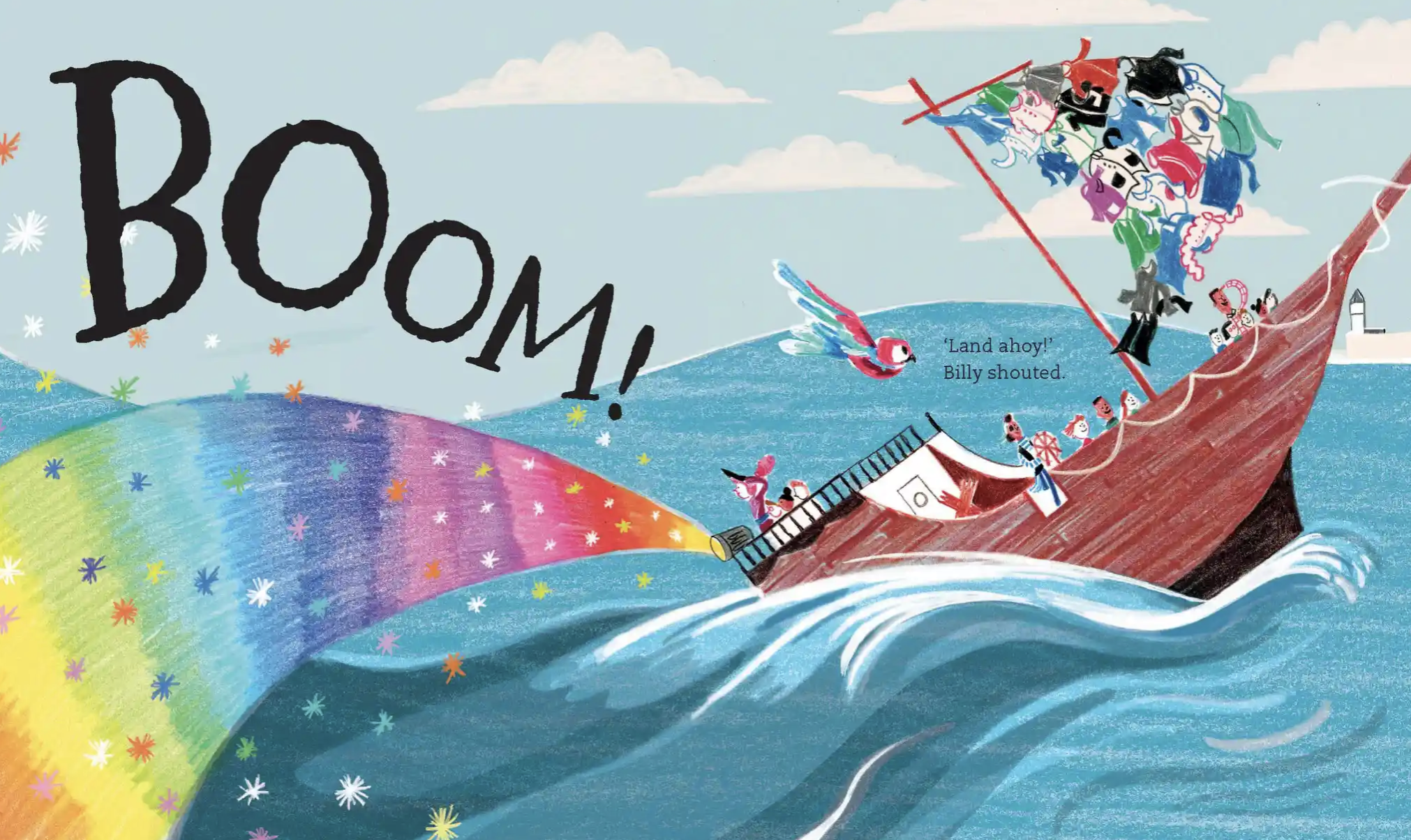
Hello Sailor - Andre Sollie & Ingrid Godon


Hello Sailor - Andre Sollie & Ingrid Godon


We Are Family - Patricia Hegarty & Ryan Wheatcroft


Uncle Bobby's Wedding - Sarah S Brannen & Lucia Soto


Happy Pride Everyone!


                                                                                   ***


Garry Parsons is an illustrator of children's books and the illustrator of My Daddies! also written by Gareth Peter. A picture book celebrating same-sex parents, shared story time and introducing children to the different kinds of family in the world today.

My thanks to James Mayhew, Gareth Peter, Harry Woodgate and Simon James Green for their heartfelt contributions.
 
Garry's work can be seen here
Follow Garry on twitter and instagram @icandrawdinos


Sunday, 20 June 2021

Picture books about Dads. Garry Parsons chooses picture books to celebrate fatherhood all year round.

One of my favourite depictions of fatherhood is the moment Geppetto lifts Pinocchio off the floor and joyfully whirls him around the room at the end of the Disney movie. This is the very last scene in the movie where distraught Geppetto is sobbing on the bed and all looks lost. But when he lifts his head to see who’s talking he realises that Pinocchio is not only alive after the ordeal with the whale but has magically been transformed into a real boy. 


Pinocchio - Disney 1940
 

I’m sure we’d all agree that Geppetto’s parenting skills in the movie require some attention but what I love about that final scene is the overwhelming sense of joy Geppetto has at being a father and the relief he has to be reunited with his son.  You can watch the scene on youtube here.

Like Geppetto, no one is perfect at being a parent and nor would we want to be, but Dads in picture books often seem to get a raw deal. Dads are often depicted as caricatures of dads, preoccupied with tasks in the shed, washing the car or tinkering under the bonnet. Sometimes unkempt or dishevelled, they can appear absent minded, aloof or uncaring, preferring to fix things than parent directly. 

Dads generally appear less in picture books than mums too and are more likely to play background roles. There are certainly more mums in picture books than dads but that is probably a fair representation of who is taking on most of the full time parenting today, particularly with books for younger children. Dads in picture books can be on the periphery of family life or simply absent from the story altogether, but that might also be a reflection on the world we live in too. 

From Lawrence in the Fall by Matthew Farina & Doug Salati
 

So it’s heart-warming to see some new Dad characters coming to the fore in recent picture books. Dads who care and parent from a place of nurture (“Lawrence in the Fall”) and dads who are gentle and willing to listen (“Jabari Jumps”) And dads who are keen to impart wisdom and help their children grow. 

What We’ll Build by Oliver Jeffers 

As it is Father’s Day this weekend we have good reason to delve back into the book shelf and pull out some old favourites too. 

Don’t Let Go! By Jeanne Willis, illustrated by Tony Ross.


I’ve picked out a few picture books with strong father figure characters who, I feel, have a lot to give and that you might enjoy too.


 Lawrence and his Papa go searching in the woods to collect things to show in school. Papa gently departs his knowledge of the forest and his wisdom of how the world works. In a moment when they become separated, Lawrence discovers a forest secret of his own. A tender story of the bond between father and son where the characters express clear emotion, beautifully illustrated scenes and characters that capture the tenderness and wild elements of the landscape.


What We’ll Build by Oliver Jeffers is a story of a father and daughter setting out plans for their life together, building memories and a home to keep them safe. A moving story of love and protection.


A story about courage and gentle parental encouragement. Jabari has made his mind up that he is going to take a leap from the diving board but it's high and a little scary but he has his dad with him for support.


Pete’s A Pizza by William Steig is a firm favourite in our house and never ceases to bring a smile. It's raining outside and Pete can't go outside to play. Pete's attentive dad decides to make him into a pizza instead and bake him on the sofa. A funny and warm story around the kindness of a tuned-in dad with paired-down but spot-on illustrations.

A Brave Bear is a contemplative story of gentle parenting and attentive awareness. Dad has to navigate encouragement and some sulking when his son has ambitions of jumping big and grazes his knee in the wilds of the forest. Beautiful, textured illustrations from Emily Hughes.


Another enduring favourite in our house is Don’t Let Go! By Jeanne Willis, illustrated by Tony Ross. A little girl wants to visit her daddy but to do that she needs his help to learn to ride her bike. "Daddy, I'm here, I won't let go. Not until you say. Hold on tight. I love you, so - We'll do this together...OK?"  Prepare to be moved by this affectionate father and daughter relationship.


Great for younger readers, My Daddy is a Giant is a simple celebration of a father with Indrid Godon's uniquely wonderful illustrations.

Dad is competently in charge, doing some chores and caring for his daughter Trixie at the same time and doing a fine job of it until it all goes wrong at the laundromat. When you're attention is focused on your toddler be prepared to make mistakes!
 

Stereotypically manly men are shown in emotional or scary moments in Tough Guys (Have Feeling Too) by Keith Negly. Evertone has feelings, unless you are a robot!


And to return to Geppetto and his son, Pinocchio by Pinocchio, retold by Michael Morpurgo, illustrated by Emma Chichester Clark

As ever, please use the comments section to recommend your favourites and let’s celebrate the fully formed Dad in picture books all year round.  Happy Fathers Day!

 ***

Garry Parsons is an award winning illustrator of children’s books and father to two boys. 

Garry is the illustrator of My Daddies! By Gareth Peter. 

@icandrawdinos www.garryparsons.co.uk 


Monday, 18 March 2019

This Blog Post Is Gay - Garry Parsons


The title of this post is respectfully borrowed and adjusted from Juno Dawson’s witty and frank manual “This Book Is Gay” first published in 2014, an important book for anyone to read, not just the LGBT* community. This book is not only informative, it is wholly accepting and basically gives the message that, whoever you are or whoever you are not, it is ok to be you. And that is a message I couldn’t agree with more and one I would hope to pass to my kids.


This Book Is Gay by Juno Dawson - Hot Key Books 2014


Apparently, the market for young adult fiction featuring characters identifying as LGBT is growing. Authors like Amy Rose Capetta, Amber Smith, Christina Lauren, Tim Federle and  Juno Dawson, who also writes YA fiction, are appreciated by readers who are looking for a broader diversity of protagonists and storylines with positive reflections of who they feel themselves to be.

Representation in books is so important not only for young people who are themselves LGBT, but for everyone finding themselves in a minority community, and also for those who are not, in order to feel empathy and gain understanding. 

The recent wave of diverse characters in young adult fiction appears to be slowly making its way as subject matter for picture books. There are and have been books alluding to gay characters or featuring same-sex parents, but, by comparison to the plethora of picture books out there, these are very few and can sometimes be lacking in subtlety or quality. 
As an illustrator, parent and member of the LGBT community myself, this is an area I feel is overlooked and in need of representation and encouragement.
This could all be about to change.
In February this year CBeebies’ Bedtime Story featured singer Will Young reading Carolyn Robertson’s picture book “Two Dads”, illustrated by Sophie Humphreys, about a boy who has been adopted and brought up happily by two fathers. This episode was shown to coincide with LGBT History Month.


Will Young  reading Two Dads by Carolyn Roberson illustrated by Sophie Humpreys


“Children’s books are one of the first ways we learn about the world around us so I’m overjoyed to be reading a story to mark LGBT History Month,” said Young.

I wholeheartedly agree. Children need to be able to see the world around them, and themselves reflected in it, no matter who they are and picture books have proven to be remarkable vehicles for this. When the subject matter sits on the periphery of our daily lives or the story concerns something we know very little about, picture books are a good way to start a conversation about them for both adults and children. 
Here are a few stunning picture books that I feel deal with complex issues in clever, subtle and thoughtful ways:
The challenges of a refugee family in "The Journey" by Francesca Sanna, tolerance in "Marshall Armstrong is New to Our School" by David Mackintosh, losing a loved one in "Grandad’s Island" by Benji Davies and the dangers of lies skewing reality in "The New Neighbours" by Sarah McIntyre, for example.  
 
The Journey by Francesca Sanna. Marshall Armstrong Is New To Our School by David Mackintosh. Grandad's Island by Benji Davis and The New Neighbours by Sarah McIntyre

So what about picture books dealing with the difference a child might feel who might later identify as LGBT? Most LGBT adults can recall the sense of being ‘different’ at a very early age. These books were not around when I was six years old, but they are titles I wish I had seen and ones that offer something else.

Something Else by Kathryn Cave illustrated by Chris Riddell - Puffin 1994


“Something Else” by Kathryn Cave, illustrated by Chris Riddell, first published in 1994 and boasting over a quarter of a million copies sold, is the story of a creature who is told he does not belong and is unjustly excluded, and also about how you can befriend a person who is finding fitting in difficult.


Perfectly Norman by Tom Percival - Bloomsbury 2017


"Perfectly Norman" by Tom Percival, published by Bloomsbury in 2017, is about a little boy who realises that being bold enough to embrace being different is what leads to his happiness.


Hello Sailor by Andre Sollie illustrated by Ingrid Godon - Macmillan 2000

My personal favourite, “Hello Sailor” by Andre Sollie and illustrated by Ingrid Godon, tells the story of Matt, who lives in a lighthouse and spends his time watching the sea for his friend Sailor to return to him. “A beautiful book…it makes – just as it should – the love between two men as natural and as deep as any other,” says the Observer.


Julian Is A Mermaid - Jessica Love - Walker Books 2018

"Julian Is A Mermaid" by Jessica Love, published in 2018 to high acclaim, The Sunday Times calling it “celebratory and ground-breaking”, is the story of a little boy who is mesmerized by the sight of three women in flamboyant dresses he sees while travelling on the subway with his Nana. He leads us, unashamedly, on a journey towards love and acceptance. Who wouldn’t want this freedom of expression for children?


Interior illustration from Julian Is A Mermaid - Jessica Love 


Whilst these four books don’t explicitly speak about same-sex relationships, gender stereotypes or being LGBT, the themes of feeling different, the need for acceptance and the exploration of self-identity can be appreciated without them being preachy. 

This is what Tom Percival says about Perfectly Norman :
the wings are symbolic—of freedom—once you allow yourself to be open and honest about who you really are, you can fly free.”


And Tango Makes Three by Justin Richardson & Peter Parnell illustrated by Henry Cole  - Simon & Schuster 2007


 And then there is the popular, and at the same time controversially unpopular, “And Tango Makes Three” by Justin Richardson & Peter Parnell and illustrated by Henry Cole.
“And Tango Makes Three” tells the story of two male penguins, Roy and Silo, who create a family together, based on the true story of two male penguins that hatched an egg in the New York City Zoo.

Roy and Silo's adopted egg hatches - from And Tango Makes Three - illustrated by Henry Cole

The story explores the universal way families form around love and shows that some families who can't have children of their own adopt, in this case with the help of the zookeeper, Mr. Gramsay, who gives them an extra egg from another penguin couple at the zoo.
“And Tango Makes Three” has been at the centre of many censorship debates on same-sex marriage, adoption, and homosexuality in animals and periodically banned in public libraries in certain states in America. In Singapore, the National Library Board were persuaded to file the book in the adult section.  
At the same time “And Tango Makes Three” has been used in schools as a teaching aid and has won multiple awards, including being on The American Library Association’s Notable Children's Book list in 2006.

Undoubtedly, picture books can be powerful starting points for provoking thought, leading to empathy or letting the reader know that “It’s ok to be me”. 

I know I would have enjoyed and valued the story of "Julian Is A Mermaid" when I was six and I certainly would have benefitted from the frankness of Juno Dawson’s "This Book Is Gay" as a young adult. 


Illustration by Spike Gerrell from This Book Is Gay by Juno Dawson

For me, these books give hope, especially in a time when the world is struggling to tackle discrimination and hatred in all its myriad forms. We need to be able to give our children a moment where they can feel confident and safe to explore the people they feel themselves to be, whatever that might be, whoever and whatever they grow up to be, even if it is to be a mermaid.

Garry is proud to have recently been asked to illustrate a picture book with an 
It’s ok to be you” theme and which was the prompt for this post.


follow -  @icandrawdinos - Twitter & Instagram


* LGBT - lesbian, gay, bisexual and transgender.

Monday, 5 November 2018

Looking into the eyes of picture book characters.

Garry Parsons takes a closer look at how illustrators render the eyes of their characters.


 Julia Sarda from The Liszts written by Kyo Maclear.

Recent conversations about characters' eyes have left me in a spin. 
It’s clear that some people have a preference for how characters' eyes are rendered - and why wouldn’t they? You may have a preference yourself. You may prefer just dots, or you might prefer ovals with dots. 


This Is the Way to the Moon by M.Sasek


There are dots, then dots within circles, then circles with dashes, then ovals with dots, and ovals with dashes, then almonds with lids and lids with lashes and lashes with dots and a lot more variations too tricky to describe. But the closer I looked the more compelling it became. 

 But it is not only individuals who have preferences. 


Gentleman Jim by Raymond Briggs


Apparently, book markets across the world have differing collective preferences on how eyes should be rendered, some favouring dots, others preferring dots within circles, for example, which may leave you with a conundrum if you aim to sell your books in more than one country.  


The Journey by Francesca Sanna


We all know that the co-edition market is important for book sales and book longevity. And what a joy it is to receive copies of your work translated into Chinese, Estonian or Swedish! But does the shape of the eyes have an impact on what sells abroad? 


Emma Chichester Clark from Have You Ever Ever Ever? written by Colin McNaughton


Supposing we were to jot down a list of criteria for a picture book to generate enough interest to secure those vital sales abroad, how far down the list would the shape of the character’s eyes be?  
And if individual countries, or even continents, do have a preference, then couldn’t the sales team just tot up the figures and request that the illustrator give the character the eyes appropriate for the market they want to sell to?  
“Is that a half circle and a dash or would that be a dot with a lash for Scandinavia?” 
“No, wait - it’s dots for Japan and circles for South America, please!” 


 Angela Barrett from Anne Frank written by Josephine Poole


It seems that it’s not quite that simple to appeal to everyone, sell to the whole world and cover all the bases, but the conversations I was having seemed to imply that there might just be a happy medium to accommodate  a healthy majority (if not everyone) somewhere in between a half circle and a dash perhaps, something that could satisfy almost every cultural requirement. Can you supply the holy grail of character eyes that appeals to pretty much everyone, please, Illustrator? 


Garry Parsons from Hey! What's That Nasty Whiff? written by Julia Jarmen


So exactly what shaped eyes should you do? And does it really matter anyway? Surely the story and the overall feel of the book is way more important than such a small detail. After all, we are talking about something as simple as a dot or a dash.  

I’m back in a spin.


 The Cat in the Hat by Dr Seuss


Reaching for the bookshelves, I browse through the variety of eye shapes to look at techniques illustrators have employed at different times to convey the eyes of their characters. 
From the 1960s to the present day, the spectrum goes from the realistic to the wildly bizarre, but mostly, in essence, they are all variations on dots or dots within circles to some degree. 


David Roberts from Tyrannosaurus Drip written by Julia Donaldson


There are now lots of picture books spread all over the desk and floor. 
Within this pile of books I noted that some illustrators alternate between dots and circles from one book to another, not sticking to one method throughout their career, but moving back and forth and chopping and changing technique. In one book a character has dots, in the next the eyes have circles, and then in another book by the same hand we are back to dots again. I even surprised myself, when I noticed how my own characters have switched and swapped between dots, circles and half circles over time, too. 


Other Goose by J.Otto Seibold 


There are illustrators who use the same eye shape throughout a whole book for multiple characters, and some who vary this. In some books animal characters are adorned with the same eyes as the people they converse with, and in others they are not. Sometimes animals and make-believe characters are given distinctly different eyes to their human counterparts, and then in some, human characters have dots and their human companions have circles on the same page. Some characters appear to flick between the two (in the blink of an eye) with the eyes changing from dots to full round circles to express, shock, horror or delight and then returning to the mildness of dots again.


Bruce Ingman from The Runaway Dinner written by Allan Ahlberg


I hoped I might identify fashions or trends for eye shapes within this pile of books in front of me, but there were always contradictions and alternatives. Obviously my quick study has been confined to just one collection of books. I’ve not explored the archives of the British Library or studied the bookshelves of other countries, but one thing that is clear is that these eyes are not just dots, circles and dashes, seen in isolation. They have to be viewed as a whole. The rendering of the eyes is embedded in the nature of the character and within the style of the illustrator. To separate the eyes out from the rest of the whole now seems like a ludicrous notion. Would we then have to have a similar conversation about noses? A tick or a curve, a blob or a point...?


 Ingrid Godon from Hello, Sailor written by Andre Sollie


So, where to leave this ramble about eyes, be they dots or be they circles? Back in the place where picture books belong, I think. On a shelf where there are no rules and where the impossible can become possible through words and pictures combined. And where no one, it seems (even though we may try) can predict the ingredients of a worldwide bestseller.


 Sara Ogilvie from Detective Dog written by Julia Donaldson


So, if you find yourself feeling conflicted over a detail like dots or circles, maybe it’s best to forget whom you are trying to please and just let your characters decide for themselves.

                                      
     We're going to end on a quiz!  
      
     Can you identify who the illustrator is by the eyes alone?
     Answers will appear in the comments section on Tuesday evening. So there's no peeking!


Garry Parsons is a children's book illustrator.

See more of Garry's illustration here.
@icandrawdinos on Instagram & Twitter

                                                                                ***