Showing posts with label writing. Show all posts

Monday, 9 September 2024

Mindful Picture Book Writing by Chitra Soundar

As a writer and with someone who learnt meditation as a child and had forgotten its benefits until recently, re-visiting the basic concepts of mindfulness has been very useful. Especially as a picture book writer – paying attention to the story and words, using a word with intent and not judging our own work critically until it is ready to be judged are all mindful things we do and we can do in our writing practice. 

So what does it mean to be a mindful picture book writer?

a) The first step is always showing up – setting aside a time for the writing and actually showing up. Regardless of the incessant chaos of our lives, we show up to write. 

b) The second step – especially useful for writers – is to be mindful of your own self and the surroundings. Most mindful practices start with mindful breathing. You quietly say In and Out as you breathe in and out deeply. Then observe the surroundings and try and write the five senses about the surroundings – from your noisy keyboard making clickety-clack noises to the smells from the kitchen or how cold or warm you are. What can you see – colourful posters or a bland white wall? Acknowledge all of those mindful observations.

You must wonder how this can help. It helps because the more you do this, the better you get at observing spaces around you and consciously remembering the five senses about those spaces. What can be more useful to writers than training your brain to consciously record details of life to use later in the writing?

c) The third step – is to imagine your characters mindfully in their space. Deliberately allow them to wander in their space. Even if you’re not an illustrator, you might have an idea where your character is at any point in time in the story – consciously wander and add sensory details that you have been accumulating by doing step (b).

It is easy to get distracted – your character might go off to different places, go with the flow. Perhaps the story might be led in a different direction. Or you might get distracted about what to cook for dinner or which book you’re going to read next. When that happens, bring your character back to where they were before your mind wandered off and start again. 

Step (b) and (c) are really hard to do when you actually begin doing them. Start with 1-minute exercises and build up your stamina to do longer durations. 

d) Now when you write your story or rewrite – channel all those experiences your character had with all their senses into the words. Because you travelled with your character into those spaces and felt what they felt, smelt what they smelt and tasted, watched and heard everything, perhaps your verbs will be active, your nouns specific and the emotion strong. 

Picture books especially with a smaller word count are acts of intention. 

You have a specific shape to the story. You have to choose precise words that invoke visuals and emotions in the editor / illustrator’s mind. And when you pay attention and do it with intention, you will slowly start seeing much stronger text on the page. But it is going to take time. Entering this space without judgement is the third aspect of mindfulness. 

Writing is often like the critic and doubter in us trying to wrestle control from our creative energy. As most writing books will say, and I can vouch for it as a writer myself and you can too, there is a place and time for everything. So when you’re writing mindfully, park the critic and doubter outside. Pay attention to the task, do it with intention and without judgement.

Then when you have got your draft on the page, bring the critic in and again pay attention, edit with intention and without judgement. Just because you can’t wrestle a story into shape doesn’t mean you’re a bad writer, it means this particular story needs more time – thinking time, imagining time, resting time and maybe rewriting time. If you get judgemental about it, it will cloud your intention of making it better and try to reject the writing.

So, the critic must be mindful as well – they are critiquing the words, not you the person. They are doing it with intention – this morning they are only critique structure, maybe a few days later, the critic can return to review just the words. Put intention into your edits. 

And you will end up repeating this process of mindful writing and mindful editing over and over again for the same story. But as you keep practicing the mindful way, perhaps you might not need that many rounds. 

I first combined meditation and writing in 2010 when I went on writing retreat run by Natalie Goldberg because her book Writing Down the Bones had brought me back from “not writing at all” to writing. It had a profound impact on me and still is my go-to cure for I can't write conditions. 

Nestled in the mountains of New Mexico, inside a Buddhist monastery, we did silent practice, sitting for meditation and writing with intention. It may not be connected, but in 2012, three of my picture books got accepted. 

I don’t always remember to be mindful, for sure. Especially as a children’s author, I’m doing events, I’m writing and working on multiple things and I have 100 different new ideas I want to write. But when my mind is busy and I feel like I’m hopping from one lily-pad of obligation to another, I find a quiet day just to sit with myself and my notebook. 

Also, when we were all confined inside when the plague hit us again, I started Write30. A bunch of us gather together every Friday (most Fridays), virtually, for 30 minutes and write to a prompt. The writers who join have already done the first step – finding the time to write. Then we pay attention to the prompt and we write. We write with intention on the prompt – but still engaging our individual creativities. I’m sure that even with a single prompt, all of us would have come up with different stories or passages or poems. Then we are non-judgemental. We talk about the experience of that writing, but we don’t read anything aloud, we don’t mock ourselves, we don’t criticise ourselves if the prompt didn’t work. We just reflect. If you want to join our #write30 meetings, email me and I will add you to the invites. 

If you want to delve deeper into mindful writing, then I’d recommend another book that will guide you step by step through the process and also provide exercises. Check it out. 

I realise this mindful practice of writing is not just for picture book writers. But personally, I feel picture book writers have a bigger need to be purposeful and intentional with their words and pictures. They need to pick their words with intention to tell the story and what can be more mindful than that?

If this resonates with you or if you try mindful writing, then do share your thoughts with us in the comments. If you want to join the weekly #Write30 session, do message Chitra directly.


Monday, 16 August 2021

Could it be… ADHD? ADHD and writing by Juliet Clare Bell


I have a terrible confession to make about Picture Book Den. So... we take it in turns to write blogposts each week and there’s a rota of who goes when…

only I don’t know where that rota is

…which means I don’t know when I’m meant to post. Which means I periodically get a heart-stopping moment where I think ‘oh no [though much less politely], it might be my turn and I’ve forgotten (again)’ -but I don’t think the thought through properly enough in the run-up to the Monday when someone posts (and ignore that nagging feeling), I think it on the Monday… but I have an almost pathological fear of checking to find the rota to see if I’m right (that I’ve missed my date). 

Sounds ridiculous, right? Because it is. Why don't I just write the dates on a calendar? And why would I choose to stick my head in the sand and NOT check the dates when I know that I haven't posted for ages? 

And yet I do it time and time again. When someone else posts on a Monday, I breathe a sigh of relief as it can't have been my week after all...  Over the years, I’ve occasionally remembered to write down my dates for the whole year onto my calendar which means I’ll get them in on time for that year -(IF I’ve remembered to look at my calendar regularly, of course) but mostly I don’t. And so, shamefully, I am reminded when I’ve already missed my deadline. It’s not that I don’t want to do it. I love being in the Picture Book Den. I’m only posting this because shame thrives on secrets (thank you, Brene Brown). I’ve got plenty of terrible confessions I could make about opportunities missed because I have huge difficulties prioritising anything, and how I can be 98% through a writing task but cannot make myself do the last two percent -for often weeks, or months, or years. But all this confession talk is working up to something that happened about four weeks ago…

It was my Usual Suspects moment (you know, when the big reveal all comes together and it’s like ‘no way! [another realisation]… no way!... [and another] no way! With each additional realisation that you’re suddenly bombarded with, you think. Wow. 

Everything 

suddenly 

makes 

sense.

It reminded me of the lightbulb moment in my most recent picture book, Ask First, Monkey! (illustrated by Abigail Tompkins). Monkey gets it wrong time and time again and doesn’t realise what he needs to do in order to work out whether someone wants to be tickled or not. 


(c) Abigail Tompkins (2020)

And then…


                                                         (c) Abigail Tompkins (2020)

The realisation...


                                                            (c) Abigail Tompkins (2020)

It doesn’t mean suddenly that he’s always going to get it completely right and never makes mistakes but it’s that realisation…

I suddenly realised -at the ripe old age of fifty, that 

must 

have 

ADHD. 

For three months after a family member suggested that both she and I had it and asked me to do an online test like she’d done I had been in complete denial. I went and did one and the ‘this result strongly suggests you have ADHD’ didn’t even leave me questioning if I had; I simply assumed it wasn’t a good test (though I was totally on board with my family member having it). I took three more tests at various points over the following months (with only the last one feeling in any way like I was doing it to find something out about me and not the wrongness of the test). Obviously everyone must come up looking like they had it. I am similar in my difficulties to quite a few friends and family and surely we didn’t all have it?! Unless, of course, you’re drawn to people with a similar slightly chaotic way of thinking/living…? And unless there’s a large genetic component and actually you might come from an extremely neurodiverse family but you all thought it was just normal (and that it was other people who were different and not you…)  

Instantly, loads of my life made sense for the first time. Before there were so many individual things that I really struggled with but hadn’t put together (really MESSY in real life -no idea how to keep a tidy home, and frantic tidying (or hiding away of mess into various cupboards before anyone comes round), always FORGETTING things, including how not to forget things -like writing things down… (and periodically thinking I'd invented an amazing new device comprising writing down what I was doing on each day before realising, once again, that that was a calendar and I had one -and could use it), not being able to stay FOCUSED -except on certain things (I could do mindless puzzles for hours, or follow some random research thought down a rabbit hole for hours), my whole pattern of work history when I worked in academia…, massive trouble PRIORITISING, having my work in one of nine places (I counted for this post) because of real difficulties ORGANISING anything, being really messy in my writing scribblings, not being able to FOLLOW even the simplest of DIRECTIONS or INSTRUCTIONS, a shockingly bad PROCRASTINATOR, an almost pathological DIFFICULTY FINISHING things. And then I think about our childhood -and, of course! I could go on (and I do, I could talk for ever, and I’d INTERRUPT you loads, too -another thing I’ve not properly realised, or at least admitted to myself, until now) but I won’t.

It’s a bit embarrassing to have been so blindingly unself-aware for so many years (I used to be a research developmental psychologist! I’m a writer! Surely being self-aware is pretty important for those jobs and I’ve seen myself as being a pretty self-aware person, so my pride took a bit of a hit). I had become more aware in some respects over the past twenty years or so -mostly since having children) and this had spilled over into my author visits in a really positive way. We play games around embarrassing moments -doing or saying the wrong thing (of which moments I have a considerably greater than average number) and we talk about why writing is brilliant -because I can be messy, I get to be in charge, I have to let go of perfectionism (for so many years I hated making mistakes and the crippling anxiety that goes with it…), I even do projects with children called ‘I am a work in progress’ and mention about how I was bullied in school for being different, and look good humouredly at all the things I struggled with.


We made a whole book about it! (Thank you to Hallfield Year 4s and 5s)

It was great way of engaging with children and helping them feel better about themselves… And the playing of lots of what if…? games where we go down those crazy rabbit holes and things become ridiculous are loads of fun

 but I still hadn’t put all the pieces together…


In the past, I was very harsh on myself and I all always asked the question

why can’t I do things that normal people can do?

I would berate myself that I could do a PhD (even if each chapter/sub-chapter deadline was scarily last minute and I had to stand up whilst writing for the last three days before I handed the whole thesis in as I knew I’d fall asleep if I sat down to write) but I was completely incapable of keeping a room tidy. I’d be furious at myself and think

What’s wrong with you?!

Even now, keeping a room tidy for a few days feels like a bigger achievement than getting a book published because it feels like I’ve finally, inexplicably gained this secret knowledge of how to be normal... 

And then I lose it again.

So what does this actually mean for writing?

There are parts of writing and related activities that seem to work pretty well for me (the more sociable bits -where I’m with students, or I’m doing school visits -doing, not organising them; the organising and admin around them are very painful). I can come up with really interesting ideas for books and love doing the research parts where I need to. And the fact that I have trouble with sustaining focus whilst working from home means that no one sees me when I do things in tiny bursts of productivity amongst long periods of zoning out. The productivity can be really productive for short bursts and I have to accept that it does work out sometimes as I DO get books published occasionally! And I have had periods with my accountability partner (2020) where lots of things come together and I have what looks and feels like a massive rush of things going right before it all goes extremely quiet again. And actually, when I am commissioned to write books, or get a book deal, I ALWAYS get them in on time. It’s down to the last minute of course (often literally) but I do deliver when I’ve got a firm deadline. But it comes at a personal cost, relying on heaps of adrenaline to make me finish it, and I’ve also missed amazing opportunities because I wasn’t able to prioritise and didn’t turn opportunities into these firm deadlines like publisher deadlines.

But the children’s writing community is lovely (check out SCBWI if you haven't already) and there’s loads of support to be had. I’ve been trying to ‘self-medicate’ with numerous productivity planners and books on getting organised/escaping chaos, and accountability partners and in-person/online write-ins for years without realising it all stems from the same thing. There’s even an ADHD term for the write-ins and similar meetings up: using a body double, where you get someone to be in the same room as you whilst you’re doing something you find difficult to do. The other person doesn’t help you; they’re just there. I find it really hard to get started and to finish things, so having people around makes getting started much easier. And I have a wonderful accountability partner (a fellow picture book author). Now she knows, she’s going to hold me accountable for some of the things I find unbearably difficult -by being my body double. I have about one hour of paperwork I need to do for part of my job each week that’s really simple if you do it straightaway but I have an almost pathological dread of doing it straightaway, so it then takes three or four times as long to do it later. From now on, my accountability partner and I will stay on our zoom call for an hour after our weekly accountability session and she’ll do whatever work she’s working on and I’ll specifically do the thing I can’t bear to do -which is actually a really easy task if there’s someone there.

And soon (pandemic permitting) I'll start back with some in-person write-ins in a local cafe. With write-ins, there’s an element of not wanting to look bad by not writing anything and feeling less inclined to look online as someone will see me, but it’s actually much more than that. My totally illogical anxiety involved in actually getting it started just isn’t there.

I’d really recommend body doubling for reading, too, if you struggle to read, or finish a book. My children asked to read together (not out loud, but silently, in the same space) over lockdown, and it’s actually got me back into reading in a way I haven’t read for over 25 years. I’ve probably given up on five books for every one that I’ve finished when I’m reading them for myself, and the ones I’ve read are mostly young adult books where they’re designed to get you engaged from the first page. I read so much as a child and I absolutely love it again now. Our reading sessions together are highlights of my week.

I realise I’ve written plenty of blogposts relating to aspects of this (especially on procrastination and motivation) and each time it feels that it’s the start of something new (I am an eternal optimist), but it’s different now (no, really!). There’s a difference between thinking something is helpful and knowing it’s necessary. ADHD isn’t an excuse for anything I’ve done (or not done) or do (or not do), but it’s an explanation and I feel like I’m arming myself with knowledge that will equip me really well for writing -and life!- in the future. Self-awareness is always good when writing authentically, and knowledge about a whole person approach (including good sleep, exercise, nutrition, mindfulness, specific strategies for prioritising, making lists, using a calendar consistently, setting loads of alarms to remind me to do things, etc. and possibly stimulant medication) is a really positive step.

One of the biggest changes in my thinking over the past few weeks is about raising my expectations. I’m naturally a happy person. I am daily extremely grateful for my life and family and friends. But in order to decide that this wasn’t a huge personality flaw (to believe that I wasn’t lazy and stupid and selfish) and to accept myself for who I am, I did lower expectations of myself quite significantly about ten years ago. If laziness wasn’t the reason I wasn’t writing as much as most writers (and why I had a messy house) then there wasn’t much I could do about it except accept it. I actually didn’t want to have much more going on writing-wise because I didn’t think I’d be able to cope with the extra workload. But that’s all changed. I feel like I want to do more, now -because if I use the right strategies and get the right support then it’s not an alarming thought to think of having more deadlines from editors. And imagine if I managed to get organised enough to do the right kind of publicity for my books? And if I sorted out a system for doing author visits that didn’t feel like the admin was so grim that it might not be worth it (and where I could do that admin with a kind body double who was just getting on with her work on skype whilst I finished my admin?). (And what about a calm, tidy house?! Now that would be something…)

Waiting lists are notoriously long so I haven’t got an official diagnosis yet (believe me, I’ve refrained from including the dozens of personal stories which would make it feel like I didn’t need to wait for a diagnosis to know!) but apart from stimulant medication which I may or may not try, I can start doing all the other things now. It’s going to be a life-long process (we’re all a work in progress after all...), but I’m enormously relieved and really excited. Next fifty years here I come. And as for the picture book den deadlines? I’m going to find the dates tomorrow and write a year’s worth onto my online calendar which I’m going to check every day. I’ve even set the alarm (with accompanying label) to do it…  

Are you a writer with ADHD (I’m guessing there are quite a lot of writers out there!)? If you have any tips for writing with ADHD, please share them below. Many thanks.

Juliet Clare Bell (always called Clare) can be found at www.julietclarebell, though oddly enough, her website needs updating...


Monday, 4 January 2021

Letting Go - The Art of Arranged Picture Book Marriage

Happy New Year to all of you. May 2021 bring us together in joy and wellness. 

As the first Picture Book Den post, I want to start with a new resolution for Picture Book writers. 

Do your best work and then let go.

Allow me to tell you why!

As a picture book writer, I’m dependent on the partnership with an illustrator to bring my book to life. This is usually (unless one of the partners in this relationship commands influence) a mediated relationship. It’s almost like arranged marriage – until the book comes out, the two parties talk through their respective people. While there might be inconsequential bickering or a misunderstood thought like in every arranged marriage, normally both sides are excited for what’s going to happen next – the wedding – the book.

The writer talks to the editor, the illustrator talks to the designer and the editor and the designer bring consensus understanding where the red lines are on each side. I say arranged marriage because often the illustrator is chosen by the publisher’s team – the editor and the designer together. If you’re lucky, they might ask you for an opinion. Just like those old-style arranged marriages in Victorian England. 

As a picture book writer by trade, I’ve long come to understand that the publishing team knows what they are doing – they can visualise the final book (which is why they offered to publish it) and they have an idea of which illustrator will suit. 

There are a number of factors to determine who should illustrate – 

  • the content and the story itself determines the kind of illustrator to choose, 
  • the style of the illustrator for the market they want to sell the book in. The look that appeals to American readers might not be the same as what will appeal to European readership. 
  • And so depending on the marketing and publishing strategy, the designer and editor will come up with their shortlist.
  • Then of course the illustrator needs to be available within the planned timetable and should be willing to illustrate and the terms need to be negotiated.

Once all of that is done, the final choice will be communicated to the writer who will go and look them up on the Internet. Unless there is a press announcement for the book being published, there won’t be a peep until the cover is ready which is normally earlier than the inside pages – so the designer and editor can showcase it around the rights markets – in trade fairs and with internal sales and marketing teams. 

As a writer, this is the first Zen step of letting go. What Buddha said, that. 

What Krishna said in Bhagvad Gita – Do you best work and leave the consequences to the workings of the world. 

That’s the most important thing for all writers, but especially picture book writers (who are not illustrators themselves) to keep in mind.

Let go of that vision in your head when you wrote the story. 

Let go of the preconceptions of how the end-papers will look like or where the spreads are broken. 

Let go of the expectation on how the covers will look or even what the blurb will say.


When you let go, any little role you play during that design and production phase will feel like empowerment.

For example, when I wrote Shubh Diwali – the story is told in the point of view of a child. There is mention of family – but nothing specific. 


Charlene Chua, the amazing illustrator brought it to life – she created the characters in the story, she made them inclusive and she introduced blended families without having to say that in the story. That made the book stronger, inclusive and joyful to more families. 

That is the power of collaboration especially when two (or more) people work separately but on the same thing. 

There is a different kind of joy in working together too – thinking of characters together, coming up with the storyline that will best serve the illustration. That is a different experience, and that doesn’t always happen to all writers in the publishing world. And remember, not all writers and not all illustrators like to work together closely. By nature, many of us create best on our own. We like tinkering in our own spaces before we produce the work. 

The flip side of allowing the writer and illustrator communicate is the spoon-feeding of imagination or the stress of too little or too much control. It doesn’t make sense for the writer to point out unnecessary things like the coat on the character should be red and I think there will be three cars parked on the street. Unless it’s critical to the story (in which case you will have either included it in the text or in the illustration notes [used sparingly]), the illustrator must be able to imagine the story in their own mind and come up with their art.

There are of course a few caveats:

a) There are stories that are drawn from real life – either of someone or the author. So, it makes sense that in those cases, the writer is able to provide visual references. Without cramping the artists’ style, the writer can guide the illustrator with the source material.

b) Stories that are culturally specific – when writing stories from a specific culture – it’s important to keep the details as authentic as possible. For example, when Frané Lessac illustrated Pattan’s Pumpkin, I was allowed to look at the roughs. I shared all of my research with the team but Frané too did a zillion % research on her own.


c) The market place – sometimes there might be a reason why something can or cannot be portrayed in a picture book (either in words or pictures) and that could dictate how the final look comes about. 

When you let go, you’re often surprised. 

When I wrote You’re Safe With Me, I had imagined (to my limited knowledge of art), a different style. 


But when Poonam Mistry tackled the story in her style, she earned herself a place in the Kate Greenaway Medal shortlist. Not only that, children love her art. If you had asked me four years ago if children will enjoy a book busy and full of intricate drawings that adults love, I would have said no. But I’m a convert – children love the intricate art, the details they can find each time they read, and the mirage of images that makes them work hard to find the full picture. 

When I write a story, in my head, there is usually a running movie. I write down what I see . I read aloud the words numerous times. Every edit is read aloud and every beat is checked. Even when not in rhyme. That story I imagined in my head, is just that. Then the editor reads the story and they imagine it while they read. Then the designer does the same thing. Then a big idea in broad strokes is sent to the illustrator with the text and they wait to see what the illustrator comes up with. 

That’s like the suspense of the arranged marriage, isn't it? What will you discover on the day of the wedding? How beautiful will it be? 

Some of you will wonder if I ever get to communicate with my illustrator? Yes and no. Often as a writer I don’t get to meet my illustrator unless they live in the same city or country. Sometimes we find ways to connect via video chats or emails. Most often I meet my illustrators (if at all) after the book has come out. However, contrary to belief, we never discuss the second book we might work on together. 


I’ve worked with Poonam Mistry on three books and we have met a few times. But each time, we will circle around the next book in question like – I’m still writing it. I can’t wait to read it. That’s it. It’s not my place to tell her or feed her ideas. The text must do that.

That is why the text must stand on its own. Remember that often the book is read aloud to children. If read in a class or in a library, the children might not even see the pictures closely until later. But the words must tell the story and there happens the magic when the listener imagines the story in their head. And that's when the connection is complete from writer to reader. Then the listener explores the art and they discover the same joy as the writer – matching their own imagination with what’s on the page. 

The cogs turn, the wheels move and the reader is understanding the relationship between words and pictures and how imaginations vary and discovering new ways of telling a story. 

So, my word of advice – Let go! Don’t try to control the process too much. And don’t expect to control the process too much. There is joy in letting go. 


Chitra Soundar is an internationally published author of over 50 books for children. 
She is also an oral storyteller and writer of many things.  Chitra writes picture books and fiction for young readers. Her stories are inspired by folktales from India, Hindu mythology and her travels around the world. Her books have been published in the UK, US, India & Singapore and translated into Chinese, German, French, Japanese and Thai. 
Find out more on her website  and buy her books here


Monday, 26 October 2020

WHY WRITING (AND NOT JUST BOOK DEALS) CAN MAKE YOU HAPPY! by Clare Helen Welsh


We all know that writing is tough. Really tough. Sometimes it’s a wonder why we keep putting ourselves through it, which got me thinking… why do we?

The science behind what happens when we write and partake in writing activities is actually quite fascinating. Our brains and bodies are constantly undergoing complex chemical processes that we can modify with simple, daily actions.  As it turns out, being part of the writing community releases lots of happy chemicals into our brains, which make us feel good and are good for us, too.

Let’s dig a little deeper.


Dopamine:

Dopmaine is known as the reward chemical. When you sign a deal, hit a word count target, or finish a draft you receive a pleasurable hit of dopamine in your brain that tells you you’ve done a good job. This is why it is important to set SMART targets for yourself and celebrate little wins. No matter how big or small, when you complete a task the dopamine is released and the chemical does its ‘feel good’ job.

You can also get a dose of dopamine when you perform self-care tasks or acts of kindness toward others. Volonteering has been shown to increase dopamine as well as having other long-term health benefits. So those of you who volunteered to be mentors in the Write Mentor Agent Showcase, or who volunteer for roles in organisations like SCBWI, will be receiving a dollop of happiness thanks to dopamine. See? Your generosity and kindness goes a long way!


Oxytocin:

Oxytocin is known as the love hormone. You can get it by playing with a dog or a baby, but also from giving a compliment. It helps us adapt to emotional and social situations and contributes to us feeling close and bonded with others. The writing community is a wonderful place – if you’re a part of it, you’ll know exactly what I mean. Oxytocin is the reason why it feels good to tell an author or illustrator you loved their book, to wish them well on publication day or to post a review telling them all the reasons you LOVE their work. Yes, it’s as easy as that! A dose of this happy hormone is released just by you being kind  and thoughtful to another person.

Oxytocin is important for us, too. It helps us form trusted relationships with our peers, which in turn supports us to take risks and stay resilient in the face of challenges – of which, of course, there are many in the writing world.


Serotonin:

Serotonin is a mood stabilizer. We can get it from exposure to sunlight and in activities such as walking and swimming.

If you’re a creative who likes to take outdoor ‘troubleshooting’ breaks, to think on a problem or solve a plot hole, the serotonin that is released will also be helping to improve your mood.

Is anyone else a creative napper? If I’m struggling to find a way forward, I often close my eyes and take a short daytime nap where I dream about my story or character. Not only does a nap boost my energy levels, a creative nap can also help me connect with my subconscious, which is great if you believe you already have all the answers to those pesky plot holes somewhere in your brain! Serotonin rewards us when we part-take in mediation-type activities, so you’ll also get a burst of happiness chemicals as well as feeling energised and inspired, too!


Endorphins:

Endorphins are known as the pain killing chemical because they release a brief sense of euphoria that masks physical pain. Laughter and exercise are two simple ways of increasing your endorphins, which have been linked to relieving the effects of anxiety and depression.

When it comes to writing, if you’re working on a comedy or writing a funny scene and making yourself laugh, you’ll be activating a good dose of endorphins. Reading funny books will also boost your happy hormones. In a race, endorphins help you ‘power through,’ pushing harder and further to achieve your goals. So, as well as making you feel good, endorphins will be helping you stay motivated on your writing journey – which let’s face it, can be a bit of a marathon!


So, it turns out there’s a whole lot more to a writer's happiness than just the book deals! Together these four happiness chemicals create desirable brain states and feelings, that make us feel good, and keeping us coming back to writing again and again, despite the many challenges it brings. They're pretty good for our health, too. 


Now you understand how writing affects your feel-good hormones, you might be able to trigger them more often!


So, what are you going to write today?


A blog? A journal? A letter? A chapter of your WIP? Some poetry or free writing? Perhaps you’re going to take a creative nap, take a brisk walk or write a review for a book you enjoyed recently.

Whatever it is… enjoy!_+

You can read more about ‘Happiness Chemicals and How to Hack Them’ here.


Clare is the author of fiction and non-fiction picture books and early readers. She is passionate about using creativity and the arts to promote a love of learning and emotional well-being. Clare also works as a Write Mentor tutor, is the Write Mentor Picture Book Writer in Residence (2021) and offers a manuscript critique service and 7 week Picture Book Course.
Clare is represented by Alice Williams of Alice Williams Literary

Monday, 27 July 2020

Writing (Picture Books) As a Business • by Natascha Biebow

I have a dream – to write more and earn enough to write more and so on. So, I’ve been reflecting on how other writers manage to do this.


The trick, it seems, is not just bum on seat time writing, but either enough publishing contracts to create an income stream, alongside potential earnings from backlist titles, or even a bestseller to earn big bucks. Maybe it’s something in-between?


The main question remains: how to get the books (or content) you write and create to actually sell to a publisher in the first place? Obstacles:


-       Frequently, you have to write many books – or creatively re-visualize the ones you’ve written so they actually sell – before a publisher says ‘yes’ and you have come money coming in.

-       Some books, especially non-fiction or longer novels, take a long time to write. Meanwhile, you’re not earning money.

-       Submissions take so much time to get a response! In the meantime, again, you’re not earning any money . . .


Most business people have a PLAN. As entrepreneurs, we are writers, creators of content, editors, marketeers, accountants, PR experts and more. Possibly, a business plan might look something like this:


1. MAKE WRITING A HABIT  


2. CREATE A BODY OF WORK


3. DIVERSIFY YOUR INCOME STREAM


4. SELL MORE BOOKS/CONTENT


Repeat!


Part 1: MAKE WRITING A HABIT 

Show up for work!


OK, so once you decide to try to make a go of writing to earn a living, how do you survive in the interim? Don’t give up the day job yet (in my case, editing), because you need to pay bills. But maybe try to consistently dedicate a few hours a week to writing. Gradually try to shift the balance between different kinds of paid work?


Part 2: CREATE A BODY OF WORK

Make products that could generate income.

I can do this. I can definitely visualize lots of books I’d like to write, that I’m excited to create. Great!


Except for the fact that just creating books doesn’t earn enough money to live off – yet. So, while waiting for those to hook in an editor . . .


Here are some things other authors are doing to try to generate a more steady income:


• Work on LOTS books at once (some authors work on up to 10 picture book or non-fiction projects at once). This might help increase the probability of the right book finding the right editor at the right time, but the chicken and egg conundrum around this that I wrestle with is:


How to spend time on so many projects when you need a day job to live? There are not enough hours in the day . . .


• Write for different types of publishing markets – e.g. work for hire, magazines, educational materials. Arguably, this doesn’t pay as well as if you sell your book on an advance and royalty deal, and sometimes these jobs can be hard to come by. Bt maybe if you are able to land some, enough of these jobs could be good ‘bread and butter’ money to start to shift the balance?


No one said it would be easy!


Part 3. DIVERSIFY YOUR INCOME STREAM 

Get creative with your content and talent to generate additional income


• For many working authors and illustrators, fees earned at events like festivals, school and library event appearances are a great way to supplement their income. Plus it’s super-important to be visible, connect with readers and promote & market your book and it can be a good earner if you’re willing to put in the time and travel.


• I can also offer workshops to schools and to other writers/creative for a fee.


The key to this is figuring out what unique skills you have and how you might be able to market them to schools, libraries, writers, etc. Then, if you can get enough gigs, you could start to supplement your day job (and, if relevant, any current book sales) income in other ways such as teaching, workshops, and appearances.


Part 4: SELL MORE BOOKS

Promote sell promote sell promote sell  . . .


Once you do have a body of work, you need to sell more copies – and keep them selling over a longer period of time! HOW?


-       Keep meeting people who you can tell about your book


I’ve been doing this by making it my goal to reach out to people who might be interested in my book every week or so and offering to connect with free content. Who?


-       Bloggers and Podcasters (and other influencers)

-       Booksellers

-       Teachers and librarians

-       Reviewers

-       Fellow authors and illustrators


Recently, I’ve been doing some virtual visits for free to promote THE CRAYON MAN with the aim of selling copies of the book to attendees.

You can create free content such as videos, activities, educators' guides and similar to support this endeavor.


But this again takes time – less time to write and create new content . . .

So, how to advance beyond this circular conundrum?


I don’t have the answer, but I am persevering.


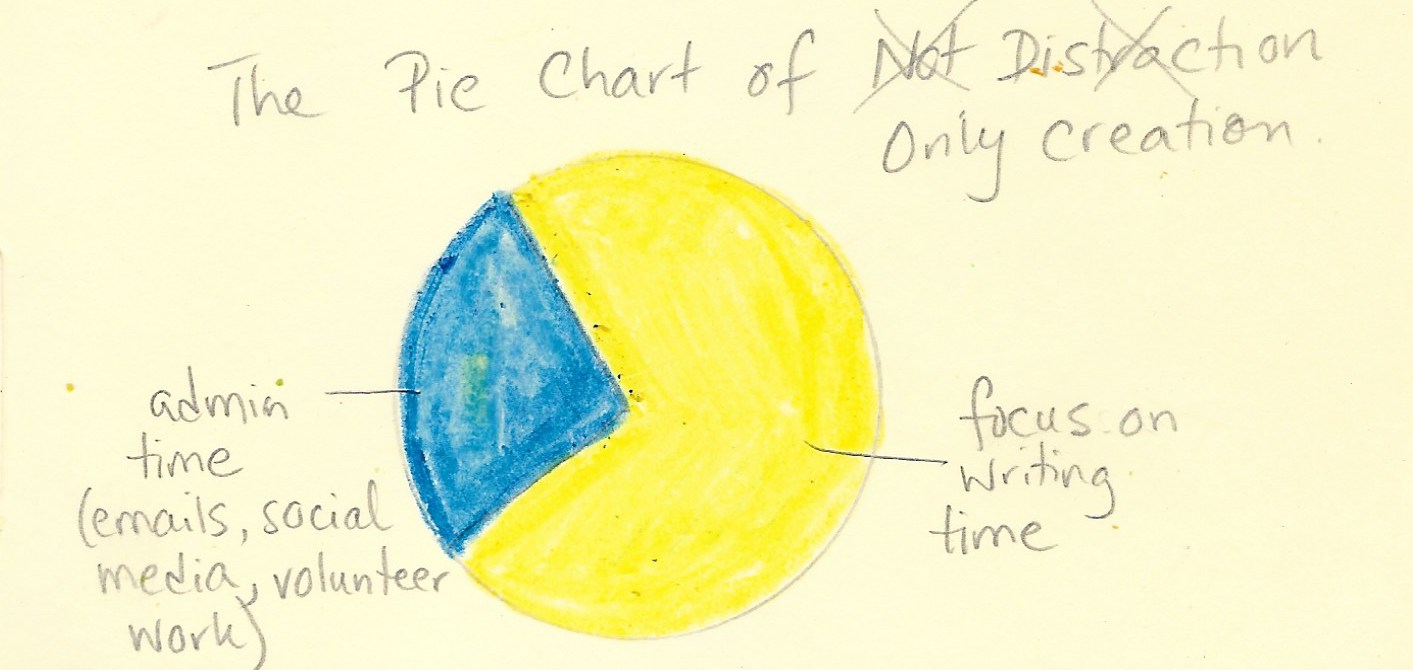
To shift the pie-chart quarters, I am trying to:


1. Be goal-centred, productive and focused in order to get more writing accomplished in a small amount of time

2. Schedule what I will do when. When we don’t have to pfaff around figuring out what to do and can ‘hit the desk running’ knowing what tasks need to be done when, we can be more efficient and waste less time. This is part of the PLAN.

** Block out creative time, day job time, family time and admin time (where I answer emails, do social media and volunteer work in blocks of time which is more efficient than being interrupted all the time).


And if I don’t manage it?


Here’s the thing I’m trying out: Be kind to yourself! There are many days when I don’t succeed in doing what I set out to achieve.


That’s OK. I can adjust. And keep writing.


_______________________________________________________________________


Natascha Biebow, MBE, Author, Editor and Mentor
 
Natascha is the author of the award-winning The Crayon Man: The True Story of the Invention of Crayola Crayons, illustrated by Steven Salerno, selected as a best STEM Book, editor of numerous prize-winning children’s books, and Co-Regional Advisor (Co-Chair) of SCBWI British Isles. She is currently writing more non-fiction picture books and a series of young fiction. She runs Blue Elephant Storyshaping, an editing, coaching and mentoring service aimed at empowering writers and illustrators to fine-tune their work pre-submission. She is also Editorial Director for Five Quills. Find her at www.nataschabiebow.com


Monday, 2 March 2020

To Be or Not to Be an Author? • by Natascha Biebow


Children are curious – they ask me
This question has got me thinking about this vocation
that is being an author:


What's not to like? You get to do something you LOVE 💖

Tell stories all day long.


When the story is flowing, time passes in a jiffy. I feel like I'm in a kind of time warp. When I'm in the midst of researching a new non-fiction picture book, I get really excited by all the interesting new facts I'm learning and have to remind myself where I started and what my end goal is, otherwise I might get stuck down a rabbit warren of (irrelevant) information . . .


Notes for my books have lots of questions

Getting to meet children and seeing them excited about stories too is a lot of FUN too.

Doing messy art with them is EVEN MORE FUN!
 
Messy artwork with Y3 & Y4 at AJS, London - looking at Nature and mixing colours like Edwin Binney

And so is drawing with children –– and grown-ups.


Having an excuse to make an awesome cake (and eat it) to celebrate your book, plus wear a silly hat is . . .

FUN!
 
The most challenging cake I've ever made. Inspired by The Icing Artist.


But being a children’s author is also HARD WORK. Making books requires countless revisions, plus the time it takes to make the final picture book often spans years.

When the story is NOT flowing – or someone else has already pipped you to the post and published ‘your’ story – writing is very TIRING.

(Where’s the duvet?!)

Authors have to be resilient and be prepared to take on board feedback from their peers, their agent, and their book’s editorial team (editor, illustrator, designer, publicist) gracefully and constructively (even though sometimes you want to throw a pillow). Authors need to be prepared to listen and persevere.

Another edit? I thought the book was finished . . .

When I finally finish writing a book, waiting for someone to say they love it as much as I do is very hard. Waiting for a book deal is . . . yes, TIRING.

Getting rejections builds a thick outer skin, but it’s also . . . you got it, TIRING.

Authors are constantly having to come up with new ideas and try to put out our very best work, which is great when it’s flowing, but not so easy when it’s not.

Once published, authors are expected to promote their book. Being on the road for author visits to schools and bookshops far from home can be . . . TIRING.


Cupcakes help.

So, it’s about even – FUN vs. TIRING.
 
But then look at COOL:
Visiting interesting places for 'research' (like inside the Crayola crayon factory). (Amazing!)
Crayola's HQ in Easton, PA
Crayola crayon labels from inside the factory!
Unpacking a box of advanced copies of your book with your name on it. (Oooh, goody!)
Walking into a bookshop and seeing your book on the playbill  . . . (Wow, who me?!)
and being an actual, really actually published author with your name on the front of a book displayed in your uni bookshop . . .

Receiving unexpected and thoughtful gifts from fellow artists:
Tara Moon handmade me this amazing giant box of Crayolas exactly
like the one from she'd kept her childhood, complete with 'worn' crayons!

Meeting readers who are soooo excited to see you and think you are . . . COOL (!), then creating stuff together. AMAZING!
Drawing with all 8 colours
Drawing together in a whole School Assembly in VA
Signing books at your old school for a new generation of readers. Wow! 
At the lower school library EARJ, Rio de Janeiro, Brazil

And for me, making unexpected connections through my book . . .  Here's a story I'd like to share with you: 
ALL SO
But best of all is . . .

Seeing readers reading your book in unexpected places.
 
This girl couldn't wait to read the book --
right near the Easton Farmer's Market where she bought it.

I’d say on balance

I count myself very lucky (even if I can’t yet make a living doing it).

Happy World Book Day! 
________________________________________________________________________________

Natascha Biebow, MBE, Author, Editor and Mentor
 
Natascha is the author of The Crayon Man: The True Story of the Invention of Crayola Crayons, illustrated by Steven Salerno, Elephants Never Forget and Is This My Nose?, editor of numerous award-winning children’s books, and Co-Regional Advisor (Co-Chair) of SCBWI British Isles. She is currently working on more non-fiction and a series of young fiction. She runs Blue Elephant Storyshaping, an editing, coaching and mentoring service aimed at empowering writers and illustrators to fine-tune their work pre-submission. Find her at www.nataschabiebow.com