Showing posts with label Business of Writing. Show all posts

Monday, 26 February 2024

Books and FOREIGN RIGHTS Moira Butterfield

March 7th sees the publication of The Secret Life of Bugs, written by me and illustrated by Vivian Mineker.  It’s the fifth book in a six-book series called Stars of Nature, and it’s published by Happy Yak – an imprint of Quarto. 


The series began with
 The Secret Life of Trees, and I didn’t know it was going to be a series at first. It only grew into one because the foreign rights were sold in many different countries. That meant that the publisher earnt enough from it to justify another series title, and then another and another – until we have ended up with 6 (one will be coming out next year). So foreign rights = repeat business for an author. 


A foreign rights deal – A foreign rights deal means that the contents of a book are licensed to an overseas publisher. I get some money each time a deal is made. In fact, my foreign rights sales comprise the bulk of my income and help in large part to pay off my advances. I’m rather like one of those pop groups that is more successful outside their own land. The reason for this is probably because I tend to write non-fiction, which doesn’t sell in large quantities in the UK. The deal will not be done by me or by my agent but by the foreign rights department of my publisher, using their contacts. This often happens at international bookfairs such as Bologna. I tend not to get sales in South America, Africa or Scandinavia (I don’t know why but I think this is pretty standard for UK books) but I do get sales in the rest of world. These can often be in quantities of 5,000 or 10,000, with repeat orders made if the books are successful. 


Translation – Once a book is sold abroad it will be, in many cases, translated. I won’t get to see or check the translation as I have no way of doing that, so I trust the translators. 


Contract – When I sign a contract for a book there will be sections in it about foreign sales – and the percentage cut I get from the deal. I freely admit that these figures are very confusing for me, and I should be much more knowledgeable about them than I am. There will usually be terms such as export salespercentagesforeign language royalty inclusive sales percentages and nominated printer foreign sales percentages. I rely on my agent to check them but I could also ask the Society of Authors to do so, as I am a member. If you need to check these things yourself, do look into becoming a member of a professional body which offers this service to you. 


Selling your own rights – Some authors will retain translation rights (eg, when self-publishing, for example) and might employ their own foreign rights agent to sell for them. I’ve never been involved I this, though, as traditional publishers are likely to want to do it themselves. 


So selling around the world is a crucial way to make a living in kid’s books, but how can you help it along? 


Make your content international – You can make sure your content is very clear and strong, so it appeals to all. And avoid including parochial things unless they play a strong part in your concept. For example, if you were writing a picture book specifically set in New York you might well add a yellow taxi, or if it was in London you might add a red bus. But if your book was more general (say, about colours, for example) you’d need to avoid mentioning that specific location-based colour of taxi or bus.  The colour might well be completely different in another country (this particularly applies to fire engines btw!). 


Be on instagram – You can’t do publicity around the world in lots of different languages, but you can be present on Instagram to respond to people who mention your books in different countries and tag you in.


Check out your publisher's foreign rights plans - If you are lucky enough to have a choice between publishers, you could ask them about their foreign rights plans. Not all publishers are equal in this respect. Some are much more pro-active than others. 


Find good homes for your copies – I get copies of different language translations sent to me contractually. I give them to people if I can. Recently I’ve been able to give to Ukranians, Bulgarians and Malaysians living in the UK, and friends with French family. It’s always a joy to receive copies and then to give them on in this way. 


Remember that kid’s publishing is a highly international business, and you may find your work being offered to kids in many nations. I can tell you it’s a massive BUZZ! 


Moira Butterfield is an internationally-published childrens’ author specialising in highly-illustrated non-fiction and picture books. Her Stars of Nature series grows this year with The Secret Life of Bugs (Happy Yak) and she has a brand new title – Does a Monkey Get Grumpy? - out with Bloomsbury in May. August sees another in her Look What I Found series and August sees Welcome to Our Playground – the follow-up to her bestseller Welcome To Our World (Nosy Crow), which as has sold in 16 different languages. 


Moira Butterfield

moira@moiraworld.co.uk

twitter @moiraworld 

instagram and threads @moirabutterfieldauthor


Monday, 22 August 2022

Surviving difficult projects - advice by Moira Butterfield

Film adaptions are famously long-winded and difficult. There’s even a phrase for it – development hell. According to Douglas Adams: 

“The Hollywood Process is like trying to grill a steak by having a succession of people coming into the room and breathing on it.” 

For writers it’s notoriously soul-destroying. The processes in children’s book publishing aren’t that bad, thank goodness, but it may not all be plain-sailing from contract-signing to publication and it can be difficult to maintain enthusiasm for a writing project when it goes through difficult times. After the initial joy of having a book accepted, there may be many rocks to navigate and perhaps some becalming, too. 


Examples of reversals a writer might encounter


* An editor wanting you to rewrite parts of your content, perhaps even more that once.  

* An editor leaving and your project going into temporary limbo. 

* New staff arriving and wanting to shift the focus of the project. 

* Changes from an international publisher wanting to buy rights, but only if you play ball. 

* Delays while an artist is found. 

* Delays you just don’t grasp due to lack of communication.  


I am giving you a list of worse scenarios here to show you that all these things can occur to all writers at some point, and if they happen to you – well, you are not alone. Many of your fellow writers will recognise the situations and sympathise. 


My suggestions 


Redevelopment – Get it clear in your mind what the editor is saying they want. If it’s not clear then ask them to make it clearer. Discussing it with them face-to-face will greatly help here. 


Be flexible and open-minded. Think around the suggestions being made. Are they a good idea? Is there another solution you think might work better and that you could both think about? Be as positive as is possible. You’re working together to make the work great. 


A good thing here is to rewrite your brief for yourself. What was your initial idea? What were its strengths. What were you writing it for? Reconfirm these things to yourself to reinforce your confidence in your decision.  


Keep all emails so you have a development trail of what’s been asked of you. If things change a great deal over and over again (Yes – actual development hell occurs) you are perfectly justified, and it’s professionally acceptable, to ask for more money. 


If it comes to the point where you think ‘no this is not what I want’, then say so calmly and logically along with your reasons. Your editor might agree with your points after thinking about it. If not, then it’s time to move the project to someone else. That is a positive thing to do for your project. It’s not your failure. Shut the door on development hell


There’s not much to be done about delays but don’t be hesitant to communicate with your editor and ask them what’s going on


Difficult projects can really take a toll so take care of your mental health. That means remembering that you are creative, for example, by taking time out to play and by working on other things. 


Do what you need to do to look after your head. (pic: my friend John Miles
found someone meditating on the top of Glastonbury Tor last week)  


 Also please, please remember that you are not alone and even the most famous writers have setbacks. Reach out to your friends in the writing community. They will understand your feelings better than anyone. 


Writing is hard and sometimes the process of publishing makes it harder. That’s the simple truth of it. Be ready but be positive, be open-minded and be true to what you are aiming for.   


Moira Butterfield is an internationally-published author whose Nosy Crow book Welcome To Our World has just been translated into its 15th language. Her newest book – Sometimes I’m a Baby Bear, Sometimes I’m a Snail (|Welbeck) aims to give young children tools to express their feelings. 


Moira Butterfield
moira@moiraworld.co.uk
www.moirabutterfield.co.uk
twitter @moiraworld 
instagram @moirabutterfieldauthor

Monday, 15 March 2021

Can I REALLY be a real writer? FOMO is slowing me down • by Natascha Biebow


I have been telling stories since I was small. 


I told stories to anyone who would listen, especially the dogs!


As a kid, we used to go on long car journeys to the south of Brazil, and I’d babble on, creating all kinds of shenanigans for my fictional characters. My grandmother lived in England, so I’d send her recorded tapes with songs and stories in the mail (in times way before the internet was invented). 


A creative writing assignment in school? On it. 


This is a whole 'collection' of short stories written in school,
loving saved for me by my mother.


A short story about a cup and a saucer - who is more important?

 Poetry competition for the school newsletter? Yes! 


I used to write poetry even. Not now!


I loved to write, but I never imagined I’d actually be a published writer when I grew up.


Like many writers I know, there is no shortage of stories we could invent or tell. But when it comes to wondering if we’ll ever get them put inside a book that will land in the hands of other readers, children, often DOUBT sets in. Even if we are published, we doubt we can do it again . . . and even another time.


I’ve been pondering this.


I can draft a story no problem. In fact, I have drawers full of stories (metaphorically speaking, of course – they are all filed on my computer, a folder for each one, many drafts in each folder . . . ). My agent and I send out the most polished ones. And we wait.


But, here’s where the problem begins. WAITING. The silence while publishing grinds its wheels starts to conjure up DOUBT again. Will anyone ever say ‘yes’?


And then there are all those other writers who are doing so well – I hear and see the noise at events and on social media – successes celebrated, reviews, awards, new books launched . . . all seemingly much faster than I can get my next one finished and signed up. I’m thrilled for my fellow writers, I really am, but still, DOUBT is a mean spiral of negative thoughts that escalates, question after question:


Should I be doing something I’m not?

Am I missing out?

Why is it not happening?

Should I be submitting there instead or to this or that competition?

Should I be writing something else?

Should I spend more time marketing my book or writing a new one or . . .?

But I already have so many stories, should I be  . . . ?

What if . . . what if . . . what if . . .?

Maybe I should dig out that novel, but I’m halfway through this picture book and that idea and . . .  What to work on? What do those editors want anyway?

PLUS I really need to earn an actual living, so I’d probably better focus on doing that.


THEN I start to make excuses for not writing:


I don’t have enough time.

I’m busy homeschooling and juggling so much right now, I really don't have the headspace for writing a great book at the moment.

I’ll just clean the house and then I’ll write if there’s time.

I can’t write that book right now.

Someone else has probably done that already.

If I don’t send that story out on submission, it can’t get rejected.

I just got a rejection, maybe I should take a little break.

I don’t know how that story ends . . .

Maybe I was only ever meant to write one book?!

Maybe I’ll just bake some cookies and think about my story instead.

I’ll never earn enough from my writing.


Oh my goodness. STOP! BREATHE!


FOMO (Fear of Missing Out) is taking over my head (and my heart).


I need a new story.


I need to remember to start THINKING and ACTING like a writer:


First, I need to remember – everyone has their own journey and this is mine. I will never be a series fiction writer churning out books quickly. I will be a book-every-so-often-that-is-inspired-and-cooked-over-time kind of author.


I start by breathing and being grateful that I am this kind of writer.


Sometimes, it can take a bit of time to figure out where you fit and to be OK with this, not trying to pigeon-hole yourself to be like others. FOMO doesn’t serve me well, I’ve realized. The slot for someone else won’t fit me comfortably. THERE IS SPACE FOR EVERYONE.


Next, I make two columns:


- how long editors take to consider submissions
- rejections (it might be the wrong manuscript at the wrong time; it’s not necessarily always about me or the story.)
- how much publishers will pay for a book and/or put in for marketing spend
- what other authors are doing
- the current state of the marketplace and trends
- what kind of writing I write


- bum on seat – commit to writing on a regular basis and stop making excuses for why I don’t have enough time to write. I need to put it in my diary. I need to plan ahead for the time I will write so that I’m not wasting time ‘preparing’.

- take webinars and courses to keep learning and improving my craft. There are some great free and low-cost webinars that can help me learn from other authors, illustrators and publishing professionals. I’ve been enjoying the great interviews on the weekly Kid-Lit Distancing socials

- be active in a writing community like SCBWI to find support, learn new skills, and make connections that will stand me in good stead when my next book comes out
- get critiques of my work – join a critique group or pay a literary consultant for their expert objective eye
- read lots of mentor texts - aloud

- keep an eye and an ear on what is going on in the market, but limit social media so it doesn’t become a distraction 

- spend time with children who are my audience and observe

- be brave and be prepared to re-think and re-visualize books that have been rejected; re-write! and reconnect with my vision
-  reach out to librarians and teachers to make new connections to promote my published book

- stop waiting for an editor to say yes and write more books so I have some on the back-burner while others are on submission

- research my new book ideas and reach out to experts

- look out for 1-1 or competition opportunities


Most importantly, I realize I can take control of the ‘no’ – either the rejection letter or the nearly, not quite feedback from editors – and choose how I will react. Will I let DOUBT set in with its breathless questions bringing on inertia and excuses, or will I look at my list of actions I can take and get stuck in and make a start?


LOOK! The list of things I can do is soooooo much longer than the other list, though arguably, the weight isn’t quite equal in that ultimately, we are all waiting for an editor to say ‘yes’ to that project we are passionate about.


It’s like any problem: it needs chunking down


Then, perhaps, the process of being a ‘real’ writer begins to look more achievable.

Plus, I am a storyteller, after all, so I’m going to weave a story around this. Once there was a girl who dreamt of becoming a writer with lots and lots of books when she grew up. But . . .  there were many obstacles in the way. Does it have a happy ending? Only the author can write THAT story.  


 ______________________________________________________________________________________


Natascha Biebow, MBE, Author, Editor and Mentor

Natascha is the author of the award-winning The Crayon Man: The True Story of the Invention of Crayola Crayons, illustrated by Steven Salerno, winner of the Irma Black Award for Excellence in Children's Books, and selected as a best STEM Book 2020. Editor of numerous prize-winning books, she runs Blue Elephant Storyshaping, an editing, coaching and mentoring service aimed at empowering writers and illustrators to fine-tune their work pre-submission, and is the Editorial Director for Five Quills. She is Co-Regional Advisor (Co-Chair) of SCBWI British Isles. Find her at www.nataschabiebow.com


Monday, 27 July 2020

Writing (Picture Books) As a Business • by Natascha Biebow

I have a dream – to write more and earn enough to write more and so on. So, I’ve been reflecting on how other writers manage to do this.


The trick, it seems, is not just bum on seat time writing, but either enough publishing contracts to create an income stream, alongside potential earnings from backlist titles, or even a bestseller to earn big bucks. Maybe it’s something in-between?


The main question remains: how to get the books (or content) you write and create to actually sell to a publisher in the first place? Obstacles:


-       Frequently, you have to write many books – or creatively re-visualize the ones you’ve written so they actually sell – before a publisher says ‘yes’ and you have come money coming in.

-       Some books, especially non-fiction or longer novels, take a long time to write. Meanwhile, you’re not earning money.

-       Submissions take so much time to get a response! In the meantime, again, you’re not earning any money . . .


Most business people have a PLAN. As entrepreneurs, we are writers, creators of content, editors, marketeers, accountants, PR experts and more. Possibly, a business plan might look something like this:


1. MAKE WRITING A HABIT  


2. CREATE A BODY OF WORK


3. DIVERSIFY YOUR INCOME STREAM


4. SELL MORE BOOKS/CONTENT


Repeat!


Part 1: MAKE WRITING A HABIT 

Show up for work!


OK, so once you decide to try to make a go of writing to earn a living, how do you survive in the interim? Don’t give up the day job yet (in my case, editing), because you need to pay bills. But maybe try to consistently dedicate a few hours a week to writing. Gradually try to shift the balance between different kinds of paid work?


Part 2: CREATE A BODY OF WORK

Make products that could generate income.

I can do this. I can definitely visualize lots of books I’d like to write, that I’m excited to create. Great!


Except for the fact that just creating books doesn’t earn enough money to live off – yet. So, while waiting for those to hook in an editor . . .


Here are some things other authors are doing to try to generate a more steady income:


• Work on LOTS books at once (some authors work on up to 10 picture book or non-fiction projects at once). This might help increase the probability of the right book finding the right editor at the right time, but the chicken and egg conundrum around this that I wrestle with is:


How to spend time on so many projects when you need a day job to live? There are not enough hours in the day . . .


• Write for different types of publishing markets – e.g. work for hire, magazines, educational materials. Arguably, this doesn’t pay as well as if you sell your book on an advance and royalty deal, and sometimes these jobs can be hard to come by. Bt maybe if you are able to land some, enough of these jobs could be good ‘bread and butter’ money to start to shift the balance?


No one said it would be easy!


Part 3. DIVERSIFY YOUR INCOME STREAM 

Get creative with your content and talent to generate additional income


• For many working authors and illustrators, fees earned at events like festivals, school and library event appearances are a great way to supplement their income. Plus it’s super-important to be visible, connect with readers and promote & market your book and it can be a good earner if you’re willing to put in the time and travel.


• I can also offer workshops to schools and to other writers/creative for a fee.


The key to this is figuring out what unique skills you have and how you might be able to market them to schools, libraries, writers, etc. Then, if you can get enough gigs, you could start to supplement your day job (and, if relevant, any current book sales) income in other ways such as teaching, workshops, and appearances.


Part 4: SELL MORE BOOKS

Promote sell promote sell promote sell  . . .


Once you do have a body of work, you need to sell more copies – and keep them selling over a longer period of time! HOW?


-       Keep meeting people who you can tell about your book


I’ve been doing this by making it my goal to reach out to people who might be interested in my book every week or so and offering to connect with free content. Who?


-       Bloggers and Podcasters (and other influencers)

-       Booksellers

-       Teachers and librarians

-       Reviewers

-       Fellow authors and illustrators


Recently, I’ve been doing some virtual visits for free to promote THE CRAYON MAN with the aim of selling copies of the book to attendees.

You can create free content such as videos, activities, educators' guides and similar to support this endeavor.


But this again takes time – less time to write and create new content . . .

So, how to advance beyond this circular conundrum?


I don’t have the answer, but I am persevering.


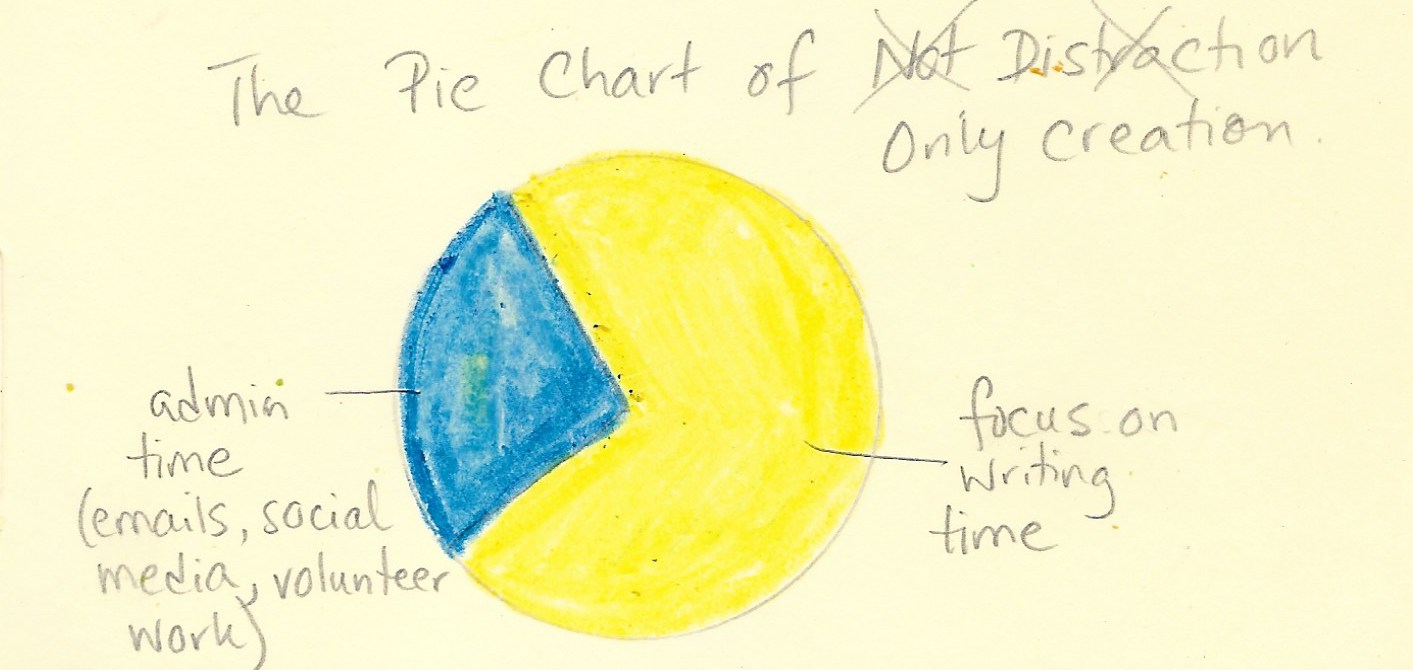
To shift the pie-chart quarters, I am trying to:


1. Be goal-centred, productive and focused in order to get more writing accomplished in a small amount of time

2. Schedule what I will do when. When we don’t have to pfaff around figuring out what to do and can ‘hit the desk running’ knowing what tasks need to be done when, we can be more efficient and waste less time. This is part of the PLAN.

** Block out creative time, day job time, family time and admin time (where I answer emails, do social media and volunteer work in blocks of time which is more efficient than being interrupted all the time).


And if I don’t manage it?


Here’s the thing I’m trying out: Be kind to yourself! There are many days when I don’t succeed in doing what I set out to achieve.


That’s OK. I can adjust. And keep writing.


_______________________________________________________________________


Natascha Biebow, MBE, Author, Editor and Mentor
 
Natascha is the author of the award-winning The Crayon Man: The True Story of the Invention of Crayola Crayons, illustrated by Steven Salerno, selected as a best STEM Book, editor of numerous prize-winning children’s books, and Co-Regional Advisor (Co-Chair) of SCBWI British Isles. She is currently writing more non-fiction picture books and a series of young fiction. She runs Blue Elephant Storyshaping, an editing, coaching and mentoring service aimed at empowering writers and illustrators to fine-tune their work pre-submission. She is also Editorial Director for Five Quills. Find her at www.nataschabiebow.com