Wednesday, 19 September 2012

Whose story is it anyway? Collaboration in Life, Launches and Books (or Question: How do you get from a song about roller skates to The Kite Princess? Answer: With help) -by Juliet Clare Bell


The Kite Princess has finally come out, three-and-a-bit years after it began its life.
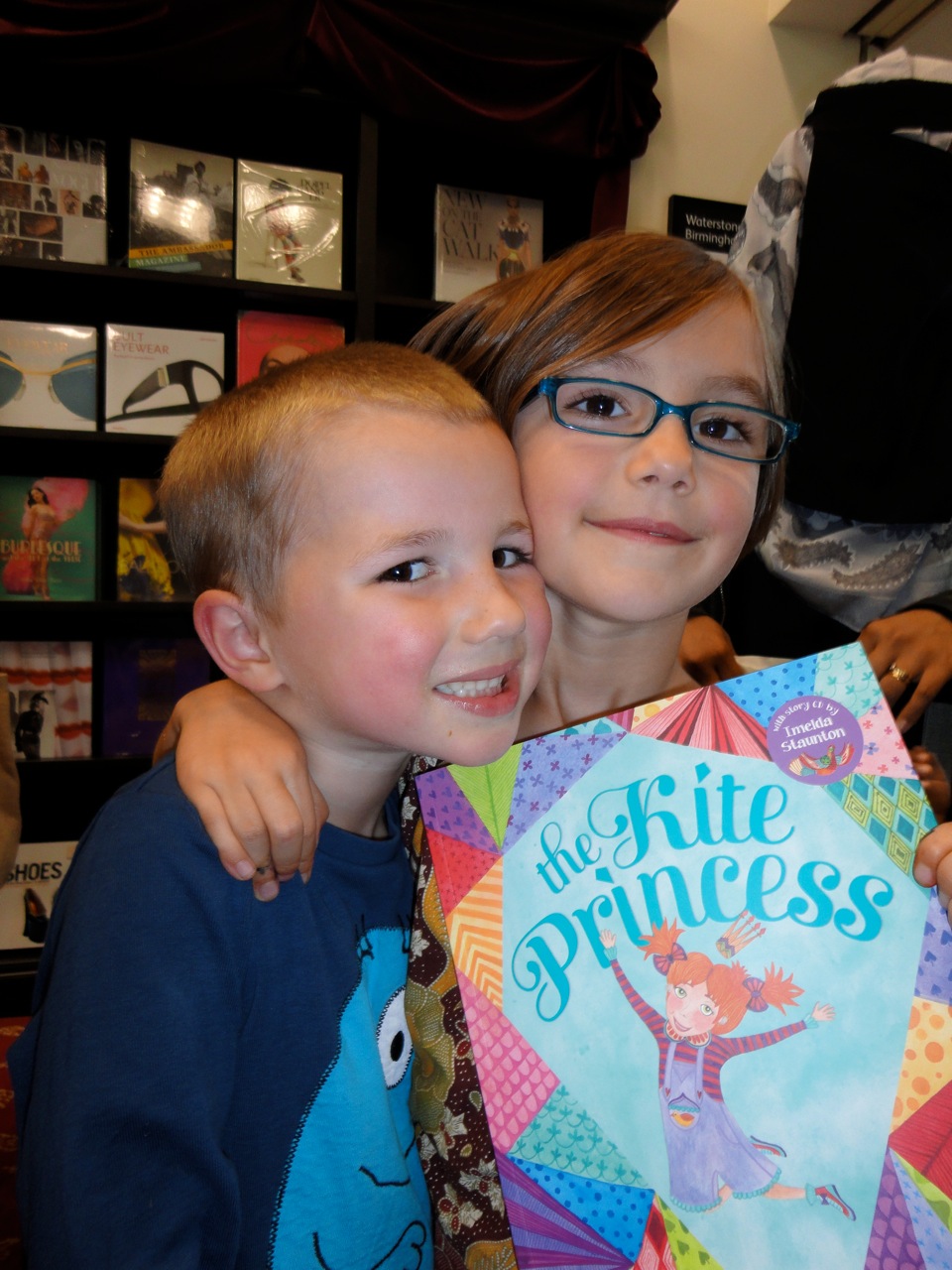
It’s been a long process and I want to talk about the collaborative nature of writing –not because I’m going to do a Gwyneth Paltrow Oscar speech...

"...and I'd like to thank my granny and my cat and the milk man.... and... who wants me to stop talking and get on with reading the book...?


"...Oh ok, then..."

but because I think it’s important to appreciate how we arrive at things. It’s great to acknowledge all the people involved. It’s also useful to debunk the myth that we do it on our own, as it then frees us up to make the most of everything and everyone surrounding us.

Ok, perhaps that doesn't extend to STEALING your daughter's own picture book (but it is very good...)

First the bit about the book. Then the launch.

People are often surprised to find that writing can involve a lot of people. It's not always the lone writer, scribbling away in isolation. For me, at least, it involves/is influenced by, lots of people (including the sleeping four-year-old with his feet on my legs as I write this in bed in the early morning...).

The characters in the story behind The Kite Princess story…

It started with a name… I got an advert through the door for a local card company. On one side in fancy writing it said Cinnamon Aitch. I (mis)read it immediately as Cinnamon Stitch and had that frustrating moment when I realised that someone else had got there first. Cinnamon Stitch would have been a great character –I instantly loved the name, but I couldn’t possibly steal it from a local company. I read it again. It was Aitch, not Stitch! I could have Cinnamon Stitch for a character! (Thank you Cinnamon Aitch for using that font. And the connection between the two Cinnamons is even sweeter now that I’ve discovered I know Sarah –co-founder of the company- as a mum at my children’s school.)

Cinnamon Aitch with Cinnamon Stitch...


So Cinnamon was born. And she already had an emerging character, but no story –yet.

Enter Addy Farmer, friend and SCBWI member extraordinaire, who’d arranged a series of talks/workshops with people in the writing industry. (Have I ever mentioned SCBWI before? Hmmmn. Note for anyone wanting to write or illustrate: join it.)
(Addy's the dead glam one, third from the right, along with her fellow Notes from the Slushpilers)

I immediately signed up to one with Tessa Strickland, co-founder and Editor-in-Chief of Barefoot Books, in June 2009. Towards the end of the talk, someone asked her if there was anything that she was particularly looking for at the moment. Tessa responded really specifically (thank you, Tessa –and note to writers, it is well worth asking this question):


She would really love a companion book for Portside Pirates (which was sung to a vaguely familiar tune)- an exciting story, to a song, about a princess.

I quickly dismissed the idea (I couldn’t imagine writing a princess story and anyway, whilst we were chatting, I'd just agreed to send her something else). But over the next few days I thought some more. Why not write one with a difference -where the feisty young heroine wanted to free herself from all the constraints of being a princess? At this point, Cinnamon Stitch came to mind –she’d be feisty –and stitching her way out of her situation…? The name fit…. And setting the story to just the right song (it would have to be in the public domain; shouldn’t be too well-known but still recognisable)? What a great challenge...

I loved going through loads of songs to decide which might work best (I’d done something similar for our wedding, where I’d put old poems that I’d always loved to various songs that were now used as hymns). I pored over nursery rhymes, traditional songs, including the ones my Irish father used to sing to me at bedtime as a child. I’d considered and dismissed ‘A Frog He Would a Wooing Go’, along with countless others, but a friend suggested it independently as we chatted with our small children crawling around the floor (thanks, Nicola Smith), so I reconsidered and decided that this was the one, and I got writing, a week after the meeting.

Cinnamon Stitch became a song about roller skates to the tune of A Frog He Would a Wooing Go:
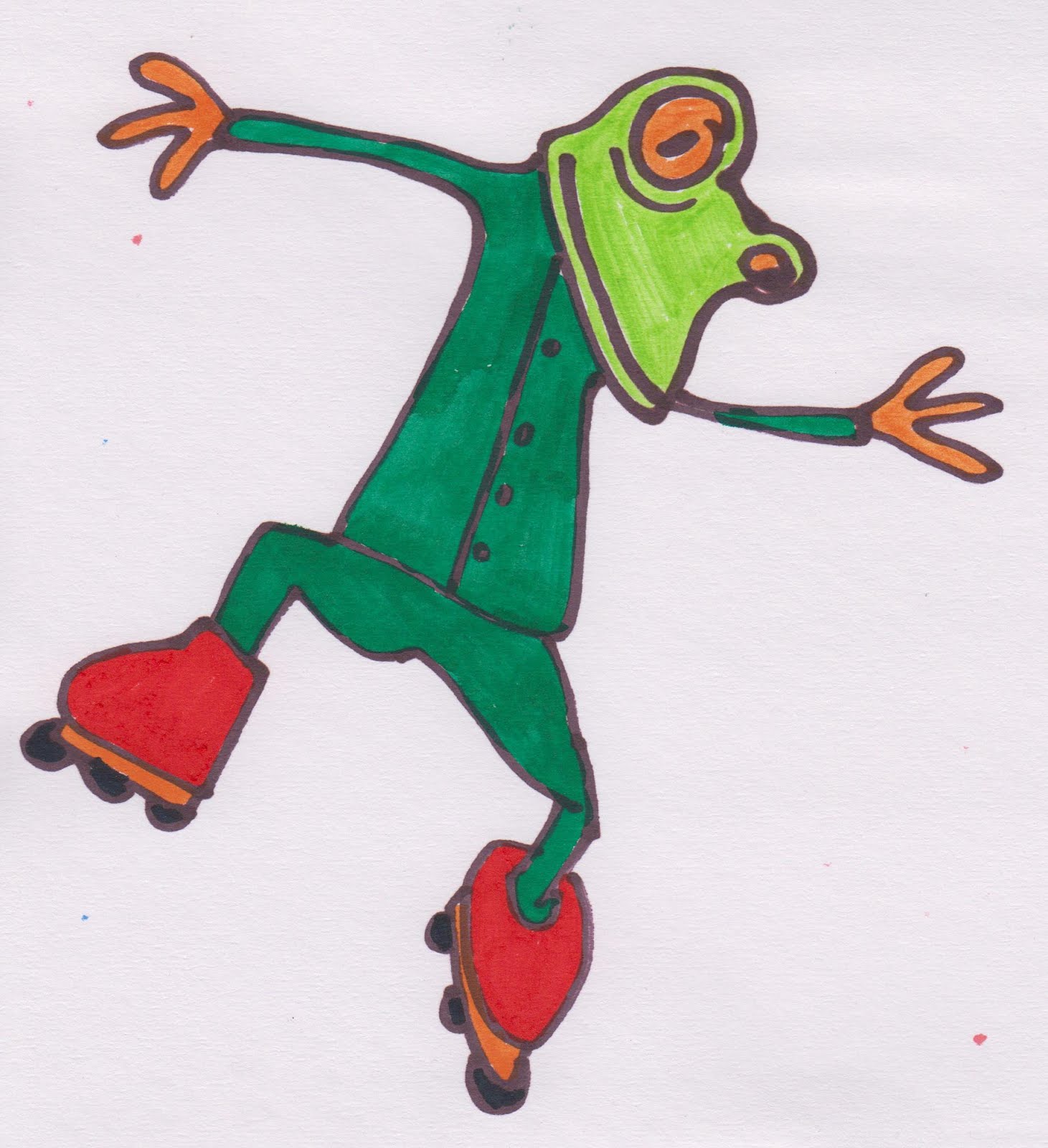
(I love the internet: I put in 'roller skates' and 'frog' and found a picture to copy. Badly. The proper one is (c)Julos)

It was such a jingly jangly frock (‘Hey, ho’ says Roly), It was such a jingly jangly frock,
But if they’d known why, they’d have had such a shock! (With a roly poly gammon and spinach, ‘Hey ho!’ says Anthony Roly.
She joined all her friends at the great Palace Gates/ They all worked together and made... roller skates!
This really was such a magnificent scene, /Until they were spied by the King and the Queen,
Poor Cinnamon knew that they’d make such a fuss, /Instead, they asked “Please could you make some for us?”
They’re all happy now and they’re less stuffy, too,/They went for a skate and their world grew and grew…

(An extract from the original manuscript I sent to Barefoot)

I sent it to Tessa in July and she got back to me in August, saying she liked the story but that two things needed to change (only two?). First, the refrain needed to be made personal to the song. So:
With a roly, poly gammon and spinach,
‘Hey ho!’ Says Anthony Roly.

Became
From her royal bows to the tips of her toes,
Hey ho! She longed for freedom.


Not too hard, but what about ditching the roller skates (which Cinnamon had made sneakily under everyone’s noses, with tools sewn into her dresses) for something more dramatic?

I had fun trying out other possibilities – making a sail for a boat? galloping into the wind? floating off in a home-made hot air balloon…? It was the balloon that made most sense to me... I’d briefly considered a kite but had just as quickly dismissed it on the grounds of health and safety (would they let me have a child floating off on a kite?) and a vague memory of an old Iain Banks novel. But then:


Mark knew a good idea when he’d had one, and soon I’d turned it into my idea (it’s hard to incorporate new ideas until they feel like your own) and began the rewrite.
I rewrote and sent the manuscript to my great critique group and critique partners (who are always part of the collaboration. Fortunately I had American, as well as English, critiquers, who could help me with cross-continental rhyming issues, since it would need to be suitable for both markets –

which ones rhyme for you?

I removed the plait (I had wanted her to snip it off and use it for a kite string), made some more changes and sent it back. Barefoot liked the story/song and in January, 2010, I signed my first ever book contract for what was now called The Kite Princess (and thanks to my newly found agents, Celia and James Catchpole who were also now part of the mix).

My children posting off my first ever book contract.

Yippee! (as Cinnamon would say). I started to learn the song on my guitar –I’m an almost complete beginner so it was taking a while...
(and no one but a dog with a tennis ball for a foot could bear to listen)...
but I wanted to be able to sing it in schools…

Anyone who has read The Kite Princess will know that it is not a song. A few months after signing, it was decided that there’d be more possibility for sequels if it weren’t a song, so it was back to expanding, rewriting and resending to my critique partners.

The bit that most readers of picture books think is the truly collaborative part is probably the least. As Malachy Doyle said in a recent Picture Book Den post, authors and illustrators very rarely work together and everything goes through the editor or art director. So without ever having had any contact with her, Laura-Kate Chapman started work on turning my manuscript into our book.

Early sketches of Cinnamon (c)Laura-Kate Chapman

(c) Laura-Kate Chapman

(c) Laura-Kate Chapman

(c) Laura-Kate Chapman

When a picture book is done well, it ought to feel like it’s been a collaboration between author and illustrator –and I hope ours does. It is, of course, also the work of many people at Barefoot, including Sarah Morris, so huge thanks to everyone involved there. And an enormous ‘YIPPEE!’ to Oscar-nominated, multi-award-winning Imelda Staunton, who narrates the story in the accompanying CD. It’s fantastic to have her read this alongside her recordings of The Gruffalo, her performances in Harry Potter (scary Professor Umbridge) and numerous other films and plays.
Imelda Staunton recording The Kite Princess for the accompanying CD.

But of course the involvement in a book also includes the readers/potential readers. If it gets read lots, borrowed lots from libraries and bought lots from shops, online and real, then everyone who buys and borrows it will be collaborating in Cinnamon’s fate.


Who knows, we might yet get to write/illustrate/read about her new adventures currently playing about in my head but desperate to pour onto the page to be brought to life beautifully by Laura-Kate Chapman.


Is the excitement or feeling of achievement dampened in any way by knowing that lots of other people played a part in it? Does it feel less like my story because other writers had suggestions about it that I took on board? Do I feel like a fraud because my husband was the one who came up with the idea of it being a kite –which is of course so central to the story now? Absolutely NOT. As a writer, you get ideas from everywhere and you’re the one who sifts and considers and decides what goes in and stays out. And crucially, you’re the one who writes it. I love life and that we are inherently social creatures and that we affect and are affected by other people, all the time, in millions of ways. And having other people influence -in whatever way- how I tell a story (and vice versa when I critique other writers’ stories), just means that when something works out and gets published, there’s an even bigger cause for celebration. And more people to celebrate with.

(c) Laura-Kate Chapman.

So onto the celebrations!

Huge thank yous to the people involved: the fantastic staff from Waterstone’s in Birmingham, particularly Chris, the deputy manager, provided the venue, set everything up, stayed way beyond closing time to sell more books, were extremely helpful and lovely and cleared everything up at the end. Crucially, for me and for my SCBWI critique group, they also provide us with space every six weeks for our critique group to meet -so they’ve played a significant role in my first two picture books, both of which were critiqued in the very space where the launch was held!

Half of my body appears to have disappeared... (half of) the man who made it happen. Chris, deputy manager, hidden in the background.

Lauren Guthrie of Guthrie and Ghani, a local and online haberdasher’s in South Birmingham, made a wonderful cloth kite with the children.

This will be flying high in the children’s department next week alongside copies of the book, thanks to Ben (head of the children’s section).

Laura-Kate Chapman, the book’s illustrator, whom I’d never met until the launch itself, drew beautiful pictures with the children of people, kites, owls, monkeys and all sorts of other weird and wonderful things.


‘She looks so fancy!’ said one of my children, in awe, after she'd met Laura-Kate. They are not used to seeing their mother looking young, glamorous or ‘fancy’.

And not forgetting a certain small, wonderful six-year-old who took the bold step of reading the book in front of everyone. And who better to read the book than my very own Cinnamon Stitch who loves to get dirty...

and climb... (Warning: don't try this at home... Unless you're a spider)


(Now I know why my children insisted on my wearing ‘the dress that you can hide under’ as opposed to the one that I'd actually bought for the launch...)

Sadly the video of Esther reading the book didn't come out -it was a fantastic reading- but I'll post a new video of her reading it when we've made it.


And of course, a launch wouldn’t be anything without the amazing people who come to it. Everyone who turned up brought something special, unique to the event, and everyone gave up doing something else in order to be there.


It was a wonderful night and one that I’ll always remember. And many hands made light work…

Thank you -for reading and to everyone who was involved in the book and the launch, including those who stepped up and took photos when the two photographers weren't able to come (Candy Gourlay, Donna Vann, Margaret Bell, Joolz Richards, Mike Safo). Huge thanks to Rebecca Colby -my long time critique buddy, and to my Birmingham critique group. I'm going to stop before I start blubbing... I love you all....

Click on the links for tips on how (not) to write a rhyming picture book; editing your manuscript and making the most of feedback. I'm also doing a picture book writing workshop as part of Birmingham Book Festival on Saturday 13th October. www.julietclarebell.com

Tuesday, 11 September 2012

Do Picture Books Have To Tell A Story? By Pippa Goodhart

My most successful picture book so far is a book called You Choose, illustrated by Nick Sharratt.  It is a picture book that sits on the fiction shelves, and yet it doesn't tell a story.  It was because it didn't tell a story that nine publishers rejected it before Random House took it on.  But must a picture book always tell a story?

 
When a text has been rejected nine times, and when the publishers all agree on the perceived problem with the text, and your agent agrees with them, it is usually time to put that text aside, and move on.  But I believed in the idea of this book too much to do that.  Having watched three daughters and their friends looking through catalogues and happily choosing things that they knew they'd never actually get, I knew that at least those children loved the game of choosing.  And, since the point of the choosing didn't seem to be necessarily then acquiring whatever was chosen, I felt sure there was fun to be had in offering choices that were totally fictional.  So a child can choose to live in a pink fairy tale palace, or a tree house, or a mushroom, or any of the thirty-two different kinds of home on offer.  They can have Santa or a wizard or a Viking, or any number of other kinds of people (many of them ordinary) as their father.  They can choose twins, an alien, a giant, or all sorts of others as siblings or friends.  Pets, places, clothes, jobs, foods, and so on; there is a mass to choose from.  And over the eight years that You Choose has been around its sales have risen and risen, and it's even winning prizes, which is lovely.

Now Nick has again spent literally years in illustrating a new book along a similar theme.  Just Imagine came out ten days ago. 


This time, instead of choosing things, you choose to change yourself.  What if you were made of jelly or cheese or were a balloon or a ghost or a robot?  Now we're getting into really imaginative territory.

 
Nick's pictures are full to bursting with ideas.  What would you like this machine to be doing or making?


Neither of these books tells a story, but it is clear from the reactions I've had to both of them that they are fich with story potential, and that all sorts of stories - serious ones, funny ones, sad ones, exciting ones, nonsense ones - come out of them.  Not my stories, but the children's own stories.  I find that exciting.  With over a million copies of You Choose out there, being shared and chatted over, I hope that well over a million stories have brewed in children's minds from the ingredients it offers. 

What particularly excites me about Just Imagine is that the protagonist in the stories that come out of this new book will almost certainly be the children themselves. 


Friday, 7 September 2012

Using The Five Senses To Inspire Your Writing - Lynne Garner


A few months ago I was asked to create a new course for WOW (Women On Writing) as a follow on for my beginners course 'How To Write A Picture Book And Get Published.' It was decided we'd set a challenge for our students, to write five books in five weeks basing each one on one of the five senses.

In order to help support the students I started researching the five senses. Also as part of that research I asked my writing friends how they'd used the five senses in their stories. These are just a couple of the replies I received:   

A story inspired by sight: 

Written by Pippa Goodhart and illustrated by Andy Rowlands.

The story as described by the author:

"Little Nelly's Big Book plays on the lack of any pictures in her big book. Little Nelly is an elephant, but the description in her book of a mouse being grey, having big ears, and having a skinny tail, leads her to the conclusion that she is a mouse. So she tries to make herself at home with a family of mice. When her friend Micky, who really is a mouse, reads the description of an elephant (exactly the same attributes as the other one) he concludes that he's an elephant, but they decide they can still be friends, even though they are different.

Quote kindly supplied by Pippa Goodhart (visit Pippa's website).

A story inspired by sound:

Written by Jane Clarke and illustrated by Chrystyan Fox.

The inspiration behind the story as described by the author:  

"Creaky Castle was inspired by a childhood sleepover in a creaky old house. My friend and I stayed up all night, terrifying each other by suggesting what the noises we heard in the house could be. The text began with ideas for lots of spooky noises, and what could be making them, and developed from there into a funny rhyming picture book."

Quote kindly supplied by author Jane Clarke (visit Jane's Website)

A story inspired by smell:

Written by me and illustrated by Mike Brownlow

This story was inspired by the many dogs I've shared my life with, the occasional smell the create, mixed with the words our family will utter when this happens, "Sorry, the dog did it!"

So next time you're stuck for an idea why not use touch, taste, smell, sound and sight to inspire you. You never know where it'll lead you.

P.S.
If you're a writer and have a book inspired by the five senses I'd love to hear about it. And with your permission I'd include in the reading list of my course.

Lynne Garner

Unashamed plug for my distance learning writing eCourses that start 6th October 2012
How To Write A Picture Book (six week course)

Friday, 31 August 2012

Edinburgh Book Festival, authors, children and a few Wallys

 
The Edinburgh International Book Festival (EIBF) has just finished.  For the last 18 days authors of all kinds of books have been speaking in Charlotte Square gardens to audiences of all ages.

 I was delighted to be taking part in the festival again this year. I ran a workshop on Writing for Children and quite a few who attended it were keen on writing picture books. 

Hamish McHaggis and Writing for Children on display at EIBF
 
 After the workshop there is the opportunity for people to come along and speak to me and ask questions that they may not have managed to ask during the workshop, also perhaps to buy a book and get it signed.
I often end up at a signing table in the adult bookshop tent, as the workshop is for adults. But I would prefer to be signing books in the Children's Bookshop tent. That is because one of the things I always try to encourage aspiring children's writers to do is to spend time in the children's bookshop, where there is always such a wonderful variety of children's books.  It is so important if you want to write picture books, or any books for children, that you get to know as much about them and about what has been published, as you can.  The bookshop is the perfect browsing ground.


Diana Hendry, Catherine Rayner, Nicola Morgan and Vivian French

Here are some of the authors involved in this year's Schools Programme, gathered in the yurt.
The children's programme at the EIBF is so varied with events for tiny tots to teenagers and from the beginning of the second week there is also the Schools Programme, for school groups only, as most Scottish children are back to school by then.
The famous, and the not so famous, rub shoulders before and after events in the wonderful Author's Yurt, complete with coloured rugs and scattered cushions and a delightful supply of food and drink -soft drinks and strong coffee to calm nerves and a glass of wine, in the evenings, to celebrate and relax after an event.

Julia Donaldson
But on the very last day, when it is all but over, the book festival is given over to children for the School Gala Day.  General public are not allowed in on that day and buses line the roads around the square as school children stream into the balloon festooned walkways and excited chatter and squeals of delight are heard as they wait to enter the magical tents.


The yurt is much quieter on the Gala day but I still love it.  Only children's authors allowed.  Julia Donaldson, Simon Puttock, Cate James and Theresa Breslin were some of those there on Gala Day this year, and it was also great to catch up with Joan Lingard as she was waiting to go and meet her young audience.

The bookfest staff were all dressed up  as Wally for the occasion and ready for fun.


Julia Donaldson was on first thing in the morning and as I came along the board walk I almost bumped into the Gruffalo - He's really tall and all brown fur and purple prickles!  But just as well he and our Hamish McHaggis never quite met!

Hamish McHaggis with Sally and Linda


Sally Collins, the Hamish illustrator, and I were doing a event based around the latest Hamish McHaggis book, the Great Glasgow Treasure Hunt, and we had a large tent filled with almost 300 children, their teachers, and some parents, too.   We had at least 5 different school groups some had come from as far as Falkirk, Fife and Glasgow and some were from Edinburgh, too.

Hamish made an appearance but soon had to go trotting back to find his Whirry Bang to have a little snack, once he had rescued his picnic basket from Sally who had been showing it to the children.


We also had some rather large and colourful mini beasts which some of the children were holding while we investigated which one is hidden in each Hamish book. It is one of the things that we kept as a little secret, never mentioning them in any of the books until this latest one! It is fun to hear how some children spotted that there was a mini beast on each page much faster than their parents did.


Sally and I also showed off the newest addition the Hamish family.   It is a cuddly Hamish toy which we hope will be on sale in time for Christmas this year. He is very soft and cuddly.


After the event we got the chance to meet some of the children as they came to get their Hamish books signed.


All too soon the book festival is over and soon the yurt and all the tents will be gone and Charlotte Square which will be magically turned back to a quiet leafy square of grass and trees, and looking as if there had never been anything else there.......................... until next year!        

Hope to see you there.


-------------------------------------------------------------------------


 www.lindastrachan.com
Linda Strachan is the award winning author of over 60 books for all ages, from picture books such as the Hamish McHaggis series, to teen novels and writing handbook Writing For Children

Monday, 27 August 2012

An Illustrator's View by Emmeline Pidgen (guest blogger)


I have to say, I'm beyond thankful that I'm one of those lucky ducks who get to do what they love everyday and earn a living from it.

 
But I don't think I could count the number of times I've had people turn glaze-eyed with jealousy or scoff at the 'triviality' of my job when I tell them I'm a freelance illustrator. “Oh so you draw pictures all day!?” they say, well, I'm not complaining – but I'll tell you this, it isn't half as easy as it sounds. 

To mould yourself a successful career in the over-saturated creative industries, and in particular the children's book illustration field, you have the guts to jump into it head-first, with a battle cry of determination and with every ounce of gusto in your body – not to be too dramatic. 

Looking through the piles and piles of picture books in my flat, I find it hard not to think technically about how the illustrators have created each page; the character designs, the storyboarding, the flow and composition from spread to spread, the weeks and weeks of editing.  But don't worry, I'm not too jaded, I can still sit down and thoroughly enjoy reading them when I want to.

I've seen a number of posts here detailing the author or publisher's experiences of picture book creation, and I wanted to let you in on the perspective of the illustrator. 


Relatively speaking, I've not been in the game long.  I graduated from the BA(Hons) illustration course at University College Falmouth in 2010 and dived straight into self-employment.  Things inevitably started fairly slowly, but now I'm here – two years on – and I'm about to start working on my fifth published children's book, and I've got a number of great clients, collaborations and awards under my belt - not bad for a fledgeling I'd say. 

But behind the scenes there's a storm of stress, screen-wearied eyes and pencil cramped hands.

There aren't many moments more exciting than getting that call or email sparkling with the news of a new book commission, you might think it's silly, but it gives me that tingly feeling in my tummy every time. So, you've got the text, you've got the contract and you've got the guidelines. “Go!” shouts the publisher, “Go now and create beautiful worlds for our eyes!”...and so you do.
In my experience the projects usually start with a cup of tea, a thorough read through of the text, some notes and a few rough sketches detailing the images that first come to mind.  You discuss your ideas with the publishers and develop some initial character designs.


For me, the next stage is a series of loose thumbnails outlining a basic idea and composition for each page.  Usually, at this stage these are more or less indecipherable to anyone but myself, so I rework them bit by bit into something comprehensible for the publishers to make comments on.


Sometimes it can be a little frustrating having so much free scope with the visuals in a book, just that it means that there's a lot of back and forth with the publishers deciding what they like or dislike in the storyboards and even through to the final artworks.  As Malachy has said in a previous post, it's not often that the author and illustrator have much contact – however I remember clearly that for one of my books the author implicitly requested that I delete the knickers on the washing line!

It's a joy to be able to interpret the text however your imagination moulds it, it's exciting, but as opposed to the visuals on each page being dictated - there's more chance it's completely off the mark for the publishers or author.

Changes to the illustrations are pretty much inevitable, and can drag on for weeks.  It does feel very disheartening when a page you've worked really hard on is completely scrapped – or an idea you loved just isn't working, but it's all part of the bigger picture and in my experience, it's always made for a better book at the end.


There are a lot of subtle tricks and techniques that go into creating illustrations for a really well formed book.  It's much more than slapping a picture on every page.  One of the main things I consider is 'pace and flow' which is basically the visual rhythm and movement throughout the book.  A good illustrator can slow the visuals down and draw the reader in with a full bleed, detailed double page spread when the text slows, or speed things up with a heavily directed whoosh, whoosh, whoosh of spot illustrations when the story's fast paced. 

Colour is definitely one of the most important factors, at least in my work.  It's so connected to our basic emotions and signifies meaning on both conscious and subconscious levels.  It's natural for us to feel that an illustration of a big, shadowy coloured creature would be more frightening than a powder pink one.  Of course shape factors in to this a lot, spikey vs soft and all that, but it's the visual language of colour that can dramatically change the feel of a page. 

Playing with scale, shape and variety of the 'camera angle' keeps the pages interesting and the reader engaged, whilst little details mean the reader can spot something new each time they pick up the book.  It's mostly a case of thinking back to when you were a child, and what you would enjoy seeing. 

For me, the final artwork stage takes the most time.  I know of a lot of illustrators who tend to spend longer on the sketches, making sure everything is precise and perfect in pencil – which is obviously very useful for the publisher to get a really clear idea of what to expect at artwork stage.  With my work I don't incorporate the pencil sketches into the finals, and so if it fits with the project and the publishers are happy I prefer to fully refine everything whilst creating the colour pieces.  For my first book 'The Flyaway Blanket' I worked in gouache paint, which although lovely, was laborious and complicated to change later on (I did do very detailed sketches for this one!).   


More recently I've tended to work with ink line and digital, which is faster and much easier to make changes to – which is appropriate for the tight deadlines and quick turnarounds I've been facing of late. 

Although these days a lot of my work is digital, I always try to incorporate scanned painted elements or textures to give the illustrations some weight and a more organic feel.  Within the past year I've learnt a wealth of new techniques to get my illustration style looking the way I want it to look, as fast as possible, but without compromising the quality. 
 
I often think that my entire career is just my hands trying to catch up with my imagination.


With picture books, I like to consider the commission not as a simple job, but as a world you're creating alongside the author and the publishers.  A world to fuel children's imaginations and strike a nostalgic chord of adventure in the Mums and Dads snuggled reading the book to their children.
Anything's possible between the covers of a book and it's the illustrator's duty not just to visually replicate what the words say, or to replace the images in the reader's imagination; but to enhance it with a vivid snapshot, a window into that world you've all created together.


www.emmelineillustration.com
@emmelinedraws

Wednesday, 22 August 2012

Reading for pleasure by Abie Longstaff

My 11 year old son has just learned to read.

I don't mean he has just learned to make sense of all those squiggles that are letters, I mean he has just learned to READ - for enjoyment and for himself.

He has always loved books and being read to.


He likes to make up stories (mainly while jumping on the sofa or building enormous armies of assorted figures). He likes to talk about books and characters and plots and he has a whole shelf of books on cd he snuggles down every night listening to. But, until recently, he has never enjoyed the act of reading.

His dislike for reading began shortly after he started school. I don't blame the school (his primary school was lovely) but I do think something is missing in the system, in the way we start our children on the curriculum so young. My boy was just 4 when he started school, one of the youngest in his class, and all he wanted to do was play. My bouncy, rambunctious child who couldn't sit down even to eat dinner, was suddenly expected to be quiet and still on the carpet, to learn his letters and practise writing. He was in no way ready for it (and I pity the poor teacher who had to control him.)


In my son's 4 year old mind the act of reading soon became work, not pleasure.  Reading was associated with homework, with effort and with chores. This association continued through primary school. Luckily he kept his love of books, which I encouraged by buying him comics and puzzle books and story cds. He also loved me reading to him each night. He was very capable of reading and would do it when he had to, he just couldn't see any joy in the process.

Alongside this he loved playing on the computer, the xbox or the ipad - for him these things were fun, nothing to do with homework or school.

Then, on holiday he borrowed his auntie's ipad. On it was the Hunger Games and, bored one afternoon, he started to read. He read and read and read till the end. I don't really know what did it - it could have been the book itself  - but I think what finally kick-started his reading was that the ipad was not associated with school or work, it was associated with fun. Whatever it was, he read all three Hunger Games books in the space of a month (while I silently danced a little jig).
 
Shame he didn't pick a classic but it could have been much worse - 50 Shades of Grey was stored on my sister's ipad too.

Reading Hairy Maclary as a new born baby