Showing posts with label editing picture books. Show all posts

Monday, 2 December 2024

How to Imagine a Picture Book World • By Natascha Biebow

The World's A Wonderful Place If You Can Only Visualize It!


When children are young, their actual world is relatively small and they are just beginning to grasp what the wider world looks like. Day-to-day revolves around home, routines, family, the neighbourhood, nursery and preschool, and everyday tasks and celebrations. Yet young children have vivid imaginations with almost unlimited scope. From just under a year, their pretend play takes off and they soon start to play with props and people around them as if they were real. 


Enriched pretend play helps young children develop empathy and social skills, learn new concepts, gain confidence and independence, understand how the world works, and improve motor skills.


When children see the possiblities in books, this can both validate their imaginative play and serve as a springboard for new ideas.


In picture books, writers and illustrators can do just about anything as long as the internal logic is sound.


Pairing seemingly random characters and objects together create such interesting, fun and compelling worlds.


A bucket portal into an ocean world? Yes!


From Billy's Bucket by Kes Gray and Garry Parsons


Or even a bucket that is full of dinosaurs – didn’t you know?


From Harry and the Bucketful of Dinosaurs Go to School by Ian Whybrow and Adrian Reynolds


Dragons that wear underpants. Of course!
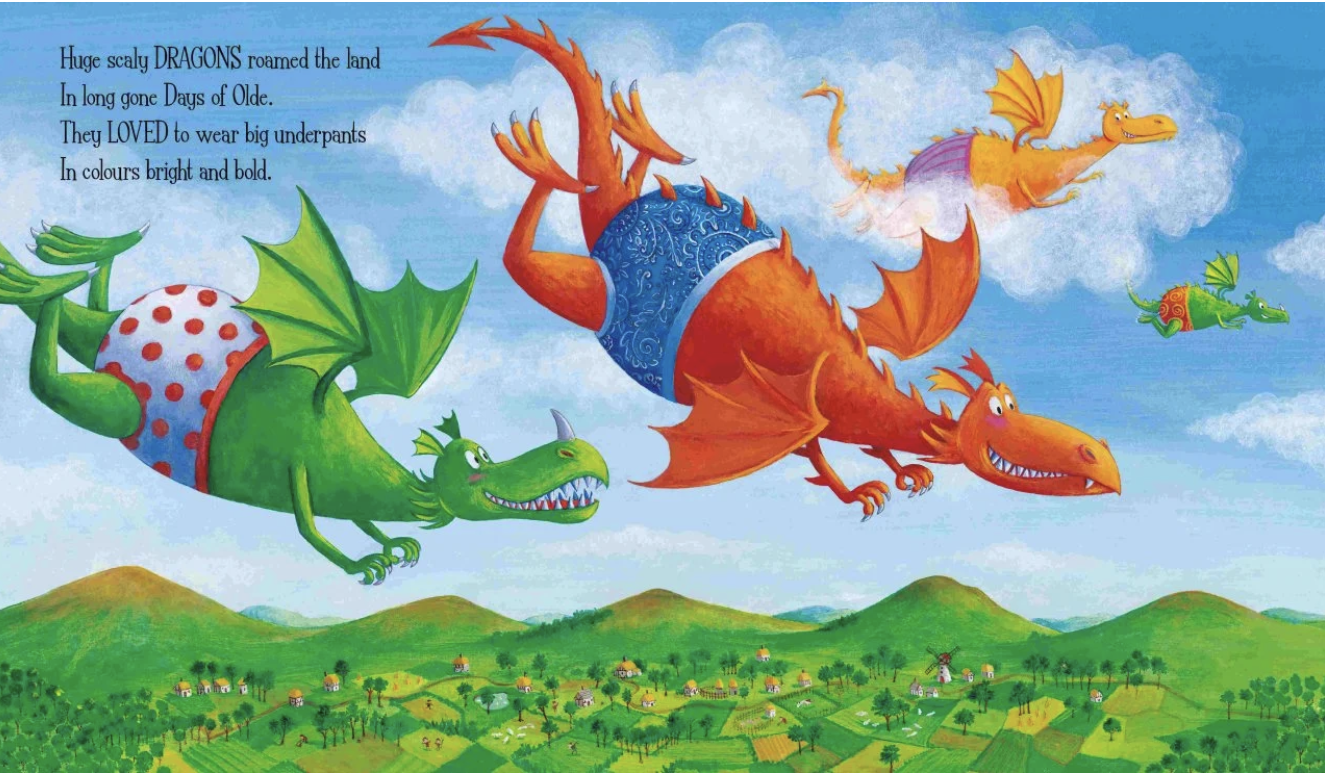


From Dragons Love Underpants by Claire Friendman and Ben Cort

A Tiger who drinks all the water in the tap – certainly.


From The Tiger Who Came to Tea by Judith Kerr

A dragon who scarfs tacos?


From Dragons Love Tacos by Adam Rubin

A generous witch with room for everyone on her broom . . .


From Room on the Broom by Julia Donaldson and Axel Sheffler


A boy who can sail alone to the land of the monsters and be King . . .


From Where the Wild Things Are by Maurice Sendak


A seed who is bad (but doesn't mean to be)?


From The Bad Seed by Jory John and Pete Oswold

Cows that type and Ducks that negotiate. . .


From Click, Clack, Moo, Cows That Type by Doreen Cronin and Betsy Lewin


Crayons that rebel . . .


From The Day the Crayons Quit by Drew Daywalt


A pigeon who wants to drive a bus . . .?


From Don't Let the Pigeon Drive the Bus! by Mo Willems


A snowdog that can fly! 

From the Snowman and the Snowdog based on the characters created by Raymond Briggs


EVERYTHING is possible!


Imaginative play is empowering and fun. And it’s a great excuse to just PLAY.


What book world will you create? Where will you go and who will be there?


_________________________________________________________________


  Natascha Biebow, MBE, Author, Editor and Mentor
 
  Want to level up your picture books? I am launching a new  online picture book course!

  Natascha is the author of the award-winning The Crayon Man: The True Story of the Invention of Crayola Crayons, illustrated by Steven Salerno, winner of the Irma Black Award for Excellence in Children's Books, and selected as a best STEM Book 2020. Editor of numerous prize-winning books, she runs Blue Elephant Storyshaping, an editing, coaching and mentoring service aimed at empowering writers and illustrators to fine-tune their work pre-submission, and is the Editorial Director for Five Quills. Find out about her picture book webinar courses! She is Co-Regional Advisor (Co-Chair) of SCBWI British Isles and was awarded an MBE for her services to children's book writers and illustrators. Find her at www.nataschabiebow.com


Monday, 22 April 2024

BIBLIOTHERAPY: BOOKS ABOUT BIG FEELINGS HEAL! • by Natascha Biebow

If you know me, it’s no secret if that I don’t go anywhere without a book to read. At the end of the day, I turn to a book to offer a quiet space of calm, a welcome escape that sets me up for a good night’s sleep. Reading makes me feel centred and whole. I like to sit and look at my bookshelf and find the book for that moment, for that frame of mind, for that state of heart. THERE IS A BOOK FOR THAT!


There's a book for that, no matter what!

Much has been written about the importance of books in instilling empathy in young readers, and how reading is the key for children’s success in later life. But can reading also heal? Are books actually good for our mental health?


According to neuroscientist and science journalist Richard Sima, “Researchers are investigating the impact of reading experiences and reporting evidence of promising mental and social health benefits . . . Now practitioners are exploring new models using the literary arts to support mental health in clinics, classrooms, and communities worldwide.”


Young children may have not yet experienced the whole wide world,
but they still have big feelings and need ways to process and deal with them.


We are wired for story. In the early years, the lines between pretend and reality are frequently blurred. Young children are often deeply connected to fictional characters and toys, interacting with them as if they were real. They are naturally drawn to telling and inventing stories in their imaginative play.

For young children fictional characters can seem rea

Reading stories allows children to step into others’ shoes, building neural pathays in their brains that prompt new ways of responding to situations (Tamir, D. I. et al., 2016). The more these new neural routes are used and practised, with each re-reading of the story, the more routine they become. Reading with a trusted adult can help children navigate their own big feelings and experiences, because stories validate children’s experiences and emotions and model new ways of thinking. 


Reading together can be healing.


In this study, researchers proposed that Bibliotherapy could offer a low-cost and accessible way to improve the mental health. How does it work? There are three stages:

Identification: the reader identifies with a story character and bonds with them.


Catharsis: through the story, the reader experiences the conflict alongside the character and how s/he resolves it.


Insight: the reader reflects on their own circumstances in relation to the story – the characters’ emotions, behaviours and conflict resolution model - and considers how they might apply these tools to their own lives.


Bibliotherapy


• validates young readers’ emotions and experiences

• models how to self-regulate, deal with conflict and big emotions

• opens a dialogue using the story as a vehicle for starting the discussion


I recently attended an excellent SCBWI talk by Melissa Manlove, formerly Executive Editor at Chronicle Books, “The Big Feelings Picture Book Workshop: Transforming Your Past Into Reader's Futures”. In the seminar, Manlove argued that “children's emotional lives are as big and as rich as adults’—and that they need stories that honor that and help them to navigate these essentially human experiences.”


All children deserve a wide variety of books to reflect their feelings and experiences. Libraries in schools and communities are essential resources for creating access to bibliotherapy!


Something Melissa said in her talk resonated with me – happy children are not children who don’t know pain, trauma or difficult situations; they are not children who don’t have big feelings.  


All children are dealing with something, small problems – like finding friends or fear of the dark – and difficult, bigger issues – like having lost a loved one, grappling with injustice, or the displacement of war –


But the difference is that happy, well-adjusted children know there is a path to the top of the mountain:


THEY HAVE A BOOK FOR THAT!


#ReadForEmpthy Collection 2024

Stories children them that there is a path, a way forward to get to the other side of the hard, bigger issues. Children need to know that there are ways to slay their dragons, to deal with their problems. 


Stories offer a path - empathy, hope and sometimes solutions.
 

Books offer a safe space for exploring big feelings and big or small problems. 


Melissa encouraged authors to not shy away from tackling big feelings and big issues in picture books, just because they’re for younger readers, but instead to show children the path for how they might solve and navigate these through story. It is up to us to create the book for THAT!

By tapping into our own big feelings and ways to navigate life, our childhood memories and experiences, and then innovate in a child-centred way, we can create books that will empower and resonate with the young readers of the future.


*Find recommendations of books that inspire empathy in the #ReadForEmpthy Collection 2024
*And Books that Help when the Words are Hard to Find on Books That Help

___________

Natascha Biebow, MBE, Author, Editor and Mentor

Natascha is the author of the award-winning The Crayon Man: The True Story of the Invention of Crayola Crayons, illustrated by Steven Salerno, winner of the Irma Black Award for Excellence in Children's Books, and selected as a best STEM Book 2020. Editor of numerous prize-winning books, she runs Blue Elephant Storyshaping, an editing, coaching and mentoring service aimed at empowering writers and illustrators to fine-tune their work pre-submission, and is the Editorial Director for Five Quills. Find out about her new picture book webinar courses! She is Co-Regional Advisor (Co-Chair) of SCBWI British Isles. Find her at www.nataschabiebow.com


Monday, 19 September 2022

How to Answer Curious Questions Kids Ask on School Visits • by Natascha Biebow


I do a fair number of virtual school visits, which are hugely enjoyable ways of connecting with teachers and librarians as well as children in many parts of the world. The highlight for everyone is usually the Q & A when the students get the opportunity to ask questions and get answers to whatever they're curious about.


Other authors and illustrators will be familiar with many of these questions, like:


- Where did you get your idea?

- Why did you become an author?

- How long did it take to make the book?

And even the more personal types of questions, like ‘How old are you? and ‘How much do you earn? Are you rich?’


This is a portrait of me doing a school visit by Angely

Every once in a while, a child will ask you something that gives you pause, perhaps something that you don’t know the obvious answer to and you find yourself umming . . .


Here are a couple that have made me stop and think:

“How many times did you mess up on the book?”


I love the idea that children think that you need to ‘mess up’ to make a book.


And indeed there is a lot of messing up!


In the first draft  . . .


And the umpteenth drafts . . .


One of the umpteenth drafts of my book.

And in the illustration roughs . . .


Steven Salerno's rough doodle for the first spread of The Crayon Man


And sometimes even in the artwork!


Messing up is part of figuring stuff out. Messing up is to be human and it’s how we make better books and learn for next time.


Messing up


is


IMPORTANT!


But I’m not sure I can count how many times I messed up to answer that kid's question . . .


“Are you and the illustrator friends?”

Ooh, wouldn't it be great if you could just hop on the phone to your illustrator, and meet up for pancakes or pizza or something? We could share about our lives, what we are making and maybe find out we both like dogs or collecting cool rocks.


Then I’d tell the illustrator how amazing they are at interpreting the words I'd written.


And congratulate them on making visual magic between words and pictures.


And sometimes, if we were on the subject of the book we're making together, I wouldn’t be able to resist offering my two cents about this and that. 


We'd be friends in no time, I'm sure!


But, if you’ve ever made a picture book, you’ll know that the process is rather different. Usually, the editor and art directors are the ‘go-betweens’, the champions and project directors of the picture book. The author talks to the illustrator through them. Very rarely do they meet – at least until the book is out in the world.


This process allows SPACE for each of the author and illustrator to each create freely and unencumbered, and to carefully weigh up and consider feedback to make the best book possible.


So, authors have to trust that everyone on team publishing has the best interests of the book at heart and that every decision that is made is for the good of creating something amazing for children. Sometimes that is HARD.


I’ve made friends with many authors and illustrators with whom I collaborated with my editor’s hat on. We play together, we write letters (and emails) to each other, we share cookies and coffee and we talk about one of our favourite things – books.

THE CRAYON MAN illustrator Steven Salerno and I have collaborated and exchanged many emails. Unfortunately, we haven’t yet met in person. I’d like to be friends with my book’s illustrator because we share something very important in common – we’ve made a book together!


I didn't know what Steven Salerno looked like until
he shared this photo for a joint blog post on his process.


“Do you sell every book you write?”

This question can be read in two ways:


Do you sell every book that you write?


If we sold every book that was printed that would be super super!

No bookstore returns.

No books pulped.

No more sitting in the bookstore at a signing waiting for a single person - anyone - to come and talk to you and buy a copy – the books would just fly off the shelves and the tables and you'd get to sign them all until they were SOLD OUT!


Do you sell every book you write?


Oh my goodness, wouldn’t that be AMAZING? Can you image if you wrote a book and it sold right away and you didn’t have to wait for ages and ages and ages for it to find a good home with an editor?


But on the flip side, it’s actually quite good that everything I write doesn’t end up

on children’s bookshelves because fairly often it needs polishing and loving and cooking some more, and then re-jigsawing and sometimes even


to


be


THROWN


OUT!


Luckily we have time, kind and generous critique group partners and editors to help us realize THAT.


and . . .


“What happened to Harold?”


Harold C. Smith was Edwin Binney’s cousin, with whom he ran Binney & Smith, the company that made Crayola crayons. Harold was the salesman in the duo, while Edwin enjoyed experimenting and inventing.


Harold made friends all over the world on his travels selling products. He later turned to writing and philantrophy.

Edwin and Harold outside the factory (From
The Crayon Man, illustrations by Steven Salerno)


You can never be quite prepared to second-guess what children might ask.

To get out of a tight situation, you can either quickly Google it under the table or . . . 


. . .  if you’re brave enough, admit you don’t know and make it a game. :We should all look it up, shouldn’t we?!"


What curious questions have young readers asked YOU on your author visits? 


_________________________________________________________________


Natascha Biebow, MBE, Author, Editor and Mentor

Natascha is the author of the award-winning The Crayon Man: The True Story of the Invention of Crayola Crayons, illustrated by Steven Salerno, winner of the Irma Black Award for Excellence in Children's Books, and selected as a best STEM Book 2020. Editor of numerous prize-winning books, she runs Blue Elephant Storyshaping, an editing, coaching and mentoring service aimed at empowering writers and illustrators to fine-tune their work pre-submission, and is the Editorial Director for Five Quills. Find out about her new picture book webinar courses! She is Co-Regional Advisor (Co-Chair) of SCBWI British Isles. Find her at www.nataschabiebow.com


Monday, 2 August 2021

How to Edit A Picture Book Without Cutting Trees by Chitra Soundar


A long time ago when I started writing picture books, I learnt about making dummies before I heard about storyboarding. Either way, both picture book dummies and storyboarding felt too "arty" for me, because I had no art skills. I can barely doodle, or use any craft supplies. Even today! Almost 10 years from when I started, most of my drawing skills are still basic.

But I'm from a software background and if you worked in the corporate world, you'd know that using a presentation software can make or break your career. I was well-versed in Microsoft Powerpoint even then and even more now and sometimes I stray into Keynote (on Macs) as well.

If you are like me and cannot draw and also find it extremely sad to print two lines on a sheet of paper to fold it in, to make picture book dummies, here is my guide to making them on a computer, definitely more eco-friendly.

Check if your PC has Microsoft PowerPoint. Your Mac will definitely have Keynote. You can also use Google Slides which is free.

A - Create a presentation of your story

Step 1: Start the presentation software and open a blank presentation.

Step 2: The first slide always comes up as a title slide. That’s what you need too. Enter the title of the book and the author name here. There is a huge positive boost to your self-confidence when you actually type in the title and your name as the author. {Protip: This works brilliantly in kids' workshops too}

Step 3: Insert a new slide and choose the simplest layout - a blank one.

Step 4: Repeat 11-14 times. UK picture book stories are usually told in 12 spreads. US publishers often allow up to 15 spreads.

{Protip: Have as many spreads as you want, that's the beauty of using the software. Then you can cut down, move text around to see how it lands. You can copy and save two versions - one with 12 spreads and one with 15 spreads}

{Pro Protip: If your story throughline is too thin or your idea doesn't have sufficient story weight, you won't be able to fill 12 spreads with "things that will happen." So creating 12 blank sides gives you an understanding of the work involved.}

Step 5:  Cut and paste text into each slide from your word document (if you've already typed it up) or from your notebook if you've already written it.

I usually write my first drafts on paper then transfer them into a document. And then if I can't get the story structure to work or unsure of something, I'll create a presentation and cut and paste to see how it all lays out.

{Protip: Don't start in the presentation software. Use it as an editing tool. Tell the story to yourself and then to the reader as many times as possible and then use this tool to help you plan the pacing and structure.}

So now you have a presentation, with a title slide and 12 slides after each representing a spread in your picture book.


[CAUTION! Save your presentation as often as you can!]


Step 6: View the story as a slideshow - click through it or set it on a timer. But watch it unfold.

{Protip: Use transitions that mimic page turns just for fun! }

So in the above six steps, you've created a different perspective into your picture book. It's another way similar to reading aloud.

B - Review your story

As you are clicking through your story, what should you be watching out for?

  1. You will see whether some part of the story is too slow and some of it is rushed, ie, pacing.
  2. This step will also reveal if your page-turns are working. Do you have a surprise before or after a page-turn? Is there enough anticipation before a reveal?
  3. You will see if one spread has more text while others have none. But this is sometimes deliberate while other times, it's a symptom of a pacing issue.
  4. How many clicks does it take to get to the actual story? How much scene setting are you doing?
  5. How quickly did the story end? Was there an Aaah! moment when the page turned?
  6. Now that all the 11-12 spreads have been clicked, can you think of a surprise ending at the last click? Can there be a joke, a twist, an image that will sum up the theme?
After the above things have been checked, you will have an idea of what changes you might have to do.

There are two options now:
a) Go back to your notebook, document and rewrite the story and come back to the presentation to do another edit.

b) Edit the story in the presentation and then of course you can export it later.

C - How to revise a story in your presentation software

How to figure out what to edit and how to edit it?

Descriptions: Often picture book writers put in descriptions that will not be needed when the illustrations are completed. Sometimes the descriptions are required to communicate plot and sometimes it's just a way to translate the story the writer sees in their head.

A good picture book is a marriage of text and pictures and hence it will help to see that working in your drafts as well.


<PROCRASTINATION ALERT!>

In every spread (slide) you see descriptions that are not required, a blue car, a big house etc, try and add images to the slide.

{Protip:You can cut and paste illustrations from google images and then read to see if you still need the words on the page. }

The story must still work without the adjectives and exposition. The story will finish its circuit in the reader's head. So only write those descriptions that you have to be specific about.

For example, if the car has to be red for plot purposes, then add red in the story. Otherwise just say car and let the reader imagine their own favourite colours. The illustrator can suggest their own visuals to help the reader too.

SetupDo you need an elaborate setup for your story? Go through the presentation again and see how many clicks does it take to get to the "inciting" incident in the story? There is no right or wrong. There is no golden rule. The setup should be as long as necessary for the story.

So keep cycling through the presentation by hiding the exposition slide and see if the story still works. Doesn't work? Sure, unhide your slide. Do you realise you don't need it? Delete that slide (and the text from your story).

ORDER OF EVENTS:  As you click through the presentation, keep thinking if there is a causal effect of one slide to another. This happened and so this happened... If not, think about whether there should be. Again, there is no golden rule, there is no right or wrong. You just have to see if you need to connect the dots for the incidents and make them build upon each other.

Go to slide-sorter in your presentation and see the 30000 feet view.


Now move things around if you need to and if you can. Edit the transition sentences when you move around the slides / spreads.


PAGE-TURNS: 

Page-turns are cliff-hangers in picture book parlance. Young children (often 3-5 years of age), should want to turn the page and see what's on the next page. So often sentences are not fully finished in a spread, they reveal a surprise when you turn the page. See if there is enough anticipation in the text that motivates the reader to ask questions like

a) Who do you think?

b) What's going to happen?

c) What will it be?


Page-turns are also good devices to setup causal effect. This happened and so.... turn the page to see what happened next.

  {Protip: Hide some slides, edit the text, move around slides - see how the flow works each time by clicking through the entire presentation.}

PACING: 

Ideally by clicking through the slides you will be able to check for the following:


        1. How soon do I know who the protagonist is?
        2. How quickly will I find out what they want?
        3. How soon is something fun going to happen?
        4. How much build-up there is to the centre-spread where everything goes BOOM?
        5. How quickly did the ending come? Was it satisfactory or did I need a slow-down page for the young reader to take in what just happened?
        6. Is there a tag or a button at the end - ie, is there a funny twist or an extra aaah moment after I've turned the last spread?

{Protip:Count the slides and the clicks, move things around including text. Build the anticipation using page-turns and make sure the middle spread (say around 6/7th) has a big scene that the illustrator can have fun with. }