Showing posts with label humour. Show all posts

Monday, 15 August 2016

WHEN DID ANIMALS START BEING SO FUNNY?

by Eoin McLaughlin


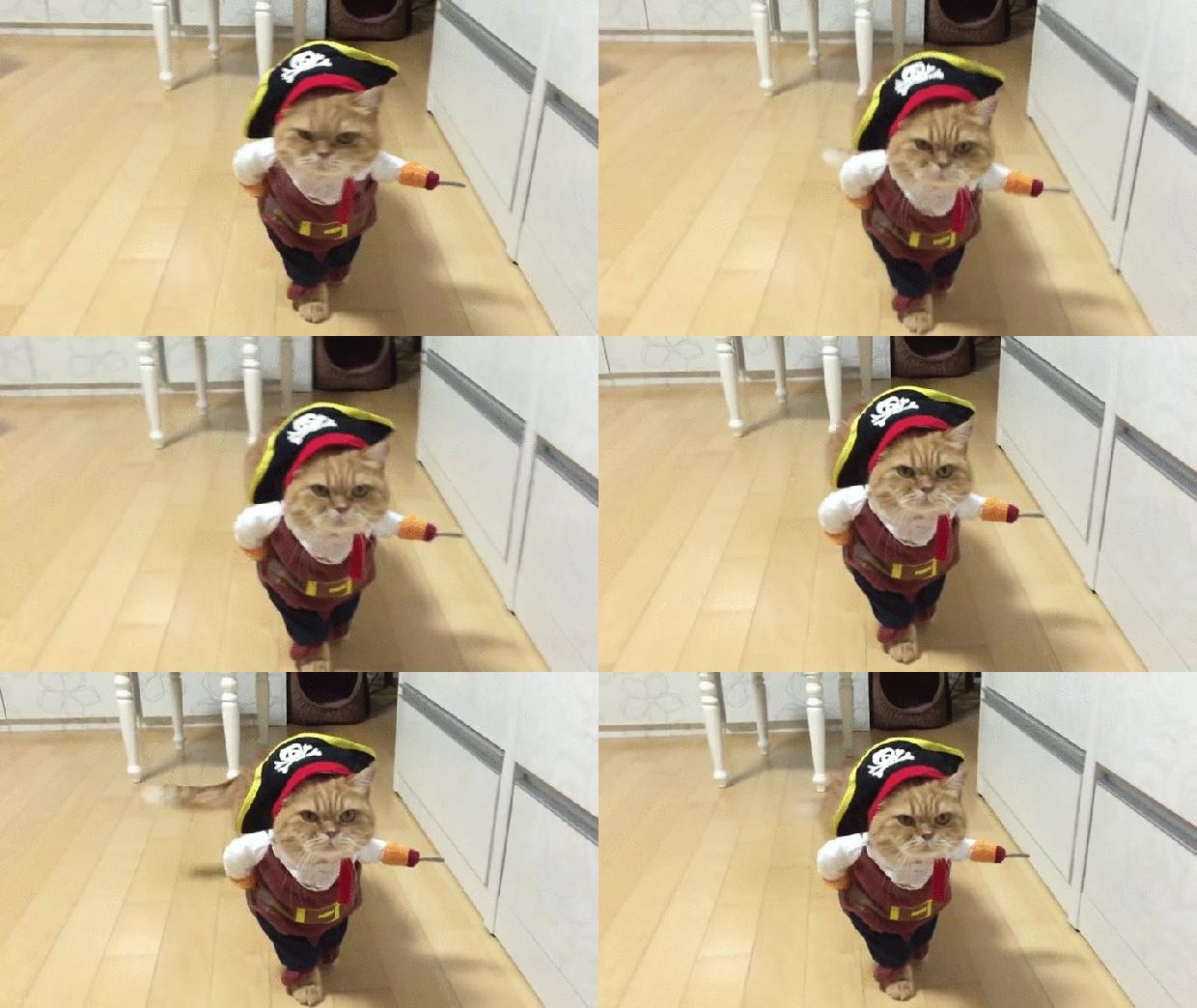
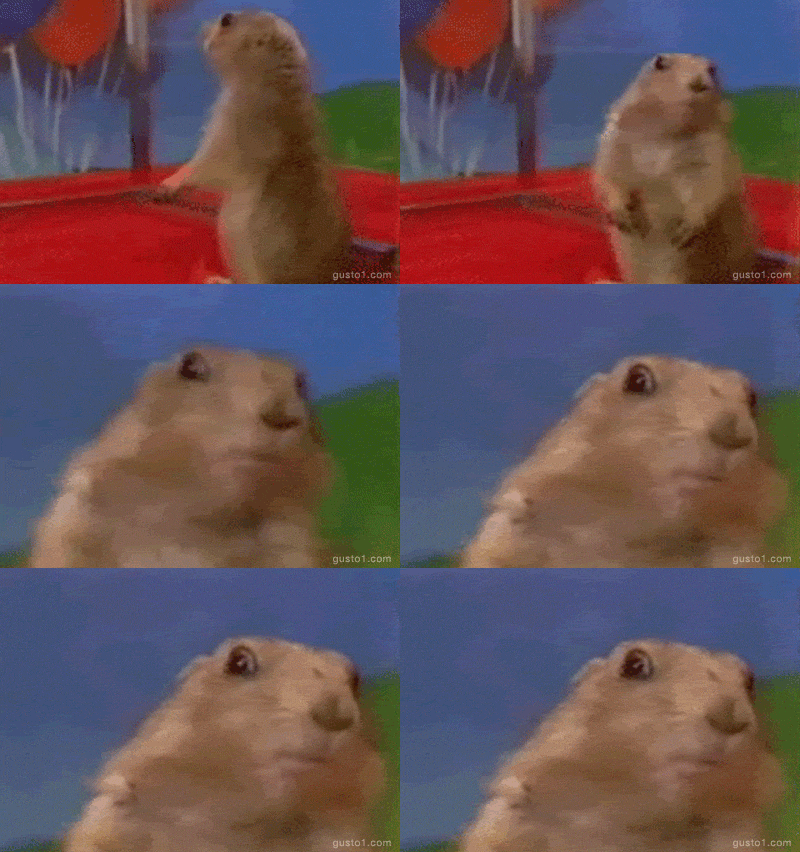
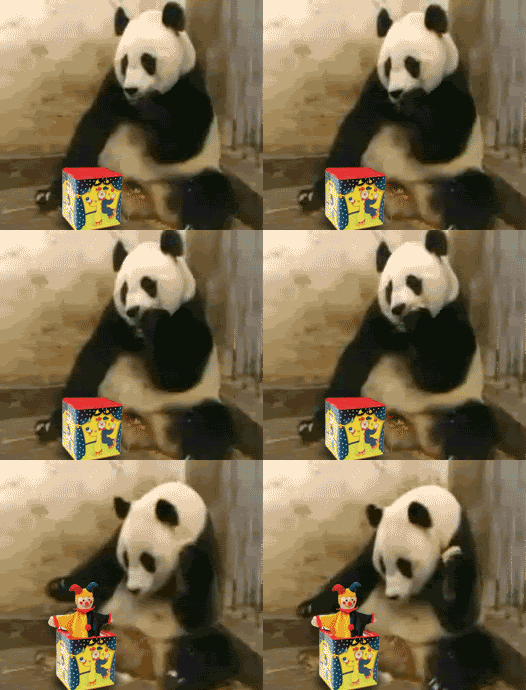
There’s nothing the internet loves more than funny animals. And by ‘funny animals’ I mean animals behaving like us humans. What could possibly be funnier? It feels like we’ve all pored over the cat who thinks he’s a pirate, the gopher with the evil look and the sneezing panda since time began. But it’s easy to forget that Youtube is only 11. The internet meme is in its infancy.  
But picture books are not. Ever since John Newbery published A Little Pretty Pocket-Book, picture books have understood, like no other medium, the comic potential of the right animal doing the wrong thing. All the way from the White Rabbit and Jemima Puddle-Duck to The Tiger Who Came to Tea and Gorilla. More often than not, there’s a funny animal at the centre of our favourite tales. Each generation seems to find their own unique slant on the joke, whether it’s greedy pandas peddling donuts or vicious bears trying to locate their hats. The funny animal is the comic gift that keeps on giving.

Four years ago, James Catchpole sold my first picture book to Dial Books. While waiting for it to come out, I have:
Married.
Moved house three times.
Realised that I love mayonnaise.
And written my first blog post (you’re reading it, hope it’s going okay!)
Amongst all that, I’ve also been reading and writing as much as I can in the hope of learning ‘The Art of Picturebooking’. And whilst, as James will tell you, I’m still very much in Key Stage 0, I have noticed an increasing number of funny animals creeping into my texts. One features an octopus learning to swim, another a bear as a detective. It seems I’m succumbing to the power of the funny animal. Whilst I’m fully embracing this as a good sign that I might be making some progress, it has made me wonder: when did animals start being funny?

There’s a small scrap of Ancient Egyptian papyrus in the British Museum, dating from the 13th Century BC. It was drawn by a scribe, for sale to ordinary Egyptians outside his local temple. What’s unusual about the papyrus, is that it depicts a cow sitting on a plow, as if she were a farmer rather than a farmyard animal. According to Daniel Antoine, one of the curators at the British Museum, Egyptian texts are full of exactly this kind of imagery. Seeing animals performing human activities was one of the Ancient Egyptians’ all-time favourite gags. It had them LOL’ing and RROTFL.
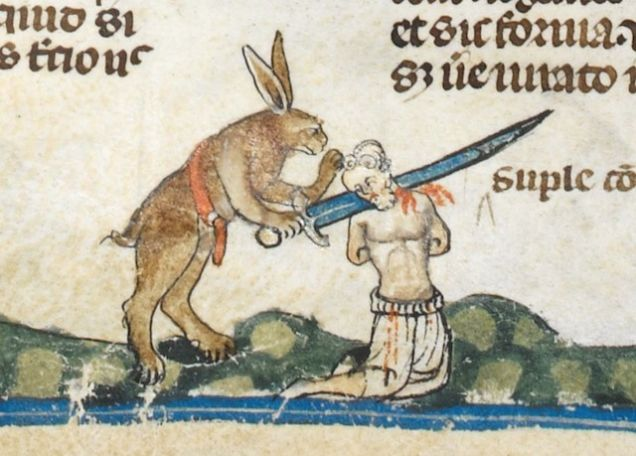
Daniel directed me towards further papyri (yes, apparently that’s the plural) where I found lions playing board games, wolves heading to the shops and cats shepherding ducks. And funny animals didn’t stop there, in medieval marginalia they seem to specialize in dark humour. [Left]
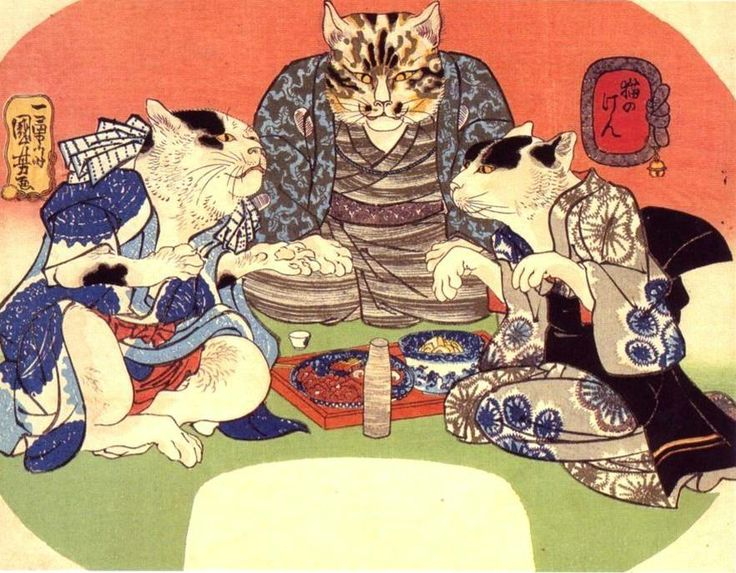
And by the 18th century, Japanese artist Utagawa Kuniyoshi seems to have already perfected the cat joke. [Left a bit, down a bit]


Whilst the funny animal isn’t regarded the world’s oldest recorded joke (that’s widely credited to be a Sumarian corker about farting) it’s very, very close. One man’s papyrus is another man’s Youtube. Funny animals have been making humans laugh for at least 5,000 years, and presumably much, much longer (before papyrus or papyri).


I guess almost all of us would count our sense of humour as one of the things most personal to ourselves, one of the things that makes us who we are and the primary reason we love the people we do. It’s quite amazing to think that we have this bond in common with our most ancient ancestors. We could have shared a good laugh with them over the picture of a cow and a plow in 5,000 BC or by showing them any number of fantastic, funny animal picture books published in 2016.
Isn’t that a nice warm feeling? Let’s bask for a moment in the amazement of inter-generational-super-connection…
Ahhhh…
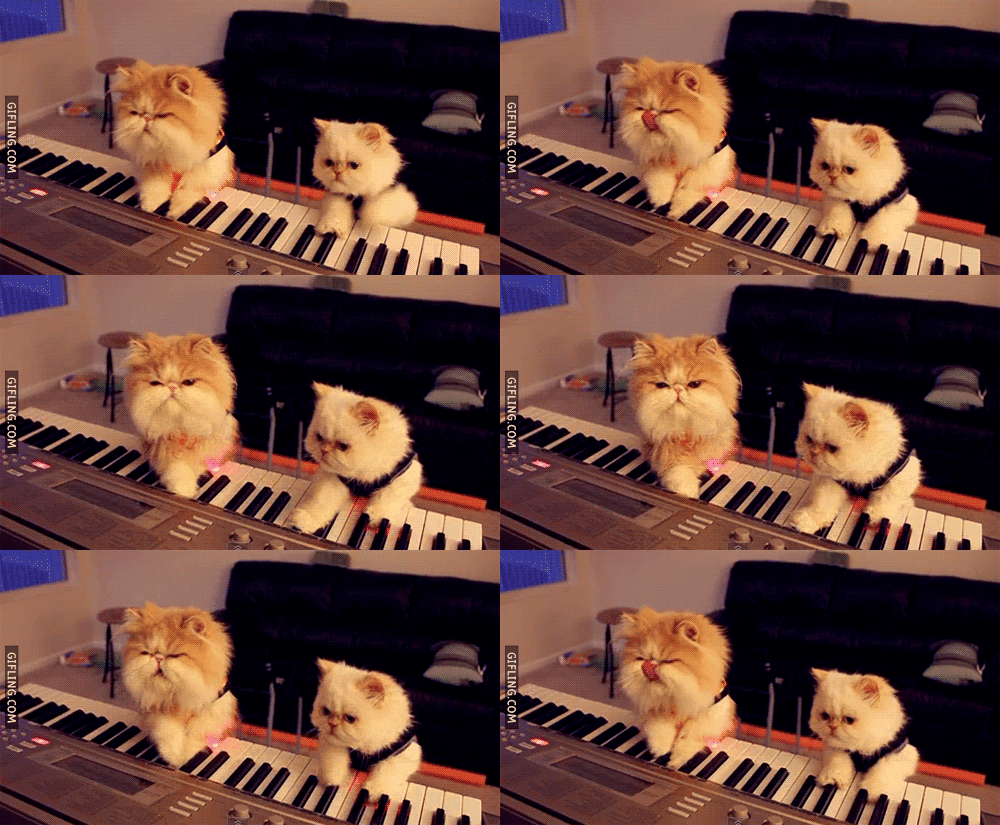
But it does pose a more serious question: “Why, after all that time, are we still picking the very same animals to be funny? For five millennia ducks, dogs, frogs, cows, cats and pigs have been getting things all their own way. Sure, they’ve been a hoot, but isn’t it time to draw a line? Shut the pen? And close the barn door? Wouldn’t it be a good idea to try some new animals for a change? Don’t you think?!” It was at this point that Daniel from the British Museum stopped replying to my emails. He’s obviously part of the funny animal conspiracy. I had no idea how deep it ran.
Regardless, it’s time to make a change. All of us gathered here have the unique opportunity to end thousands of years of subjugation. That’s why, right here, right now (drum roll please) I’m launching ‘The Campaign For Getting More Weird Animals, Things Like Marmots And Poison Dart Frogs, Onto Our Papyri, By Which I Mean Children’s Books’, or ‘TCFGMWATLMAPDFFOOPBWIMCB’.
Granted, it could do with a catchier name. Perhaps we can think of a new one at the first annual meeting, taking place at The National Hystrix Sanctuary.
For the next 5,000 years, bring on the musk ox, the capybara and the skink.
To kick things off @eoinmclaughlin will be tweeting a 142 character funny animal story every day this week, featuring a very deserving, obscure animal. Just leave your favourite weird animal in the comments.

Eoin’s first book, This is NOT a Bedtime Story is coming soon from Penguin Random House (Dial Books). More to follow from Walker and Bloomsbury.

Monday, 28 March 2016

THE PICTURE BOOK EVENT ANXIETY CHECK LIST

by Michelle Robinson


Event coming up? Worried you’ll forget to WORRY about something? Fret no more. This handy checklist of unnecessary anxieties is guaranteed to have you losing sleep for weeks.
  1. I will not find the venue.
  2. I will find the venue is insalubrious.
  3. I will turn up on the wrong day/week/month/continent.
  4. My car will break down or else I will crash it. Probably into the venue. Or the children.
  5. The train will be cancelled. The train will break down. I will crash the train.
  6. I will be late. I will be flustered. Everything will go wrong.
  7. I will be early. I will still be flustered. There will be no excuse for anything to go wrong, and yet absolutely everything will.
  8. I will have to cancel due to crippling anxiety and/or illness. I will let everyone down. I will damage my reputation and no on will ever ask me to do an event again. Fingers crossed.
  9. The promised essentials (powerpoint, flip chart, paper, pens, valium, etc.) will not materialise.
  10. I will leave my books at home.
  11. I will leave my memory stick at home with my slideshow on it.
  12. I will remember the memory stick, but will bring the wrong file, most likely something inappropriate or incriminating.
  13. The event organiser will be unable to conceal their disappointment in me.
  14. The children will boo and chant, “WE WANT THE GRUFFALO.”
  15. I will have to read ‘The Gruffalo.’
  16. No one will turn up. 
  17. Everyone will turn up.
  18. Johnny Depp will turn up and I will not be able to think of the first thing to say to him.
  19. Nose bleed.
  20. Panic attack.
  21. Fainting.
  22. Sudden inexplicable onset of Tourette’s. 
  23. Earthquake.
  24. Volcano.
  25. Tsunami.
  26. Alien invasion.
  27. Brain drain.
  28. Someone will look at me funny, putting me off my stride so badly I launch involuntarily into a musical number from Grease.
  29. The children will be Mensa protégés who correct me on my grammar.
  30. A child will ask a question that destroys or unhinges me.
  31. I will fall flat on my face. 
  32. I will catch shingles from lingering pox on the venue carpet.
  33. These are pre-school children. I could even catch bubonic plague.
  34. The organiser will not have arranged book sales.
  35. The organiser will expect me to bring along books and cash float. They will also expect me to do maths while talking and signing books for children with names like, "Eve, spelled Yvxwezfgh."
  36. I will not sell a single book and everyone will know I am a loser.
  37. No one will offer me a drink all day.
  38. Someone will offer me a drink but I will start choking on it, mid-story.
  39. I will choke to death in front of everybody.
  40. I will not be able to locate the loo.
  41. I will have an accident.
  42. Looking for the loo, I will enter the broom cupboard and have to style it out.
  43. …resulting in a request to read ‘Room on the Broom.’
  44. My family will resent me for spending time away from home.
  45. My children will forget what I look like.
  46. My husband will think I am away so much I must be having an affair.
  47. I will go all that way and - assuming #18 did not happen - there will not be anyone worth having an affair with.
  48. No one would want to have an affair with me anyway: I arrive a witless, charmless mess dressed as an impoverished bag lady.
  49. A local newspaper journalist will come and take a horrible photo, capturing my dishevelled bag lady look forever and making it the most prominent image result for me in Google.
  50. The photo will appear in the paper with the caption, ‘Not even Julia Donaldson’.
  51. The photo will not appear, being deemed less newsworthy than a sponsored shoeshine. 
  52. My publishers will not even notice that I am hauling my arse all over the country to promote our book.
  53. My publishers will notice, but will be too busy celebrating the umpteenth reprint of ‘The Gruffalo' to care.
  54. My publishers will see the terrible national newspaper write-up with the unfortunate photo of me, book aloft, smiling, beside the burning venue and sobbing children.
  55. There will not be cake.
  56. There will be cake, but I will choke on it.
  57. Repeat anxiety #39.
  58. They will ring to cancel when I am five minutes away because, “We thought you had written ‘The Gruffalo'.”
  59. Julia Donaldson will turn up, dressed as the Gruffalo, and deck me.
  60. Some manner of very public, non-choking related death.
I’m worried I’ve omitted a load of things I ought to be worrying about. Please share any fears I’ve yet to consider below. Don't worry, folks. You'll be great. After all, you’ve got this anxiety thing nailed. 

Not a bad effort.
Not even Julia Donaldson.
Michelle Robinson's latest book, 'Goodnight Spaceman' is out on April 7th. She has many events scheduled this year and has a few of her own unique fears:-
  1. Everyone will be disappointed that I am not Tim Peake.
  2. If Tim Peake were watching my event from space, he would be disappointed.
  3. They only invited me because they are hoping I can introduce them to Tim Peake. Disappointment is inevitable.


'Goodnight Spaceman' is published by Puffin, illustrated by Nick East and features a very special foreword by ESA astronaut, Tim Peake. 

Tuesday, 14 July 2015

The Big Wide World - Jonathan Allen - two days late. . . . sorry. . .


It's about this time of year that from every college and 'university' in the land, or at least a fair few of said institutions, fully fledged baby illustrators emerge, blinking, into the cold, hard daylight.
Well, I was once one of those.

In my hand, speaking figuratively, I had a list of children's publishers culled from my researches in the childrens section of Foyles in Charing Cross Road, London, which was next door to the Graphics Dept of St Martin's College of Art, where I was just completing my studies.

There were a few things I had to get my head round, amongst which was the idea that each publisher had its own 'list' with it's own special aesthetic, something that was not immediately obvious to a raw newcomer, and then to choose publishers with who's list and aesthetic my work would fit in. Not far short of guesswork basically.

So I did that to the best of my abilities and, showing commendable initiative, well, compared to some of my contemporaries anyway, rang the relevant art editors. I got a few appointments too, one being at J.M Dent who were located in a posh part of town, just next to Wimpole Street and Harley Street. Publishers seemed to be all located in interesting old buildings in places like Bloomsbury and Covent Garden for some reason.

I met the Art editor's assistant, as the art editor was away, and to her credit she told me to ring back when the art editor was back in a week's time, as my work was 'just up her street'.
Amongst the stuff in my portfolio were a few nonsense poems I had written and illustrated, and a very graphic but humorous version of 'There was an Old Lady Who Swallowed a Fly'. When I finally showed the art editor, (the late Vanessa Hamilton) my work she amazed me by suggesting that if I wrote some more poems, she might very well publish them as a book.


I went away and wrote some more poems and in due course a book was published. "A Bad Case of Animal Nonsense" came out in about 1978 (aaaaaargh! I can't possibly be that old can I?)
Not to a mad fanfare or to huge success, but it was a foot in the door and I managed to keep going from then on, helped by being in a great cheap housing co-op flat and having got used to living on student income levels, but it built up over time and I even manage to make a half decent living at it.

These days I don't know what the score is. To me it all looks pretty depressing, but my perspective is warped by my experience of the way things were back then, it bears little relation to the publishing world as it is now, especially from a new graduate's perspective.

The fortunate ones will find and take the opportunities that are out there, and the rest will find ways to get by, or find other ways of making a living. Just like in my day. Except in my day we didn't have student loans and tuition fees hanging over us. It makes me sad that economic conditions will very likely push the study of Art into being something feasible only for the rich. I wouldn't have been able to go to Art College without a student grant. . .

So, to all you illustrators, just out of college, trying to find a foothold in the world of work, I wish you all the luck in the universe. May you find some joy and satisfaction in what you find out there, whatever it may be. I look forward to seeing what you come up with.

Thursday, 26 March 2015

Look who’s laughing now - Crossover humour in picture books • Elys Dolan

A big THANK YOU to this month's guest blogger, Elys Dolan, author-illustrator of the very funny Weasels and Nuts in Space. Elys explores how picture book humour can appeal to both young and old in this post.


I’m a big fan of funny picture books. They’ve brought me moments of hilarity featuring everything from speedo wearing wombats to ugly ducklings that grow up to be even worse looking ducks. I’m so much of a fan I even try to make the odd one myself along with doing a PhD about them. I find such books funny even though I’m apparently a fully paid up grown up with a mortgage, a tax return and a grey hair I found the other day but don’t want to talk about.

So prepare yourself because I’m about to get very nerdy about the kind of picture books that are funny for both children and adults. I’ll be using the term crossover humour to describe it. I’ll wax lyrical about why they are the kind of books I want to make and the implications that come with that.

But before I begin here’s a quick disclaimer:

There are few things more subjective than what is or is not funny. Therefore I can’t guarantee that you won’t think the things I’m purporting to be amusing are quite the opposite. If this happens please accept my apologies and lets hope we never have to sit next to each other on a long plane journey.

There’s many types of humour used in children’s books but I’ve chosen three to use as examples, toilet humour, parody and physical humour, because they illustrate the use of different kinds of humour within the same book to achieve a crossover appeal. These examples are going to come from my own work. The first reason for this is that I’m deeply self-centred. The second is if I were to cover the subject in its entirety, in reference to various picture book makers, you’d be reading this for days and probably run out of food and other essential supplies. Thirdly I can put my own images on the internet without asking for permission and not get into trouble.

Toilet humour

I’ll start with the classiest type of humour. From my experience of doing book events this goes down brilliantly with kids. This vignette from my first book, Weasels, almost always gets a laugh because sometimes all you have to do is show them a toilet:


Having said that I find the grown ups in the audience aren’t above it either. You tend to have to be a bit subtler and let their own dirty imaginations do the work. I’ll often get the odd parent laughing at this bit from Weasels when the lights suddenly go out:


Toilet humour is frequently used in picture books, sometimes lazily and sometimes to great effect. Well know examples include Poo Bum by Stephanie Blake, The Story of the Little Mole Who Knew it Was None of His Business by Werner Holzwarth and Wolf Erlbruch.

Parody

I seem to do this a lot and won’t realise it until half way through development. I’ll think ‘I’m going to do a book set in space’ and some how I end up referencing, and poking fun at, Star Wars, Star Trek, 2001 A Space Odyssey and all the other stuff I’m a fangirl for. This is glaringly obvious in my second book Nuts in Space. Does this place remind you of anything?: 


And perhaps this Moose is a little like William Shatner in his own way:  

And there’s more than a few Bond film references in Weasels including this chap who’s a bit like a certain evil genius/super villain:  


It’s a fairly adult form of humour because it often requires prior knowledge of external references but I get a great reaction from the reader. Parody like this doesn’t seem very common but there are some excellent examples of parody when it come to reworking fairy tales. The Stinky Cheese Man and Other Fairly Stupid Tales by Jon Scieszka and Lane Smith one of my favourite and there’s Goldilocks and the Three Dinosaurs by Mo Willems.

Physical humour: Slapstick & Humorous Physicality

Under slapstick I’m including all Laurel and Hardy style falling over and comedic accidents. For example:

Electrocution 


Ducks getting sucked into vacuum cleaners


And the classic slipping on a banana skin.


By humorous physicality I mean characters that are funny just from the way they look. I often do this by exaggerating certain features and essentially making them look ridiculous. For example here’s a Baywatch hippo:


I’ve exaggerated the size of said hippo, and trust me it’s no easy thing to make a hippo even chunkier, for comedic value. Putting her in a swimming costume and making her run seems to add to the entertainment too. There’s some great examples of exaggerated characteristics in Melvin Peake’s Captain Slaughterboard Drops Anchor and in Marc Boutavant’s animal characters from Around the World with Mouk.

I find that physical humour appeal much more to children than adults. I’m not entirely sure why, perhaps it’s slightly too direct for adults, and there are of course exceptions but in my own experience it’s the child that react the most to this.

So of the three forms of humour I’ve described parody appeals most to adults, toilet crosses between ages and slapstick appeals mostly to children.

Why on earth would I use crossover humour? 

I started using crossover humour, and any humour at all for that matter, unconsciously. I didn’t even realise I was doing it until people started telling me. Now the question that looms large for me is why would an author or illustrator include crossover humour in a book for children? I can’t speak for any other practitioners (although I’m planning to glean a range of opinions as part of my research) but I can offer my own philosophy.

I think the initial motivation was my own entertainment. This job is difficult, time consuming, and unlikey to make me rich so I’ve got to be enjoying myself. I do this by putting my own sense of humour into my work and doing things that make me giggle to myself like a crazy lady.

A less self-involved reason is how funny I find the book is a good form of quality control. I sometimes encounter the perception that children have lower standards of humour. I don’t think this is the case. Sometimes different things appeal to children but the standard is always very high and if they’re not enjoying it they will let you know. So, if it’s not good enough to keep me entertained how can I expect my readers to enjoy it?

I’m conscious that my readership isn’t only children. Children’s books are encountered by parents, older ‘reluctant’ readers, booksellers, publishers, other authors & illustrators, reviewers etc. I firmly believe you need to direct the majority of humour towards your core audience but I don’t want the rest to go wanting. If there’s a poor tired parent who’s been asked by their little angel to read one of my books for the 1000th time I hope I can at least raise a brief smile with a gag about death bananas.

Issues with cross over humour: 

I do occasionally meet resistance from my publishers and others in the industry when using this multi-level humour. Weasels went through a number of rejections and a few of them were because the humour was found to be ‘too adult’. I think subsequently crossover humour has been one of my unique selling points as an author and illustrator but I’ll talk about the pitfalls I’ve encountered.

Kids won’t ‘get it’. 

If you’re going to put in jokes for grown ups it may be that not all children will understand them. Children and adults have different frames of reference and a form of humour like parody require knowledge of external context for you to get the joke. The question here is does everyone have to get every joke? I know this can be a controversial view but as long as such jokes aren’t in the majority and they provide a different form of interest too I think it’s okay if they don’t.

For instance, in Nuts in Space there’s this moment:  


Now this requires a certain knowledge of Star Wars to get this joke. It’s fairly safe to assume not all children will have seen Star Wars so they won’t. On another level though I think an evil space monkey having a duel with a Moose using strip lights is a pretty interesting thing on its own. So, if it’s not going to be funny for everyone then at least make it interesting for the others so it works on two levels. I tend to think of the interest as the first level and the added joke as the second level.

The format makes it hard to to get the balance right

I was talking to an editor recently about why there’s more cross over humour in film and tv (think pixar films etc) than kids books and they said it’s perhaps because a picture book is like a haiku. Every word needs to count whereas in a film it’s one of many. Therefore in a picture book it’s much easier to upset the balance because too much of the content operates on the second level, excluding part of your audience. This is certainly a risk for simpler, more linear, picture books though it’s not impossible to achieve cross over humour in this context. Jon Klassen’s I Want my Hat Back has a kind of deadpan humour that appeals to adults whilst successfully telling a tale about a nefariously stolen hat to children. It works on those two levels and it does this consistently throughout the story. This subtle technique is way beyond the likes of me so I approach it in a different way. I work in a detailed, information heavy, manner so I can sneak in the odd moment of second level humour amongst the falling over and fart jokes.

What’s appropriate?

There’s all sorts of theories and differing opinions about what’s appropriate to include in children’s books and this does impact on the kind of humour you can use. For instance some toilet humour could be considered too revolting or some slapstick too violent. I encountered this recently in regards to dog turds. To be precise, this turd here: 


It’s the punchline of a joke which I’m not going to reveal in full because it’ll ruin the ending of my new book The Mystery of the Haunted Farm (yes that was a shameless plug). It seems the British reader has no problems with the odd dog poo but the publisher worried Americans would find this dog turd disgusting instead of funny because they have different standards of what’s acceptable. This lead to months of debate and extensive consultation with an American publisher to decide if dog turds are acceptable punch line for a picture book. Eventually it was decided that the turd could stay but it was a close run thing. I had to remove the blue bottles flying around it though. It’s a hard life.

Using cross over humour can be like walking on a knife edge desperately trying to keep your balance. Despite this it’s the times when I’ve done a reading of one of my books and I’ve got both kids and parents laughing that makes all the fretting, rewrites and frantic colouring in worth it. So if you’ll excuse me I’m off to draw a pig wearing underpants falling down toilet whilst dressed like Darth Vader and do it all over again.


Elys Dolan's latest picture book Nuts in Space is published by Nosy Crow.

Find out more about Elys and her books at elysdolan.com
You can also follow Elys on twitter @ElysDolan


Tuesday, 15 April 2014

There Are Two Types of Picture Book - by Jonathan Allen


It's something that I realised a long time ago but never tried to define. That for me at any rate, children's books, and especially illustrated children's books fall broadly into two camps with two different functions - Funny, and what I shall call, for want of a better word, (though I'm sure one exists and I will think of it the second after I press 'publish') 'Transporting' books. Funny books are made with the purpose of generating laughs, obviously, and 'Transporting' ones are made with the idea of taking you into another place or world for a brief time.

The illustrations have a huge role to play in this of course, and the way the Funny v 'Transporting' thing works in the visual field.

Funny deals in simple 'reduced to the essence' line drawings, in character and stance, details aren't important, as immersion in a created world is not in it's remit. Funny deals with the already familiar. Not necessarily familiar surroundings but familiar situations. Surroundings only ever need to be suggested.

'Transporting' deals in complexity and detail. Detail is important for believability, the more detail (up to a point) the more the possibility of successful immersion in the world created. I put books where the creation of a certain mood is important into this category. Funny doesn't really deal in mood creation.

The interesting thing about this split, to me, is the attitude of the public towards each camp. There is some of the time honoured (and unexamined) respect shown to work that betrays obvious evidence of hard work and 'skill'. But that is to be expected, unfortunately. Putting that aside, it does seem that work that speaks to perhaps a deeper place in their hearts and minds lingers longer in the public imagination than work which 'merely' amuses.


I have always thought that this was a bit sad, as a lifelong fan of Tom and Jerry, and The Beano, and books by people like James Marshall, I feel that they, and other work in the same vein will always be under rated in as far as bestowed 'greatness' goes. Probably because it deals with small, familiar situations and with humour, which is never considered all that 'important', or particularly hard to do. A bit like Picture Books ;-)


The other thing I realised at about the same time was that illustrated children's books that get onto any list of all time greats in the field will be largely from the 'transporting' camp.
'Where The Wild Things Are', 'Winnie The Pooh', 'Peter Rabbit', 'The Tiger Who Came to Tea' 'The Snowman'. 'Tim All Alone' etc.


The interesting thing is that I can't as readily name a list of great funny picture books. I tend to think in terms of illustrators rather than in terms of actual titles. Artists such as Quentin Blake, James Marshall, Jon Klaasen, Tony Ross, Colin West, though much loved, would never top any 'best of all time' lists though they may come close. I think this is because once something is laughed at or with, it is perceived as being of lesser value than something 'serious', even if that perception is entirely unconscious.

Dr Suess may be the exception, but head to head with Sendak? There's a contest! ;-)