Showing posts with label animal characters. Show all posts

Monday, 10 August 2020

Using Animal Characters in Picture Books by Clare Helen Welsh


Animal characters are hugely popular in picture books and there are many reasons why creators star them in their stories. But what are the pros and cons of using animal characters vs human characters and what do we need to know?

After being invited to talk about animals in picture books at a really fun #ukpbchat event, I put all my thoughts down in a post for Picture Book Den. And because I have a talent for making things more complicated than they need to be, I’ve arranged them in a suitable acrostic poem!


Archetypes:

Animals often come with pre-packaged personalities. For example, foxes are thought to be sly, bears live in caves, mice are small and eat cheese. When creating a picture book character these are useful because they can help a character feel familiar to a child. The advantage of this is that young children can open a book and quickly get a sense of the story. Picture book characters need to be relatable, so using archetypes can help.

However, the market is flooded with books that include foxes, bears, dogs, cats, rabbits, mice and wolves. I find there’s something exciting about subverting archetypes and turning these stereotypes on their head to create something new and more original.


(Note: It might be worth bearing in mind that there could be a very good reason why some animals do not feature highly as picture book characters! For example, pigs and hedgehogs might not have the global appeal publishers are looking for.)

Non-fiction:

Animals are cute, engaging, fascinating and lots of fun to read about! For these reasons, animal characters are a great place to start if you’re looking to write non-fiction picture books. This was how my foray into non-fiction began and I have now sold five non-fiction narrative texts about animals. They can be funny, poetic or anything in between. Here’s one of mine that came out most recently. It’s the first in a series with MacMillan, illustrated by Nicola O’Byrne.


Anthropomorphism:

Anthropomorphism is defined as the attribution of human characteristics or behaviour to an animal or object and it’s a little bit marmite with publishers as far as I can gather. I’ve written picture books where the animals speak and wear clothes, and some where they do not. I have some where humans and animals talk to each other, and some where no one talks. There really is a huge range. It would be worth researching the kinds of books a publisher has on their list to see where they sit on the anthropomorphic scale. And do bear (Ha!) in mind that it can vary depending on what type of picture book you’re looking at.

For one of my non-fiction stories publishing in 2021, I was asked to tweak lines that anthropomorphised the animal protagonist, too much. On the other hand, Lenny is publishing with a different publisher and is a walking, talking ring-tailed lemur on holiday in South America! However, I do know that Nicola was asked to make the style realistic and she worked tirelessly on the setting to ensure authenticity, the reason being that biologically accurate books help children to learn and retain knowledge about the animals involved.


Laughs:

We’ve established that animal characters are instantly relatable and come with their own set of character traits that authors can use and subvert. ‘This Book has Alpacas and Bears’ by Emma Perry and Rikin Parekh is a great example of subverting the trope that bears make great book characters. Rikin’s illustrations are a suitable witty match for Emma’s text.  Jim Field and Kes Gray’s ‘Oi’ series and Mo Willem's Pigeon books are also packed with giggles!


Inclusion:

Animals are easy to empathise with – everyone can see themselves in an animal character. The potential for animal characters is that all children can see themselves in books. That’s not to say they should be replacing diverse human characters. NOT AT ALL. We desperately need to see more diverse human characters in children’s stories and the industry appears to be slowly moving towards representing and celebrating different backgrounds. There's much more work to be done, but certainly one of the positives of animal characters is that they are inclusive.

Masculinity:

Historically, animals are often referred to as masculine. It’s always worth looking at your characters to see which sexes they identify with. How many of your stories have female protagonists? Male? Are animal main characters more or less likely to be male? I made a little table of my published texts. The results were surprising!


Animal protagonist
Human protagonist
Female protagonist

 1
5
Male protagonist

6
7

Androgynous (at point of submission)
3
5

These are published (or soon to be) titles. I’d hope that in my desktop files there are more books with female, animal protagonists. Michelle Robinson and Deborah Allright have created a great example of how to switch up stereotypes in She Rex! Also look out for Rashmi Sirdeshpande and Diane Ewen's, 'Never Show a T-Rex A Book,' which features a female dinosaur character.


Safe spaces:
A big positive of using animal main characters, is that creatives can use the distance between the child reader and protagonist to explore darker and more scary themes. In Isabel Thomas and Daniel Egneus’ new book for example, children learn what happens to our bodies when we die, prompting all kinds of conversations about life issues. Here’s the blurb:

‘In the frost-covered forest of early spring, fox is on a mission to find food for her three cubs. As they grow, she teaches them how to survive in the wild. Until one day, fox dies. Her body goes back to earth and grass and air, nourishing the world around her and bringing the forest to life. Death is not just an end, it's also a beginning.

This feels less hard-hitting than it would were the main character a human, of course. Animal protagonists are a way of creating distance, allowing creatives the freedom to tackle themes and issues that may be too confronting with human characters. This is the case for Donna David and Laura Watkin's picture, 'Oh no, Bobo!' which has a gentle message about consent. 


In summary, children’s books of all kinds have long contained animal characters and I can’t see that trend disappearing any time soon. Animals spark wonder in children and provide potential for beautiful, funny and engaging illustrations. But it is worth thinking carefully about the animal you choose, making sure they star in your story for all the right reasons. 


BIO: Clare is the author of over 30 books for children, that star both animal and human main characters. She writes fiction and non-fiction picture book texts - sometimes funny and sometimes lyrical. She currently has books in development with Little Tiger Press, Andersen, Nosy Crow and MacMillan so watch this space. You can find out more about her at her website www.clarehelenwelsh.com or on Twitter @ClareHelenWelsh .

Monday, 15 August 2016

WHEN DID ANIMALS START BEING SO FUNNY?

by Eoin McLaughlin


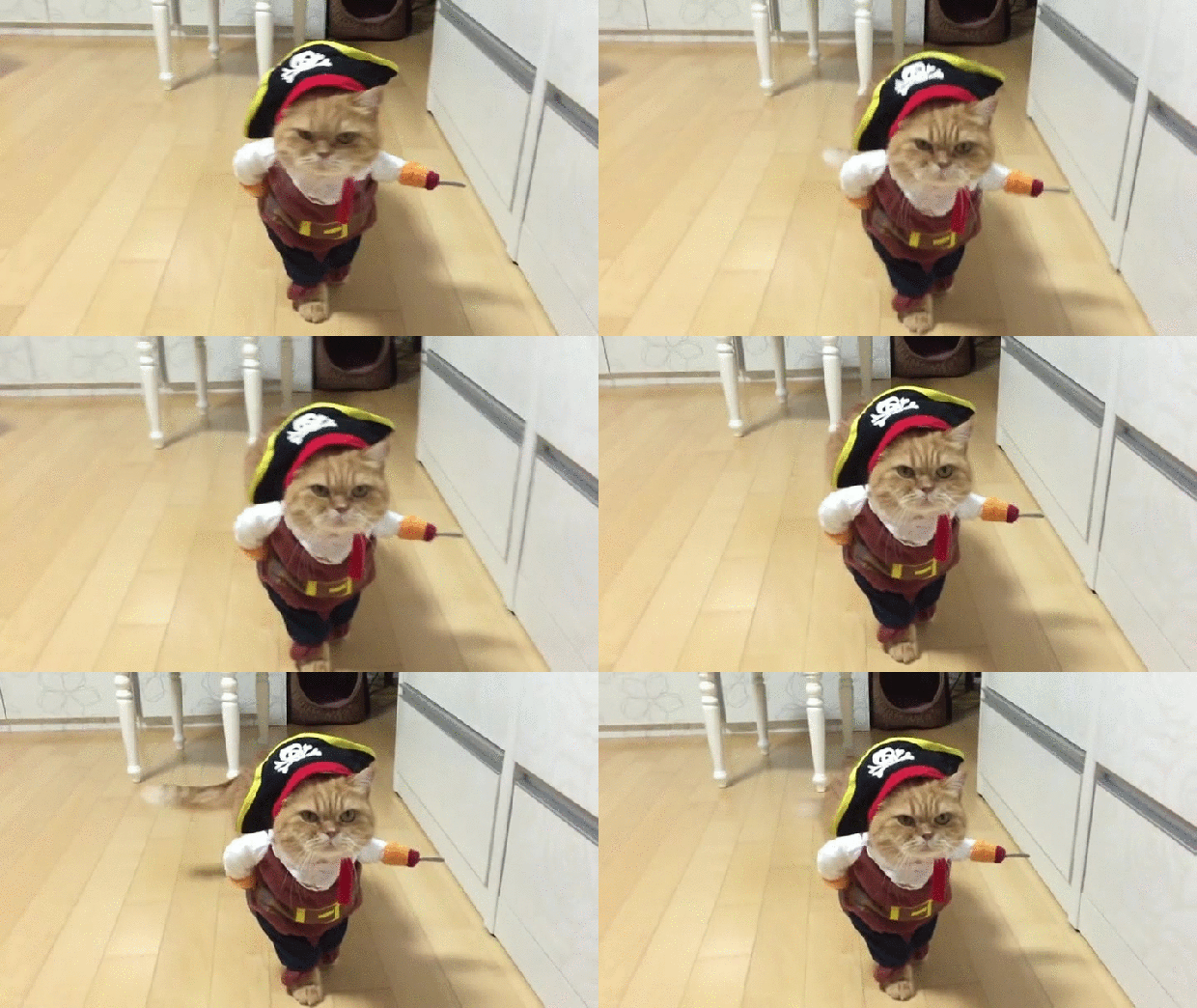
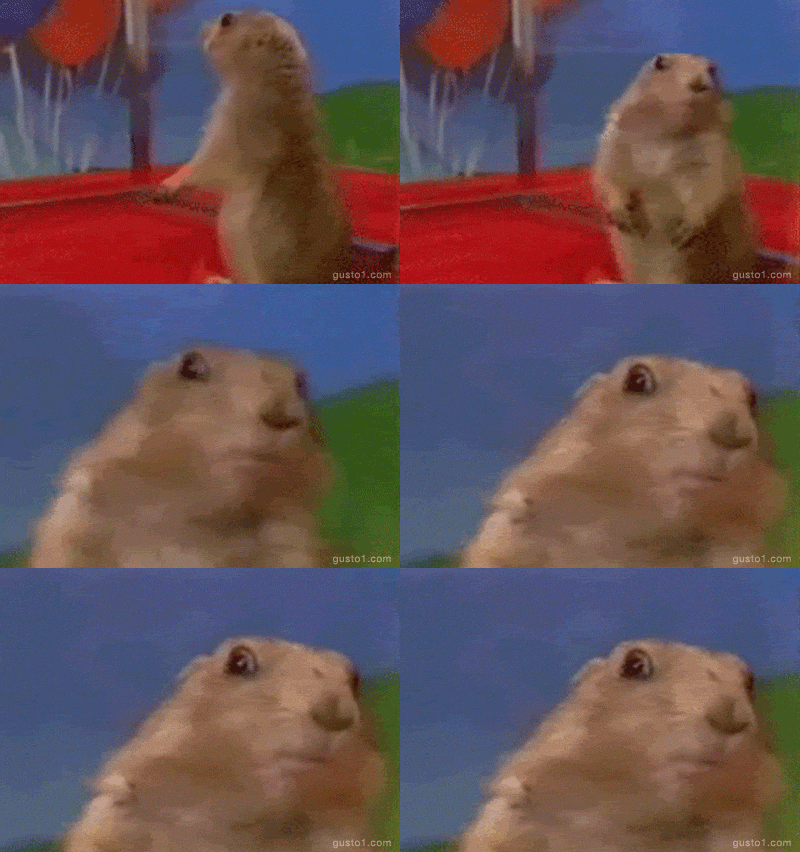
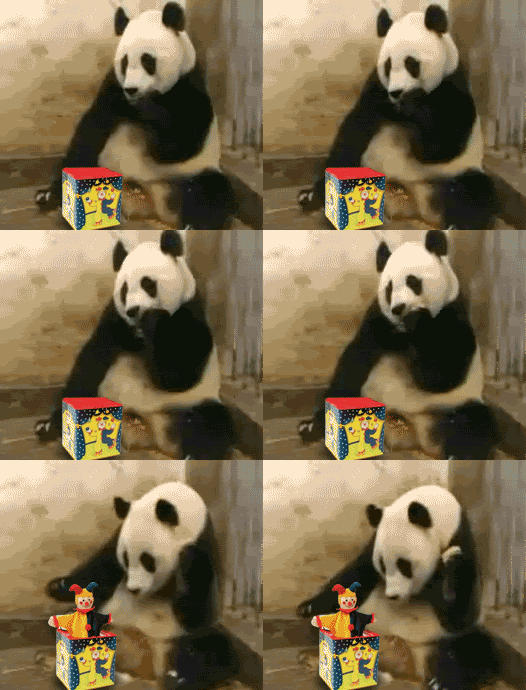
There’s nothing the internet loves more than funny animals. And by ‘funny animals’ I mean animals behaving like us humans. What could possibly be funnier? It feels like we’ve all pored over the cat who thinks he’s a pirate, the gopher with the evil look and the sneezing panda since time began. But it’s easy to forget that Youtube is only 11. The internet meme is in its infancy.  
But picture books are not. Ever since John Newbery published A Little Pretty Pocket-Book, picture books have understood, like no other medium, the comic potential of the right animal doing the wrong thing. All the way from the White Rabbit and Jemima Puddle-Duck to The Tiger Who Came to Tea and Gorilla. More often than not, there’s a funny animal at the centre of our favourite tales. Each generation seems to find their own unique slant on the joke, whether it’s greedy pandas peddling donuts or vicious bears trying to locate their hats. The funny animal is the comic gift that keeps on giving.


Four years ago, James Catchpole sold my first picture book to Dial Books. While waiting for it to come out, I have:
Married.
Moved house three times.
Realised that I love mayonnaise.
And written my first blog post (you’re reading it, hope it’s going okay!)
Amongst all that, I’ve also been reading and writing as much as I can in the hope of learning ‘The Art of Picturebooking’. And whilst, as James will tell you, I’m still very much in Key Stage 0, I have noticed an increasing number of funny animals creeping into my texts. One features an octopus learning to swim, another a bear as a detective. It seems I’m succumbing to the power of the funny animal. Whilst I’m fully embracing this as a good sign that I might be making some progress, it has made me wonder: when did animals start being funny?

There’s a small scrap of Ancient Egyptian papyrus in the British Museum, dating from the 13th Century BC. It was drawn by a scribe, for sale to ordinary Egyptians outside his local temple. What’s unusual about the papyrus, is that it depicts a cow sitting on a plow, as if she were a farmer rather than a farmyard animal. According to Daniel Antoine, one of the curators at the British Museum, Egyptian texts are full of exactly this kind of imagery. Seeing animals performing human activities was one of the Ancient Egyptians’ all-time favourite gags. It had them LOL’ing and RROTFL.
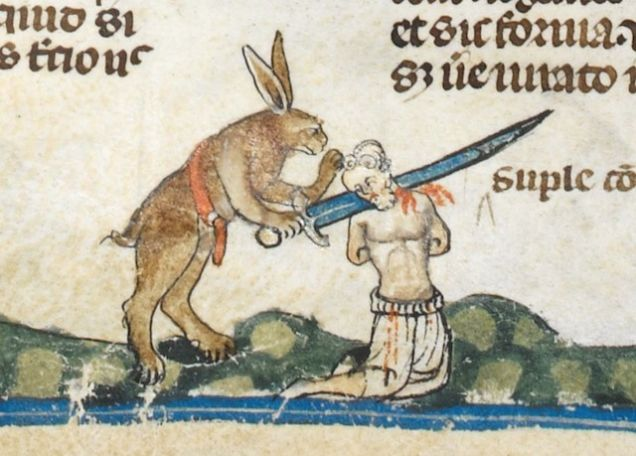
Daniel directed me towards further papyri (yes, apparently that’s the plural) where I found lions playing board games, wolves heading to the shops and cats shepherding ducks. And funny animals didn’t stop there, in medieval marginalia they seem to specialize in dark humour. [Left]

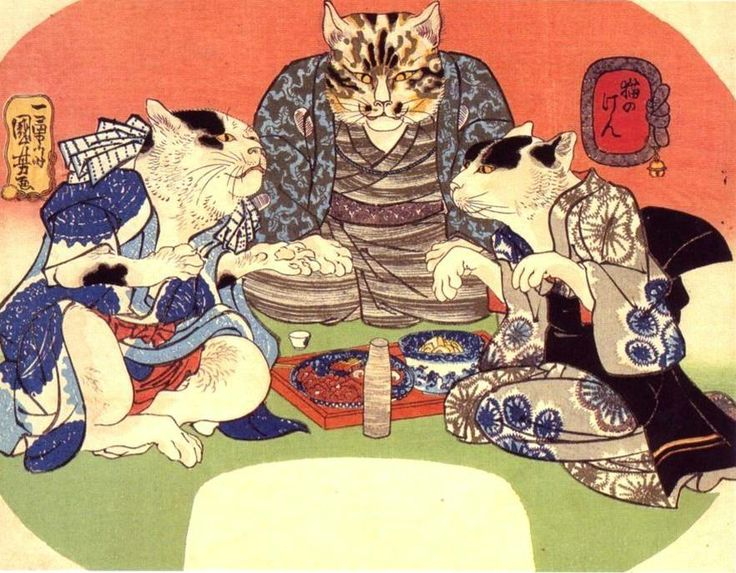
And by the 18th century, Japanese artist Utagawa Kuniyoshi seems to have already perfected the cat joke. [Left a bit, down a bit]


Whilst the funny animal isn’t regarded the world’s oldest recorded joke (that’s widely credited to be a Sumarian corker about farting) it’s very, very close. One man’s papyrus is another man’s Youtube. Funny animals have been making humans laugh for at least 5,000 years, and presumably much, much longer (before papyrus or papyri).


I guess almost all of us would count our sense of humour as one of the things most personal to ourselves, one of the things that makes us who we are and the primary reason we love the people we do. It’s quite amazing to think that we have this bond in common with our most ancient ancestors. We could have shared a good laugh with them over the picture of a cow and a plow in 5,000 BC or by showing them any number of fantastic, funny animal picture books published in 2016.
Isn’t that a nice warm feeling? Let’s bask for a moment in the amazement of inter-generational-super-connection…
Ahhhh…

But it does pose a more serious question: “Why, after all that time, are we still picking the very same animals to be funny? For five millennia ducks, dogs, frogs, cows, cats and pigs have been getting things all their own way. Sure, they’ve been a hoot, but isn’t it time to draw a line? Shut the pen? And close the barn door? Wouldn’t it be a good idea to try some new animals for a change? Don’t you think?!” It was at this point that Daniel from the British Museum stopped replying to my emails. He’s obviously part of the funny animal conspiracy. I had no idea how deep it ran.
Regardless, it’s time to make a change. All of us gathered here have the unique opportunity to end thousands of years of subjugation. That’s why, right here, right now (drum roll please) I’m launching ‘The Campaign For Getting More Weird Animals, Things Like Marmots And Poison Dart Frogs, Onto Our Papyri, By Which I Mean Children’s Books’, or ‘TCFGMWATLMAPDFFOOPBWIMCB’.
Granted, it could do with a catchier name. Perhaps we can think of a new one at the first annual meeting, taking place at The National Hystrix Sanctuary.
For the next 5,000 years, bring on the musk ox, the capybara and the skink.
To kick things off @eoinmclaughlin will be tweeting a 142 character funny animal story every day this week, featuring a very deserving, obscure animal. Just leave your favourite weird animal in the comments.

Eoin’s first book, This is NOT a Bedtime Story is coming soon from Penguin Random House (Dial Books). More to follow from Walker and Bloomsbury.

Saturday, 17 October 2015

Turning your family into animals by Jane Clarke

In the fifteen years I’ve been writing picture book texts, I’ve turned most of the members of my family into animals by matching up a trait of theirs with an animal that can be used to exaggerate it. Often this is just in my head, and incidental to the story, but occasionally the match up has made a book:


My dad hated to go to the dentist - and as a result had a couple of false teeth.  I turned him into the grandpa walrus who is persuaded to go to the dentist and in Tusk Trouble, illustrated by Cecilia Johansson.


One of my sons was prone to very impressive temper tantrums when he was small - he’s Trumpet, the Little Elephant with the Big temper, illustrated by Charles Fuge. 


My other son never could resist a dare - he's the racoon in Creaky Castle illustrated by Christyan Fox.


And me? I’m quick to panic, so I’m the squawking hen in Stuck in the Mud illustrated by Garry Parsons.


Have you turned any of your family into animals? Let us know if you have - and if you haven't -  why not have a go? 


Jane's latest picture book, illustrated by Charles Fuge - and inspired by her baby granddaughter.

Friday, 14 February 2014

Unleash Your Inner Rabbit by Jonathan Allen


A few years ago, oh all right, more than a few years ago, I did a drawing workshop as part of day at Andover Library (I think it was there. . .). Anyway, it was concerned with drawing animals in a kid's book style, working from some stuffed animals the museum service had available. It was quite fun, and some nice drawings resulted. But it wasn't the results that made it interesting for me, it was the change of viewpoint it triggered. It made me look at what I do from an outsider's perspective and begin to see it as a process to be explored objectively.

Drawing for children's books, in my particular niche at least, is about simplifying. About reducing something to its essence and expressing that in a few lines. The interesting thing about this process is, that the essence you are reducing something to has as much to do with shared preconceptions as it has to do with physical reality.

I'll give an example of this in context. I was doing some drawing on a big flipchart while on a school visit, and as a bit of fun, I tried an experiment. Before I began to draw I asked the children to shout out as soon as they knew what animal I was drawing. I quickly drew two basic sausage shapes, sticking up vertically.


That was all that was needed. "Rabbit!" was the immediate response. I drew a long tube, thicker at one end, with an inverted 'v' at the thin end,


"Elephant!" came the cry almost immediately. They didn't need many visual clues at all. Some of them even got "Giraffe" straight away from one ear and the two knobbly bits on it's head, I didn't even have to draw the long neck!


So what were they responding to? I think it was the idea of the particular animal that they were recognising. The shared concept of what a rabbit, for example, 'looks like' - what makes up a satisfactory rabbit according to our learned preconceptions. This shared concept would have been absorbed from children's books, cartoons and any other second or third hand manifestations of the collectively agreed Rabbit we carry within us, that they would have been exposed to. Some of it might have come from exposure to real rabbits, but not much.

Current scientific thinking seems to indicate that this mental process is a basic part of how the brain copes with the complexity of the visual world, by categorising and storing information into 'templates' to hold visual input up against, and guaging the relative importance of that visual input etc.  We interpret the world on a 'need to know' basis, and our 'need to know' rabbit has -

1 - Big, sticky-up ears.
2 - Two prominent front teeth, though not 'fangs'.
3 - A white fluffy tail.

Which is why, in a Children's book, as long as a character has those attributes, it doesn't matter what shape or colour it is, what size it is, or whether it talks, wears clothes, or drives fork lift truck, everyone knows it's a Rabbit. Of course it is!

featuring my 'inner, need-to-know fork lift truck'. . .


Tuesday, 4 June 2013

My Illustration Style – A Brief History – only not so brief, sorry. . . by Jonathan Allen


As an illustrator amongst a gaggle of writers I guess I'd better post something about illustration. So here goes.

I'll write about influences, subject matter and how I came to be doing what I do another time, OK? If you don't know my work, (gasp! is such a condition even possible!?) I draw appealing, funny animals in a simple 'cartoony' (for use of a better word) style.
Today I'm going to talk about my drawing process and how it came about.

This is a rather ropey but fun little video I put together of my current process in action. Dig the music ;-) Sorry it ends rather abruptly, this vid making lark is a bit of a learning curve.


Some history - I started off drawing simple outlines of said funny animals and background trees, windows etc, truncated by the edge of the frame. Colouring the resulting shapes with flat poster paints in bright colours straight out of the pots. It looked quite nice, in a bold, abstract, graphic sort of way, and I got a commission to do a couple of cards for Gallery Five in this style while I was still at college, which was encouraging.

This kind of thing, though these were done a few years later

But this flatness became very limiting, so by a process of good old trial and error, the flat colour evolved into a more subtle watercolour/gouache wash in naturalistic colours over/under the same simple outlines.

This was pretty good, but not quite right, so by dint of further trial, error and evaluation, the addition of cross hatching with a finer pen - to help define form and texture, was settled on. This worked well and after a touch more refining, became my 'style'. Phew. . .


This was one of my first illustration jobs, for Gallery 5


My procedure was this, I started off with a pencil rough, which I either copied or traced onto artboard. I added wash to that, then, when it was dry, I drew a pen outline using the ubiquitous Rotring pen. I then added the cross hatching using a thin version of said rotring pen. This was Ok but the pen would clog frequently, as anyone who used rotrings and their ilk would affirm. Still, it worked and was successful so this was my preferred method for years.


From my first picture book, 'Guthrie Comes Clean', 
published by J.M Dent, way back. . 


Until the mid nineties. . . drum roll. . . swiss roll. . . iced bun. . .
It was then that I became attracted to the idea of using a computer to make my artwork on, as this had just become possible at a more or less consumer level. I didn't want to use it to make computery looking fancy stuff, (that was SO naff, even then) but to draw and paint directly into the computer in my usual style, using a graphics tablet and a bit of software called Painter, which imitated 'natural media' such as water colour, digitally. It sounded interesting, and, well, I just liked the idea for some reason.
So I took the plunge and bought a Mac (a 7100 I think it was called. I still have it in the attic. No idea why. . . ) a Wacom tablet and some software, and thus equipped, set to work learning how to use it all. It was fun actually. I like working things out. Usually. My work is essentially coloured-in drawings as opposed to painterly creations utilising the characteristics of the medium, so the computer could get pretty close to my fairly unexpressive line and wash style.

From 'Fowl Play' one of the first books I did on computer for Orion

The advantages were that unlike 'real' artwork, everything was editable. I could change the size of things, tweak the colours and thickness of line, etc., which was great, especially when working out page layouts, etc. Also, artwork didn't need to be scanned, which was nice for me because it always annoyed me that a scanner would show pencil lines that as far as I was concerned had been erased as they were invisible to the naked eye. Publishers always defended this by saying that the scanners were so 'good' that they picked up everything. A strange definition of the word 'good' I always thought. So good they can pick up things you can't even see! . .. fah!
The disadvantage was that nobody in the publishing industry knew what the heck they were getting or what to do with it. I wasn't exactly an expert either. The main point of contention and concern was that as the artwork only existed on screen, the colours varied according to what screen it was being viewed on. Calibration was important. Everyone had to be confident that they were seeing the same colours as each other as there was no actual bit of artwork to compare the printers proofs to.
I wasn't ever so popular ;-) But we got there in the end. The publishers and printers knew that the repro industry was well on it's way to being digitally led and that they had to adapt.

Baby Owl, conceived and created on computer

I've worked on computer ever since. A lot of artists now scan their work in and modify it in Photoshop. And a lot of artists use Adobe Illustrator, which lets them produce resolution independent images, funnily enough using flat colours and simple outlines like my ancient poster paint images did. It's just normal now but I remember those pioneering days. . . One day I shall sit my grandchildren round the fire and tell them tales of the days when men were men and a megabyte was something significant. And they will fall asleep in seconds flat. . .