
During a
school visit, have you ever been talking about your writing process and a great
top tip for writing... and then found yourself thinking “what a great idea! I should do that.” ? And you realise that you’ve
not actually done it (or that your writing process has strayed away from what
you’re describing) recently…
Maybe I’m
the only one, but I suspect not. And the time around World Book Day, usually the busiest time of the year for author visits, is a good time to listen
carefully to what you’re saying to others and making sure that you practise
what you preach.
I am currently
going into one school for two days a week over a five-week period, where
amongst other things, I am practising and discussing mindfulness with the
children and how mindfulness can help us in our everyday lives and when we are
writing. Jess Mikhail (who illustrated Two Brothers and a Chocolate Factory) is
doing the same with illustration.

I'm lucky enough to be working on a mindfulness and writing/art project with Jess Mikhail, after having worked with her on Two Brothers and a Chocolate Factory: The Remarkable Story of Richard and George Cadbury, above.
I have
practised mindfulness, on and off, over the last twenty five years, and it’s
been extremely useful, but I hadn’t used it much over the past ten years and
not deliberately when writing.
One of the
things we’ve focused on a lot in the school is making mistakes and taking risks
and trying to encourage children to embrace their mistakes and feel better
about making them. If you’re afraid to get things wrong, you’re unlikely to
take risks in your work (or life) because of the fear of failing at something.
So we’ve been using mindfulness to try and feel better about getting things
wrong.
There’s a
great clip for children from Kung Fu Panda that deals simply with trying to
remain present. It might feel a bit corny to an adult but it’s quite easy to
grasp and the children pick it up pretty easily:
Clip from Kung Fu Panda (directed by Mark Osborne and John Stevenson)
And one way
of feeling ready to take risks and make mistakes is by being in the present –and
not worrying about the past (how you felt when you made mistakes before) or the
future (what might people think of you if you do something that’s wrong?).
So I’ve
shown them my very messy, rough plans for my stories –on messy paper, where I’m
not censoring my ideas but getting everything I’m thinking down onto paper before I try and actively shape it. And I
talk about how it not being in a beautiful notebook makes it easier for me not
to worry about messing up something that’s clean and fresh and beautiful.

Scrappy planning for a picture book of mine, which I share with surprised (and amused/horrified) children.
I’ve given
them each a lovely clean sheet of blank A4 paper and then got them to scrumple
it up, jump on it, rip it and then use it so it feels less like something that
it would feel bad to make a mistake on. And then we’ve
made deliberate mistakes on the page –it can be surprisingly hard to write your
name wrong, but we do, and then we write sentences where the structure is
clearly wrong –and then talk about how we feel about doing it.

Children writing their own names wrong and coming up with sentences that are grammatically wrong, on scrumpled up and jumped on paper...
And they
love the book, Beautiful Oops, by Barney Saltzberg, which celebrates the
mistakes we makes and shows us how to make the most of them
Beautiful Oops, by Barney Saltzberg
So I hope we’re
now at the point where the children are feeling more inclined to take risks and
make mistakes in their writing and art throughout the rest of the project –and beyond.
But am I
practising what I preach?
Well, in
terms of being messy and writing on big scrappy paper and not censoring my
thoughts as I’m planning, then yes. That’s definitely how I work. And taking
risks? Every time I show my work to anyone –whether it’s my agent, my editor or
another writer, I’m taking a risk. All authors do it -so yes, again. But in
terms of being mindful and trying to be present as much as possible, especially
when writing?
I’ve tried.
Since we arranged the project many months ago and whilst I’ve been thinking
about the project, I have tried to be practise mindfulness with my writing more
often. With my most recent story, I actually tried a different way of writing the
first draft of the manuscript –with mindfulness very much in mind.
I am writing
a picture book on a very sensitive subject. It’s a story about a girl whose
older brother gets sick and then dies. There are all sorts of expectations
about the book and I do feel a real responsibility to get it right as the
people who will read it will be very vulnerable. Whilst I was researching the
book, interviewing bereaved parents and doing creative work (for their own
books) with bereaved and pre-bereaved siblings, and with young people with
life-limiting conditions, I made no notes for my story at all. But I immersed
myself in what I was doing and tried to be as ‘present’ as I could be. When it
came to writing the first draft, I did make a scrappy mind map one morning
(between 6 and 7 am, when I can focus best, without distraction)

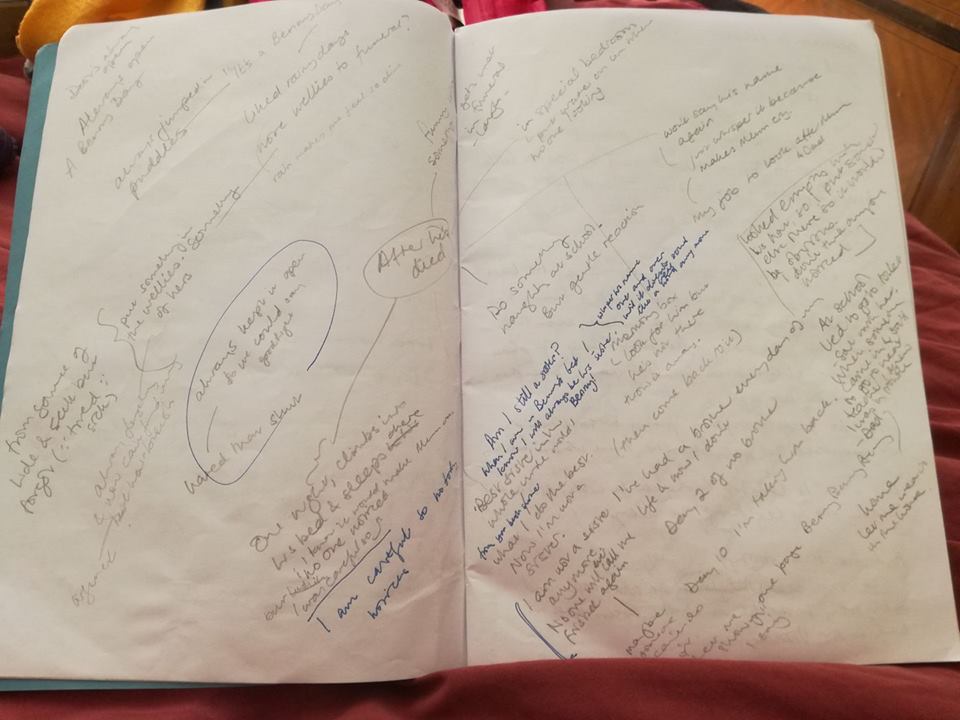
and then the
following morning, I wrote my story. But the story felt fragile and I’d
deliberately not thought about it too much. I wanted to be as focused as I could
without distraction so I tried something new:
I wrote it
in the dark.
I had to
have just enough light so that I could see that I wasn’t writing lines directly
on top of other lines, but I only even glanced down at the unreadable page when
I’d got to the end of each line, just to be sure there was some space between
the lines:

Written in the dark (at what turns out to be a not very horizontal angle)
And the
results?
In terms of
focusing on the present, and reducing distractions (as we’re trying to
encourage the children to do), I was much better able
To focus: I
don’t visualise things so in the dark, I don’t have any images or colour and I can’t
be distracted by seeing any objects around me
To keep
going: I couldn’t read what I’d written so I wasn’t immediately being
distracted from my task of keeping on writing by being tempted to edit words or
phrases that I’d just written
Not to worry
about mistakes: because I couldn’t see
them!
I can find
myself easily distracted when writing but practising mindfulness and being able
to focus like this actually worked really well for me. And interestingly, the
story written this way has needed far less editing than a lot of my stories.
School
visits are valuable in many ways, but this school project has been helpful in an
unexpected way: because of the particular project I’ve really had to go away
and practise what I preach. And for me, at least, it’s worked.
Have you
tried any unusual ways of writing –as an experiment, or so you can focus
properly? Or have you tried other things to help you focus? And how have school
visits helped you as an author? Please leave a comment, below.
www.julietclarebell.com


