Showing posts with label Abie Longstaff. Show all posts

Monday, 17 July 2023

Top Tips for New Picture Book Writers - Lynne Garner and Friends

I'd planned to write a post where I shared my top tips for those new to picture book writing. I'd written my first paragraph when I decided to include some helpful links from the Picture Book Den.  However, it soon became clear I would be repeating advice already given and perhaps not as eloquently as other members of the PBD team or our guests. So, I decided to pick a few posts which I hope new picture book writers will find helpful.

So in no particular order

Writing Retreat - Abie Longstaff (includes advice on how to shape your story) 

Abie Longstaff - www.abielongstaff.com/

An Acrostic of Patience - Chitra Soundar

Chitra Soundar - http://www.chitrasoundar.com/

How Not To Write a Rhyming Picture Book - Juliet Clare Bell


Juliet Clare Bell - www.julietclarebell.com

Checking Roughs - a Vital Picture Book Author Skill - Moira Butterfield

Moira Butterfield - www.moirabutterfield.co.uk

Writing (Picture Books) As a Business - Natascha Biebow


Lynne Garner - https://lynnegarner.com/

I hope you find these useful and if you have any tips yourself please do share. 

Monday, 29 June 2020

Adapting to picture book life online


With events in book shops, libraries and schools cancelled, I’ve been curious to find out how some of my friends and colleagues have been adapting their picture book lives.

Pippa Goodhart

Pippa’s been wearing her fantabulous empathy glasses for Empathy day online events.


 She’s also busy reading stories including Daddy Frog and the Moon as part of a project with Cambridgeshire Libraries.

A bigger picture book online project was taking part in Puffin Random House’s Big Dreamer Festival that ran for a full week online. " Nick Sharratt was the artist in residence, every day drawing big dream ideas sent in by children. The first session of the festival gave the world premier of Nick and my You Choose Fairy Tales which was to have been published in March, but is now scheduled for September. But if anybody wants to see it all, and to hear Nick and my choices for each spread, here’s the link


Abie Longstaff

Abie’s made the move to live online events.


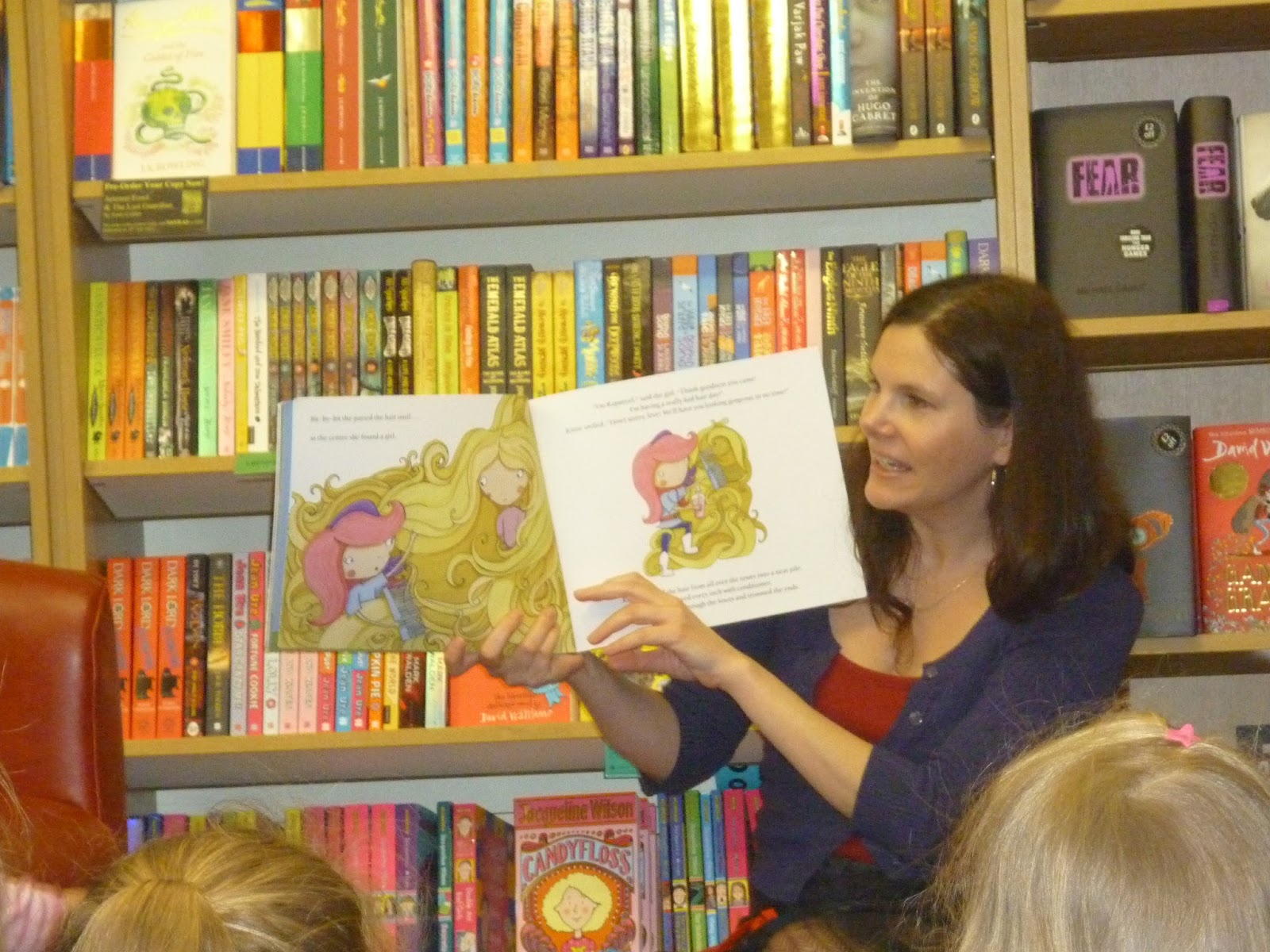
“I’ve done a few live events now. At first it was surprisingly stressful, more stressful than a real life reading. I think the worries about the tech and broadband signal were factors, but there was also the feeling of talking into empty space that was initially very intimidating. In a real life event you see the children laughing or nodding along, and there are so many opportunities for interaction. With a live event on for example, Facebook, you can't see your audience and that makes it hard, particularly when your books are aimed at little ones. I've finally got into the swing of it now though and I really enjoy them. It's lovely to have the events stored online, and it means that far more people can see your event. I've had people emailing from all over the world who would never normally be able to come to a Fairytale Hairdresser reading. The online events feel more inclusive - people from all backgrounds and abilities can attend and it's lovely to be part of a movement like that.’"

Here's a link to her Book Nook Q and A


Garry Parsons

"I've been spending more time online than ever before. Launching a picture book during lockdown requires almost immediate responses, so I find I'm constantly checking and updating, which at first was distracting but now feels like a new normal. I'm not a natural with social media so it has been an interesting learning curve, finding ways to interact and get attention online and I've spent a lot of time making things to be downloaded.  I'm used to talking and drawing at live events but that has changed to attempts at recording myself (awkwardly) talking to camera, announcing drawing prizes and taking live drawing sessions on Zoom. It feels like the picture book has evolved a necessity to have a multi-media and multi-sensory experience attached"


Natascha Biebow

Since the beginning of March, I've done many more virtual school visits and have become more confident about my presentations, even when tech fails and I have to resort to show and tell. Some of these had over 100 second and third graders! It is really fun to interact with them and to be able to feel that maybe your book is connecting with young readers stuck at home.
SCBWI was quick to respond to the needs of teachers, librarians and parents at home, creating a huge pool of online resources by published members: SCBWI Connects. As well as submitting existing resources to this initiative, I also created new ones, prompted by online initiatives that I could link up to, like  Outdoor Classroom Day.


Inspired by fellow SCBWI members, who created the fabulous Our Corona Diary project, I made a video about how to make a Crayola Doodle Keepsake Diary.

 Possibly my biggest challenge was to create an acceptance speech video when THE CRAYON MAN was awarded the Irma Black Award for Excellence in Children's Books in early May.

It was so exciting, but sadly the awards ceremony in NYC had to be cancelled. It turned into a three-day video project which I filmed and created with the help of videographer son who was fortuitously, well, AT HOME!  Filming in your garden with ever-changing light and cheeping birds is one thing, but there's no accounting for the 'studio quiet' you need when the other stay-at-home neighbours are doing PE homeschooling next-door.... And the dog decides to walk into the frame also.


Gareth P Jones

"This year I have done lots of new things. I’ve uploaded interactive short stories, readings and virtual festival performances. I’ve found that those connected with existing events (Camp Bestival, Wychwood & The Summer Reading Scheme) have fared better than those I did independently. I am gradually moving towards virtual school visits. My assemblies were always based around questions from pupils so I have been asking schools to send me questions. Then I record a rambling reply to all of these, which is working OK. But my favourite online project has been a collaborative song performed with authors around the UK in support of bookshops."

Clare Helen Walsh 

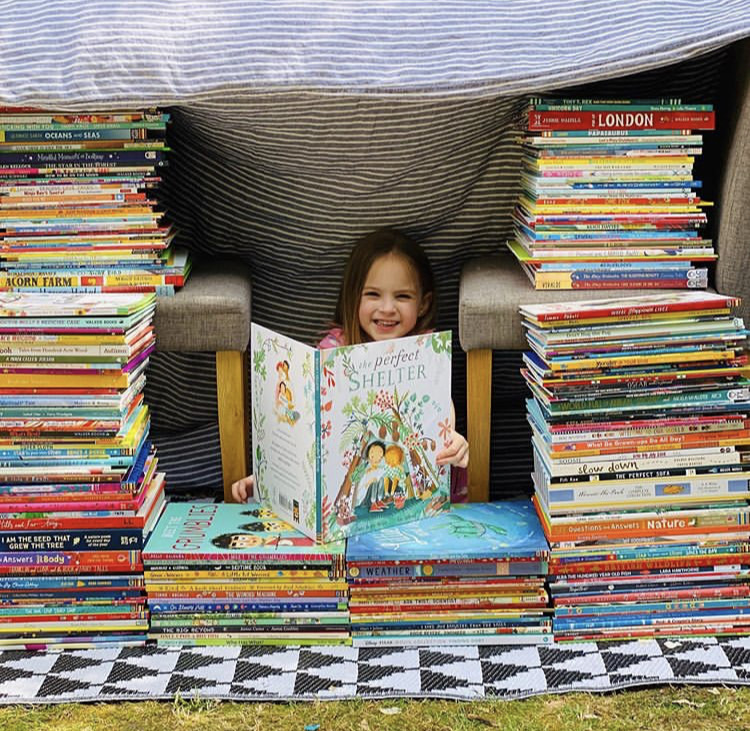
Clare has had not one but two picture books published during lockdown, and says she’s been forced to think more creatively about how she ‘launches a book’ and interacts with little readers and their families. For the publication of ‘How Selfish!’, Clare planned a virtual duck race! And for ‘The Perfect Shelter,’ people were invited to post photos of their dens and take part in a community collage.


If you’re inspired to hold your own virtual event, you can find out more information here https://clarehelenwelsh.com/2020/04/13/dot-and-duck-are-back/#more-2294 and here https://clarehelenwelsh.com/2020/06/25/the-perfect-shelter-publication-day/ Clare says that working digitally was a challenge at first, but definitely means more people have been able to join the fun!

Lucy Rowland

Lucy did a Skype visit with a school in Switzerland. 


She says "Benji slept best when he was on me at that time so I had him in the carrier. It all went really well except that Benjamin was sick all down my top but the teacher assured me that the class didn't notice! Phew! "

Addy Farmer

I’ll leave the last words to Addy Farmer, a picture book writer, mentor and a Local Network Organizer for the Society of Children’s Book Writers and Illustrators (SCBWI).
"Before the lockdown, most of my writing interactions were with my physical SCBWI group. In the PPE (pre pandemic era) we met once a month at the University of Lincoln for book chat and to critique picture book texts and writing for older children and it was lovely and supportive. Now, we still meet once a month for book chat and crit but the fact that it's online has somehow endowed it with added support - maybe it's the fact of being alone but together. 

There are drawbacks to meeting virtually; not everyone enjoys using the technology or even being seen on screen; the technical hitches; the getting used to talking in turns rather than the more free flow conversations in 'real life'. I'd recommend Google meet over Zoom simply because the former has no time limits. Once we got over the initial technical hitches and established talking protocols, the virtual get-together has worked well.

In the PPE, I started meeting my picture book crit partner, Liz Miller, online. Back then, it was a fantastic boost to my writing - in terms of upping the quantity and quality of my picture book texts. Now, it is also even more of a joy to meet and talk texts. If you can get it, this close writing support is a treasure beyond measure.   


So, whatever happens, find your people and enjoy whatever means of talking you can; even if it means that you spend the entire session upside down. Critical friends are good for your writing and your heart, especially now."

Absolutely, Addy! Keep well y'all x


Jane Clarke's been reading her picture books online for her granddaughters, contributing a fun Al's Awesome Science session for the Silly Squad Summer Reading Challenge, and has been so busy Zooming, Skyping, WhatsApping and Facetiming, she's been finding it hard to get any writing done :-)

Monday, 11 November 2019

Writing a Bedtime Book by Abie Longstaff

My son was a brilliant sleeper.  He was such a chilled baby that he could nap anywhere. I used to take him along to art classes in the pram, lay a coat over him and he’d soon be snoring. Then along came my daughter. She was a little ball of anxiety; colicky, wriggling, crying. She wanted constant back-patting, warm reassurance. And, no; she did not like going to sleep.
If I were placing a curse on my worst enemy, I would give them a baby who did not sleep. It’s a hidden problem – you drag yourself around like a zombie and no one knows quite how exhausted you feel: tired to your very bones. If you also have a toddler, add to this the need to be smiley and bouncy and present for your older child. Every day you hope this will be the night the little one sleeps, every evening you do all the right things – the bath, the calm singing, the back patting. But invariably your hopes are crushed as the second you sneak out of the room, the cries start up. It’s tough going. All you can do it ride it out.
As my daughter grew, together we read a big pile of sleepy baby books. They brought great comfort: for me in knowing that mine wasn’t the only child who wanted to stay up and play; for her in seeing her behaviour mirrored in a picture book. She wasn’t naughty, she just wanted adventures or reassurance.
We loved Goodnight Moon (Margaret Wise Brown), How do Dinosaurs say Goodnight (Jane Yolan and Mark Teague) and Dr Seuss’s Sleep Book, and our absolute favourite was The Baby Who Wouldn’t Go to Bed by Helen Cooper. 


Of course, my own baby grew up. Then my sister called in a state of utter exhaustion – her little one wouldn’t sleep. It took me back to those tired days, and all the wonderful bedtime books. I decided to create something sleepy and soothing. The result was Who’s going to Bed? (illustrated by Eve Coy).
So, how do you write a good bedtime book?
Concept:
Of course every picture book needs to be interesting and engaging, but there’s a fine line to walk here – don’t aim for too much excitement. You want to find a comfortable level: a bit of adventure, but in a familiar environment. Think of sleepy feelings: swinging, flying, floating, rocking and try to set your story around these. In Who’s Going to Bed, I chose familiar story characters – teddies, animals, pirates, knights - to create a comfortable, recognisable world.

Text:
You need to find a rhythm to your text, something almost lyrical to lull a child to sleep. Repetition, sibilant sounds, soft consonants, long vowels. I’ve included words like ‘sleep’, ‘yawn’, ‘shhhh’, ‘tired’; and increasing their frequency of use toward the end of the book. 

Pictures:
Illustrator Eve Coy has used a limited palette of sleepy blues and greens – there are no loud, sharp colours here. She’s created something soft and gentle and magical. 

The End:
With a bedtime book, you don’t want the end to be too funny or surprising. The aim is to settle and soothe. You want something safe – concepts like home, kiss goodnight, parents, duvet, bed, snuggling, cuddling. And if you can, try to bring the focus onto the reader, rather than the story characters.

I’ve had lovely messages from parents saying their child is yawning at exactly the right moments! I hope the book brings comfort and pleasure. Most of all, I hope the book brings sleep.

Visit Abie's website to find out more about Abie and her wonderful books https://www.abielongstaff.com

Monday, 28 May 2018

Where do you get your ideas from? by Lucy Rowland

In April, Lynne Garner wrote a blog post for Picture Book Den called ‘Having Fun Making Stuff Up’.  She spoke about attending a writing retreat with the Scattered Authors Society.  During the retreat, Lynne took part in a workshop where she was encouraged to use drawing as a way to generate ideas for picture books.  http://picturebookden.blogspot.co.uk/2018/04/having-fun-making-stuff-up-lynne-garner.html

As many authors and illustrators know, one of the most popular questions we get asked is….‘Where do you get your ideas from?’ and it can be quite a tricky question to answer because the truth is ideas really are everywhere! And yet, I still find it interesting to hear what people say.  Their answers often make me realise how a method that works for one author or illustrator might not be the best approach for another.  But it also shows there is no right or wrong way to find ideas.


At the London Book Fair this year, I was excited to attend a talk from our Children’s Laureate, Lauren Child.  As part of her laureateship, Lauren wants to encourage people to ‘let children dawdle and dream’.  She wants to set up a challenge on her website for people to ‘Look Down’ and notice, as they walk around, the small, forgotten or misplaced items on the floor and to consider what the story around these objects could be.  It reminded me of another post by Lynne Garner where she challenged Picture Book Den readers to make up a story based on some of the objects she’d photographed on a walk. http://picturebookden.blogspot.co.uk/search/label/Lynne%20Garner?updated-max=2017-10-23T07:00:00%2B01:00&max-results=20&start=3&by-date=false 


I once heard author, Tracey Corderoy, speaking at a Nosy Crow ‘Picture Book Master Class’.  For Tracey, looking through illustrators’ work and finding interesting characters can spark her to wonder ‘what could this character’s story be?’   Picture book author, Lou Carter, also told me that she often writes a story around a character.  The character is very much the starting point for her.  I found this really interesting as it’s something I rarely do.  Perhaps it’s because I’m not such a visual person?  Maybe this is also why I don’t use drawing to come up with new ideas?


I often get my ideas because I like to play with words.  My first book ‘Gecko’s Echo’ (with illustrator Natasha Rimmington) came about simply because I liked the sound of these words together.  Next year, I have a second book coming out with Ben Mantle- I can’t reveal what it is called just yet but it also has a rhyming title that very much inspired the story and, again, this came about from playing with language.   Mine and Kate Hindley’s latest book, ‘The Knight who said No’ was initially about a viking (rather than a knight) and this idea came to me when I was playing around with the words ‘The vikings are striking!’


I’ve always loved rhyme and rhythm.  Sometimes I find rhythms that I particularly enjoy and I see if I can write a story around that rhythm.  For example, I love the rhythm in ‘Bad Sir Brian Botany’ by A.A.Milne:


‘Sir Brian woke one morning and he couldn’t find his battleaxe;
He walked into the village in his second pair of boots.
He had gone a hundred paces, when the street was full of faces,
And the villagers were round him with ironical salutes.’

I mean…What a fantastic rhythm!!

I was in Australia when I re-read this poem and that evening I was looking at the fruit bats in the trees.  I then asked myself that very important question that we often ask ourselves as authors and illustrators…WHAT IF?  ‘What if there was a fruit bat who didn’t like fruit?...what would happen then?’
And I wrote around the Sir Brian rhythm as a challenge to see if I could do it.

‘Once there was a fruit bat and the fruit bat’s name was Jeremy.
Jeremy had always felt he didn’t quite belong.
No he wasn’t like the others and his sisters and his brothers
Used to look at him and giggle ‘cause he always got it wrong.
And worst of all were mealtimes. Jeremy just dreaded them.
His brothers and his sisters used to think it was a hoot!
See it isn’t very easy when your dinner makes you queasy
And Jeremy refused to try a single bite of fruit.’


I use the ‘what if’ question a lot during my school visits.  What if it really did rain cats and dogs? What if you woke up and your teachers had turned into zombies? What if children ruled the world? (Cue loud cheers from the class!)  The children are generally fairly excitable by this point but I then encourage them to come up with their own ‘what if?’ ideas and their suggestions are truly brilliant! In fact, I might have to steal some of their ideas myself!

Further investigation into where people find inspiration taught me that Abie Longstaff sometimes uses the childhood games she played with her younger sisters as ideas for stories. Juliet Clare Bell uses the artwork hanging on her walls. Penny Dolan once wrote a guest blog for Picture Book Den and put it brilliantly…’Picture books are a pleasure to write once you’ve got an idea.’  One of the places she gets inspiration is from the schools themselves when she is doing school visits.  http://picturebookden.blogspot.co.uk/search?q=penny+dolan 


Ideas really do come from many different places and you might find that you have certain tendencies or preferences when hunting for your own?  So….Where do you get your ideas from? 

Monday, 22 May 2017

Time Goes By • Abie Longstaff

I love picture books that give a sense of time moving - especially those where the seasons change in the background.

In 'Dear Daddy' by Philippe Dupasquier, Sophie writes to her father who is away at sea.


It's a very sophisticated picture book. Using a clever split-scene layout, it shows us both Daddy's and Sophie's world, and deals with complicated conceptual ideas of time. Children can see that the seasons change for Sophie but not for her father, who is in a different time-zone. All this is accomplished in remarkably few words due to Dupasquier's busy, detailed illustration style.

This was one of my favourite pages. It shows the split screen of the season where Sophie is, and above where her dad is. My sisters and I loved it because we grew up in Hong Kong, which is depicted in the upper section.

Across the Fairytale Hairdresser series, Lauren Beard and I do have the seasons change, but I've never managed it in one single book - and I'd love to try!

It's summer in The Fairytale Hairdresser and Aladdin

And winter in The Fairytale Hairdresser and Father Christmas
For me, the most beautiful book showing seasonal change is 'I am a Bunny' by Ole Risom and Richard Scarry.


My mother read this book to me, and I read it to my own children. It is a perfect example of a simple, yet exquisite, picture book - one where poetry meets art. I find it almost meditative in quality and very moving. Nicholas, the bunny, has a real appreciation for his world, and the illustrations reflect this:


I suppose I'm thinking about seasons, and change, because I'm moving on from the Picture Book Den. I've loved being a part of the Den for years now and I'm sorry to go; but it feels right to have a change. I'm sure I'll be popping up somewhere else soon but for now: thanks to my fellow Denners, and to readers of the blog.

See you around! :)

Monday, 28 November 2016

Author Technology by Abie Longstaff

How do you use technology for writing?

Lots of my author buddies use Scrivener - writing software that allows you to organise notes and research alongside your manuscript. Many of my friends extol its virtues but, because my books are shorter than theirs, I've never felt the need to use it.

In fact, at first I thought I didn't use technology at all for writing:

I scribe longhand in notebooks, recording every idea in case one comes in useful later.


I scribble out my plots by hand

I research at the library or by reading through my own groaning shelves of picture books


Yep I thought, except for the final write up in Word, I can get by without technology at all.

I tapped through my phone feeling quite zen and satisfyingly Luddite. Only - up popped Twitter and Facebook and Blogs and my stash of Bookmarks and I realised that yes I do use technology for picture book writing - I use the internet. And I use it at every stage of the process.

1. For inspiration

I flick through the Comedy Wildlife Awards for photos of foolish animals
I use Google Images - eg I might simply type in 'penguin' to see if anything visual sparks an idea.
I have Pinterest boards to store ideas for my books - my Fairytale Hairdresser one is here and looks like this:


2. For research:

If I want fairy tales I use Sur la lune, which has a wonderful forum as well as research notes on each tale.
For myths I often visit Seven Miles of Steel Thistles.
Then, of course, there's the high-level scientific research we authors routinely have to do:


3. For writing advice:

I look on forums and sites like
SCBWI
Notes from the Slushpile
Author Allsorts
Girls Heart Books

4. For promotion

I use my Twitter and I follow the Picture Book Den Twitter
I use my Facebook
my website
and I blog here on Picture Book Den as well as other sites as a guest.

I follow a whole range of wonderful blog and book review sites such as
Serendipity Reviews
Story Snug
Nayu's Reading Corner
Heather Reviews
Tales of Yesterday
Luna's Little Library

So I guess I'm not as much of a Luddite as I thought!

What about you - what technology do you use for writing?

Abie Longstaff's latest picture book is The Fairytale Hairdresser and the Princess and the Pea.

Monday, 29 August 2016

Monday, 30 May 2016

Creation or Promotion? Is there time for both? by Abie Longstaff

I've been really busy with work recently. But not with writing; with events.

I love doing author events: school visits, literary festivals and bookshop readings. It gives me a buzz to meet children, hear their ideas, share stories and help them with their creative writing. But it takes its toll. It’s exhausting. There's the panic of
Will my train be on time?
Will the school’s technology be compatible with mine?
Will anyone come to the bookshop?
(see Michelle Robinson’s excellent list of other things to panic about - here)

In day-long school events I might run up to six sessions for Reception to Y6. So when I finally make it home I tend to crumple on the sofa for the rest of the evening.

There’s been a lot of talk about author events in the book world recently, including a fantastic post on author fees by Nicola Morgan, and an article in the Guardian on the budgeting pressures faced by literature festivals.

Pay is an important issue. Events are hard work and we should be compensated fairly for our time. But some events don’t pay (eg bookshop events); while others pay but not quite enough to reflect the work you put in (lit fests). Then there’s the wider question of promotion in general – hours spent (unpaid) on social media, blog posts, press articles.

As authors, how do we balance promotion and creation? How much time should we spend selling the product rather than making it?

Some authors see promotion as very much part of their role. I know a writer who does lots of free events, puts her own money and time into marketing her books and works incredibly hard on promotion. I know another writer who hates promotion – she devotes all her time to writing and, for her, the best way to sell books is simply to write more (and better) books.

There are a growing number of lit fests across the country, umpteen bookshops keen to have an author visit and oodles of book blogs to post on. A writer could spend the entire year doing shows, bookshop readings, articles and guest blogs - but every day spent doing promotion is one fewer in which we could be writing.

How do we know if the time we spend promoting is worth it? And what does ‘worth it’ even mean? There’s the financial angle: selling books, promoting your brand. There’s the enjoyment angle: connecting with children, seeing the impact of your book on the world. There’s also a doing-good factor: maybe you’ll help a child learn to love books, or help a library stay open.

A very wise person, author Liz Kessler, devised a clever 'is it worth it?' formula (her post about it is here). She’s listed the upsides and downsides of events, and devised a scoring system to weigh the pluses against the minuses.
You score the following (each has a different maximum value):
Sales (S) – out of 10
Payment (P) – out of 5
Word of mouth W) – out of 3
Time (T) – out of 10
Cost (C) – out of 3
Enjoyment (E)– out of 3
Good cause (G), ie where it’s for charity – out of 3

Then her formula goes:
(S + P + W) must be greater or equal to (T + C – E – G)

I like Liz’s formula and I often use it when considering doing an event. But of course, it’s just a guide and you have to factor in your personal preferences - for example, because I love doing events I allow myself to score the enjoyment out of a higher number than 3. And I might consider the good cause to be particularly worthy, thus worthy of being allotted more than 3 points. Also - sometimes the value of the event isn’t apparent until after it’s over. A few weeks after one of my lower-selling events I got a letter from a little girl saying how much she loved the book she had bought that day. That alone made it worthwhile.

But the scoring system is a useful guideline and I’ve never come up with a better one.

What about you?
How much of your time do you want to devote to promotion?

How do you decide which events, paid or unpaid, to give time to?


Tuesday, 1 March 2016

Is this the real life or is this just fantasy? by Abie Longstaff

I love fantasy - any kind of fairy tales, mythology or crazy invented wackiness.

But I also chortle when a book manages to reference real life.

I loved the use of 'Henopoly' in Chicken Nugget (Michelle Robinson and Tom McLaughlin)


This poster in Spaghetti with the Yeti (Charlotte Gillain, Adam Gillain and Lee Wildish) made me laugh with its X Files reference:


And who could fail to giggle at a line of royal underpants in The Queen's Knickers (Nicholas Allan)?


Lauren Beard and I try to squeeze as many real life references as we can into our fairy tales. In the latest Fairytale Hairdresser, Beauty and the Beast, we've got:

Art references:


Literary references:


And even a nod to musical genres


But can you guess which musical style/performer each outfit represents? And, more importantly, can you please settle the row between my husband and me - is Number 1 Rude Boy or Pete Docherty?