Showing posts with label picture book inspiration. Show all posts

Monday, 28 November 2022

Sometimes You Have To Try On Different Trousers: How to Revamp Nonfiction Picture Book Ideas


I’ve Been Trying on Different Trousers  . . .


In the past few years, I’ve written four new nonfiction books.


I began them with gusto. I love true stories. Those nuggets of facts that make you go ‘wow, really?!’ have me dancing round the house to find someone who will listen to my latest discovery. I also love detective work, even if it means going to great lengths to fact-check and dig for missing links or get in touch with an expert.


But then those manuscripts didn’t sell. So I went back to the drawing board.


I read. I did more research.  


I was searching for a new way to grip the reader (and editor). One that would ‘fit’ the story in a different way.


I asked myself:


Was there another way in to tell this story? Could I change the point of view? Could I include different facts? Could I change the style of nonfiction or the target age group?  Could I make it longer, shorter, with sidebars, more back matter or . . .?


According to bestselling nonfiction author, Melissa Stewart, I was shopping for a new text structure. It’s like shopping for a pair of trousers (pants, if you’re American), she says.


“When we shop for pants, we usually know what purpose we want them to serve. Are they for playing sports? Relaxing around the house? Going to a fancy party?”


Authors have to figure out what they’re most excited to share with readers.  They have to rule out pants that are the wrong colour, size or fit. Pants they don’t like. Pants that are not fit for purpose.


Text structures are patterns that help us to arrange and connect ideas so young readers can “access, understand and remember information more easily.”

In the case of narrative nonfiction, they are an important part of the voice and way IN to the story.


Melissa Stewart has identified seven structures:


Description:

Sequence /Chronological Sequence

List

Compare & Contrast

Cause & Effect

Problem- Solution

Question & Answer


Finding the right text structure is like building
the right frame for a house - it can really make a book!

Once you rule out some structure types that instantly don’t seem like a good fit, you eventually get to the point where you have to try them on to see which fits best. That’s where mentor texts can really help. Looking at other picture books with a critical eye and acting like a detective can be useful to reassess what kind of structure would work best on your book. In their book, 5 Kinds of Nonfiction: Enriching Reading and Writing Instruction with Children’s Books by Melissa Stewart and Marlene Correia, the authors suggest looking at the same topic with different text structures. For instance FROGS. When you do this, it's amazing how many different approaches you can find for exploring just one topic in a children's nonfiction book! Lots of different structures, lots of different lenses.
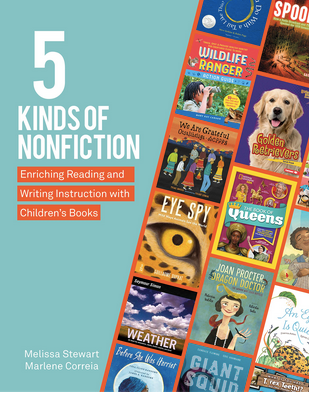
 

Kinds of Nonfiction: Enriching Reading and Writing Instruction with Children’s Books
by Melissa Stewart and Marlene Correia
 

Sometimes, you need another element as well – a personal connection to the story, an a-ha! nugget that will really hook young readers and make them take notice. You have to write and rewrite to figure out and understand what your book is really about and why it matters. Is it surprising to you? Does it make you think in a new way?


When even when I finally find the right fit, the right pants, I also need to personalize them – I need to check: why am I writing this story?  


Melissa points out that there are other structures that imaginative authors have invented to fit the topic. For example, in SWIRL BY SWIRL: SPIRALS IN NATURE by Joyce Sidman and Beth Krommes, the text starts with examples that are small and snug; these get bigger and spiral outward and finally curl up again for the ending – just like a spiral. 


In one of my favourite recent nonfiction picture books, WHAT’S IN YOUR POCKET? COLLECTING NATURE’S TREASURES by Heather Montgomery and Maribel Lechuga, Heather tells stories of what famous scientists’ collected and kept in their pockets as children – and links how these later led them to make important discoveries as grown-ups. 
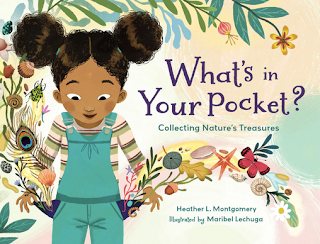


For instance, Diego Cisneros-Heredia, kept snails, slugs, scorpions and lizards in his pockets – and later discovered more than thirty new species of frogs. And Bonnie Lei collected tide pool creatures and later studied sea slugs and even found a new kind!
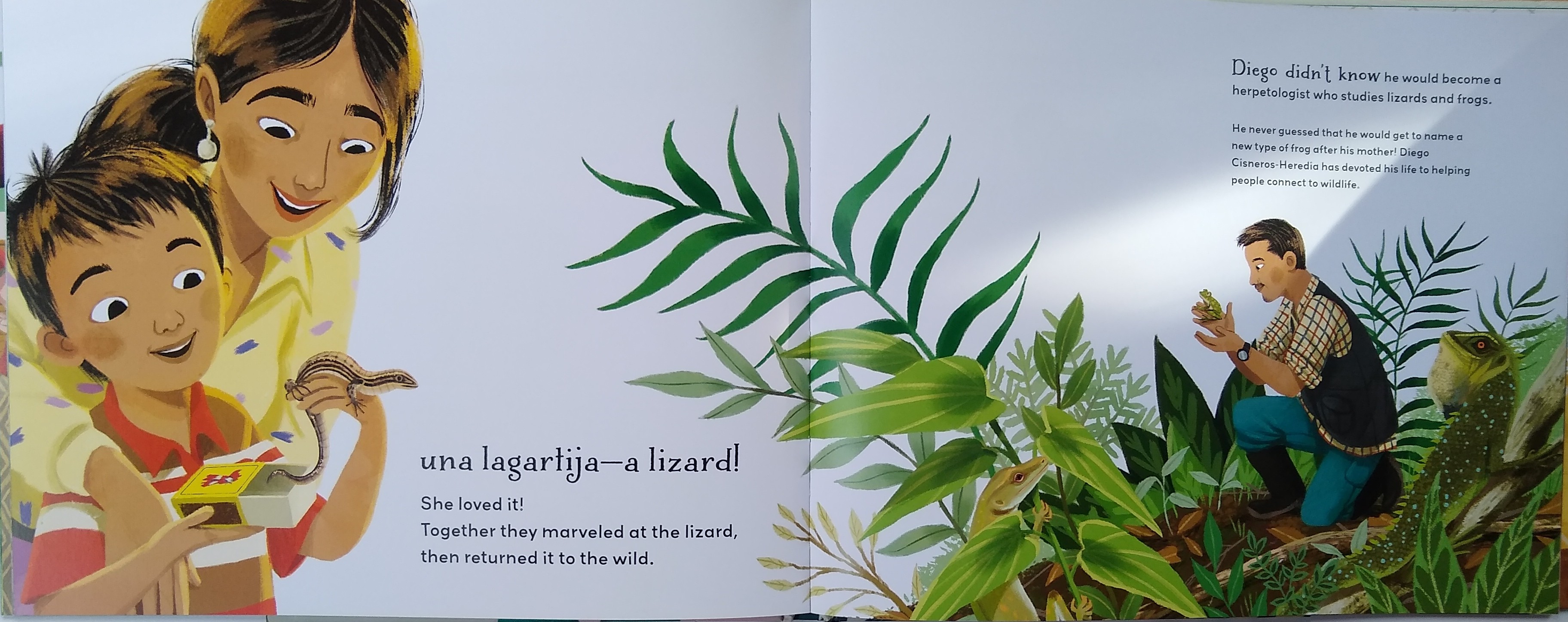
 

From What's In My Pocket? by Heather Montgomery and Maribel Lechuga

From What's In My Pocket? by Heather Montgomery and Maribel Lechuga

Heather Montgomery cleverly makes each figure relevant to young readers by tapping into a universal childhood love for collecting and outdoor play – and cleverly links this to how they were growing science skills that would lead to a lifelong passion working in the field.


This is what I am hoping to somehow create for each of my nonfiction book ideas. But how?


LOOK really closely at your topic. Look for:


• patterns

• key vocabulary words

• how do you want to make the reader FEEL?

• links to children’s lives and interests!


The hardest part? Keeping it SIMPLE and not being tempted to jam in everything!


I am inspired by Melissa Stewart’s tales of how it can take a long time to find the right structure and sell a book to an editor. For instance, it took her from December 2010 to December 2014 to get the manuscript for Can an aardvark BARK? accepted.  In this time, she experimented with four different structures!


https://www.melissa-stewart.com/timelines/timeline_aardvark/timeline_aardvark.html

Perhaps there is hope for my ideas and revised stories yet. I’m not giving up!


_________________________________________________________________


Natascha Biebow, MBE, Author, Editor and Mentor

Natascha is the author of the award-winning The Crayon Man: The True Story of the Invention of Crayola Crayons, illustrated by Steven Salerno, winner of the Irma Black Award for Excellence in Children's Books, and selected as a best STEM Book 2020. Editor of numerous prize-winning books, she runs Blue Elephant Storyshaping, an editing, coaching and mentoring service aimed at empowering writers and illustrators to fine-tune their work pre-submission, and is the Editorial Director for Five Quills. Find out about her new picture book webinar courses! She is Co-Regional Advisor (Co-Chair) of SCBWI British Isles. Find her at www.nataschabiebow.com

Monday, 28 May 2018

Where do you get your ideas from? by Lucy Rowland

In April, Lynne Garner wrote a blog post for Picture Book Den called ‘Having Fun Making Stuff Up’.  She spoke about attending a writing retreat with the Scattered Authors Society.  During the retreat, Lynne took part in a workshop where she was encouraged to use drawing as a way to generate ideas for picture books.  http://picturebookden.blogspot.co.uk/2018/04/having-fun-making-stuff-up-lynne-garner.html

As many authors and illustrators know, one of the most popular questions we get asked is….‘Where do you get your ideas from?’ and it can be quite a tricky question to answer because the truth is ideas really are everywhere! And yet, I still find it interesting to hear what people say.  Their answers often make me realise how a method that works for one author or illustrator might not be the best approach for another.  But it also shows there is no right or wrong way to find ideas.


At the London Book Fair this year, I was excited to attend a talk from our Children’s Laureate, Lauren Child.  As part of her laureateship, Lauren wants to encourage people to ‘let children dawdle and dream’.  She wants to set up a challenge on her website for people to ‘Look Down’ and notice, as they walk around, the small, forgotten or misplaced items on the floor and to consider what the story around these objects could be.  It reminded me of another post by Lynne Garner where she challenged Picture Book Den readers to make up a story based on some of the objects she’d photographed on a walk. http://picturebookden.blogspot.co.uk/search/label/Lynne%20Garner?updated-max=2017-10-23T07:00:00%2B01:00&max-results=20&start=3&by-date=false 


I once heard author, Tracey Corderoy, speaking at a Nosy Crow ‘Picture Book Master Class’.  For Tracey, looking through illustrators’ work and finding interesting characters can spark her to wonder ‘what could this character’s story be?’   Picture book author, Lou Carter, also told me that she often writes a story around a character.  The character is very much the starting point for her.  I found this really interesting as it’s something I rarely do.  Perhaps it’s because I’m not such a visual person?  Maybe this is also why I don’t use drawing to come up with new ideas?


I often get my ideas because I like to play with words.  My first book ‘Gecko’s Echo’ (with illustrator Natasha Rimmington) came about simply because I liked the sound of these words together.  Next year, I have a second book coming out with Ben Mantle- I can’t reveal what it is called just yet but it also has a rhyming title that very much inspired the story and, again, this came about from playing with language.   Mine and Kate Hindley’s latest book, ‘The Knight who said No’ was initially about a viking (rather than a knight) and this idea came to me when I was playing around with the words ‘The vikings are striking!’


I’ve always loved rhyme and rhythm.  Sometimes I find rhythms that I particularly enjoy and I see if I can write a story around that rhythm.  For example, I love the rhythm in ‘Bad Sir Brian Botany’ by A.A.Milne:


‘Sir Brian woke one morning and he couldn’t find his battleaxe;
He walked into the village in his second pair of boots.
He had gone a hundred paces, when the street was full of faces,
And the villagers were round him with ironical salutes.’

I mean…What a fantastic rhythm!!

I was in Australia when I re-read this poem and that evening I was looking at the fruit bats in the trees.  I then asked myself that very important question that we often ask ourselves as authors and illustrators…WHAT IF?  ‘What if there was a fruit bat who didn’t like fruit?...what would happen then?’
And I wrote around the Sir Brian rhythm as a challenge to see if I could do it.

‘Once there was a fruit bat and the fruit bat’s name was Jeremy.
Jeremy had always felt he didn’t quite belong.
No he wasn’t like the others and his sisters and his brothers
Used to look at him and giggle ‘cause he always got it wrong.
And worst of all were mealtimes. Jeremy just dreaded them.
His brothers and his sisters used to think it was a hoot!
See it isn’t very easy when your dinner makes you queasy
And Jeremy refused to try a single bite of fruit.’


I use the ‘what if’ question a lot during my school visits.  What if it really did rain cats and dogs? What if you woke up and your teachers had turned into zombies? What if children ruled the world? (Cue loud cheers from the class!)  The children are generally fairly excitable by this point but I then encourage them to come up with their own ‘what if?’ ideas and their suggestions are truly brilliant! In fact, I might have to steal some of their ideas myself!

Further investigation into where people find inspiration taught me that Abie Longstaff sometimes uses the childhood games she played with her younger sisters as ideas for stories. Juliet Clare Bell uses the artwork hanging on her walls. Penny Dolan once wrote a guest blog for Picture Book Den and put it brilliantly…’Picture books are a pleasure to write once you’ve got an idea.’  One of the places she gets inspiration is from the schools themselves when she is doing school visits.  http://picturebookden.blogspot.co.uk/search?q=penny+dolan 


Ideas really do come from many different places and you might find that you have certain tendencies or preferences when hunting for your own?  So….Where do you get your ideas from? 

Monday, 23 January 2017

Beyond the Doughnuts by Nicholas John Frith (Guest Blogger)


Published in the UK
by Alison Green Books, 2016
Welcome to our guest at the Picture Book Den: author and illustrator Nicholas John Frith. His first book, Hector and the Hummingbird, had us grinning and won the Klaus Flugge Prize for most exciting newcomer to picture book illustration in 2016. Now Nicholas muses (or in his words, ‘brain spews’!) on his second book, Hello Mr Dodo!

I’m not entirely sure where the idea, for my latest picture book, Hello, Mr Dodo!, came from. But it was all in there somewhere, when I was reading a newspaper article about the discovery of a flightless bird, in New Zealand, that had previously been considered ’extinct’; watching 'The Hunter', the Willem Defoe movie, about the rumour of the last Tasmanian Tiger and the planned exploitation of it; growing my interest in birds and the natural world; and reflecting on my own childhood summers.

Hello, Mr Dodo! is pretty new to the shelves, but I am pleased when I hear people are noting the underlying themes of the story, beyond the bright doughnuts and advertised ‘friendship’ tale. Many of those themes were influenced by my thoughts on the material listed above and are what really drove the project forward within me.

“Martha was cuckoo about birds.”


That’s how the story begins. And from the very first draft, that’s how it always began. I love a bit of word play. At one point there were a good handful of bird-related puns in the text. Although they didn’t all make it past my editor (Alison Green), it was a still bit of a lark!

The story didn’t change much during the process of making the book. It always began and ended pretty much the same way as it does. With only the timings of when Martha realises the bird is actually a dodo, and the where-and-when of the secret being let slip, shifting in the narrative.

As I dug deeper into the history of the dodo, I realised just how little was known about them. How much of it was vague, and how almost mythical they were. And therefore, how interesting liberties could be t
aken with the dodo, without stretching the truth too far.

They didn’t have to be living in Mauritius – as they had been put on boats by the Dutch. They could love eating doughnuts – as no one can disprove that they’d love these sweet fried treats! 


One thing about the dodo ‘character’ that was paramount to me though, even within his friendship with Martha, was that ‘Mr Dodo’ remained a bird, an animal. Despite Martha’s engagement.


With the artwork, I wanted to embrace the opportunity to use bright spot (pantone) colours again, as I had with my debut, Hector and Hummingbird. And the summer setting was perfect for this. The dodo was a joy to draw too and I’m particularly pleased with his partially vacant demeanour.

When I start imagining the artwork for a book, I start imagining the entire book. The endpapers, the size, the paper type, the layout, the title page, the typography, and the extras. Extras that add another dimension to the book (and the story), like the KNOW YOUR BIRDS page at the back of Hello, Mr Dodo! or the SPOT THE JUNGLE ANIMALS in Hector and Hummingbird.

And I try to think of the feeling I’d have if I were holding the final book in my hands. 


Endpapers: Hello, Mr Dodo!
I strive to put across this importance, of the book as a whole. About how it makes us feel, as well as the story in the words.

If it were up to me I’d love it if the ‘lead’ edition of my books were always hardbacks.

Talking of hardbacks… Hello, Mr Dodo! will be published (in hardback) in the USA later this month, by Arthur A. Levine Books. Which I’m excited about.

Anyhow.

Thanks to Picture Book Den for the opportunity to brain spew (my words, not theirs) on their blog. It’s really just been snippets of reflection on my latest book.
Cheers
Nicholas

One last thing… A good friend of mine recently mentioned that, since reading Dodo, his young son now starts on, incessantly, about wanting doughnuts each time he sees an image of a dodo! So, I’m sorry, if this happens to you too. But the fact is, dodos love doughnuts! Ask Martha, she’ll tell you the same.

Thursday, 26 November 2015

Tweak or Give Up? - Some dodgy advice from yer uncle Jon - by Jonathan Allen


Finally sending an idea out to an agent or a publisher is always an act of faith. Faith in your own ability and in your own judgement. The trouble is that when ideas get turned down it can make this faith seem completely misguided. . . That depends on your mental resilience of course. I always say, somewhat flippantly, that there are two ways people react to rejection, one is to conclude that they are total rubbish and have rubbish ideas, and the other is to take the attitude that 'the fools don't appreciate my genius'!
The latter is probably better for your sanity, but rather too close to delusion perhaps, and the former is just defeatist.
Having faith in your own judgement is a big part of being a writer, (and any other kind of creator or maker) and that faith is a fragile thing so you have to look after it ;-)
Easier said than done, I know.
Rejection is part and parcel of being a writer, it's not pleasant, but its a fact of life and has to be accepted as such otherwise no one would ever send their precious ideas out into the world at all.

So us writers and illustrators work hard on our ideas, tweaking and revising to make them into something a publisher can look at and see how they would work as books. The difficult bit is knowing when an idea has reached that point, knowing when to stop tweaking the idea and submit it. Knowing when to jump. . . Is it underworked or overworked? Too loose or too prescriptive?

You hope you have worked hard enough and got the idea as 'right' as you can get it because once something has been turned down, you can't really tweak it and send it in to the same person again to see if they like it with your added 'improvements'. They won't have the time or patience for that.
There are no doubt exceptions to this, but generally, if a publisher or agent is interested in an idea they will make some allowances, and will often suggest ways to make it work better if such is needed. If they aren't interested, they won't be willing to spend their precious time analysing it and telling you why it doesn't appeal.


So, do you tweak your idea and send it to someone else?
The trouble is, it is impossible to know why an idea gets rejected. There may be two people in a meeting who are mad about it, but three who weren't keen. There may be two really good ideas on the table and only one slot in the Spring list, so someone has to lose out. Or it may be because your idea is rubbish and nobody in their right mind would touch it with a barge pole. . . It's unknowable, so really it's not useful to speculate too much. Also, to complicate things still further, your 'improvements' might not enhance the idea at all, and the next person to see it may have preferred the first or untweaked version had they seen it. . . Or not. . . You could drive yourself nuts with this stuff.

So really, you have to put the effort in and have faith. Get an idea to the point where you like it and you think it 'works', then let it go knowing you have done your best. If it doesn't find a publisher, move on. You will keep having ideas.


Some might be rubbish ideas, as writers can easily be too close to an idea to fully judge its value, and of course the last thing you'll have wanted is to have spent your precious time and energy in the ultimately futile pursuit of a rubbish idea. But on the other hand, often the only way you can get an idea to the point where you can make some kind of judgement of its worth, is by putting the time and energy in and seeing how it turns out. 'Wasted' time is a given. It's part of the deal.

Only you can decide if your continued faith in an oft rejected idea is misplaced. You may get a flash of inspiration and find the perfect way of making your idea work, or you might find that you have just added more wasted time to time previously wasted. Are you being laudably persistent or are you flogging a long dead horse? I've been in both situations so I can't really offer useful advice on how to tell the difference other than by the result, or lack of it.

Basically I think we are all winging it and hoping for the best, argubly from an increasingly informed perspective as time goes on, but don't quote me on that. ;-)

Good luck btw. . .


Wednesday, 2 September 2015

Is Winnie the Pooh in jail (and how did Roo escape)? Moira Butterfield

I’ve been writing some children’s city guides for Lonely Planet, and while doing so I discovered the whereabouts of the real Winnie-the-Pooh. He left the Hundred Acre Wood behind long ago and, along with his friends Eeyore, Piglet, Kanga and Tigger, he’s been living in New York, along with David Bowie (that‘s two of my biggest heroes in the Big Apple now).

Pooh and his crew are living on 42nd Street, in the Children’s Center of the New York Public Library, and not everyone is happy about it.

The UK Times pointed out that “Winnie the Pooh is not just a reference to a fictional bear, but to a national concept of a childhood Eden." Ironically (I expect) echoing Greece’s demands for the return of the Elgin Marbles from the British Museum, the thundering editorial called for this “plundered piece of history” to be returned to live in a purpose-built museum in the Ashdown Forest in East Sussex (the inspiration for the Hundred Acre Wood).

Meanwhile America’s Newsweek described the toys as “being in prison” (they are in a bulletproof glass case), and called Winnie “the Elvis of stuffed toys”.  The Library denies any possible emotional toy trauma issues, saying the world-famous stuffed stars “are as happy as when they lived in the Hundred Acre Wood.”  All pressure has been resisted to repatriate the “Furry Five”, even after PM Tony Blair apparently discussed it with President Bill Clinton back in the day.


The story goes that Winnie was bought from Harrods in London, along with his stuffed friends, and given to Christopher-Robin Milne as a young boy. He played with them up the age of nine or so, during which time his journalist father A. A. Milne created imaginary stories about them. In 1947 the US publisher of the books visited the home of the Milnes and saw the toys. Smelling a commercial opportunity he asked for the toys, and soon they were winging their way to the offices of US Publishers E. P. Dutton & Co, eventually to be donated to the New York Public Library in 1987.

Any thoughts of a crying bereft boy would be wrong, however. Christoper-Robin Milne apparently readily agreed to them leaving, saying he was an adult now and had left childhood behind. Now that's sad. 

Little Roo, perhaps sensing the upcoming rejection, is not with the others because he was “lost” in an apple orchard in the 1930s. I expect he hopped off while he still could. I wonder what he's up to these days...

The New York Public Library assure us that Winnie and friends are looked after very well in their new home. They get vacuumed and repaired regularly. During a recent repair (the library said they were ‘going for spa treatment’) they were replaced on display by…Wait a minute! What’s this? They were replaced by the original umbrella and carpet bag that inspired Mary Poppins, once owned by author P.L. Travers. The Library have that, too! Call the PM immediately!


I wonder if any of you have found writing inspiration from an object that you or your children/young relatives own. If so, tell us about it, and please, please take care of it!

Moira has a series of new history books, Britain in the Past, for ages 6-8, published by Franklin Watts. Somewhere in her Dad's loft there are some Roman coins picked up in childhood. 

www.moirabutterfield.com
@moiraworld