Showing posts with label creative nonfiction picture books. Show all posts

Monday, 28 November 2022

Sometimes You Have To Try On Different Trousers: How to Revamp Nonfiction Picture Book Ideas


I’ve Been Trying on Different Trousers  . . .


In the past few years, I’ve written four new nonfiction books.


I began them with gusto. I love true stories. Those nuggets of facts that make you go ‘wow, really?!’ have me dancing round the house to find someone who will listen to my latest discovery. I also love detective work, even if it means going to great lengths to fact-check and dig for missing links or get in touch with an expert.


But then those manuscripts didn’t sell. So I went back to the drawing board.


I read. I did more research.  


I was searching for a new way to grip the reader (and editor). One that would ‘fit’ the story in a different way.


I asked myself:


Was there another way in to tell this story? Could I change the point of view? Could I include different facts? Could I change the style of nonfiction or the target age group?  Could I make it longer, shorter, with sidebars, more back matter or . . .?


According to bestselling nonfiction author, Melissa Stewart, I was shopping for a new text structure. It’s like shopping for a pair of trousers (pants, if you’re American), she says.


“When we shop for pants, we usually know what purpose we want them to serve. Are they for playing sports? Relaxing around the house? Going to a fancy party?”


Authors have to figure out what they’re most excited to share with readers.  They have to rule out pants that are the wrong colour, size or fit. Pants they don’t like. Pants that are not fit for purpose.


Text structures are patterns that help us to arrange and connect ideas so young readers can “access, understand and remember information more easily.”

In the case of narrative nonfiction, they are an important part of the voice and way IN to the story.


Melissa Stewart has identified seven structures:


Description:

Sequence /Chronological Sequence

List

Compare & Contrast

Cause & Effect

Problem- Solution

Question & Answer


Finding the right text structure is like building
the right frame for a house - it can really make a book!

Once you rule out some structure types that instantly don’t seem like a good fit, you eventually get to the point where you have to try them on to see which fits best. That’s where mentor texts can really help. Looking at other picture books with a critical eye and acting like a detective can be useful to reassess what kind of structure would work best on your book. In their book, 5 Kinds of Nonfiction: Enriching Reading and Writing Instruction with Children’s Books by Melissa Stewart and Marlene Correia, the authors suggest looking at the same topic with different text structures. For instance FROGS. When you do this, it's amazing how many different approaches you can find for exploring just one topic in a children's nonfiction book! Lots of different structures, lots of different lenses.
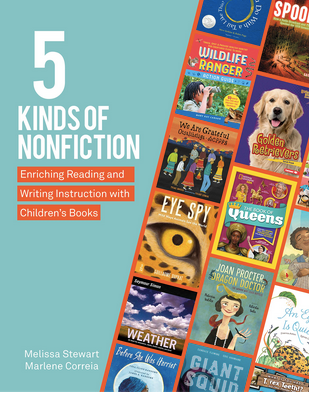
 

Kinds of Nonfiction: Enriching Reading and Writing Instruction with Children’s Books
by Melissa Stewart and Marlene Correia
 

Sometimes, you need another element as well – a personal connection to the story, an a-ha! nugget that will really hook young readers and make them take notice. You have to write and rewrite to figure out and understand what your book is really about and why it matters. Is it surprising to you? Does it make you think in a new way?


When even when I finally find the right fit, the right pants, I also need to personalize them – I need to check: why am I writing this story?  


Melissa points out that there are other structures that imaginative authors have invented to fit the topic. For example, in SWIRL BY SWIRL: SPIRALS IN NATURE by Joyce Sidman and Beth Krommes, the text starts with examples that are small and snug; these get bigger and spiral outward and finally curl up again for the ending – just like a spiral. 


In one of my favourite recent nonfiction picture books, WHAT’S IN YOUR POCKET? COLLECTING NATURE’S TREASURES by Heather Montgomery and Maribel Lechuga, Heather tells stories of what famous scientists’ collected and kept in their pockets as children – and links how these later led them to make important discoveries as grown-ups. 
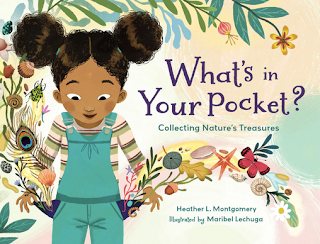


For instance, Diego Cisneros-Heredia, kept snails, slugs, scorpions and lizards in his pockets – and later discovered more than thirty new species of frogs. And Bonnie Lei collected tide pool creatures and later studied sea slugs and even found a new kind!
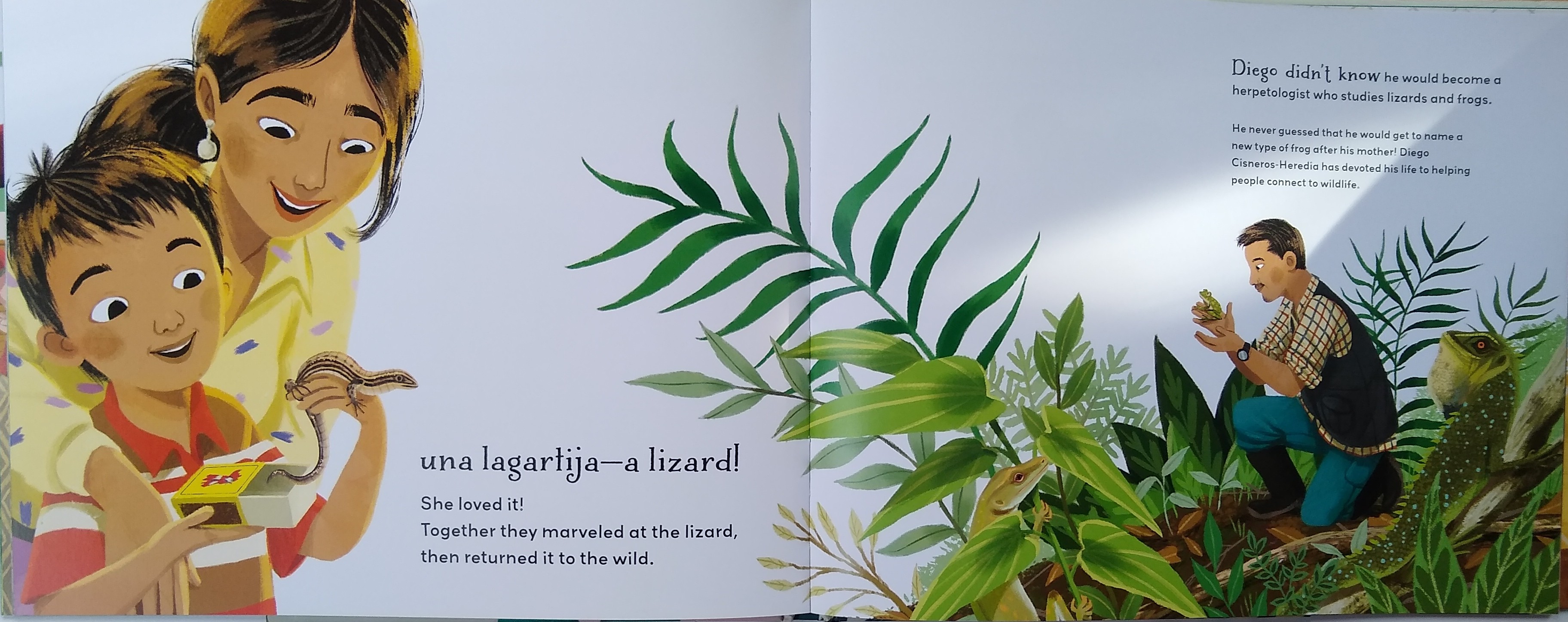
 

From What's In My Pocket? by Heather Montgomery and Maribel Lechuga

From What's In My Pocket? by Heather Montgomery and Maribel Lechuga

Heather Montgomery cleverly makes each figure relevant to young readers by tapping into a universal childhood love for collecting and outdoor play – and cleverly links this to how they were growing science skills that would lead to a lifelong passion working in the field.


This is what I am hoping to somehow create for each of my nonfiction book ideas. But how?


LOOK really closely at your topic. Look for:


• patterns

• key vocabulary words

• how do you want to make the reader FEEL?

• links to children’s lives and interests!


The hardest part? Keeping it SIMPLE and not being tempted to jam in everything!


I am inspired by Melissa Stewart’s tales of how it can take a long time to find the right structure and sell a book to an editor. For instance, it took her from December 2010 to December 2014 to get the manuscript for Can an aardvark BARK? accepted.  In this time, she experimented with four different structures!


https://www.melissa-stewart.com/timelines/timeline_aardvark/timeline_aardvark.html

Perhaps there is hope for my ideas and revised stories yet. I’m not giving up!


_________________________________________________________________


Natascha Biebow, MBE, Author, Editor and Mentor

Natascha is the author of the award-winning The Crayon Man: The True Story of the Invention of Crayola Crayons, illustrated by Steven Salerno, winner of the Irma Black Award for Excellence in Children's Books, and selected as a best STEM Book 2020. Editor of numerous prize-winning books, she runs Blue Elephant Storyshaping, an editing, coaching and mentoring service aimed at empowering writers and illustrators to fine-tune their work pre-submission, and is the Editorial Director for Five Quills. Find out about her new picture book webinar courses! She is Co-Regional Advisor (Co-Chair) of SCBWI British Isles. Find her at www.nataschabiebow.com

Monday, 2 March 2020

To Be or Not to Be an Author? • by Natascha Biebow


Children are curious – they ask me
This question has got me thinking about this vocation
that is being an author:


What's not to like? You get to do something you LOVE 💖

Tell stories all day long.


When the story is flowing, time passes in a jiffy. I feel like I'm in a kind of time warp. When I'm in the midst of researching a new non-fiction picture book, I get really excited by all the interesting new facts I'm learning and have to remind myself where I started and what my end goal is, otherwise I might get stuck down a rabbit warren of (irrelevant) information . . .


Notes for my books have lots of questions

Getting to meet children and seeing them excited about stories too is a lot of FUN too.

Doing messy art with them is EVEN MORE FUN!
 
Messy artwork with Y3 & Y4 at AJS, London - looking at Nature and mixing colours like Edwin Binney

And so is drawing with children –– and grown-ups.


Having an excuse to make an awesome cake (and eat it) to celebrate your book, plus wear a silly hat is . . .

FUN!
 
The most challenging cake I've ever made. Inspired by The Icing Artist.


But being a children’s author is also HARD WORK. Making books requires countless revisions, plus the time it takes to make the final picture book often spans years.

When the story is NOT flowing – or someone else has already pipped you to the post and published ‘your’ story – writing is very TIRING.

(Where’s the duvet?!)

Authors have to be resilient and be prepared to take on board feedback from their peers, their agent, and their book’s editorial team (editor, illustrator, designer, publicist) gracefully and constructively (even though sometimes you want to throw a pillow). Authors need to be prepared to listen and persevere.

Another edit? I thought the book was finished . . .

When I finally finish writing a book, waiting for someone to say they love it as much as I do is very hard. Waiting for a book deal is . . . yes, TIRING.

Getting rejections builds a thick outer skin, but it’s also . . . you got it, TIRING.

Authors are constantly having to come up with new ideas and try to put out our very best work, which is great when it’s flowing, but not so easy when it’s not.

Once published, authors are expected to promote their book. Being on the road for author visits to schools and bookshops far from home can be . . . TIRING.


Cupcakes help.

So, it’s about even – FUN vs. TIRING.
 
But then look at COOL:
Visiting interesting places for 'research' (like inside the Crayola crayon factory). (Amazing!)
Crayola's HQ in Easton, PA
Crayola crayon labels from inside the factory!
Unpacking a box of advanced copies of your book with your name on it. (Oooh, goody!)
Walking into a bookshop and seeing your book on the playbill  . . . (Wow, who me?!)
and being an actual, really actually published author with your name on the front of a book displayed in your uni bookshop . . .

Receiving unexpected and thoughtful gifts from fellow artists:
Tara Moon handmade me this amazing giant box of Crayolas exactly
like the one from she'd kept her childhood, complete with 'worn' crayons!

Meeting readers who are soooo excited to see you and think you are . . . COOL (!), then creating stuff together. AMAZING!
Drawing with all 8 colours
Drawing together in a whole School Assembly in VA
Signing books at your old school for a new generation of readers. Wow! 
At the lower school library EARJ, Rio de Janeiro, Brazil

And for me, making unexpected connections through my book . . .  Here's a story I'd like to share with you: 
ALL SO
But best of all is . . .

Seeing readers reading your book in unexpected places.
 
This girl couldn't wait to read the book --
right near the Easton Farmer's Market where she bought it.

I’d say on balance

I count myself very lucky (even if I can’t yet make a living doing it).

Happy World Book Day! 
________________________________________________________________________________

Natascha Biebow, MBE, Author, Editor and Mentor
 
Natascha is the author of The Crayon Man: The True Story of the Invention of Crayola Crayons, illustrated by Steven Salerno, Elephants Never Forget and Is This My Nose?, editor of numerous award-winning children’s books, and Co-Regional Advisor (Co-Chair) of SCBWI British Isles. She is currently working on more non-fiction and a series of young fiction. She runs Blue Elephant Storyshaping, an editing, coaching and mentoring service aimed at empowering writers and illustrators to fine-tune their work pre-submission. Find her at www.nataschabiebow.com

Sunday, 23 March 2014

Turning Black and White into Colour: Creative Nonfiction Picture Books ... and Chocolate by Juliet Clare Bell

George Cadbury aged about 20 (c) Cadbury Archive.

I’ve fallen in love, and I’m having a whirlwind romance with [cue page turn]...

Creative nonfiction picture books.

Creative nonfiction picture books are simply picture books where the story happens to be true. Sounds really simple but it took me a while to work out that’s what I wanted to do...

I’d thought about writing non-fiction for younger children before. But the passion wasn’t there. I love picture books. I love the way the words and pictures are so much more together than they are separately. I love the drama that can be created in such a short space. I love the form and the constraints.

There was plenty of really interesting information in the nonfiction books I was looking at...

Save The Orangutan (c) Sarah Eason, Powerkids Press.

They all felt very educational –which isn’t a criticism at all. I love learning and I was enjoying reading them but they didn't make me want to write them (like good picture books do). So I shelved the idea of writing nonfiction until something that really grabbed me turned up. Then one day ... [cue page turn]

Something that really grabbed me turned up.

An illustrator friend, Jess Mikhail, and I were both approached by Bournville Village Trust, in Birmingham, UK. Would we consider writing and illustrating a picture book together about Bournville? This is where the Cadbury brothers built their famous chocolate factory in the late nineteenth century, followed by a model village, created for the benefit of the factory workers, wider community and society. The story is fascinating. It’s passionate, political, philosophical, ground-breaking with an extraordinary family at its heart. And of course, there’s chocolate. Lots of chocolate. Would we consider creating this picture book?

(That's meant to be an excited me, pretending to have to ponder on the question that actually has an obvious answer. Didn't quite turn out that way...)

[cue the page turn where everyone knows the answer and can shout it out loudly together:]

YES!

Unusually, because this has been commissioned by BVT rather than a traditional publisher, we get to choose the angle and approach for the book and the design. At first, I thought we’d go down the route of fun historical book with lots of interesting facts and a mix of illustration, photos, letters etc.. There are some really interesting and fun books like that that we looked at:

I've read Mandy Ross's Children's History of Birmingham over and over and it's great.
(c) Mandy Ross, Hometown World.

...and we've really enjoyed the Avoid... books.
Avoid Being a Second World War Evacuee by Simon Smith, David Salariya and David Antram, Bookhouse.

I originally thought that our book might end up somewhat similar in format to these books.

But without thinking too much more about the structure, or indeed trying to impose in advance which story I’d try and tell, I got on with the research...


...and what an exciting area to research.
(My walk up to the entrance, where the amazing archives are located.)

I immersed myself in the world of the Cadburys and chocolate.

I’ve had amazing access to the archives and I’ve interviewed some fascinating people in their eighties and nineties, who used to work in the factory and whose families worked there well before. I’ve toured the Bournville Village Estate

(Old photos of Bournville Village Trust. Copyright BVT)

and watched footage that’s over one hundred years old.


I’ve read letters and handwritten personal reminiscences about the 1880s

(c) Cadbury Archive
(c) Cadbury Archive
Recognise this signature and what it became? (c) Cadbury Archive

and I’ve got access to incredible photos...

But back to the structure –and creative nonfiction...

After a while of playing around with different ideas, Jess and I decided we’d like for it to be a real picture book, telling a real story. I got loads of nonfiction picture books out of the library. Some of them were full of fascinating facts and were really well written. But I didn’t find any beautiful ones that were telling a story. So I asked at the library if there were any they thought were really unusual, arresting, beautiful. The librarian came up with one that she felt was in a completely different league from the others. But we couldn’t find a copy anywhere. I kept asking what made it so special and she said, “you’ll know when you see it”. I reserved it but in the meantime, I couldn’t resist and I bought it, too.

Can We Save The Tiger? by Martin Jenkins and Vicky White is indeed a beautiful book, which unusually for a nonfiction book, was shortlisted for the Kate Greenaway Award in 2012.
(c) Martin Jenkins and Vicky White, Walker Books

But I couldn’t find any others –except one story we had at home that was first out in 1999:

This beautiful book, Stone Girl, Bone Girl is about Mary Anning, the girl who inspired the popular children's tongue-twister She Sells Sea Shells on the Sea Shore (c)Laurence Anholt and Sheila Moxley, Frances Lincoln Books).
(c) Laurence Anholt and Sheila Moxley (Frances Lincoln Books)

And then someone from my fantastic online critique group (most of whom are American) posted up about WOW Nonficpic, an online nonfiction picture book forum and about an online course that was coming up, run by nonfiction picture book author, Kristin Fulton, which some of us might be interested in. And I feel like I entered into a new world of creative nonfiction that is much more common in the US than here in the UK. There was lots of talk about different, beautiful creative nonfiction picture books and my wish-list grew and grew...

I decided to do the four-week online course, where I was introduced to yet more beautiful creative nonfiction picture books.

The beautiful, simple creative nonfiction picture book, Me...Jane about the childhood of Jane Goodall (c) Patrick McDonnell, Little, Brown.

(c) Patrick McDonnell, Little, Brown.

Balloons Over Broadway (c) Melissa Sweet, Houghton Mifflin

from Balloons Over Broadway (c) Melissa Sweet, Houghton Mifflin
Tree Lady by H Joseph Hopkins, Beach Lane Books.

Tree Lady by H Joseph Hopkins, Beach Lane Books.

A Splash of Red (c) Jen Bryant and Melissa Sweet, Knopf

From A Splash of Red (c) Jen Bryant and Melissa Sweet, Knopf

Henry's Freedom Box (c) Ellen Levine and Kadir Nelson, Scholastic Press

Locomotive (c) Brian Floca, Simon and Schuster.

I wanted to be immersed in a world of books that was new to me (and which there was little access to in the UK) and to be surrounded (virtually) by other people who were passionate about the form of creative nonfiction in the way that I’m so often surrounded by those writers who are passionate about picture books. The course was extremely good (I’d very seriously recommend it to anyone writing or interested in writing nonfiction picture books)–and timely for me. I’ve learned lots, and have now got hold of a pile of books that I can use for inspiration (about completely different subjects). I’d already fallen in love with the research and the story for our book, but now I’d fallen in love with the form of book, too.

About four months after I’d starting researching the book, I decided which story I wanted to tell (the history is so fascinating I could have told lots). I spent weeks working on a picture book structure and testing it out with other writers.


And I presented it to all the relevant people in Bournville earlier this week and it got the big thumbs up.

Creative nonfiction is very much like a fiction picture book. It’s about the story and the way you tell it; the use of page turns and the highs and lows. The expectation and surprise and like all good picture books, it needs to stand up to being read again and again. And the illustrations must be lovely, as with all good picture books.

The very beautiful The Journey Home by Fran Preston-Gannon, Pavilion Books. It's not quite creative nonfiction (it's a made up story about endangered species) but it's beautiful and inspirational.

(c) Fran Preston-Gannon, Pavilion Books.

I’m so excited.
First, by the story –of two innovative young Quaker brothers...
Richard Cadbury in later years (c) Cadbury Archive
George Cadbury as an older man (c) Cadbury Archive

who did something remarkable. The death of their beloved mother had left their father, John Cadbury,

John Cadbury (c) Cadbury Archive

a broken man and his cocoa factory and business was failing badly. With great integrity, humanity, sacrifice and an extraordinary vision, they took on the business, and turned it round to become incredibly successful throughout the world, whilst at the same time working to create much better working conditions,

Bournville, the 'factory in a garden' 1879 (c) Cadbury Archive

The girls' dining room (c) Cadbury Archive

living conditions

from this...
Birmingham slums (c) Cadbury Archive
to this...

(c) Cadbury Archive

circa 1905 (c) Cadbury Archive

Bournville Green (c) Cadbury Archive

Early cottages built for the new model village (1905) (c) Cadbury Archive

Early housing (c) Cadbury Archive

Almshouses for former factory workers, built by Richard Cadbury (c) Cadbury Archive


First Bournville cottages, 1880 (c) Cadbury Archive

and spiritual and physical conditions for many thousands of people.


Early shot of girls at the factory (c) Cadbury Archive

Bournville Friends Meeting House (c) Cadbury Archive

(c) Cadbury Archives

Friends Hall 1901 (c) Cadbury Archive

Girls' Physical Training Den, 1902 (c) Cadbury Archive


Camp school (or 'school on a barge') 1919 (c) Cadbury Archive


Day continuation school (c) Cadbury Archive

(c) Cadbury Archive

Girls' gymnastics, 1912 (c) Cadbury Archive

Swimming lessons, provided free during work time, 1910/1911 (c) Cadbury Archive

But I’m also really excited about having discovered creative nonfiction. I’ve got several other creative nonfiction books I’d really like to write after this one. I think that this love affair will go far...

I’ve spent so much of my time up at the factory archives, breathing in the sumptuous smell of chocolate as I get off the number 27 bus, I know I’m going to feel quite bereft when it’s over. It’s been like a dream job and I don’t want it to end.

But it’s time to get down to the actual writing now, bringing colour to the black and white, having made piles of notes over the past few months. The first really really rough draft will only take a couple of days to write as I know the story so well and I’ve got my structure sorted. Then I’ll spend the next couple of months playing with the language, fleshing it out and editing it.
OK, we're not quite (?!) there yet, but we will be... once I've finished the text and Jess has illustrated it...

As the wonderful David Almond said at a talk I went to last year:

“Make it lovely.”

And that’s what we plan to do.

What are your thoughts on creative nonfiction? Why are there so many more beautiful creative nonfiction picture books in the US than in the UK? Do UK publishers not feel there is a market for them? Are they there and I’m missing them? Or is there going to be the same explosion of these books in the UK in the coming years? I really hope so. Jess Mikhail and I are in an unusual position of being able to create what we most want to create, knowing that it will be produced and published (in conjunction with BVT), but it would be fantastic to see lots more on the shelves in schools, libraries and bookshops...

www.julietclarebell.com