Showing posts with label The Fairytale Hairdresser. Show all posts

Monday, 22 May 2017

Time Goes By • Abie Longstaff

I love picture books that give a sense of time moving - especially those where the seasons change in the background.

In 'Dear Daddy' by Philippe Dupasquier, Sophie writes to her father who is away at sea.


It's a very sophisticated picture book. Using a clever split-scene layout, it shows us both Daddy's and Sophie's world, and deals with complicated conceptual ideas of time. Children can see that the seasons change for Sophie but not for her father, who is in a different time-zone. All this is accomplished in remarkably few words due to Dupasquier's busy, detailed illustration style.

This was one of my favourite pages. It shows the split screen of the season where Sophie is, and above where her dad is. My sisters and I loved it because we grew up in Hong Kong, which is depicted in the upper section.

Across the Fairytale Hairdresser series, Lauren Beard and I do have the seasons change, but I've never managed it in one single book - and I'd love to try!
It's summer in The Fairytale Hairdresser and Aladdin

And winter in The Fairytale Hairdresser and Father Christmas
For me, the most beautiful book showing seasonal change is 'I am a Bunny' by Ole Risom and Richard Scarry.


My mother read this book to me, and I read it to my own children. It is a perfect example of a simple, yet exquisite, picture book - one where poetry meets art. I find it almost meditative in quality and very moving. Nicholas, the bunny, has a real appreciation for his world, and the illustrations reflect this:


I suppose I'm thinking about seasons, and change, because I'm moving on from the Picture Book Den. I've loved being a part of the Den for years now and I'm sorry to go; but it feels right to have a change. I'm sure I'll be popping up somewhere else soon but for now: thanks to my fellow Denners, and to readers of the blog.

See you around! :)

Tuesday, 1 March 2016

Is this the real life or is this just fantasy? by Abie Longstaff

I love fantasy - any kind of fairy tales, mythology or crazy invented wackiness.

But I also chortle when a book manages to reference real life.

I loved the use of 'Henopoly' in Chicken Nugget (Michelle Robinson and Tom McLaughlin)


This poster in Spaghetti with the Yeti (Charlotte Gillain, Adam Gillain and Lee Wildish) made me laugh with its X Files reference:


And who could fail to giggle at a line of royal underpants in The Queen's Knickers (Nicholas Allan)?


Lauren Beard and I try to squeeze as many real life references as we can into our fairy tales. In the latest Fairytale Hairdresser, Beauty and the Beast, we've got:

Art references:


Literary references:


And even a nod to musical genres


But can you guess which musical style/performer each outfit represents? And, more importantly, can you please settle the row between my husband and me - is Number 1 Rude Boy or Pete Docherty?

Friday, 2 October 2015

Ten ways I use panto for picture books by Abie Longstaff

I love pantomimes. I like the silliness, the crazy costumes, the audience participation.
I like the way they cater for all ages - the children and the grown-ups - so that the whole event turns into a family affair.

Many of the elements of a good picture book can be found up there on stage under the bright lights: 

1. A simple, strong story
Most panto is based on a fairy tale or a ballet. Whatever your story theme, remember to make the essence of the story simple and obvious for young children. At their heart, good picture books have a strong story-line.

2. Evil villains and good heroes
Panto is extreme in this way. The baddies are really bad, and the goodies are really good. Whatever your version of good and bad - make it clear.


3. Great character names
Panto is brilliant for outlandish names. Widow Twankey, Buttons the groom, Hanki and Panki, Carrie Bucket.
Mr Lovelybuns, from the Claude books by Alex T. Smith - one of my favourite character names!


4. Jokes for the grown ups
Don't forget the adult who has to read your book over and over to their child (poor thing!). Try and think of something to keep their interest, as well as the child's. It could just be something small in the background:
The witch's books in The Fairytale Hairdresser and Rapunzel
5. In jokes or references
Pantomimes are very clever about playing with a well-known genre - this can be a great source of jokes:
The Looking Glass magazine in The Fairytale Hairdresser and Snow White
6. Slapstick
Children love slapstick humour. It's simple and visual. So many picture books do this well - Dr Seuss, Richard Scarry and others were masters of the genre. I also love the Hairy Maclary books for this:
Dogs going mad in Hairy Maclary, Sit by Lynley Dodd
7. Audience participation (He's behind you!)
Lauren Beard and I spend a long time making detailed scenes for children to spot characters. Detail can create a talking point and encourage that feeling of sharing a story together:
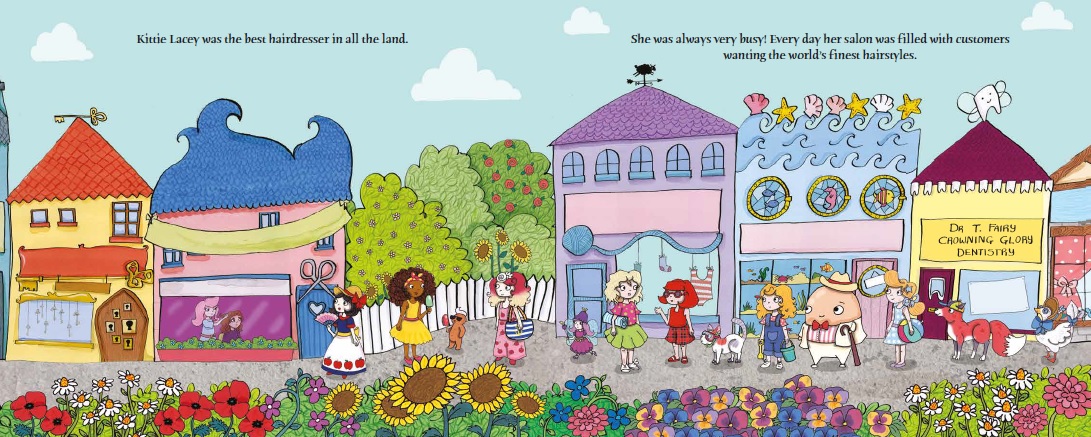
The high street in the Fairytale Hairdresser
8. Dressing up
Who doesn't like dressing up? Panto is fab for fancy, frilly, gender-swapping, crazy costumes.
The Fairytale Hairdresser and Snow White
9. A big finale
In panto this is often a big dance/song. The page turns of the book should lead up to a fun or exciting climax:
The winter ballet from The Fairytale Hairdresser and the Sugar Plum Fairy
10. A happy ending
Awww. Almost every picture book has a snuggly, cosy, happy ending.
Rapunzel getting married
But surely it's not panto season already?
Oh yes it is!

The latest Fairytale Hairdresser is based on The Nutcracker ballet

Wednesday, 29 July 2015

Creative Crafts from Books by Abie Longstaff

I love the idea of books being cross-curricular, with 'We're going on a bear hunt' used to look at landscapes and nature, or 'The Very Hungry Caterpillar' to discuss life-cycles. My favourite way of playing with the ideas in books is to make crafts. I think it brings the stories alive.

Some bloggers do this very well (see www.playingbythebook.net). So do some schools. My daughter's class recently had to make the garage from David Almond's Skellig out of a shoebox, a project my eleven year-old loved.

Garage
When I write, I like to play around with different creative tools like paint, pencil and fabric. I find it helps me connect with the story and it creates a strong foundation to take to schools and lit fests later. Children love hearing about what has inspired the books and they have a lot of fun recreating or playing with the objects.

For Fairytale Hairdresser, of course, I have long-haired dolls for the children to style.


I like to have a range of dolls, representing the different fairy tale characters, even if it means having to source a mermaid tail, or dye a doll's hair to find the right shade of purple to become the Sugar Plum Fairy.

Tail made by Sally Channon (Salstuff)

Rapunzel, Snow White and Sleeping Beauty


Hair dyed with sharpie ink


There are lots of craft projects you can make with children based on their favourite books, and some schools have come up with wonderful ideas. Grow House Forest School in Switzerland had a Fairytale Hairdresser craft day, with activities including building the Three Pigs' houses (and testing their strength using a hairdryer!)


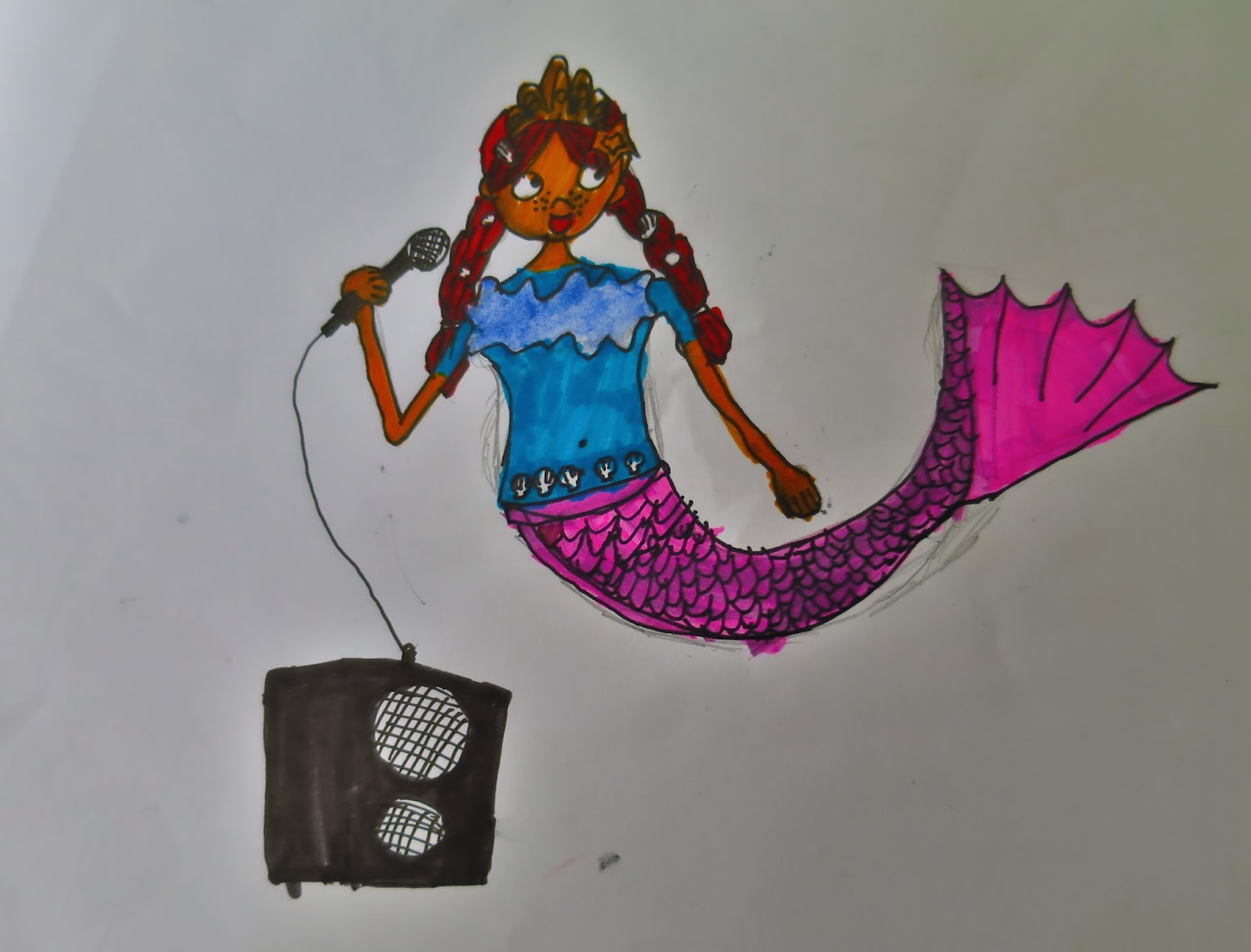
Children can do drawings of their favourite characters (see Lauren Beard's 'How to Draw a Singing Mermaid' in the Guardian here http://www.theguardian.com/childrens-books-site/gallery/2015/may/30/how-to-draw-a-singing-mermaid)


They can make maps tracking journeys across the book

Map from The Magic Potions Shop, illus by Lauren Beard
or buckets of potions


and there's ultimate tribute: dressing up as your favourite book character!

Kittie Laceys on World Book Day

For my Magic Potions Shop series, I've been busy making teeny potions bottles.

At events, we've been imagining our favourite potion (Flying Potion? Invisible Potion? Exploding Powder?) and drawing it or making it with glitter or feathers.

Let me know your craft ideas - I'm always looking for more projects! :)

(You can find lots of crafts, including activity sheets to download, on my website www.abielongstaff.com)


Wednesday, 20 May 2015

Adapting fairy tales - the Little Mermaid by Abie Longstaff


Rewriting fairy tales is always a challenge.

I like to bring the world up to date, to help children engage with the story better. This might include tackling gender, class and diversity issues, as well as making the characters dress and behave in a more contemporary style. Whatever your aims of adaptation, you still need to make sure the story retains enough of the flavour of the original to allow children to identify familiar themes and characters.

The latest Fairytale Hairdresser book - the Little Mermaid - had an added element to tackle. The original Hans Christian Anderson story is very dark and many people are not familiar with the ending. The tale is about sacrifice for love and has strong themes of moral 'goodness'. Anderson's mermaid chooses to swap her tail for legs, even though every step she takes will be like 'treading upon sharp knives'. In the end, she fails to win the heart of her prince and is given one last option to avoid becoming foam on the sea: kill the prince. The Little Mermaid refuses, and instead she throws herself into the ocean to meet her death.

Unsurprisingly, the Disney version has a different ending. In the 1989 film, Ariel and her prince fall in love and she is made a human permanently by her father, King Trident.

Like Disney, I wanted to steer clear suicidal mermaids, but I felt uncomfortable with the film's message of 'change for the one you love' so I spent a long time thinking through what I wanted to say. Why is the mermaid unhappy the way she is? Should she become a human permanently? Should the prince become a mermaid?

In my story (spoiler alert) the little mermaid finds she misses her tail. She returns to being a mermaid and she and her prince (Marino, a diving instructor) spend half of their time in her (underwater) palace:


and half the time in his:


You can read the original Little Mermaid tale here.

The Fairytale Hairdresser and the Little Mermaid is available from Amazon here or Waterstones here and also in independent shops like this one.

Monday, 16 March 2015

Collaborative Writing by Abie Longstaff

In the Winter edition of The Author I saw an article by Terence Blacker called 'The seven habits of highly ineffective authors'. His final no no was this:


I totally disagree with him. In fact, the instant shaking of my head as I read his point made me realise how much I like to collaborate. All authors work differently; I know plenty who do work better alone: they get inspiration from long walks, from listening to music, from living inside their own heads. I'm not one of these: I'm a talker. I like to think aloud, chatting through my plots and characters with friends. I've always enjoyed this part of the process and I find the act of verbalising my story, and of having others question me on it, forces me to formulate it properly and to ensure the plot (in terms of action and emotion) makes sense.

I brainstorm with editors, with my husband and with fellow authors (Jane Clarke, Saviour Pirotta, Rebecca Lisle and I recently had a fantastic joint session talking through plots and characters). I like hearing what other people have to say and I like thinking about their book issues as well as my own.

Once I've written a first draft I often do manuscript swaps with authors (we do a monthly one here at picturebookden where any denner can send round a draft for comment), I show it to my agent and to my editors.

Funnily enough, it's not that common for picture book authors to collaborate with illustrators. Sometimes I don't ever meet my illustrator and the editor acts as a go-between. On Fairytale Hairdresser, because it is a series, Lauren Beard and I do talk through issues and plots and I love hearing her ideas on the text. When we were making the Snow Queen Lauren and I met up for coffee. She said; I'm thinking Russian-ish, I said; I'm thinking blue and spiky, and we ended up with this jointly inspired look:

Recently I've heard a number of authors talk about more major scale collaboration: Sarah McIntyre and Phillip Reeve jointly authored the wonderful 'Oliver and the Seawigs' and they spoke at the Society of Authors about how enriching the experience was. Lee Weatherly and Linda Chapman talked at a conference about writing the 'Sophie and the Shadow Woods' series together and I know many other authors who write, or plot, with another person.

For me the phrase 'to be any good as an author you have to be on your own' just doesn't ring true. Where Blacker is right is that the final decision has to be mine, and I have to stand or fall based on it. But for me, listening to others makes my books deeper, richer and better.

What about you?

Tuesday, 11 November 2014

The Curse of Busy-ness by Abie Longstaff

It's coming up to Christmas season. The shops are full of decorations, the ads are on the telly and the kids are behaving extra well just in case Santa's making a list and checking it twice.

I do love Christmas. I'm one of those people who gets ridiculously excited about the whole thing. I love seeing my family and consuming my weight in cheese. I'd happily have a glass of mulled wine with a mince pie any time of year.

But...for me the run up to Christmas is often filled with a growing sense of panic.


This time of year I suffer from the curse of busy-ness. It seems like there are never enough hours in the day to get everything done and every task is done at full speed.

Like many authors I have extra events to do or attend. I also have a Christmas book out which needs promoting. I have my day job, and my kids...and the Australian Christmas cards that need writing and posting...and every other reason to dash around like a headless chicken.

Only - the other day, because I was so busy, I didn't notice a good friend of mine was ill. I'd let my rushing around get in the way of something really important.

As picture book writers we need space to dream, and time to do it. As I run madly from one job to the next, scribbling on the train to make up lost time, I'm starting not to enjoy my creative work. I've been curtailing my day-dreaming time, cramming it between tasks. That's not the way to write. Worse; I've been neglecting my friends.

So my well-before-new-year's resolution is to slooooow down.

I've found some lovely bird song to listen to (it's tropical to remind me of growing up in Hong Kong):
 
I'm focusing on enjoying the journey; gazing out of the window instead of editing a book.


I'm going for a walk by the sea as often as I can.


I'm meeting up with my good friend next week.


And I found this lovely video of a craftsman who knows how to take time to make his creations perfect:

Wishing you all strength and TIME to cope with the pre-Christmas season,

Abie

(My new book is The Fairytale Hairdresser and Father Christmas)


Tuesday, 15 July 2014

Where I Write - Group Post

As a group we're often asked where we write. We're not sure why people are so interested because it's something we do every day, so we see it as just another ordinary part of our lives. However, as we've been asked, it would be rude not to answer the question! So four of us have joined forces to let you in on the secret of where we write.

Abie Longstaff

I write in my writing hut in the garden.


It's only a few steps from my house, so I have a very short commute!

Inside I have a comfy chair, a desk and some big cushions in a pile on the floor so I can curl up and read.


Pippa Goodhart

For the first twenty years of my writing career I wrote in whatever corner of the house I could. The computer was in our bedroom, and the main table always had to be cleared for mealtimes. But then - da daaa! - my wonderful husband (who happens to be an architect) built us a brand new house. What would you like in it, he asked?  Well, where to begin?!  I now have a library landing with backlit bookshelves that leads onto a balcony with rocking chairs - bliss.  But he and I also share a big studio room; his drawing board and desk at one end, and my writing mess at the other. One long wall is lines with built-in bookshelves.  But, as you can see, even now I have to share my writing space!


Jane Clarke

I've taken over the smallest bedroom, overlooking the apple tree in the back garden. Watching the birds (and the occasional squirrel) is a great displacement activity.


The walls slope so fitting everything in is a bit of a challenge and things tend to get stacked in heaps in the corners.


I use the beams to pin things on.


Occasionally I have a tidy up and clear out, but clutter is the default setting for my writing room.


Jonathan Emmett

For the first 10 years as a writer/paper-engineer, I worked in a little room at the back of our first house that looked out onto the back garden. As well as a desk, I had a huge “double elephant” sized drawing board, a large light-box and a plan chest, all crammed into the same small space.

My first office in my old house was rather like a ship's galley.

I needed somewhere to store all my books and art materials as well, so I built a big storage unit to house it all. There's a diagram of it on the right and you can just see the edge of it on the left of the photo above. There was a very practical reason for the unit’s 'grand piano' shape. It needed to be narrow at one end, to leave me enough space to sit behind my drawing board, and wide at the other, so I could have a decent bookcase beside my desk. When we moved house, the storage unit came with me to my new office which is quite a bit bigger and looks out onto the street. As you can see in panorama below, I have a silver birch tree right outside my window!
A panorama view of my current office. Click on "view sphere", then click and drag inside the image to move around.

One of the best things about moving house was that I finally had enough space for a sign-writer’s vinyl cutter. These computer-controlled machines are usually used to cut out the coloured vinyl signs you see stuck to the sides of vans and above shops, but I’ve adapted mine so that I can use it to cut out the pieces of card for the prototype pop-up books I design. The home-made stand it's mounted on folds down, a bit like a deck-chair, so that I can store the cutter under my drawing board, when it’s not in use.


We hope you've enjoyed this group blog and if you're an author we would love to know where you write. So please do let us know.

Regards,

Abie, Pippa, Jane and Jonathan.