Showing posts with label World Book Day. Show all posts

Monday, 27 February 2023

World Book Day's Profound Purpose, by Pippa Goodhart

This is the week of World Book Day when a large portion of the world enables and celebrates reading for pleasure for everyone. YAY! for something really, really good happening across the world.


I wonder if you recognise the fairy tale castle below? 


It isn’t from fiction. It’s from real life. It’s The Peace Palace. What better thing to build a palace for?! It’s in The Hague in The Netherlands, and it was purpose built to house The International Court of Justice. (Not the International Criminal Court, also in The Hague, but the International Court of Justice.) 


Few people know about the ICJ because its job is to prevent the sort of events that make the biggest frontline news. It works in a similar way to other courts. Those who disagree present their cases, and a panel of judges decides the correct legal outcome. But these are international disputes, from boundary quarrels to determining how formula milk should be promoted, and even deciding the law governing Space. Those judgements can prevent potential wars from boiling into reality.  I’m proud to say that my lovely Daddy, Robbie Jennings, was an international lawyer working on cases at The Peace Palace for many years. In time he became the British judge on a team of fifteen judges, and then President of the Court.


What is the relevance of all that to World Book Day? Well, I’ve just learned that World Book Day was begun by, and is organised by, the United Nations, as is the International Court of Justice. Both, in their very different ways, share the same vital aims. Secretary-General of the UN, Antonio Guterres, says –


‘In the end, it comes down to values. We want the world our children inherit to be defined by the values enshrined in the UN Charter: peace, justice, respect, human rights, tolerance and solidarity.


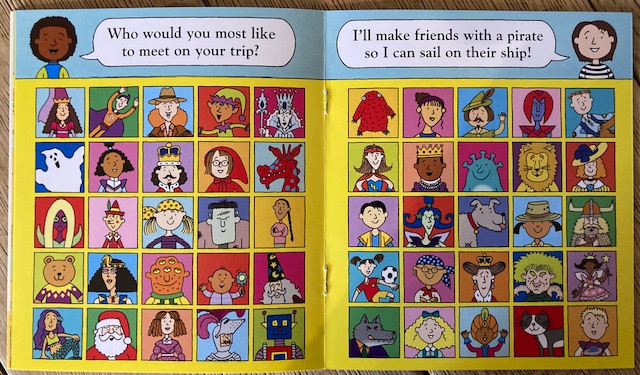
I’m very chuffed to be the author of one of this year’s £1 World Book Day books; You Choose Your Adventure. As with the other, bigger, You Choose picture books, it is Nick Sharratt’s wonderful pictures which most obviously achieve here those aims of us all sharing our world fairly and kindly and imaginatively, at the same time as having fun. The world needs more fun, and it needs young people with fertile imaginations. 


So, here is some happy mixing of different kinds of children and different kinds of adventure. Enjoy!


Last year fifty million £1 World Book Day book tokens were given to children in the UK, with over two million books gifted in exchange for them. One in seven the children getting those books didn’t previously own a book. 


For full information about all the World Book Day books on offer, and the events and activities also there be enjoyed, see World Book Day 2023


And watch out for further You Choose news to come a bit later this year!  


Monday, 15 July 2019

Building Kids’ Bookshelves - Just One (More) Book At a Time • by Natascha Biebow


I have this image stuck in my mind: just one book on a lonely bookshelf, occupying pride of place.


A precious resource.


The key to so many things, among them MAGIC. Yes, the magic of reading, the magic of another world, the magic of access, the magic of fun.


I grew up in a non-English speaking place, so books were treasured gifts from family living in England.


I loved reading, and I loved books. My school had a library also. More windows.


I still have these books. They are friends. When I was old enough, I filched from my parents’ bookshelves as well. 


But for many, the reality is very different. 

In 2018, in the UK, the National Literacy Trust surveyed 44,097 children aged 8-18. It worryingly concluded that 1 in 11 children and young people in the UK don’t own have a book of their own at home. 

The same survey also revealed unsurprisingly that “the more books a child owns, the more likely they are to do well at school and be happy with their lives.

It is well documented that reading for pleasure is the single biggest indicator of a child’s future success, and that reading is key to developing empathy. Picture books (and all books!) matter.
 

There are some great initiatives to bring books into households:


Booktrust’s Bookstart – which gives free books to every child in England and Wales at two key stages before school, as well as free packs for children with additional needs.  

World Book Day –  where each child receives a £1 book token towards a book – is a registered charity on a mission to give every child and young person a book of their own. Published figures state that WBD reaches 15 million children and young people in 45,000 schools every year.


With every book donated, there is a greater chance of a child discovering their love of reading and gaining access to a brighter future. 


But, clearly, there is more to be done.


Even if children have one book on their shelves, they should be entitled to more. Access to books through free school and public libraries is something that will benefit everyone’s future.


This week, Cressida Cowell took over the mantel of Children’s Laureate from Lauren Child, with an ambitious ten-point charter:


In her impassioned speech at the launch event, Cowell talked about the magic of books and reading for fun. She promised to do more to lobby for access to books, school libraries and author and illustrator visits.


And she promised to LISTEN to what children are saying about books and reading and needing to address our planet’s climate emergency.   

School children support Cressida Cowell's laureate launch speech


Cowell admits that it’s a huge list, but she’s committed and she has the laureateship behind her.


But is there something I could do to contribute, I wondered?


I thought about this again . . .


And I remembered: on my author tour this Spring to promote THE CRAYON MAN, I met a teacher and librarian who shared with me the order form for my book that went home with the children. On it, in addition to the possibility of ordering my book to be signed when I came to the school, parents and carers could also choose to buy a book for another child, one who might perhaps not have access to such a thing. And people did!


At another school, the PTA purchased a book for the library and a copy to give out as reward for children who had achieved something noteworthy at school. I know some authors and illustrators, if they're able, sometimes donate a copy of their book to the school library.


If, for every author/illustrator visit we did, even one child got a book who might not otherwise have one, just think how many more books might be on that bookshelf?


_______________________________________________________________

Natascha Biebow,
MBE, Author, Editor and Mentor
Natascha is the author of The Crayon Man: The True Story of the Invention of Crayola Crayons, illustrated by Steven Salerno, Elephants Never Forget and Is This My Nose?, editor of numerous award-winning children’s books, and Co-Regional Advisor (Co-Chair) of SCBWI British Isles. She is currently working on more non-fiction and a series of young fiction. She runs Blue Elephant Storyshaping, an editing, coaching and mentoring service aimed at empowering writers and illustrators to fine-tune their work pre-submission. Find her at www.nataschabiebow.com


Wednesday, 14 February 2018

World Book Day Treasure Hunt • Jonathan Emmett


Last year's Picture Book Den post on how to organise a "Picture Book World Cup" in schools got such a good response that I thought I'd follow up with a similar post on how to run a Picture Book Treasure Hunt.

Like the Picture Book World Cup, this is an activity that I originally ran with my former Patron of Reading school, Asfordby Captain's Close Primary in Leicestershire. We did our treasure hunts in June, which meant we were able to run them outside, in the school grounds, but a hunt would work just as well inside. And it would make an ideal book-themed activity for the upcoming World Book Day, which is why I'm blogging about it now!

A Captain's Close student discovers one of the question sheets.

We ran two separate treasure hunts: a picture book themed hunt for Key Stage 1 and a novel themed hunt for Key Stage 2. I'm going to describe how to run the KS1 picture book version, but the KS2 version works in a similar way and you can find information on it and links to download packs for both versions at the bottom of this post.


How the hunt works

The hunt is a race against time. The first student to complete it correctly wins. A winner's certificate is included in the download pack, but schools may want to offer a book as a prize as well.

Once they have completed the hunt, students will need to hand in their answer slip to a Hunt Collector (a nominated member of staff), so make sure all the students know who the Hunt Collector is and where they can be found before the hunt starts. 

If the hunts we ran are anything to go by, the winner is more likely to be a tortoise than a hare. Make it clear that the winner is the first student to hand in a CORRECTLY COMPLETED answer slip. The twentieth student to hand in their slip could still be the winner if the previous nineteen have not completed the hunt correctly!

It will take a little time to check the answer slips, so let the students know when the winner will be announced. If you're running the hunt in the morning, you might tell the students that the winner will be announced in an afternoon assembly.

The hunt uses a set of ten multiple choice question sheets like this one:


The question sheets are stuck up in different locations around the whole of the school. Before the hunt starts, make sure students know where they can and where they cannot look.

Students all start the hunt at the same time, but in any place, with any sheet. It makes sense to split students up as much as possible at the start so they begin in lots of different locations. That way, they will not all be looking for the same question sheet at the same time.

Each student is given an answer slip like this:


When a student finds their first sheet, they write down the big letter at the top in the first square of their answer slip. Then they read the question and decide which of the four book covers at the bottom of the sheet is the correct answer. Then the student has to find another sheet that has that book cover at the top and repeat the same process.

Students should be able to answer the questions in the KS1 hunt in the download pack by looking at the books' covers. Remind students that if they have a problem reading or understanding a question, they can ask a teacher for help.

As students search for the question sheet with the correct cover, they will probably spot other question sheets that they will need to find later on in the hunt, so students should try to remember where each sheet is, even if it's not the one they're currently looking for.

When a question leads a student back to the question sheet they began with, they should have a letter in each of the 10 boxes. They have now finished the hunt and should hand in their answer slip to the Hunt Collector straight away!

The first student to hand in a correctly completed answer slip to the Hunt Collector wins.


Tips for the organisers

Example question sheet: Before starting the hunt, use the example question sheet in the download pack to explain how the hunt works and what students have to do.

Synchronise the start: Agree an exact start time for the hunt, then split the students into small groups and ask a member of staff to accompany each group to a different part of the school to start the students at that time.

Leave time to find the winner: If the hunt we ran is anything to go by, the first students to hand in their slips will have got their letters in the wrong order and you will have to check through several incorrectly completed slips before finding a correctly completed winner.

When you announce the winner (preferably in an assembly), you might want to spread the credit and heighten the tension by revealing the top three hunters in reverse order.  If the school is feeling generous, they could give a prize to the runners-up too.

Tips for the Hunt Collector

Don't worry about marking the answer slips as they come in! The important thing is to keep a record of the order you receive them. So write a number in the top box in the top right corner of each slip as it is given to you.

The first few students to give you their answer slips will probably have filled them in incorrectly, so keep collecting the slips and recording the order you receive them in until you've collected them all or until the time programmed for the hunt is over.

Once you've collected all the answer slips, you can use the long marking strip in the download pack to check the sequence on each slip quickly. Starting with the first answer slip to be handed in, line up the first letter on the slip with the first occurrence of the same letter on the marking strip. If the student has completed the hunt in the right order all of the following letters will match those on the marking strip.

Use the long marking strip to check the sequence quickly, by lining up the first letter on the student's sheet with the same letter's first appearance on the strip.

If the sequence of letters on the first slips you check don't match the sequence on the marking strip exactly, put a cross where the sequence is broken. It's worth keeping rejected slips in the order they were collected in as, in the event that no student gets the whole sequence right, you will need to go back through the slips and pick out a winner with the longest correct sequence.  

Once you've found the winner you can fill out the certificate in the download pack and present it to them.

Foundation and Reception Simplified Option

Foundation and reception students can do an easier version of the hunt by simply finding all the question sheets and writing down all the letters. The winner is the first student to hand in a slip with all the correct letters in any order.

Hunt the Teacher Option

The download pack contains an off the peg version of the hunt that will work in any school. However, the original hunts we ran included extra questions about teachers' favourite books, as shown in the example below.

Additional Hunt the Teacher question sheets like this get
students talking to teachers about their favourite books.

To answer this question, students had to find the teacher and ask them which book was their favourite. This was a good way to show children that grown-ups enjoy reading and to get the students talking to staff about their choices. If you want to create your own version of the hunt using this option, you will need to ask staff to name their favourite books in advance so they can be written into the hunt. And if a staff member is unexpectedly away on the day (as was the case with one of our hunts), make sure another staff member knows the correct answer and that the students know who this is before they start the hunt.

Key Stage 2 Version

A download pack for an off the peg Key Stage 2 version featuring children's novels is also available below. This runs in exactly the same way as the KS1 version, but has the following tweaks to make it a little more difficult:

  • There are 15 questions instead of 10.
  • While the answers to some questions can be found by looking at the covers, others require a little knowledge of the books.
  • On some question sheets, more than one of the covers at the bottom of the sheet can be found at the top of other sheets, so students can't just go looking for any of the four options like they can in the KS1 hunt - they need to find the sheet with the correct cover to get the correct sequence of letters. If students get back to the sheet they started with and haven’t got a letter in all 15 of the boxes, they will probably have skipped a few letters by answering a question incorrectly.

And of course, you can create your own KS2 hunt with some hunt the teacher question sheets just like the ones described for the KS1 version above.


Click on an image below to download a Treasure Hunt pack as a zip file.


Key Stage 1


Key Stage 2


For some more ideas for activities your school can do to celebrate World Book Day,


For an exciting picture book race against time, check out Jonathan's rhyming romp The Silver Serpent Cup, illustrated by Ed Eaves, and published by Oxford University Press.

Find out more about Jonathan and his books at his Scribble Street web site or his blog. You can also follow Jonathan on Facebook and Twitter @scribblestreet.

See all of Jonathan's posts for Picture Book Den.

Wednesday, 29 July 2015

Creative Crafts from Books by Abie Longstaff

I love the idea of books being cross-curricular, with 'We're going on a bear hunt' used to look at landscapes and nature, or 'The Very Hungry Caterpillar' to discuss life-cycles. My favourite way of playing with the ideas in books is to make crafts. I think it brings the stories alive.

Some bloggers do this very well (see www.playingbythebook.net). So do some schools. My daughter's class recently had to make the garage from David Almond's Skellig out of a shoebox, a project my eleven year-old loved.

Garage
When I write, I like to play around with different creative tools like paint, pencil and fabric. I find it helps me connect with the story and it creates a strong foundation to take to schools and lit fests later. Children love hearing about what has inspired the books and they have a lot of fun recreating or playing with the objects.

For Fairytale Hairdresser, of course, I have long-haired dolls for the children to style.


I like to have a range of dolls, representing the different fairy tale characters, even if it means having to source a mermaid tail, or dye a doll's hair to find the right shade of purple to become the Sugar Plum Fairy.

Tail made by Sally Channon (Salstuff)

Rapunzel, Snow White and Sleeping Beauty


Hair dyed with sharpie ink


There are lots of craft projects you can make with children based on their favourite books, and some schools have come up with wonderful ideas. Grow House Forest School in Switzerland had a Fairytale Hairdresser craft day, with activities including building the Three Pigs' houses (and testing their strength using a hairdryer!)


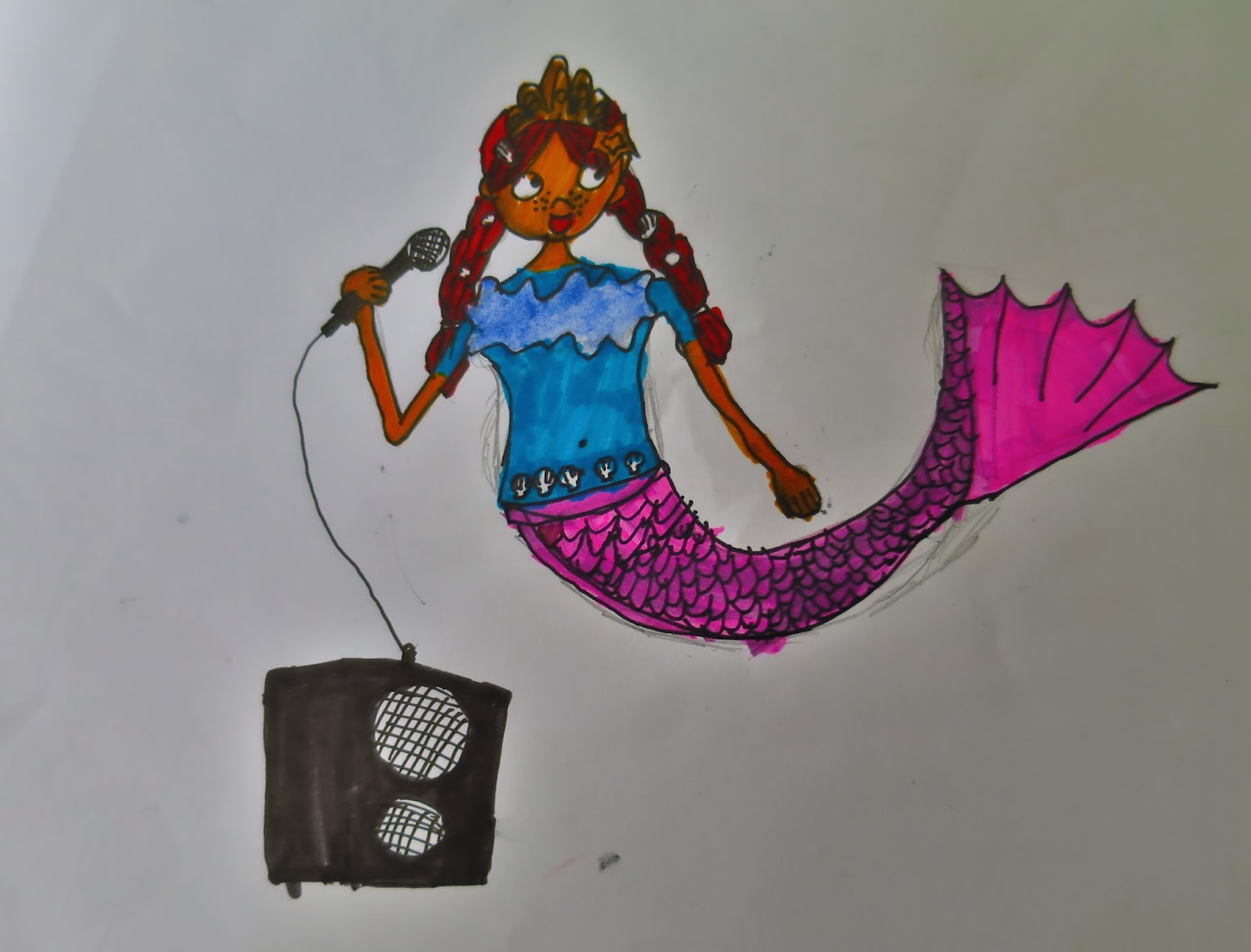
Children can do drawings of their favourite characters (see Lauren Beard's 'How to Draw a Singing Mermaid' in the Guardian here http://www.theguardian.com/childrens-books-site/gallery/2015/may/30/how-to-draw-a-singing-mermaid)


They can make maps tracking journeys across the book

Map from The Magic Potions Shop, illus by Lauren Beard
or buckets of potions


and there's ultimate tribute: dressing up as your favourite book character!

Kittie Laceys on World Book Day

For my Magic Potions Shop series, I've been busy making teeny potions bottles.

At events, we've been imagining our favourite potion (Flying Potion? Invisible Potion? Exploding Powder?) and drawing it or making it with glitter or feathers.

Let me know your craft ideas - I'm always looking for more projects! :)

(You can find lots of crafts, including activity sheets to download, on my website www.abielongstaff.com)


Thursday, 7 March 2013

Happy World Book Day (Week) and how to do the best school author visit you can by Juliet Clare Bell

On World Book Day week, with one visit under my belt and three more to go, I thought I’d write about school author visits. For many of us, it’s the busiest week of the year and we’re all doing our thing in different schools but a lot of us don’t really know what other authors are actually doing. Our school visits will reflect our personality in the same way that writing does, which means that the visits will be all be different. I’ve done a lot of visits in the last couple of years but there are plenty of authors with more experience, who've been doing it for decades –including some of the ones I’ve included in this post, so I'm no expert. But I'm really interested in what makes a good visit? Or more important, what makes an excellent, inspiring visit? And can we learn from each other (like we do in critique groups with our writing)?

I asked some authors, illustrators, teachers and librarians for their thoughts on and experiences of school visits...

ENTHUSE, ENTERTAIN, INSPIRE
I will remember forever when Helen Cresswell, children’s author (Lizzie Dripping, The Bagthorpe Saga) came to our school when I was a child (and I’m gutted as I’ve misplaced the photo of her signing my book. I had it last week!). So here’s a picture of it instead:


She was a real author and a real person. She said things that I still remember over thirty years later. But she didn’t teach us...

DON’T BE A TEACHER –it comes up time and again when people talk about what they want from author visits. You’re NOT a teacher (well if you are normally, you’re not today, whilst you’re being an author).

Candy Gourlay (author of Tall Story) says:
Don’t be the teacher...the children want an experience that transports them outside the school barriers...

And so do the teachers
says George Kirk, teacher and children’s writer.

You can provide something that teachers cannot provide. That’s why you're there. Give the children something that a teacher cannot give them: an insight into an author’s world.

Jane Clarke (author of Stuck in the Mud, amongst many other books, and fellow Picture Book Den-er) says:
Aim to inspire and enthuse and leave them bursting with imaginative ideas they can’t wait to express in words and/or pictures.

But how do you do that?

BE YOU-WRIT LARGE

Children love to feel like you’re letting them in on a secret. Tell them things about you and how you write. And make it entertaining.

Mine your past. What can you use from your past to give children an idea of what makes you tick and how you ended up doing what you’re doing? What funny/interesting things have happened to you that you can use in a way to put your points across? Can you make it personal (without feeling like you’re giving too much of yourself away)?

Why on earth would I want to tell children about the time I blurted out something excruciatingly embarrassing to Darth Vader when he came to my school in 1977 and it was being filmed for the local news (and they subsequently cut the story from the television)?


Because a) it’s funny and it’s a great start to an assembly to have everyone laughing in horror; b) it brings us closer –I’m human and it’s true. We all do embarrassing things. But I’m letting them laugh at me and I’m laughing at myself; c) it’s relevant to the points I’m going to be putting across later about writing.

Similarly, I play a game where I tell the children stories about me as a child and they have to guess which one is not true.


(Children sometimes guess which one isn’t true –but they usually think it’s not true because it’s so outrageous. In reality, it’s actually not true because the true story is even MORE shocking.)

The children all get involved in trying to guess; they get to laugh at me (again); and once again, it’s relevant to the points I want to make about writing–but in a way where I don’t come across as being a teacher.

Mel Lerway (parent) says about an event by Andy Stanton:
he has the children engaged, excited and enthused about reading.... his presenting style fits with his writing style but I guess the principles are the same [for any author]–energy (bucketloads), humour, slapstick humour and a dash of good old reading out loud...
.

Steve Cole (author of the Astrosaurs series) says:
I just try and use comedy to engage with them and to interact as often and as sillily as possible. I try and make them think it’s very easy to write and give them ideas on how they can come up with their own stories, to make writing seem as inclusive and fun as possible. Never make it seem like an amazing, mystical act, but rather something like sport or a hobby that they’ll get better at the more they do.

Respect your audience and prepare well –to be yourself in an accessible and engaging way.

In a great blog post on the value of author visits to schools and pupils, Deb Lund (children’s author) talks about how school visits can demystify authors, motivate writing and ignite sparks. By being yourself and letting children into the secret of the work involved in writing something good and the importance of persistence you can also validate what the teachers have been teaching but in a way that’s fun and memorable. To this end, it’s great to bring

PROPS!

Children love seeing your earliest workings out for your story


(they get to unravel it –and it’s long....)
Let them see how messy it is (in my case, at least), different drafts, rejection letters, comments from critique groups, roughs, editor comments, proofs and final book. It shows the reality of it –and the work and perseverance needed- but in a way that a teacher CANNOT SHOW THEM.

BUBBLES


Who doesn’t love bubbles? I always use bubbles –because they’re great, and because children love them but also because they make complete sense of the points I’m trying to get across.

Time and again, teachers, librarians and authors asked came up with one major point:

BE INTERACTIVE

For illustrators, this is often
drawing, live drawing! Do a bit of that and the kids are hooked,
says Kate Pankhurst, illustrator and author of Mariella Mystery
Get the kids up adding to your drawings and use their ideas to build a new character for them as a demo before they try for themselves.

But there are plenty of other ways to be interactive for those of us who are less good at drawing...

The writers and teachers I asked said...

Ask lots of questions, do quizzes, let them ask you questions, play games –get children involved.

Julie Fulton (author of Mrs McCready was Ever So Greedy) uses a greedy teddy bear to get children coming up with a class poem. I let the children take charge of me and I become their character in their story where they choose, collectively, what happens to me. Lots of authors also have a bag with objects in so that children can take objects out and come up with stories. The objects are rarely used in the way they might be in real life...


Here’s my bag. The ballet shoe has been a home to various different creatures; a boat; a bed for a tiny person; a catapult etc. The blue ball has been a planet, a weapon, a spaceship... This gets children interacting beautifully with each other, too.
For many picture books, at least, reading to the children can be highly interactive...


In Don’t Panic, Annika! there are children being various characters up at the front, but everyone in the audience also joins in with panicky faces, counting, taking deep breaths and shouting out phrases.

With older children, picture books are great because you can talk about the structure of the story that they’ll be using themselves and coming across in novels, but on a much smaller, manageable scale.


And you can make your visits even more interactive by encouraging the school/children to do some preparation in advance of your visit –let them know your web address (I’ve had children bring up things about me that I’d completely forgotten I put on my website) and Bryony Pearce says it’s great to put up at least one chapter of a novel if that’s what you’re writing on your site so children can read some of your work in advance. This might be more important for novels than picture books, but I’ve got a YouTube video of a real-life Annika reading Don’t Panic, Annika! that schools have sometimes accessed via my website before a visit.

I’ve not touched on Skype visits here –I did my first two just a couple of weeks ago (with Lori Degman, author of 1 Zany Zoo (her and the school children I was talking to over in Chicago and me and the school children she was talking to here in the UK). I’d love to hear from other authors/teachers who’ve done/been part of Skype visits. It struck me how different the interactive element has to be out of necessity and I’d love to know how people keep virtual visits as interactive as they can.

How can we improve our visits and make them even better?

If it’s possible to get feedback, it can be extremely helpful. Sian Cafferkey (teacher and fan of author visits) says:
If you are selling books - which is fine - don't limit signing just to those who are buying... As a teacher - make what you say/do suitable for the age group you're meeting... We've had authors who just have a standard spiel that they think will work for all ages - it won't!
Teachers can provide excellent feedback (though it might be nerve-wracking to ask them).

I’ve recently been observed by an agent who arranges school visits for artists (including authors) whose books I’m now on. Two weeks before that, I got to watch a day of Sarwat Chadda (author of Ash Mistry and the Savage Fortress), and it struck me how useful it would be for us to sit in on other people’s visits periodically –for us and for them. And in the meantime if that’s not possible, perhaps we could continue to share some tips and thoughts with each other. After all, we’re trying to provide the best session we can possibly deliver to the children we’re visiting. And if we do it well, it can have a lasting effect on the children we see.

Finally, I think it’s crucial to ask yourself why are you doing visits?

There are lots of reasons authors and illustrators visit schools: to inspire children to read and write and dream...; to earn much needed income so you’re able to write; to promote your books; to sell your books. Different people do it for different reasons: as someone who is passionate about getting children engaged in reading for pleasure (I’ve currently got a grant to do just this) and improving their lives and confidence, the focus of my visits is to inspire children. I need to be paid for it –it’s professional work –just as plumbers and actors and doctors and hair dressers get paid for their professional work. If I did it unpaid, it would be costing me money, as it is time that I am not earning from writing. And it makes it more possible for me to sustain a life where I write. But I don’t do it to promote my books or to sell them –I think with picture books this is different from books for older children as it’s usually parents buying the books and they won’t be there at the visits. For events outside school –festival and bookshop events and those run through parenting groups or even nurseries, promoting and selling books may be a much clearer reason behind the event. Whatever the reason, be aware of why you’re doing it. And if you don’t actually enjoy it, you should say no –for your sake and for the sake of the children you’re visiting. It’s hard to inspire when you don’t feel inspired to be there. If you’d prefer to stay at home and write books instead, then you can inspire them from a distance with your next book.


Thank you to all the authors, illustrators and teachers who offered their thoughts and tips on school visits for this post.

Are you an author or illustrator who does visits, or a teacher or librarian who arranges them? I’d love to hear what works well for you... Do you have any top tips on what to do/what not to do? Do you have any thoughts on fees? Thank you.

Juliet Clare Bell is the author of Don’t Panic, Annika! (illustrated by Jennifer E Morris; Piccadilly Press); The Kite Princess (illustrated by Laura Kate Chapman, narrated by Imelda Staunton; Barefoot Books) and Pirate Picnic (an early reader, illustrated by Mirella Minelli; Franklin Watts).


www.julietclarebell.com

Wednesday, 13 June 2012

Why We Write – Alison Boyle

Question 1: Why should we write?
Answer 1: Because we must. 
Question 2: But why must we?
Answer 2
: Eco-nomic necess-i-ty?
For most writers across the world it's flying in the face of economic necessity to spend time on writing.
Question 3: So why keep going in the face of hours of commitment that may end in a rejection?

I refer you back to
Answer 1.
Balaclavian public art. Was it a Sassie who swooped on
the Northern Quarter in Manchester, England,
to paint this street furniture, then disappeared?
If we write picturebook texts and they move from the realm of our personal computer or notepad to the public realm of a printed book or eBook or app etc, our ideas and the way they're expressed have the potential to be remembered. They can get people thinking and talking and can provide the foundations for so much more.

If you are fortunate to have had one book published you'll know the thrill of either seeing it discovered by a 'new' reader or re-discovered by an 'old' reader.
PICTURE THE SCENE World Book Day 2012. A four year-old girl waits patiently for an exceedingly long snake of young children to be guided into the classroom for a Visiting Author session. I am the Visiting Author, I've brought some books with me that the school wants to buy. They're in my bag...
Four year-old Girl: What do you do?
Me: I write books, including for children.
Four year-old Girl: [Long pause, looking round at her classmates]: We're children.
Me: You are.
Four year-old Girl: Have I read any of your books?
[If she can read she is doing well for her age, and if she can't then I enjoy knowing that the grown-ups in her life are valuing her contribution]
Me: Maybe.
[Visiting Author scans the classroom, and seeing two healthy-sized wooden boxes of picturebooks, walks over with a mixture of trepidation and hope. Four year-old Girl watches Visiting Author with that question hanging in the air.
In under ten seconds a book by Visiting Author is located, and it's a well-thumbed edition. Four year-old Girl, who looks intrigued]
Me: I wrote this book.
[I did, I did, and it's in my top three and I've never fallen out with it, and I really liked the editor and the illustrator - this, as all published picturebook authors will know, is not guaranteed - and
it's been borrowed thousands of times from libraries across the UK]
Four year-old Girl: [Smiles]
Me: [First I listen to an introduction by the teacher, then I launch into my World Book Day session, telling the story of a classmate who incited me to rummage through the class's book box.]
PICTURE ANOTHER SCENE A close friend I met in publishing leaves to qualify as a teacher and build a school in a remote part of Ghana with an inspirational Ghanaian woman. Literally build it, cement scooped into the boot of the Head's car to avoid it being syphoned off overnight before water can be added and bricks can be stuck together to make some walls.

Whilst over in Scotland my friend volunteers at a local primary school helping children who have additional needs, often due to their family circumstances.

The Volunteer Teacher asks a Seven year-old Boy to go to the bookshelf and choose five books...
Volunteer Teacher: 'Oh, you've chosen a book written by one of my friends.' [Note: No product placement involved]
Seven year-old Boy: [Looks askance at Volunteer Teacher] I don't believe you.
Volunteer Teacher: No, really.

[They read all of the books together]
Volunteer Teacher, friend, and biased-towards-me person: Which is your favourite out of those five?
Seven year-old Boy: This one.

Of course the chosen book is the one I wrote. If it hadn't been I wouldn't have heard the story. I protest to my friend that the boy was trying to impress his new teacher, whom he likes. The response was that the boy never chooses anything just to go along with the teacher. I don't think she's completely right, but I don't think she's completely wrong either. (By the way, it's the same book as in the first example.)

All writers have stories about how their words and ideas get people thinking and talking. Whether shared or not, these experiences bring sporadic energy to the ongoing labour of writing. Many authors are strapped for cash and finding it increasingly hard to make a living out of their art, due to fewer offers, lower advances and unsettled routes to market. But this is also a time of opportunity.
Writers need to survive for new writing to happen. I write because I have to, but it isn't just about me. Many children who are keen to read our books can't even get to school. If they can get to school and the schools are good ones, our books can make a difference.
Question 4: What can we do to reach readers?
Answer 4
: We can write.
Question 1: Why should we write?
My Right Honourable Friend, I refer you back to the answer I gave some moments ago -
Answer 1)
There's a story or two you might like to read on this website. If you look deep enough you will find the foundations.

On the side wall of a car park in Manchester, England,
an enormous bird perches; cement supports the painting's base.