Showing posts with label Jeanne Willis. Show all posts

Monday, 27 June 2022

Different perspectives by Jane Clarke

I’ve always loved picture books that show the same event or story from different perspectives, and/or empower the child ‘reader’ to feel as if they know more than the characters on the book. 

Here are a few of my favourites. They date back a while, but then again, so do I…


Rosie’s Walk written and illustrated by Pat Hutchins


Rosie the hen is completely oblivious to the dangerous fox stalking her, but the reader is in the know.


The Bottomley books by Peter Harris, illustrated by Doffy Weir


In Bottomley, Cattery, Bottomley the cat's account of what went on during his stay at the cattery doesn’t quite match that of the owners of the cattery and fellow guests.


The Doctor Xargle books by Jeanne Willis, illustrated by Tony Ross - in which Dr Xargle leads a class of small aliens to discover much about the habits of the strange creatures who live on Earth. Only Dr Xargle doesn’t get it quite right…


Dr Xargle’s Book of Earth Hounds is still a family favourite


Different perspectives have crept into a quite a few of my own picture books. So I’m delighted that my newest about-to-be-published picture book also plays with perspective - on a subject dear to my heart. 


In A Small Person’s Guide to Grandmas, illustrated by Lucy Fleming, the small person’s views are not telling the whole story - something I hope will bring a smile to the face of a happily exhausted Grandma reading the book to their very own small person.


This week, Jane's a very happily exhausted grandma, as she has her rapidly-getting-larger small people, UK and USA varieties, all together for the first time since the pandemic.

Monday, 18 April 2022

Eggstra-ordinary picture books about Eggs! by the Picture Book Denners

The team decided this would be a great time to share our favourite egg themed books – however tenuous that link is. So, here goes!

Lynne's egg book:
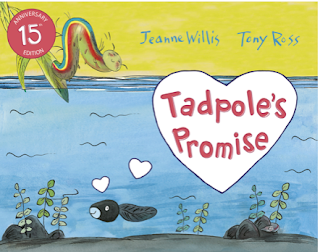
I nominate Tadpole's Promise written by Jeanne Willis and illustrated by Tony Ross

When eggs are mentioned, I think it’s fair to say most people think bird eggs. However, there are a huge number of other critters which lay eggs. For example, ladybirds, slugs and snails, earth worms, spiders, butterflies, and frogs. The book I’m nominating is about the last two on this list, a frog and a butterfly. Both of which hatch from eggs!
 
I stumbled across this book in my local book shop. I was researching for a publisher, who might have been interested in a story I was working on. As I had limited time, I’d told myself I’d only flick through the books to get a feel for them and would, under no circumstances read them. Well… that didn’t happen.
 
I pulled Tadpole's Promise from the shelf and flicked to the first page. I began to read and just kept reading, until I’d reached the last page. It’s one of the few times I’ve had a laugh out loud moment in a bookshop, quickly followed by a little pang of guilt. I don’t want to give the ending away because it’s clever, it’s tragic and it’s amusing. Plus, it’s a great way to introduce children to the circle of life and the natural wonder of metamorphosis.


P.S. If you want to see the eggs for each species I’ve mentioned just click on the link. 


An Egg is Quiet by Dianna Hutts Aston and Sylvia Long

Natascha's egg book:

AN EGG IS QUIET by Dianna Hutts Aston and Sylvia Long is part of a series of beautiful nature books. Each has deceptively simple, poetic main story text and layers of more detailed informational text about eggs belonging to all kinds of species.

The book opens with beautiful eggs on the front endsheets and the back endsheets feature lots of colourful hatched creatures.

It begins with a whisper . . .

"An egg is quiet . . ." (hatching), then builds:
 
An egg is also 'colorful'  . . .  (colours),
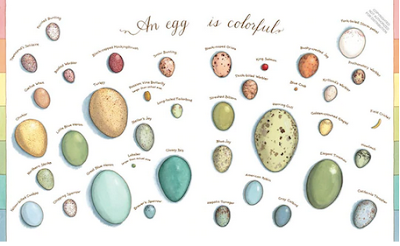
From An Egg Is Quiet by Dianna Aston & Sylvia Long


'shapely' . . . (shapes), 'clever' (camouflage to safeguard from enemies) and 'comes in different sizes'. It is 'artistic', 'textured', 'fossilized', 'giving' (life cycle), and . . .

"Noisy!"
 
The book ends with the joyful sounds as the creatures hatch out into the world.

From tiny hummingbirds to giant ostrich, oval ladybird eggs to tubular dogfish eggs, gooey frog eggs to fossilized dinosaur eggs, the detailed images alongside the rhythmical text are mesmerizing!


Clare's egg book:

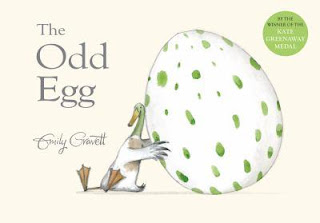
'All the birds had laid an egg. All except... Duck!' 

That is until Duck finds the most beautiful egg in the whole wide world. The other animals aren't convinced initially. But a twist in the tale soon shows them the error of their ways. 

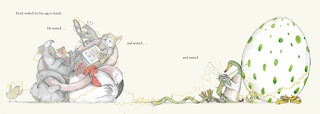
In the 'Odd Egg!' by Emily Gravett, the first thing that strikes me is how masterful the illustrations are. I love the softness of Emily's characters and the pencil line details. The book also has some clever novelty elements which add to the fun and interactivity and come into play with then eggs hatch. The double page where the reader meets the birds' babies is done so well! 


As well as warm illustrations, there's plenty of onomatopoeia spattered amongst in the concise text, drawing the reader in and making it a great read aloud. It might not be the ending you expect to this sweet, cutesy book... all the more reason I like it! 

Jane's egg book:

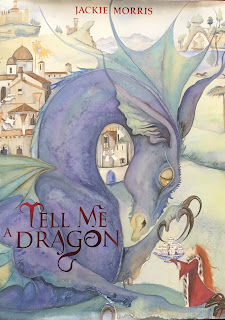
 I'm choosing "tell me a Dragon' by Jackie Morris (Frances Lincoln 2009)


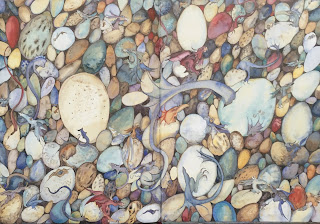
This may be a bit of a cheat, as eggs only appear in the endpapers!


For years now, this beautiful, lyrical book has been the favourite of one or another of my four granddaughters. It's inspired us to have lots of fun together, collecting pebbles and dreaming up what type of dragon might hatch out of them.
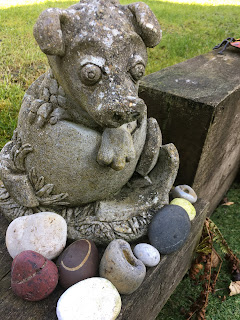
Jane's youngest garden dragon, guarding some pebbly 'eggs.'


Pippa's egg book: 

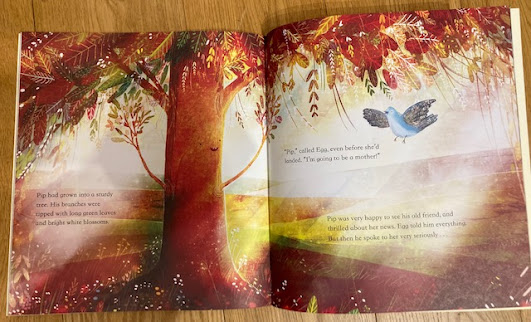
Pip & Egg, written by Alex Latimer and illustrated by David Litchfield


Well, as a Pip, I had to choose that title, didn't I! But it's also a superb picture book, thoughtful and beautiful, kind and wise.


Egg and Pip become great friends, but then life brings changes. Unlike in wonderfully shocking Tadpole's Promise (see above), these two are destined to come through challenges to their friendship that leave them still good friends, but different, at the end. First Pip begins to sprout roots and can no longer move. Pip grows taller and leafier as we turn the pages. And then Egg changes ... into a baby bird! Pip understands when Egg needs to fly to a wonderful city to meet other birds. But guess where bird Egg wants to be when she realises she has an egg inside her? Back to the wonderful tree that Pip has become. What could be more satisfying?


Chitra's egg book

In my egg book, the eggs are not characters. But they are both the victims and the heroes of the story. Farmer Falgu Goes to the Market is about eggs that have to crack to become something else. It's a story of making the best of any situation, and it's the story of resilience, even when it comes to something as fragile as an egg. I also wrote a detailed blog post about why I wrote about eggs when I don't eat eggs.  

Illustrated by Kanika Nair


Moira's egg book 

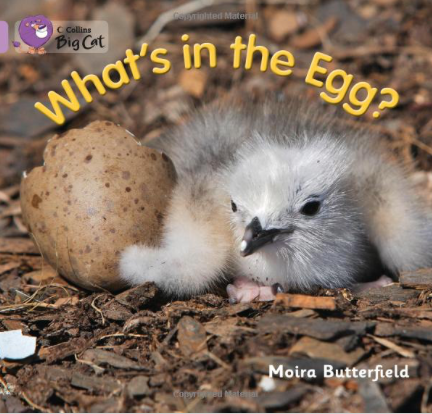
Well, here's a strange little tale about an egg picture book, and about being an author....Back in 2012 I was asked to write a book for ages 4-5 on eggs. Only it wasn't going to have any words! I was nonplussed but I said yes because the fee seemed generous for writing a book with no words, and there were royalties. I was asked to select photos from a picture library that would tell an unspoken narrative about eggs - a narrative using pictures that young emerging readers could chat about with a grown-up. So I found egg photos that told of animals such as fishes, crocodiles, seagulls and eagles....and so far  'What's In the Egg' has gone on to earn me 3 times the original advance. The lesson? As an author, don't necessarily say no to unusual opportunities, even if they sound a bit strange. Keep your mind open!
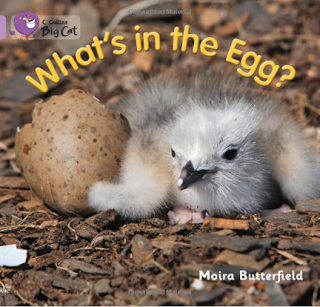

The book I 'wrote' with no words. 

Garry's egg book

J.Otto Seibold presents Other Goose. Re-nurseried!! and Re-rhymed!! Childrens Classics

If you're a fan of wacky and zany or you just want to shake things up a bit for Easter, then this is the book for you.

J.Otto Seibold re-tells some classic 'Mother Goose' nursery rhymes in his inimitable illustrative style. The book includes a chapter called ' Of Eggs and Accidents - fried, tried and justified' where Humpty Dumpty goes to the mall and buys some platform boots in the sale, size eggleven. In part two he steps in a hole and loses one boot which leaves him clopping around and around in circles. 

Bonkers and lots of fun, this book gets my shout for Easter.


Mini's egg book

The Good Egg 

I did a rather egg-based post back in February to mark 20 years since the publication of my very first book, which was about an egg (Egg Drop.) You can find it here. In it I do a round-up (OK, an oval-up...) of some favourite egg books including this one. Happy Easter, and wishing you the best of eggs!

Sunday, 20 June 2021

Picture books about Dads. Garry Parsons chooses picture books to celebrate fatherhood all year round.

One of my favourite depictions of fatherhood is the moment Geppetto lifts Pinocchio off the floor and joyfully whirls him around the room at the end of the Disney movie. This is the very last scene in the movie where distraught Geppetto is sobbing on the bed and all looks lost. But when he lifts his head to see who’s talking he realises that Pinocchio is not only alive after the ordeal with the whale but has magically been transformed into a real boy. 


Pinocchio - Disney 1940
 

I’m sure we’d all agree that Geppetto’s parenting skills in the movie require some attention but what I love about that final scene is the overwhelming sense of joy Geppetto has at being a father and the relief he has to be reunited with his son.  You can watch the scene on youtube here.

Like Geppetto, no one is perfect at being a parent and nor would we want to be, but Dads in picture books often seem to get a raw deal. Dads are often depicted as caricatures of dads, preoccupied with tasks in the shed, washing the car or tinkering under the bonnet. Sometimes unkempt or dishevelled, they can appear absent minded, aloof or uncaring, preferring to fix things than parent directly. 

Dads generally appear less in picture books than mums too and are more likely to play background roles. There are certainly more mums in picture books than dads but that is probably a fair representation of who is taking on most of the full time parenting today, particularly with books for younger children. Dads in picture books can be on the periphery of family life or simply absent from the story altogether, but that might also be a reflection on the world we live in too. 

From Lawrence in the Fall by Matthew Farina & Doug Salati
 

So it’s heart-warming to see some new Dad characters coming to the fore in recent picture books. Dads who care and parent from a place of nurture (“Lawrence in the Fall”) and dads who are gentle and willing to listen (“Jabari Jumps”) And dads who are keen to impart wisdom and help their children grow. 

What We’ll Build by Oliver Jeffers 

As it is Father’s Day this weekend we have good reason to delve back into the book shelf and pull out some old favourites too. 

Don’t Let Go! By Jeanne Willis, illustrated by Tony Ross.


I’ve picked out a few picture books with strong father figure characters who, I feel, have a lot to give and that you might enjoy too.


 Lawrence and his Papa go searching in the woods to collect things to show in school. Papa gently departs his knowledge of the forest and his wisdom of how the world works. In a moment when they become separated, Lawrence discovers a forest secret of his own. A tender story of the bond between father and son where the characters express clear emotion, beautifully illustrated scenes and characters that capture the tenderness and wild elements of the landscape.


What We’ll Build by Oliver Jeffers is a story of a father and daughter setting out plans for their life together, building memories and a home to keep them safe. A moving story of love and protection.


A story about courage and gentle parental encouragement. Jabari has made his mind up that he is going to take a leap from the diving board but it's high and a little scary but he has his dad with him for support.


Pete’s A Pizza by William Steig is a firm favourite in our house and never ceases to bring a smile. It's raining outside and Pete can't go outside to play. Pete's attentive dad decides to make him into a pizza instead and bake him on the sofa. A funny and warm story around the kindness of a tuned-in dad with paired-down but spot-on illustrations.

A Brave Bear is a contemplative story of gentle parenting and attentive awareness. Dad has to navigate encouragement and some sulking when his son has ambitions of jumping big and grazes his knee in the wilds of the forest. Beautiful, textured illustrations from Emily Hughes.


Another enduring favourite in our house is Don’t Let Go! By Jeanne Willis, illustrated by Tony Ross. A little girl wants to visit her daddy but to do that she needs his help to learn to ride her bike. "Daddy, I'm here, I won't let go. Not until you say. Hold on tight. I love you, so - We'll do this together...OK?"  Prepare to be moved by this affectionate father and daughter relationship.


Great for younger readers, My Daddy is a Giant is a simple celebration of a father with Indrid Godon's uniquely wonderful illustrations.

Dad is competently in charge, doing some chores and caring for his daughter Trixie at the same time and doing a fine job of it until it all goes wrong at the laundromat. When you're attention is focused on your toddler be prepared to make mistakes!
 

Stereotypically manly men are shown in emotional or scary moments in Tough Guys (Have Feeling Too) by Keith Negly. Evertone has feelings, unless you are a robot!


And to return to Geppetto and his son, Pinocchio by Pinocchio, retold by Michael Morpurgo, illustrated by Emma Chichester Clark

As ever, please use the comments section to recommend your favourites and let’s celebrate the fully formed Dad in picture books all year round.  Happy Fathers Day!

 ***

Garry Parsons is an award winning illustrator of children’s books and father to two boys. 

Garry is the illustrator of My Daddies! By Gareth Peter. 

@icandrawdinos www.garryparsons.co.uk 


Monday, 11 December 2017

Giving It A Twist, by Pippa Goodhart

In my new picture book, Chapatti Moon, illustrated by Lizzie Finlay, I did something that writers get told not to do.  I added a design note to say, 'Could the next spread involve twisting the book to see the illustration in portrait rather than landscape/'  Why did I want that?  Because the story involved the runaway chapatti being kicked up into the sky by a donkey, and I wanted the audience's eyes to look up in the same way as Mrs Kapoor does.  So we go from -


...to ...


I'm not the first to have used that trick in a picture book by any means, and that thought set me looking for other examples.

This Is Not A Book by Jean Jullien uses the fold half way down the book on portrait to brilliant advantage, turning the book into a chair -

Or a computer -


Other books use that format with different purpose.  Emily Gravett's The Rabbit Problem makes the whole book a calendar which could be hung just like a real one -


And, another of my favourite picture books, Tadpole's Promise, written by Jeanne Willis and illustrated by Tony Ross, uses that horizontal gutter as the divide between water and air.

The problem with that idea is that the story action happens very much at the meeting place between those two elements, and so the main point of interest is sometimes a bit lost in the fold.  

Do you know of other examples that use this book orientation to a particular purpose?  Or can you think of one that might work well in a book?

Friday, 17 October 2014

Unhappily Ever After? By Pippa Goodhart

Does horror have a place in picture books?

There’s been a lot of recent discussion as to whether or not there are too many unhappy and hopeless endings in books for teenagers. But what about unhappy endings in picture books?


Jon Klassen’s ‘This Is Not My Hat’ won the Kate Greenaway prize at the same time that Kevin Brooks’ controversial book 'The Bunker Diary' won the Carnegie. Both deal in horror. Both could be said to end unhappily.

‘This Is Not My Hat’ is a very beautiful book. It's a very simple book. It's a very powerful book. It’s truly dramatic and exciting. (Spoiler alert!) We are told the story in a few sentences narrated by a little fish who is boasting that he’s stolen a hat from a big fish, but the big fish is asleep and probably won’t notice. But we can see in the pictures that the big submarine shaped fish isn’t asleep: he’s awake! And he’s angry! And he’s going after the little fish into a mass of green weeds … before coming back out with his hat. And that little fish voice has stopped.


Why is that so powerful? Its power is in what is not said or explained. It is in that space left to be filled with the reader’s own imagination.  What most of us imagine is a horrible massacre of the little fish by the big one. So it is us, rather than Jon Klassen, making the story end with horror. Is finding horror in ourselves more powerful than being given it from the outside?

A lot of the reviews on Amazon say that this is a book for adults and older children rather than children of the usual picture book age. When I think of my daughters at, say, two to five years old, they would have made that grisly imaginative leap and been upset by it. But would they actually, at some level, enjoyed the thrill of that horror, or just been upset? I don’t know.

One Amazon reviewer took from that book a message of: find out the perpetrator, kill him and eat him. But it's more complex than that. The supposition that the fish has been eaten (and it’s only happened in the reviewer’s mind, remember, not explicitly on the page in any way!) raises the big and important question of fairness. Did the little fish deserve to die for stealing something that wasn’t his, and then cockily boasting that he’d got away with it? Small children have strong opinions about fairness. Where does fairness lie in this case? And is capital punishment fair? It’s all so interesting! I think it’s the interesting moral dilemma in this story that stays with us more than the horror, whereas it was definitely the horrors in Struwwlpeter that have haunted me and has stayed with me long after ‘nice’ books have faded from memory.


There is the view that childhood is a golden time of innocence, where the nasty side of life doesn’t yet have a place. For some children their early years truly are like that, and I think I’d hesitate to upset things for those children with too early a dose of unhappily ever after. There are plenty of picture book stories that deal in horrors (think of The Owl Babies raising the possibility that Mum has been eaten by a fox!) but in which things are brought to clearly happy endings. The difference here is that we are left still mid-horror, albeit in a way that many would take as black humour more than straight horror.


There are ‘unhappy’ books that are aimed squarely at addressing some real life horrors, of course. Rebecca Cobb’s beautiful ‘Missing Mummy’ shares the misery and misunderstanding and anger of a small girl whose mother has died. I wouldn’t offer that to a child who had no notion yet that a mother could die, but it makes a wonderful discussion point for children who have experienced the death of their mother, or for those who know another child going through that real horror. 

Different books are going to suit different children in different situations and at different times, and we adults have a role in guiding the right books to the right children at the right moment. We have the luxury of a huge choice, even within picture books. I think that’s wonderful. But it trips some people up.


Look at the reviews for Jean Willis and Tony Ross’s ‘Tadpole’s Promise’, and you’ll find much greater outrage than for ‘It’s Not My Hat’. I suppose that is because people have picked up what looks like a nice little love story about a tadpole and a caterpillar who promise to love each other for ever and never to change …. And they haven’t thought through the inevitable problems implicit in that set-up! Clearly people have bought the book, and not read it themselves before reading it aloud to a small child audience who are sometimes horrified when the frog eats the butterfly! An outraged adult reader is going to produce an upset child. Maybe some children will be upset even if the reader has warned that this is a story that isn’t going to end happily. But for some the kind of bright child who delights in following an idea through to a logical conclusion, that book is an absolute delight! Besides, the frog isn’t unhappy because it’s oblivious of quiet who it has just eaten. And the butterfly isn’t unhappy because it’s, well, dead. This is a great book to read out loud to students of writing. They tend to gasp and say, ‘but I didn’t think that children’s books could end like that!’


Should they? What do you think?