Showing posts with label Tiny Owl. Show all posts

Monday, 4 December 2023

Recycling A Christmas Folktale, by Pippa Goodhart


            There is a folktale Christmas story that’s well known in the Ukraine and Russia, Germany, Poland, Norway, Denmark and Finland, but was new to me when I met it as a bookseller in the 1980s.


            This The Cobweb Christmas version of the story has old German Tante trying to make her home clean for Christmas, sweeping out the spiders. She brings a tree in, and decorates it with cookies for the local children to have on Christmas Eve before Christkindel comes in the night to fill the toes of their shoes. She’s asleep when Christkindel passes by and sees spiderswanting to go in and see the special tree. He opens the door to let them scuttle in.


The spiders cover Tante’s tree in webs, but Christkindel touches the webs and turns them all to gold and silver; a reward for Tante’s kindness to the children. 


            That book is no longer in print, but there are other versions of this story that take the story in quite different directions. The Spider Who Saved Christmas by Raymond Arroyo has a golden back spider weaving a great veil of web over the entrance to a cave where Mary, Joseph and baby Jesus hide as they flee from King Herod. As baby boys are slaughtered outside the cave by Roman soldiers ‘with blood streaked swords’, Jesus is saved because the sunlit sparkling web hides the Holy family from the soldiers. Other versions combine those ideas by having Christ himself visiting a poor home and blessing cobwebs on trees, giving wealth. That idea of spider silk turned into gold and silver is, apparently, is the origin of tinsel on Christmas trees.

            Stories in which spiders bring good luck go further back to pre-Christian times. And of course Christmas trees originated in more pagan ideas, only becoming part of our familiar Christmas traditions from C19th. This is a story adapted and adopted countless times over time and space. And now I’ve written my version of it. 


            Old Bear in my Christmas Cobwebs story is really me at heart, remembering how magical Christmas was as a child. We never saw the decorated tree with lights switched on until Christmas morning, and even then only after breakfast had been eaten, the kitchen floor swept, and we all stood in height order to open the door … and, da daa! There it was. 


Like me, Old Bear is the one preparing a tree and decorating it for others now. She wants it all to be magical for the friends she invites. But she doesn’t want the spiders making her house untidy. 


Not wanting to miss out, as Old Bear sleeps, the spiders come to look at the decorated tree. ‘In the moonlight, they span and swung and spiddled, scuttling and exploring and weaving and winding wondrous webs.’ So, when Old Bear wakes up and looks at her tree, its ‘drippily draped in droopy grey cobwebs.’ Her friends are on their way, and she’s not happy …

… But you can easily guess what’s going to happen when the sun comes out! Old Bear gets some surprise Christmas magic after all, and thanks her spiddly spider friends. 


Ema Malyauka from the Netherlands has brought Christmas Cobwebs to wonderful visual life, and I love the feeling of stories linking countries and peoples at Christmas. The spiders and spider web Christmas tree decorations that have been traditional in Ukraine for so long, are beginning to appear in other Christmas trees, too, including the one in Nick Sharratt and my new You Choose Christmas book.


How many other folktales can you spot being referenced in the decorations on this tree?


Wishing you all some Christmas magic, maybe from where you least expect it! 


Monday, 28 February 2022

The Beauty of Slowing Down, by Pippa Goodhart

Do you remember the wonder and beauty of that first lockdown in spring of 2020? 

There were those who were doing the caring, facing the worst horrors of covid in overstretched hospitals, risking their lives to keep transports and food supplies moving, working all hours to teach our children in person and online, and many more doing ‘key’ jobs. Two of my daughters were caring for covid patients, one barely protected by paper mask, plastic apron, and goggles donated by a local school, the other better equipped but pregnant and not knowing what the potential harm to her child might be from the patients with covid she was treating. All of it pre-vaccinations of course. 

            But for my husband and me, and millions more lucky ones, there was another side to this time when so many ‘normal’ activities became impossible. The sky, seemingly clear of aeroplanes, was bright blue day after day. The colours of spring flowers opening seemed more vivid than ever before, the bird song richer. I remember standing on a footbridge over the M11 motorway, and seeing empty road on either side as far the eye could see. One bright May morning we took our inflatable canoe on Cambridge’s Backs, normally a time and place where the river would be crammed with tourists being punted up and down. We took our allotted hour’s exercise in paddling down river and back, and saw not a single other human river user. But the blue sky was being scribbled on by a small ‘plane enjoying itself as it practiced to offer sky hearts to the NHS. What privilege of calm and beauty and humour and kindness for some of us, even whilst others worked harder than ever before. 


            So, when publisher Tiny Owl asked me to write a picture book that captured something of what we had learned from our lockdown experiences, it was the slowing down and noticing things that felt to me to be the appropriate focus. Children reading the resulting book would either not remember those lockdown times, or simply not know how unusual they were. We adults have the context of ‘life before’ all that, but young children have only the context of ‘life after’ … so far as it has settled to a new kind of normal. Certainly there’s now again a feeling of rush, with a perceived need to catch up with everything, including what children might have been missing out on. The calm has gone.  


            The story I wrote, ‘Stop The Clock!’, richly and cleverly illustrated by Maria Christania, makes no reference to the Covid 19 pandemic. Indeed, the illustrations developed from ones in which some people in the street were wearing face masks to none doing that. But it isn’t a story that shies away from more ongoing social issues. 

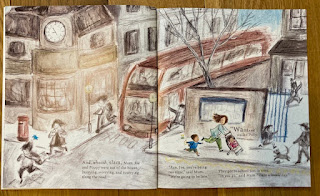
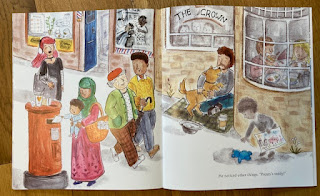
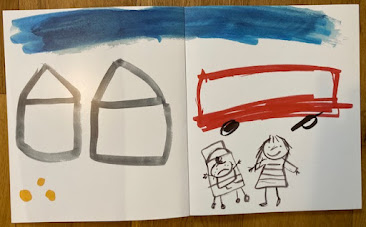
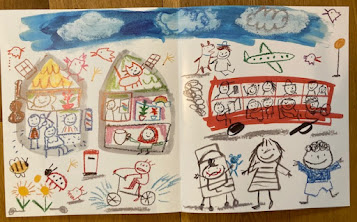
            Joe is rushed to school by Mum, and then rushed in his work in school by teacher Mr Khan, both of those adults nagged by clocks ticking onwards. But Joe wants time to think and to finish the picture he’s painting. So – and here’s the beauty of what stories can do which real life can’t – he stops time. He goes back over the route taken to school, now noticing the colour and interest and detail, adding those things to his picture. He finds the reason why little sister Poppy was crying, but there’s so much more to see. The bird plopping poo onto somebody’s head! The beggar in the doorway. The exhaust from the bus making the cyclist cough. The Venus fly trap plant about to snap shut on a fly. The cake squelching as a bite is taken. And much more. 


            My favourite pictures in the book are Joe’s painting. The difference between the opening and closing endpapers summarise the story beautifully –


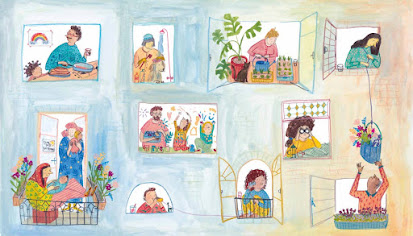
            Tiny Owl commissioned pieces for another, very different, book about what we experienced and learned from lockdown times. They asked their illustrators to produce images and writing about how the experience had been for them. The result is 'Unlocked', a moving, funny, and inspiring. It genuinely brings a tear or two to my eyes, and also makes me laugh. These wonderfully creative people from around the world (Switzerland, the UK, the Netherlands, Iran, South Africa, Portugal, Italy) all found imaginative ways of making the most of the necessary restrictions. Music, gardening, zoom parties, cooking, and just closing eyes and properly listening are just some of the things they did.  This book is one for everyone, and I’ve bought it as a gift for more than one adult now. Highly recommended. 


            There have been children’s books explaining covid and vaccinations, and books praising our rescue services in pandemic times. But do please make comments below suggesting other books which aimed to capture that ‘time out’ experience of months of restrictions.  


Monday, 13 February 2017

Building Bridges Through Picture Books, by Pippa Goodhart


 As our world divides, and distrust between different peoples seems to be growing, our children need to learn to do better than us.  That will only come through understanding and communication between cultures.  This has set me thinking about the few occasions when my story text has been illustrated by an artist from a different culture.  

The first time was when I wrote a silly rhyming story about Three Little Ghosties who like to bully ghoulsies, witches and ogres.  They are about to scare a human child … when the child wakes up and scares them instead.  I had a particular British illustrator in mind for this book.  Colin Paine did these lovely roughs ...


 … but Bloomsbury appointed an Italian illustrator, Anna Cantone, to do the final illustrations.  She used collage to produce very ‘designery’ images (please excuse the badly lit photo!).  I wasn't sure about them to begin with.  And yet I’ve come to love them.  Why?  Well, largely because young children react to them so well!  (NB This book is now out of print).


I’ve had books illustrated, published and sold in South Korea, and those have surprised me by showing children who look more British than Korean to me. 


 I asked my fellow Picture Book Den contributors what experiences they had in working with writers or illustrators from other cultures, and only Jonathan Emmett had experience of working this way.  He told me …


It took three years to find a suitable illustrator for my picture book story The Santa Trap and I’d almost given up hope of ever finding one when my editor Emily Ford discovered Argentinian illustrator Poly Bernatene. Poly brought a distinctly South-American Gothic feel to the illustrations that was a perfect fit for the dark, cautionary tale.


Poly’s English is pretty good these days (and certainly puts my miserable Spanish to shame) but back then his wife Paula translated the story’s text and Emily’s email correspondence so that the language difference did not seem to present too much of a problem. We’ve since done three more books together and are hoping to do a fifth. Although Poly can sometimes interpret my words in a way that I hadn’t intended, this often leads to interesting and appealing results.

That highlights one obvious problem; language differences.  And yet translation of short texts isn't hard.  Perhaps there should be more cross-cultural cooperation?  

There is!  Tiny Owl Publishing have recently launched an exciting and innovative move to publish children’s picture books which ‘bridge cultures’, specifically between Iran and Britain.  They asked me to write a fable for an Iranian illustrator to work on.  So I wrote A Bottle of Happiness, and, remarkably quickly, there was my story made into the most beautiful and, to me, initially slightly strange images by Ehsan Abdollahi.


As with Three Little Ghosties, I wondered whether the style would be too sophisticated and strange to British children’s view, but not a bit of it!  More fool me for underestimating them.  Of course ALL styles, indeed the whole world, is new to a small child, so they naturally tend to be more open to new ideas than we adults might give them credit for. 

In our modern world, we need to know facts about each other, but I strongly believe that we also need to have a proper feel for, and familiarity with, each other’s worlds and outlooks.  We need to share cultures.  

My father, who was a lovely and wise man, used to say that the point of education was to give us more things in life to enjoy.  Well, having access to the beauty and insights of other cultures certainly gives us more things to enjoy.  So let’s give that joy to our children!