Monday, 3 April 2017

Never Too Grown Up for Picture Books • Chitra Soundar

I love picture books – to read on my own, to read aloud to my nephews and to write. But the side-effect of writing picture books is that I also have to perform the book – or as I call it – Sing for my Supper. I usually sing a modified version of Old MacDonald Had a Farm – all it requires is enthusiasm.

Notice the cap and the drums...
When I get invited into schools, I usually have to do sessions with children from Reception to Year 6. Reception, Year 1 and Year 2 are perfect for the picture books. I tell stories, we make up stories together and they love reading from the picture books.
Then for Year 3 and Year 4 – I read from my chapter books and discuss the stories for their inner meaning of justice and fairness. That’s all good.

But what happens when I go into Year 5 and 6 classes? They are too old for my picture books and definitely not interested in my younger chapter books. At first I used to show my books for 30 seconds and then say, “I write for younger kids, let’s do some writing ourselves.” I would never bring out my books again thinking they might not be interested.
Then one day it occurred to me that I could use picture books in Upper Key Stage 2 too, as long as I use them effectively to draw them in and bring a different perspective. Here are some ideas I use in Key Stage 2 classrooms with my picture books. Maybe as a writer in schools or a teacher you  might be able to use them too.

Idea #1: Convert my fictional story into a non-fiction activity
I read the story aloud in class and then use the book as a jumping off point to discuss non-fiction that underpins the text.
For example Pattan’s Pumpkin is the retelling of an ancient legend – but when I use it in KS2 classrooms, I engage the children in the setting – the beautiful UNESCO protected Sahaydri Mountain Range and talk about the fauna and flora of the region. I bring in some information sheets about the region, the animals etc and the class works in groups to create non-fiction booklets about the mountains, or animals or India depending on which topic interests them.

Of course teachers love this workshop too as it covers a bit of geography, science, reading and I sneak in a bit of Maths. Check out the teaching ideas I share with teachers here.

Idea #2: Picture Book Story Board Workshop
In this workshop, I talk about the layout of a picture book as a writer. I show them my notebook where I break up text into spreads, draw boxes to figure out what might go into each spread. I talk about page-turns, exciting events and story mountains.
Then I give each table a story that I am currently working on. Each group then designs the picture book turning into designers and illustrators. They have to break out my text into spreads and put illustrations and words into 12-box grid. Each group comes up with a different design and they love to compare and discuss their reasons.


Idea #3: Plan Your Own Picture Book
This workshop is a combination of the other two. First I tell them a story from one of my picture books. Especially one that has a pattern – usually from one of the titles from the Farmer Falgu series.
For example, in Farmer Falgu Goes to the Market, my character goes on a journey and encounters problems throughout his journey and in the end finds resolution.
Then I invite the class to throw ideas into a big story salad. Can we make Farmer Falgu go somewhere else? Whom will he meet? What problems will he face? So far we have sent off Farmer Falgu to the moon, to the undersea and to alien planets. The children decide the characters Farmer Falgu meets, the obstacles in his way and the resolution.

Some children of course then change course and find their own characters and that’s okay too. Once we have discussed the basics, then either in pairs or on their own, they plan their storyboard. Some develop the whole story while others enjoy telling the story to everyone else. Read more stories that were developed in classrooms here. 
The important thing is then the children engage with the picture book without guilt. They are often told they are too old for it. When they are allowed to, they enjoy it very much – but in a very different way.

So if you’re a picture book author who is nervous to go into older classes, you can move up from Reception, take off your costume and do workshops with the older kids too.


Chitra Soundar writes picture books and young fiction and is published in the UK, India, US and many other countries. Follow her on Twitter @csoundar and find out more about her at www.chitrasoundar.com. 

Monday, 27 March 2017

BECOME A CELEBRITY AUTHOR IN 10 EASY STEPS - by Michelle Robinson

Michelle Robinson: successful
children's author and non-entity
Every time a celebrity puts their name to a children’s book, a professional author drops down dead. With celebs 'shutting us out of our trade', authors are heading toward extinction. It's hard not to feel bitter when your books aren't even stocked, let alone given their own pedestal. But sucking on sour grapes does not an attractive author make.

Chin up, chums! It's not all that bad. Besides, we ought to be flattered: the rich and famous want to be just like us. Can you blame them? We get to have 'a name' and hang around in our pyjamas all day, not being recognised in public. We'll never be considered too unfit or too wrinkly to do our jobs. Still, from where I'm sitting being rich and famous looks pretty appealing too...

How about we level the playing field and supplement our income with second jobs - as celebrities.


PUT THE ARGOS APPLICATION FORM DOWN.

You've already defied all odds to make it into print despite being a complete non-entity. If you can do that, you can do anything. A monkey with a typewriter can write a bestselling picture book and you can host the Brits! You're 10 steps away from a high profile second job that's WAY better paid than the one you've been busting a gut over. Take a shortcut to fame!

GET A SECOND CAREER AS A CELEB IN 10 EASY STEPS


Step 1: Look loaded
You'll need to speculate to accumulate. I know this is hard when regular children's authors don't make a lot of money, but if you're going to convince everyone you're worth squillions, you need to stop wearing rags. From now on, travel first class and invest in some half decent clothes. Men: buy a tailored smoking jacket, it's what Ant and Dec would do. Women: if we want to be taken seriously we’re going to have to start showing a little more flesh - no socks from now on.

Step 2: Act confident
The paparazzi won't shoot themselves - although you'll soon be wishing they would! Shoulders back, chest out. A shower wouldn’t hurt. Turn up the confidence a notch while you're at it and stop acting so grateful for having achieved your dreams. Demand the dream with a cherry on top. You’re worth it.

Step 3: Handle your own publicity
Once we’re famous we’ll have all the publicity we need - and more. Until then it’s a case of do-it-yourself. Try getting a mention on Steve Wright’s Sunday Love Songs or running down the high street naked. It doesn’t matter if your books don’t figure in any of this. At this stage all exposure is good exposure.

Step 4: Get 'legit'
You’re going to need a blue tick on Twitter and a squillion followers. Everyone knows you don’t necessarily come by thousands of adoring fans legitimately. Just like a top ten slot in the bestseller charts, you can simply buy a fanbase. This is not cheating; this is celebrity publishing. We’re going for quantity not quality.

Step 5: Bluff it
Nothing says ‘Paint me orange and feature me in Heat Magazine’ like wearing a huge pair of shades and a baseball cap down Lidl’s. Serendipitously you'll find these items readily available in store. Hop to it (and stop using clever, writerly words like 'serendipitously'). Note: it is acceptable to dress down when incognito, provided all loungewear is by Gucci.

Step 6: Create a stir
We can’t all be literary sensations, but we can all be sensational. Do something outrageous. It will give you material for that memoir you’ll finally have time to write in prison. Goodness knows you'll be too busy to write the rest of the time what with all those television appearances and international flights. Don't worry about your schedule; your PA will soon be organising everything for you, and you won't have to do school visits, ever again. With any luck you won't have to write anything ever again either - someone else will do it for you. You could even request a body double for all those top-billing lit fest events you'll be doing. Get in!

Step 7: Acquire a cute back story
Sales and marketing departments love 'a hook'. Those lucky old celebs have them ready made. ‘Treasure in the Attic’s Wotsisface has treasure in HIS attic with new children’s book masquerading as pile of junk’. ‘Reclusive writer's cardigan provides refuge for rare moths’ isn’t going to cut the mustard. You and I are going to have to dig a little deeper to create eye catching headlines. Consider selling your own granny. Who cares if you're disinherited? Pretty soon you're going to be MINTED.

Step 8: Get a famous partner
Remember when Jools Oliver wrote a children's book? No? Oh. Well, a celebrity author is one thing, but a celebrity author with a celebrity partner is TWO THINGS. Photoshop yourself into a compromising situation with a celeb of your choosing. Don’t worry about being sued; you can settle out of court once you’ve made your first million.

Step 9: Smile
Coffee and red wine may help with the unsociable hours writing requires, but nobody wants to see their ill effects in HD. Tooth whitening is expensive and you’ve probably blown all your cash on a butler. Thankfully you are naturally creative and have a plentiful supply of Tippex. Say cheese!

Step 10: Grow a thick skin
Don’t expect to be welcomed to all those star-studded parties* with open arms. Those celebs didn’t just suddenly become children’s authors without putting in the hours. Okay, maybe some of them did. Still, if you should happen upon some children’s authors having a moan about the amount of non-entity authors selling loads of books, smile politely and find someone sympathetic to talk to. Like Madonna.
*Orgies...? Take breath freshener.

See you on your luxury yacht, my friend!


Michelle Robinson manages the tricky balancing act of being both a successful children’s author and a total non-entity. She has seven picture books publishing in the next six months - and still no invitation to appear on Oprah!

‘Daisy Doodles’, illustrated by Irene Dickson with photography by Tom Weller, publishes with OUP in June 2017. 

Monday, 20 March 2017

Are you rich? by Jane Clarke

A couple of weeks ago, I was sent an email via my website, it didn't address me by name:

 "I have a Fiction Story which I plan to Publish in UK. However, I do not have enough revenue to sponsor the idea. Hence I need a Partner that can assist me in this regard. If interested, You are to pay me 10,000 pounds which will entitle you to 50% of the royalties from the sales of the book after it has been publish.”


There are so many things wrong with this scenario, all I could do was smile as I hit the delete button. But, regardless of whether this is a scam or not, it has an underlying belief that all authors must be rich. It’s a belief that’s clearly shared by a lot of people I meet when I’m out and about doing author-ish things, and I’ve been out and about doing lots of author-ish things round World Book Day this month. The children I’ve seen are often up front enough to ask 'are you rich?’


My reply? "Yes! I have a new granddaughter. She's my third, I'm rich in granddaughters!"

One of the very precious things in my life

But despite the underlying truth in that, it's a bit disingenuous.

So for the record, although I now have had over 80 books published, writing has not made me rich. This isn’t a moan, I love my job and I feel very privileged to earn my living from writing, but my current income is around what I would be earning if I was still teaching.


Happy author


You may have heard of writers receiving a ’six figure advance.’ An advance is what is the publishers pay you in advance of the publication of your book. My most recent advance for a picture book text was for £2750 (paid in 3 instalments). After publication, once the publishers have recouped the costs of the book in question, I will earn royalties of 3.75 percent on each book sold (as long as they are not heavily discounted). 

Some tedious details.

If a book does well, royalties may occasionally be in the thousands over the lifetime of the book, but that’s very rare - more often a book earns just a few pounds a year - or nothing when it goes out of print. It’s also hard to get picture books taken by publishers, I feel very lucky if I get one or two a year. I do other sorts of writing, like ghost writing and writing for reading schemes, and chapter books (all with smaller advances than for picture books) and school visits to supplement my income.

Having fun  helping Reception class make up a story

It’s no hardship or compromise, I really enjoy all these things.  I think I have the best job in the world!  In the UK, we’re fortunate to receive an annual payment from  Public Lending Right (and lots of people borrow picture books from libraries, thank you, it all adds up!). A couple of times a year, there's a much smaller payment from the Authors Licensing and Collecting Society - if you register each title you get a tiny amount each time a poem or story is copied, broadcast or recorded by an institution that responsibly registers its use.http://www.alcs.co.uk. 


Thanks to PLR and ALCs every little bit adds up.

Of course, there are a few exceptions who have made pots of money from children’s writing, but they are in a tiny minority. Much lower down the financial scale come the fortunate people like me who earn their living from children’s writing. But the majority of children’s writers and illustrators do not earn enough money to make a living from it, and don’t dare drop the day job. 

So please don't assume any of us at the PictureBookDen are rolling in it. You're not rich, by the way, are you? If you have the odd £10,000 to spare, you're welcome to take my website correspondent up on that offer! :-)


Jane’s latest picture book is Neon Leon, fabulously illustrated by Britta Teckentrup, who is almost certainly not rich either :-)


Monday, 13 March 2017

Practising What You Preach in School Author Visits: Mindfulness, Mistakes and Early Picture Book Drafts by Juliet Clare Bell


During a school visit, have you ever been talking about your writing process and a great top tip for writing... and then found yourself thinking “what a great idea! I should do that.” ? And you realise that you’ve not actually done it (or that your writing process has strayed away from what you’re describing) recently…

Maybe I’m the only one, but I suspect not. And the time around World Book Day, usually the busiest time of the year for author visits, is a good time to listen carefully to what you’re saying to others and making sure that you practise what you preach.

I am currently going into one school for two days a week over a five-week period, where amongst other things, I am practising and discussing mindfulness with the children and how mindfulness can help us in our everyday lives and when we are writing. Jess Mikhail (who illustrated Two Brothers and a Chocolate Factory) is doing the same with illustration.


I'm lucky enough to be working on a mindfulness and writing/art project with Jess Mikhail, after having worked with her on Two Brothers and a Chocolate Factory: The Remarkable Story of Richard and George Cadbury, above.


I have practised mindfulness, on and off, over the last twenty five years, and it’s been extremely useful, but I hadn’t used it much over the past ten years and not deliberately when writing.

One of the things we’ve focused on a lot in the school is making mistakes and taking risks and trying to encourage children to embrace their mistakes and feel better about making them. If you’re afraid to get things wrong, you’re unlikely to take risks in your work (or life) because of the fear of failing at something. So we’ve been using mindfulness to try and feel better about getting things wrong.

There’s a great clip for children from Kung Fu Panda that deals simply with trying to remain present. It might feel a bit corny to an adult but it’s quite easy to grasp and the children pick it up pretty easily:


Clip from Kung Fu Panda (directed by Mark Osborne and John Stevenson)


And one way of feeling ready to take risks and make mistakes is by being in the present –and not worrying about the past (how you felt when you made mistakes before) or the future (what might people think of you if you do something that’s wrong?).

So I’ve shown them my very messy, rough plans for my stories –on messy paper, where I’m not censoring my ideas but getting everything I’m thinking down onto paper before I try and actively shape it. And I talk about how it not being in a beautiful notebook makes it easier for me not to worry about messing up something that’s clean and fresh and beautiful.


Scrappy planning for a picture book of mine, which I share with surprised (and amused/horrified) children.


I’ve given them each a lovely clean sheet of blank A4 paper and then got them to scrumple it up, jump on it, rip it and then use it so it feels less like something that it would feel bad to make a mistake on. And then we’ve made deliberate mistakes on the page –it can be surprisingly hard to write your name wrong, but we do, and then we write sentences where the structure is clearly wrong –and then talk about how we feel about doing it.


Children writing their own names wrong and coming up with sentences that are grammatically wrong, on scrumpled up and jumped on paper...


And they love the book, Beautiful Oops, by Barney Saltzberg, which celebrates the mistakes we makes and shows us how to make the most of them


Beautiful Oops, by Barney Saltzberg


So I hope we’re now at the point where the children are feeling more inclined to take risks and make mistakes in their writing and art throughout the rest of the project –and beyond.

But am I practising what I preach?

Well, in terms of being messy and writing on big scrappy paper and not censoring my thoughts as I’m planning, then yes. That’s definitely how I work. And taking risks? Every time I show my work to anyone –whether it’s my agent, my editor or another writer, I’m taking a risk. All authors do it -so yes, again. But in terms of being mindful and trying to be present as much as possible, especially when writing?

I’ve tried. Since we arranged the project many months ago and whilst I’ve been thinking about the project, I have tried to be practise mindfulness with my writing more often. With my most recent story, I actually tried a different way of writing the first draft of the manuscript –with mindfulness very much in mind.

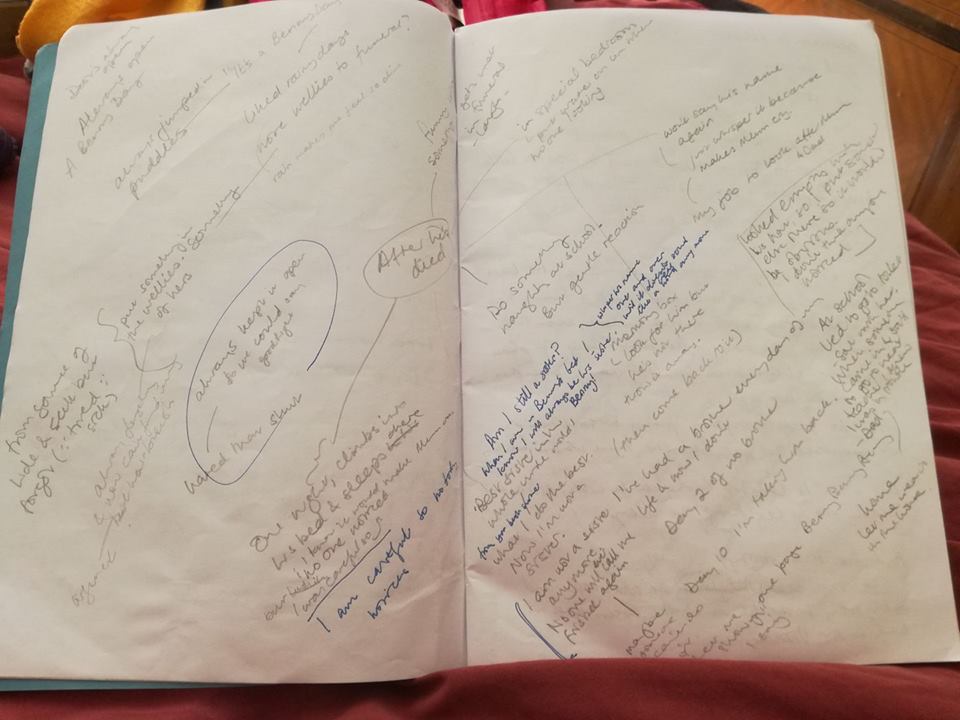
I am writing a picture book on a very sensitive subject. It’s a story about a girl whose older brother gets sick and then dies. There are all sorts of expectations about the book and I do feel a real responsibility to get it right as the people who will read it will be very vulnerable. Whilst I was researching the book, interviewing bereaved parents and doing creative work (for their own books) with bereaved and pre-bereaved siblings, and with young people with life-limiting conditions, I made no notes for my story at all. But I immersed myself in what I was doing and tried to be as ‘present’ as I could be. When it came to writing the first draft, I did make a scrappy mind map one morning (between 6 and 7 am, when I can focus best, without distraction)


and then the following morning, I wrote my story. But the story felt fragile and I’d deliberately not thought about it too much. I wanted to be as focused as I could without distraction so I tried something new:

I wrote it in the dark.

I had to have just enough light so that I could see that I wasn’t writing lines directly on top of other lines, but I only even glanced down at the unreadable page when I’d got to the end of each line, just to be sure there was some space between the lines:


Written in the dark (at what turns out to be a not very horizontal angle)


And the results?

In terms of focusing on the present, and reducing distractions (as we’re trying to encourage the children to do), I was much better able

To focus: I don’t visualise things so in the dark, I don’t have any images or colour and I can’t be distracted by seeing any objects around me

To keep going: I couldn’t read what I’d written so I wasn’t immediately being distracted from my task of keeping on writing by being tempted to edit words or phrases that I’d just written

Not to worry about mistakes:  because I couldn’t see them!

I can find myself easily distracted when writing but practising mindfulness and being able to focus like this actually worked really well for me. And interestingly, the story written this way has needed far less editing than a lot of my stories.

School visits are valuable in many ways, but this school project has been helpful in an unexpected way: because of the particular project I’ve really had to go away and practise what I preach. And for me, at least, it’s worked.

Have you tried any unusual ways of writing –as an experiment, or so you can focus properly? Or have you tried other things to help you focus? And how have school visits helped you as an author? Please leave a comment, below.


www.julietclarebell.com

Monday, 6 March 2017

School Visits for Infant Years by Abie Longstaff

It's March. School visit season. So if you see raggedy authors looking exhausted, pulling large bags behind them please smile at us in sympathy.

For me, school visit season is both the most exciting and the most knackering time of year. It's the time when I step away from my computer and go to see my audience. It's wonderful to find that the world you created in your head really resonates and impacts on kids. And there's nothing better than seeing children dressed up as your character.

Kittie Laceys on World Book Day 
But school visits can be really stressful and tiring, I cover Reception to Year 6, and each year has its own particular needs. KS1 is an age group that few authors cover (we PictureBookDenners are a rare breed) and I often get phone calls from panicked author friends saying 'Help! I have to talk to Reception - what do I say?' Here are some tips for the picture book age group.

1. Timing
4 year olds do not sit still for long. 30-40 minutes is about right. 

2. Size
Large groups can be intimidating for small children. It's better to do multiple sessions repeated in each Reception class, rather than put all the year group together into a hall.

3. Technology
Put the book up on the interactive whiteboard so that all the children can see the illustrations clearly. If you read from your lap the kids will jostle and wriggle to get a closer view.


4. Make your session interactive
Ask questions, do noises and silly voices, ask children to bark like a dog or cackle like a witch. The more they are involved the more they'll listen.

5. Dress up
Kids love outfits, wigs and costumes.

Fairytale Hairdresser skirt
Fairytale Hairdresser hair


6. Bring props
This age group is very tactile. They love to hold things. Bring soft toys or objects that go with your book.
Bottles for Magic Potions Shop
Rapunzel hair to try on

Dolls waiting to have their hair done
7. Show them your mistakes
I bring my sketchbooks and notebooks and show children how messy I am and how many times I need to re-write until I get it right.

8. Tell them about you
Kids love to hear about where you live and work

My writing hut
9. Get them creating
This age group is old enough to plot very simple stories.
I show them a scrapbook with animals in and together we invent a story about a character. Pick a photo where an animal is doing something exciting or showing a strong emotion.
The Comedy Wildlife Awards has great pictures you could use.

10. Structure your event
I asked picture book author Alex English ('Yuck! said the Yak') how she organises her infant events. She said:

'I'd suggest splitting your workshops into lots of sections so that there is a variety of activities - listening to stories, getting up and being active, colouring, cutting and sticking, writing a poem together (with you writing on the board). Then you can do as many or as few bits as you can fit in - it can be very hard to judge how long things will take them or how quickly they will start to get bored!'

11. 'Questions'
The questions from this age group are not really questions. They are more of a chat. One little boy put his hand up to tell me 'I had pineapple for breakfast'. This is the kind of interaction you should expect. It's VERY cute and I love having little chats with all the kids.

12. What can illustrators do?
Hannah Shaw ('Bear on a Bike') advises:

‘I do live-drawing, and I make my talk much more about the illustration side. I prepare rhymes, riddles and jokes, as well as a 'making' or drawing thing linked to the book. The children love any kind of craft activity and I often give them a fun worksheet for them to colour in or add to.’

13. Relax and enjoy it
I love this age group! They are always so excited and enthusiastic. My main problem is gently peeling them off me when they've been cuddling me for a bit too long.

Please add your tips below - I'd love to hear how you cope.

Abie's latest book is The Fairytale Hairdresser and Aladdin - out on 9th March!


Monday, 27 February 2017

Openings with a Promise – the Emotional Journey of Your Character • Natascha Biebow


I love it when as a writer you realize that other creative people face similar struggles or challenges with their craft. 


Like when I attended the SCBWI conference in LA last summer, I was heartened to hear how Drew Daywalt, the author of the NY Times bestselling The Day the Crayons Quit, waited six years for his agent to find a publisher who ‘got’ his book and wanted to publish it.
 
The Day the Crayons Quit
by Drew Daywalt and Oliver Jeffers


Or like how Jon Klassen of I Want My Hat Back fame was stuck because:


“… I had a problem in that I didn’t like drawing characters. I like drawing scenery and inanimate objects and I especially liked it back then. The challenge of making a piece where the subject wasn’t a living thing was really fun, and I liked how quiet the effect was.”


I Want My Hat Back by Jon Klassen


I recently received a gift. It was one of my favourite kinds of books – the story of a fellow writer. As I savoured the book, its pages, beautifully designed windows into E.B. White’s life and writing, I realized a few things:


Some Writer! by Melissa Sweet
• E.B. White kept a journal and he finished each entry by asking himself a question that he could think about as he was drifting off to sleep.

from Some Writer! The Story of E.B. White by Melissa Sweet
 
from Some Writer! The Story of E.B. White by Melissa Sweet


Yes! This is such a good technique – to mull the questions of the day, of the story, of a stuckness that becomes unstuck in the subconscious of slumber. I love to do that too!


• In his column One Man’s Meat for Harper’s Magazine, he wrote in 1982 about the influence of moving to a farm in Maine, where “confronted by new challenges, surrounded by new acquaintances – including the characters in the barnyard who were later to appear in Charlotte’s Web – I was suddenly seeing, feeling, and listening as a child sees, feels and listens”.
from Some Writer! The Story of E.B. White by Melissa Sweet

I thought about this. As I read on . . .


• It took E.B. White a year of revisions to settle on the iconic opening for Charlotte’s Web. 

Charlotte's Web by E.B. White, illustrated by Garth Williams,
published 1952


In Some Writer!, Sweet includes images of White's original manuscripts, complete with crossings-out and musings in the margins. 

I learned that E.B. White tried at least six different tacks to nail the opening of his most famous book. First:


“Charlotte was a grey spider who lived in the doorway of a barn.”


Then: “I shall speak first of Wilbur.”


Then: “A barn can have a horse in it, and a barn can have a cow in it, and a barn can have hens scratching the chaff and swallows flying in and out through the door – but if a barn hasn’t got a pig in it, it is hardly worth talking about.”


After a year, White wrote: “At midnight, John Arable pulled his boots on, lit a lantern, and walked out the hoghouse.”


Next, he cut to the action: “Where’s Papa going with that hand ax?”


Which was shortened to: “Where’s Papa going with that ax?”


opening chapter from Charlotte's Web by E.B. White

I was struck by this journey to find the way into the story. The story was there all along, wasn’t it, but it was only when White cut to the emotional core of the characters’ emotional journey and told it like child might experience it that it felt right.


In previous blogs about creating compelling openings and using “show, don’t tell”, I wrote about the importance of:


• showing readers through the character’s body language, action and dialogue

• including the answers to the questions who, what and where to create a compelling opening

• clear character motivation – why?

• creating vivid, detailed scenes


But, connecting these elements with

• the promise of the characters’ emotional journey and

• “seeing, feeling, and listening” like a child


is what will really hook readers into the story and get them to keep turning the pages.


When we read the opening line of Charlotte’s Web, these elements come together almost effortlessly. But the weren’t effortless at all . . .! 


E.B. White with his beloved dog

Wow, some writer!
  
________________________

Natascha Biebow
Author, Editor and Mentor

Blue Elephant Storyshaping is an editing, coaching and mentoring service aimed at empowering writers and illustrators to fine-tune their work pre-submission.  Check out my small-group coaching Cook Up a Picture Book courses!
Natascha is also the author of Elephants Never Forget and Is This My Nose?, editor of numerous award-winning children’s books, and Regional Advisor (Chair) of SCBWI British Isles.