Showing posts with label Charles Fuge. Show all posts

Monday, 6 August 2018

Are you famous? by Jane Clarke

Over the last few weeks, I’ve done assorted school and library events for the under 8 year olds, and, when it’s time to chat, I've been asked “are you famous?” They’re puzzled because I’m standing in front of them, being introduced as a special visitor  - yet they haven’t seen my face on TV - and won’t have heard of my name, except in the context of that event.


Sky Private Eye (illustrated by Loretta Schauer) - Jane at the event at Barnes Lit Fest

If I ask the children if they know any picture book writers or illustrators, the name they most often come up with is Julia Donaldson. They know her as the author of the Gruffalo books, but they often struggle to name Axel Scheffler as the illustrator - or to add any more names to the list. The majority of picture book writers and illustrators are invisible to them.
But when I ask the same children what picture books they love, their eyes light up. They know the title and the characters and can’t wait to tell me all about the story. They remember who read their favourite book to them, how it made them feel - and how they requested it to be read again, and again, and again. The book is etched into their hearts and has become part of their childhoods.

Most adults I’ve asked can also recollect in detail the stories the picture books they loved as a child, and see the illustrations in their mind’s eye  - even if they can’t remember the name of the author and illustrator. Often, as adults, they have sought out the book they loved as a child so they can read it to their children.


 I had to track down Downy Duckling (Ladybird Books, fist published 1942!) to share with my sons. I had no idea who wrote and illustrated it -the names of AJ MacGregor and W Perring are not on the cover.

So when I’m asked “are you famous?” I explain that not many people know my name or what I look like, but they might know and love some of the stories I’ve created - and that sort of fame makes me very happy.


 In the case of the picture books I’ve written, Gilbert the Great is probably the best known, thanks to Charles Fuge’s wonderful illustrations, and this summer, in the USA, there was even a Gilbert plush in Kohl’s, helping to raise money for Kohl’s Cares charities. 

Do you have a favourite picture book you remember as a child, but didn’t find out the names of the author and/or illustrator until you were much older?

 Jane also often gets asked “are you rich?” She answered that question in this post https://picturebookden.blogspot.com/2017/03/are-you-rich-by-jane-clarke.html
Nothing has changed, except she’s now even richer in granddaughers (4)!


Monday, 30 April 2018

Read it - again, and again, and AGAIN! by Jane Clarke

Do you or a family member have a favourite picture book, read so many times that everyone knows it by heart  - and can see the illustrations with his or her eyes shut?

Every night my 3 year old granddaughter requests


Wow! said the Owl by Tim Hopgood

Yep. EVERY NIGHT. You might be able to slip in another book as well, but this one has to be the last book before sleep. It’s reassuring and upbeat, with a sense of wonder - and my 10 month old granddaughter already loves it, too.


This is the one my 4 year old granddaughter in the USA currently requests most:

Llama llama red pyjama by Anna Dewdney

There are several picture books from my sons’ 1980s childhoods that I can visualise page by page because I was requested to read them again and again, and again. Top of the pile are:
Henry’s Busy Day by Rod Campbell - with the much-stroked (and snot-wiped-off) furry ending that makes you go aaah.


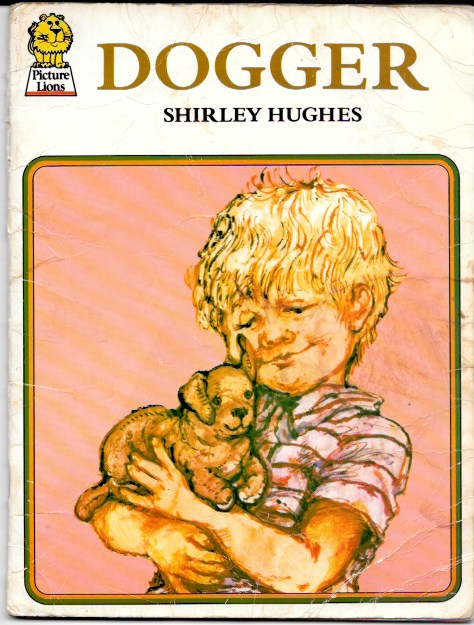
 Dogger by Shirley Hughes was another huge favourite:


My sons totally identified with Dave and his toy dog. It’s quite a long book, so after the umpteenth reading, I’d attempt to skip the odd page, or summarise. They always caught me out.

Going further back, I realise that I must’ve been the same when I was a child, because I can still recite the entire text of this book and see all the illustrations in my mind’s eye: 

Downy Duckling by W Perring and AJ Macgregor (first published 1942! The original got lost somewhere down the line, but I was able to find a new edition, yay!)

I remember the feeling of comfort and safety that this story gave me as a child, and finding it again is like a warm hug from the past. 
So what do all of these very different books have in common? I think it’s that they lull the child into his or her happy place. 
It might be too overt for today's tastes, but the ending to Downy Duckling nails it:


What picture books have you read again, and again, and AGAIN?


Jane's very happy to report that one of her four granddaughters is currently stuck on one of her books - Who Woke the Baby? illustrated by Charles Fuge - at one and a half she's too small to say why, but she clearly loves to roar at the lion and clap at the happy ending.


Monday, 7 November 2016

Intriguing details in picture book illustration, by Paeony Lewis

I adore spotting details in the illustrations of picture books. Occasionally an author might suggest a visual extra to the publishing editor, but unless it’s vital to understanding the story we’re not supposed to do this because we’re writers and not illustrators. It’s frowned upon by editors. Plus even if we do suggest something, the illustrator usually takes it one step further. 

An alarm clock, clock tower and watch from No More Yawning
written by Paeony Lewis, illustrated by Brita Granstrom (Chicken House)
For example, although I suggested it might be fun to have clocks scattered throughout No More Yawning, to show bedtime getting later and later, the illustrator, Brita Granstrom, went beyond this. Brita included a wall clock, alarm clocks, a clock tower and watch (and maybe something more I still haven’t spotted?).

When I’m in schools I tell the children that illustrators often add wonderful little extras into the pictures that aren’t in the writer’s story. So when I read Hurry Up, Birthday I ask them to look out for  Muncher the rabbit who's always eating. I never suggested this to the illustrator and it’s a delightful extra by Sarah Gill. Illustrators are really good at this stuff! 


Muncher is the one in the foreground, eating the berry
in Hurry Up, Birthday written by Paeony Lewis,
illustrated by Sarah Gill (Piccadilly Press)


Six more images of hungry Muncher, illustrated by Sarah Gill, from Hurry Up, Birthday


All this got me thinking and I asked three lovely illustrators if they had any examples of 'extras' in their illustrations, or even images that have a hidden personal meaning. Here's what they said and it shows there can be so much more to an illustration than just the writer's story. With thanks to illustrators Mandy Stanley, Bridget Strevens-Marzo and John Shelley.
 

Mandy Stanley
"Occasionally, I'll add a small bug or similar if it's appropriate to the theme of the book. Roo the Roaring Dinosaur features a little red ant – the publishers noticed this 'secret' and decided to make it a feature for children to spot throughout the pages!" 

Can you spot the red ant? From Roo the Roaring Dinosaur,
written by David Bedford, illustrated by Mandy Stanley (Simon & Schuster)

From the back cover of Roo the Roaring Dinosaur.
The publisher noticed Mandy's ant on each page of the
book and turned it into 'spot the ant'.

Out of all the books illustrated and written by Mandy, including her Lettice the rabbit stories, Rufferella is still one of her favourites. 

Rufferella, written by Vanessa Gill-Brown,
illustrated by Mandy Stanley (Bloomsbury)
"Rufferella has more personal ‘extras’ than most of my books, partly I think because the style is detailed and I can slip them in easily. Also, I worked on this project with my sister and it felt playful to include a few little items that she would recognize as well."


Mandy's grandma is shown knitting as she sits on a park bench.
The park is Chapelfield Gardens, Norwich.
Rufferella, illus by Mandy Stanley


Other items featured include: Mandy's bathroom at the time of illustration;
a set of three framed pictures that were on the wall of Mandy's niece's bedroom;
a chevalier mirror belonging to Mandy's mum;
and a magazine rack made by Mandy's husband for her sister.
All from Rufferella, illustrated by Mandy Stanley
Sometimes illustration extras can be particularly poignant, as is the case with the final example from Mandy.


 From Three Little Kittens (Time for a Rhyme)
by Mandy Stanley (Harper Collins)

"Around the time my dad died, with much emotion, I added a few tiny anchors here and there in books as a tribute and reminder of him. He was a sailor when he was young. He loved to use the anchor image as his maker's symbol on anything he had made so in Time for a Rhyme: Three Little Kittens, published by Harper Collins, a ladybird holds on to an anchor rope, sailing a tiny paper boat in the rhyme, 'One, Two, Three, Four, Five' - it's a tiny detail but it means more to me than the whole illustration."

Plus there’s another tiny detail, that might be tricky to see. However, look closely because….  


"I made the string that wraps around the 'o' of the anchor say 'Ken' (my dad). It made me chuckle because I almost decided to make it describe his initials 'KGB' - Kenneth George Brown. The initials on his suitcase would often cause great interest at airport security, etc.!"


Sneaking 'KGB' into a picture book could have led to lots of interesting conspiracy theories! 


Bridget Strevens-Marzo

From Knock, Knock! written by David Bedford,
illustrated by Bridget Strevens-Marzo (Little Hare)

"This illustration is part of the left-hand page of a book I did (well over a decade ago!) with author David Bedford, called Knock, Knock! The main mousey character’s last minute efforts to get dressed are interrupted by a banjo-playing dog, a rabbit trumpeter and more. The scene remains the same on all but the final spread, with a gatefold door flap on the right of each page giving children a tiny glimpse of who is behind the door.

To avoid monotony page by page, I had the mouse getting dressed and odd instruments building up on the far left. I also came up with a small ongoing visual story around the bird family outside the window. But I still felt it needed a bit more, for more 're-reading’ fun so I added a coat hanger and rack which gradually fills up – and plants that get knocked over (not shown here). On top of all this, comes just one ‘extra’ I sneaked in that only my two children and a few might recognize - a small photo of a black and white painting (with a just a hint of Mickey Mouse ears in it) by my former husband and lifelong friend, the artist Mick Finch."


"I don’t generally place hidden stories or secrets  into my pictures, though my recent Shakespeare book has a hidden theme in that every single spread in the book contains Shakespeare himself - sometimes  he’s obvious because he’s the central part of the picture, but on some pages he’s hidden amongst the crowd. A Shakespearian Where’s Wally! That was just a fun addition bonus theme."


Where's Shakespeare?!
From Will's Words, written by Jane Sutcliffe, illus by John Shelley (Charlesbridge Publishing)


"It’s not often I plan these kind of things. However I do populate my image with personal references and objects around me, things which only I and my sharp-eyed associates know are auto-biographical."


"This is from my latest book, for the Japanese market Yozora wo Miage-yo (Look up at the Night Sky) and shows a typical Japanese family apartment. This too though is full of personal stuff (see the close-ups below). I took photos of such an apartment when I was researching the book, but I also have memories of my own old place in Japan, which was a similar modern condominium apartment."
Illustrations by John Shelley


"That’s my personal brand of olive oil,
but also the Japanese tea container next to it is mine."


"The baby character is ‘Brat’, a character I designed that was merchandised and promoted in Japan in the early 2000’s, it had a web comic and went on a lot of t-shirts and other apparel. I still have this collector’s figurine on my studio shelf. 
Also from my studio shelf are the juggling balls (never managed to learn properly) and the two Japanese picture books behind are my books."


"In this spread from Crinkle, Crackle, Crack - It’s Spring! the room is filled with things from my daughter’s room - the piggybank, the giraffe, the bear, the fish, the mirror, the dressing gown thrown over the bannister, the globe, the things on the wall etc. - all sourced from my daughter’s room. The Lautrec poster of Aristide Bruant is one of my oldest memories when I was at primary school - it was on one of the classroom walls and always fascinated me, the first time I experienced a poster or French art (this was around 1969!). for some reason it just suddenly came back to my mind when I was painting this picture."Crinkle, Crackle, Crack - It's Spring! written by Marion Dane Bauer, illus by John Shelley (Holiday House)

John says self-portraits are common in illustrations and here are two examples.


"That’s me on the scaffold of course." From I Wish I Could be a Ballerina written by Rosie McCormick,
illustrated by John Shelley (Inky Press/Backpack Books)


"I used selfies on an iPhone to pull some faces for Will’s Words - smartphones are great for doing hand references!"  From Will's Words, written by Jane Sutcliffe, illus by John Shelley (Charlesbridge Publishing)

 *****
Thinking about it, the way illustrators sometimes add personal extras to their illustrations is similar to what a writer will do in a story. A story may include memories, or is inspired by a person, place or object, or perhaps include the particular character traits of a friend or family. Our life experiences underpin our writing and sometimes we don’t realise it until later. In one instance an editor suggested I tone down a character because they’d be unbearable to live with. What the editor didn’t know was that I’d already toned down the character and it was based on… (sorry, I’d better not say!). 

Finally, there are also instances where picture book illustrators add in their own fun, visual extra which is aimed at the adult, not the child.


From Gilbert the Great, written by Jane Clarke,
illustrated by Charles Fuge (Simon & Schuster)
Can you spot the allusions to Jaws?
For example, I’ve read the excellent Gilbert the Great picture book(s) many times but never noticed something. The author, Jane Clarke, told me that illustrator, Charles Fuge, added allusions to Jaws for adults to appreciate. The wreck is named 'The Orca' and the barrels feature in Jaws 2. I’ll admit that although I adore the book I’d never have noticed this extra because when I watched Jaws at the cinema I spent most of the time with my eyes shut!

I’ve always thought I was somebody who looked hard at illustrations, but now I’m going to look harder. I suspect I concentrate too much on reading the written word, unlike young children who listen to the story but only look at the images on the page. Children are often more visually literate than the adults. Though the personal items included in illustrations will remain a mystery, unless we're told.


If you have any favourite ‘extras’ or know a story behind an illustration, we’d love to hear about it in the comments' section below. Happy looking!


Paeony Lewis
www.paeonylewis.com