Showing posts with label Inclusive. Show all posts

Monday, 15 May 2023

Let’s talk about authenticity by Nadine Kaadan

The annual CLPE survey, which is funded by Arts Council England, launched in 2017 with the key focus of determining the extent and quality of ethnic minority characters featured within Picturebooks, Fiction and Non-Fiction for ages 3–11 published in the UK. The fifth Reflecting Realities report was published in November 2022. Annual reporting shows an increase in the number of children’s books published featuring a minority ethnic character from 4% in 2017 to 20% in 2021.

The percentage of books published with a main character from a racially minoritised background has risen year on year but remains extremely low at 9% in 2021.

We invited Nadine Kaadan to reflect on championing inclusive representation in the UK based on her own experiences. 


When I moved to London in 2013, we thought it would be for around a year. My husband said to me “When the conflict ends in Syria we will come back” and we both truly believed that. We never imagined the life that we would build here, and here we are, 10 years and two children later. 

I was told, to my dismay, that publishing a children’s book would be almost impossible here. There were only 3% of children’s books published that featured BAME characters. I thought my chances were close to zero, but I wanted to try. I feel so grateful that Lantana Publishing picked my stories, and my journey started with them.
 
As sad as it was to be forced to leave my country, writing and illustrating children’s books was my way to process what was happening, and still is. It’s the thing that has helped me the most in directing my grief and anger at what was happening in Syria.

I’ve been lucky enough to write books about my experiences, both through my own eyes, and the eyes of the children I knew. 

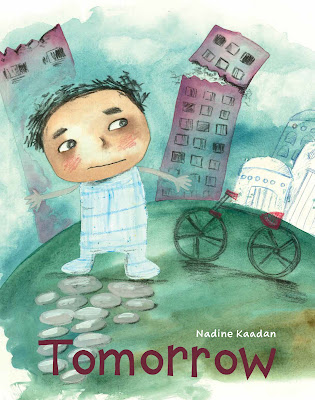
‘Tomorrow’ is based on my life during the war in Syria, watching how children reacted (including my niece) and seeing the confusion in their eyes. I really felt the need to bring that story to life. 


Most recently, I’ve been able to collaborate with other writers and illustrators: Ada Jusic, Ramzee, Sonya Zhurenko, and Marie Bamyani to tell our real life stories to help children understand our experiences. 


During my 10 years in London, I have watched the children’s book industry grow and mature, especially when it comes to diversity and inclusivity. It is wonderful to see more and more authors of colour getting published, with so much more awareness of the importance of more inclusive children’s books.


However, it’s sad to still see such a lack of authenticity within the children’s book market, and so much cultural appropriation. The subjects of Syria, war and seeking refuge particularly tug on my heart strings.

I wonder why authenticity isn’t at the forefront of the industry’s minds? Why aren’t we seeing more writing of people’s own stories? Why are there stories by authors that are not part of the culture they’re writing about? Stories about things they have not experienced, such as war? It is great that there is more exposure and awareness being sought.. but isn’t it important that what’s being read is authentic… coming from real life experience?

Editors and publishing houses seem to be trying to solve the issue of diversity by simply hiring an author of colour, but we are not a monolith. Our cultures and experiences can be so vastly different and they are not interchangeable. I also do not believe that hiring sensitivity readers solves this issue either. In fact, I think it adds further to it.

I really feel that where there is a story about war, cultural diversity, or disability, we really need authenticity - people telling their own stories in their own voices. No matter how much research has been done, our own voices bring real depth and truth to any story; because only we can bring real life memories and cultural identity to the characters and the plot.
 
That being said, I have also read some wonderful books, that are truly authentic, which I have found extremely inspiring and empowering. My son’s bookshelf is full of these books! Three of our favourites are:

‘That’s not my name’ written and illustrated by Anoosha Syed
 A story that comes from the author’s own experience of people mispronouncing her name.


‘Wonderfully Wired Brains’ written by Louise Gooding and illustrated by Ruth Burrows
A wonderful book about the world of neurodiversity, coming from the author’s own life.

‘Chicken in the Kitchen’  written Nnedi Okorafo illustrated by Mehrdokht Amini
Nnedi brings her beautiful Nigerian culture in this fun filled adventure of an Anayago during the yam festival.


Nadine Kaadan is from Damascus, Syria, now living in London where she completed her Masters in Communication Design in Kingston University, and a Masters in Art and Politics at Goldsmiths University. Nadine is passionate about championing empowered and inclusive representation in children’s books. Her work with young refugees was featured in a BBC short film under the title ‘Writer Nadine Kaadan Helps Syrian Children Understand War’, and CNN Connect the World  program among others. 
She is the 2019 winner of the Arab British Centre Award for Culture, and was nominated for the Asian Women Of Achievement Award 2020. Find out more at https://www.nadinekaadan.com/ 

What's your experience of inclusive and representative books for children in the UK? Do you have books you would like to recommend to other readers? Share with us.

Monday, 3 August 2020

A Hero's Journey with Farmer Falgu

When I’m mulling over a new picture book idea, I often take a large white paper and scribble all over it. Call it a spider diagram during a hurricane. I don’t see patterns yet – but I’m jotting down all ideas around the idea, words that remind me of the idea, ideas that give birth to more ideas.

Find out more about spider diagrams here
 The spider diagram reveals a picture - with broken bits of web, ideas glinting through the gaps, I gather those ideas into a new image. That new image needs a structure.  As much as I’m creative with ideas in the beginning, when I'm playing, when I'm daydreaming, I still need the comfort and safety of structure to organise those chaotic thoughts into a cohesive narrative. Yes! Picture Books have a structure and story arc as much as novels. 
Allow me to tell you a story. The year was 2012. I had published one picture book in 2006/7 and nothing had happened since then. I had a computer full of stories – some that did see the light of day many years later. But many that will never be dusted off.
            I sat down to write my first Farmer Falgu story. (Yes it's a series and find out here about how it became a series). 
Farmer Falgu series was illustrated by Kanika Nair and published by Karadi Tales, India. Available for sale in the UK from Letterbox Library.
I had a general idea of the story – it was going to be about noise and sounds. I had somehow stumbled upon the character – all I knew was that he was going to be a farmer in a farm full of animals. Perhaps it was my childhood growing up in small towns and villages, next to farms, perhaps it was reading all these English books about farms – who knows how our subconscious works and how ideas come up to the surface.
            Reading that story again and dissecting it during a course I taught, I realised it uses a number of structural devices. The first one - The Hero's Journey is what I'm going to talk about now.

How does Farmer Falgu Goes on a Trip map to the Hero's Journey? Is Farmer Falgu going to fight evil villains and jump over aeroplanes and risk his life to save a precious treasure? Not really! At least not in this book.
a)     Spread 1 sets up the problem. Jumping straight in, there was no setup for who Farmer Falgu was and where he was – because that’s what the pictures will do.

b)    Spread 2 shows us the inciting incident – Farmer Falgu sets off on a trip to be away from the problem. Hence the title
c)     Spread 3 – shows character – Farmer Falgu is kind and compassionate despite his troubles. But this spread also sets up a future problem. 
     Every action must have an equal and paying off reaction in fiction. 
d)    Spread 4 shows the problem caused by spread 3.
e)    Spread 5,6 & Spread 7,8 make the problem worse. And they add to the problems.

f)      Spread 9 – Farmer Falgu is rid of the new problems caused by his kindness. But he hasn’t yet solved his original problem.
g)    Spread 10 – False hope. Farmer Falgu thinks he has achieved his goal.
h)    Spread 11 – Nope! He was wrong.
i)      Spread 12 – Farmer Falgu ponders over his original problem and he thinks about the problems over the rest of the spreads. He has a final epiphany. Yes! He has solved his problem.
j)      Spread 13 – He returns home with a changed mindset. Nothing in his farm has changed. But Farmer Falgu’s realisation over the course of his journey has changed his attitude.

With some exceptions of deadly battles and evil villains, this is a hero’s journey. Farmer Falgu, our hero, set off to solve a problem, confronts confounding problems, has a false sense of achievement and then loses hope and then finds the thing that makes him happy. He has gotten what he needed, not what he wanted.  
To make this easy for picture book writers, I have a handy storyboard planning tool here. 
            Based on the above dissection, here are some tips for you to take away on your own stories.
  1. Think about your character and story as a hero’s journey. See how it maps out in terms of spreads.
  2. The planning doesn’t need to come before the writing. If you’re like me and prefer to free write, write the story, from start to finish. Make it fun and interesting and then go back and review the structure.
  3. Check the pacing with respect to the narrative. See if you have more spreads in the beginning and you’re rushing to the end.
  4. Make sure the problems are progressively complex or accumulating. In picture books, it’s a lot of fun to add to disasters culminating in a big spread of glorious hullabaloo.
  5. Check if the character has an internal need and an external want.
Happy Structuring!

Chitra Soundar is an internationally published, award-winning author of over 40 books for children. She is also an oral storyteller with a loud voice and she also writes trade fiction, non-fiction, poetry and theatre. Her stories are inspired by folktales from India, Hindu mythology and her travels around the world. Chitra regularly runs writing workshops in schools across the world. Find out more at www.chitrasoundar.com.

Monday, 7 January 2019

Learning from Reflecting Realities and Reading the 1% by Chitra Soundar


Based on the children's books published in 2017, CLPE researched and analysed the representation of ethnic minorities in children’s publishing. Their findings are available here

Here in this blog post I wanted to highlight the findings for picture books.

According to their first ever analysis in 2018, only 6% of picture books published in 2017 featured a child from an ethnic minority. As an aunt of mixed-race nephews I was also deeply concerned to find that only 0.2% of all books published in 2017 featured mixed-race children in the narrative.

I looked at this report as a writer and wanted to explore how as writers we could contribute to the growth of this percentage. UK is a multi-cultural society, not now, but from Roman times. Check out this article and furore over Mary Beard suggesting it was.

But whether they were fairy tales or the stories that Victorian Britain published even as an empire was hardly inclusive. But in 2018, if we are still discussing the lack of representation and not just by race, but also by ability, gender, sexual orientation, diverse types of families, then as a writer I think we do play a part in changing this.

Reading through the recommendations of the CLPE Reflecting Realities report (that sentence is weirdly alliterative), here are some of my key lessons for me as a writer, which not only applies to writing inclusively but also generally good writing.

a)                    Avoid the shorthand; Include the Specific: When portraying a child from a minority group, the details we use should be specific and authentic and should not degrade to a stereotypical two-dimensional shorthand. Isn’t that true of all stories and all children? The key to make something more universal is not making it two-dimensional, but highlighting the specific that is so authentic that the underlying truth shines through.
b)                   Well-rounded representation of characters from ethnic backgrounds – research plays a huge part in this. Understanding a culture from the inside is no mean feat – there are subtle clues, vivid details and yet so many places where mistakes can be made. But isn’t that true for all character portrayals? Perhaps it feels easier when we write about things we know intimately. But when we write about something slightly distant from us, whether it is about another race or culture or even a person with a differing ability, should we go beyond the surface?
c)                    Children love having fun. Isn’t that true? So why do children from a different race or ethnic group or even from families that are different from us just talk about their problems and issues? Should my nephews worry all the time about why their mum’s family eats different food to their dad’s side? Or should they just have fun, try different foods and do things their own way? While it’s great to showcase another culture or ethnic group, it’s important not just to portray the difference or their struggles lest the children should grow up thinking fun is for not for them.
d)                   Children identify with characters in stories. Isn’t that why we have so many character led series that are such big hits? By extending that to children from a different race, why shouldn’t they see children they can identify with, as a series lead or as the main character of a picture book? Why do they have to be sidekicks always?
e)                   First do no harm - And finally, while representing all races in important in stories, it’s also the responsibility of creators not to include characters just for the sake of it. A bad representation is worse than no representation. If a nuanced portrayal of a child from another culture or background than you is not possible either due to time or other constraints then as a writer I have to consider if I’m correct in including it anyway.

I’m from India and I often write stories set in India or Indian families. But even when I write about India, I do a lot of research to understand the region or family I’m writing about. Even though my stories would fit into the 1% that’s recorded in the survey, I still think there is a lot to think about when I choose topics to write or characters to portray. My goal is to write stories set in a mixed-race family and write about children just like my nephews, having fun, celebrating birthdays, making friends, going on vacation etc. And this report was helpful in identifying the areas I needed to focus.

CLPE are now re-launching their survey for books published in 2018. As an author or illustrator, if you think your book would qualify, read here and request your publisher to submit your book to the research.

Want to read inclusive books and don’t know where to buy them? Check out Letterbox Library.


Chitra Soundar is an Indian-born British writer, storyteller and internationally published author of children’s books, based in London, England. Chitra writes picture books, poetry and fiction for children and often visits schools, festivals and libraries to tell her stories. Find out more at www.chitrasoundar.com. Chitra also teaches a course in writing picture books. Find out more here. Follow her on Twitter @csoundar.

Monday, 5 February 2018

Inclusive Indie Publishers • Chitra Soundar

In the last few years, there has been a positive trend of many independent publishing houses being setup and many of them are inclusive and diverse. While some focus on publishing stories from around the world, others bring work of translation into the UK. And in some cases, new houses are focussing on specific cultures that are under-represented in the UK.

My picture books in the UK are published by three indie houses that support cultural diversity and it is great to know that there are more publishers whose mission is to bring the world to the children here in the UK.

Here is a list I put together based on my own un-scientific research. If you know of any others, please leave their names in the comment section.

I’ll start with the three publishers I’ve worked with:


Otter-Barry Books – Janetta Otter-Barry published both poetry and inclusive books as a publisher at Frances Lincoln and her new venture carries on that tradition with beautiful books for today’s world.

Lantana Publishing – In their own words, “Lantana Publishing is hugely proud to bring UK children’s publishing one step closer towards achieving a more diverse and inclusive children’s book landscape for the next generation of young readers.”

Red Robin Books – while Red Robin Books were originally setup to produce and promote books by Neil Griffiths, they also now produce books by other authors and illustrators. I’m proud to say my Farmer Falgu series have been adopted by Red Robin Books in the UK.


I haven't worked with the publishers listed below, but I've heard wonderful things about them. 

Tiny Owl Books – The books they publish…”give children unique perspectives on universal themes such as love, friendship and freedom and a greater awareness of the diverse and colourful world we live in.”

FireTree Books – Verna Wilkins is back and she has renewed her commitment to inclusive books at her latest venture FireTree Books. Her first publishing house Tamarind Books is now part of Random House and continue on their mission too.

Book Island – this publisher brings books from other languages into the UK.
Read here about why more translated books are important for the children in the UK

The next two publishers focus on a specific cultural heritage - African and Chinese respectively.

African Parrot – is a publisher based in Edinburgh who want to promote positive images about Africa to children across the world.

Snowflake Books is a joint venture between Taiwan and British experts to bring Chinese stories to the UK

Darf Publishers and Pushkin Children’s produce a number of children’s titles from writers and illustrators across the world, though their main focus is fiction.

Sweet Apple Books  also publish inclusive children’s books.


And slightly venturing outside the island, here are some publishers with similar missions.

Yali Books, NY who promote stories from South Asia

Golden Baobab & African Bureau for Children’s Stories is a non-profit organisation based in Ghana, whose vision is to inspire the imaginations of African children through African stories.

Groundwood Books, Canada who are particularly committed to publishing books for and about children whose experiences of the world are under-represented elsewhere.


So if you’re a parent who is looking for diverse picture books for your children or a teacher who wants to have an inclusive bookshelf or a writer/illustrator who is looking for inclusive publishers, do check these publishers out.

If you have suggestions for other publishers, especially indie, who are committed to an inclusive list, do leave their names in the comment section.


Chitra Soundar is a writer made into an author by indie publishers. From her picture books in India to the ones in the UK, she works with wonderful publishers whose passion for inclusive books is infectious. Find out more at www.chitrasoundar.com or follow her on Twitter at @csoundar.