Showing posts with label Joyce Dunbar. Show all posts

Monday, 5 December 2022

Cumulative Christmas picture books, by Pippa Goodhart

On the first day of Christmas my true love sent to me 

A partridge in a pear tree.

On the twelfth day of Christmas my true love sent to me

Twelve drummers drumming

Eleven pipers piping

Ten lords a-leaping

Nine ladies dancing

Eight maids a-milking

Seven swans a-swimming

Six geese a-laying

Five gold rings

Four calling birds

Three French hens

Two turtle doves

And a partridge in a pear tree! 


                      This image by George Buchanan


That English Christmas folk carol dating from at least the C18th is a fun game of a rhyme, testing our memories as we go through the ever-lengthening list of ever-dafter items. It’s been made into numerous picture book versions over the years, nicely fitting the standard twelve spreads. There’s a lovely Alex T Smith version in which Grandma has got carried away giving her granddaughter almost, but not quite, the traditional list of presents. ‘Seven snorkling squirrels’, or ten rhinos racing, for example, fit the bonkers nature of the original, and makes for a glorious images! 


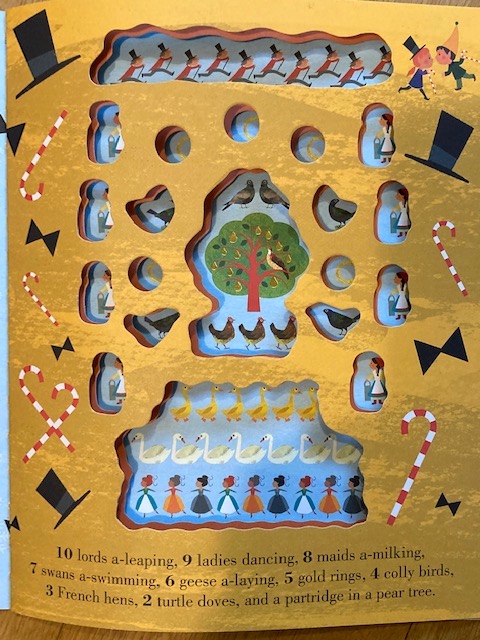
I also love this Britta Teckentrup version with cut away windows in the pages that reveal more and more.


            But there was (its sadly now out of print) a cumulative Christmas picture book story that played brilliantly with the verbal and illustrative rhythm and build-up to play the Nativity story to best story effect.  


Joyce Dunbar’s This is the Star has a text based on the format of traditional rhyme story, This is the House that Jack Built.


This is the star in the sky.

These are the wise men come from afar

Who also saw and followed the star,

Bearing the gold, and fragrant myrrh

And frankincense, the gifts that were

Placed by the manger warm with hay

Wherein a new-born baby lay.

This is the ox and this the ass

Who saw these wonders come to pass

At the darkened inn where the only room

Was a stable out in the lamplit gloom

For the donkey and his precious load

Who trudged the long and weary road,

Looked on by the angel shining bright,

Who came to the shepherds watching by night

That saw the star in the sky.


But then, with shock and focus and clarity, the next spread gives us starkly and clearly …

This is the child that was born.


… before the book gives us another spread even more full of text, and then, again, going for the minimal …


Still shines the star in the sky.


That’s such a thought-provoking truth! Gary Blythe’s stunningly realistic illustrations, giving us a newborn baby who actually looks newborn, and wise men properly pondering the sight of this child, are as powerful and moving as the text.


I hope that your Christmas cumulates loveliness of all sorts around you. Would your own twelve days of Christmas make a picture book?! Happy Christmas!  


Monday, 23 July 2018

From Nursery Rhyme to Picture Book, by Pippa Goodhart

Nursery rhymes are often nonsensical, at least to modern child understanding, and yet they persist, generation to generation, often having lasted hundreds of years.  Why?  It’s the rhythm and the rhyme and the repetition that makes them memorable and easy to join in with, as well as nice to rock a baby to.  Those three ‘r’s, rhythm, rhyme and repetition, are often found in picture book stories for young children for those same reasons.  So it makes good, clever, sense to use an established old rhyme as the basis for a new picture book story.  Here are three such books which work wonderfully well –

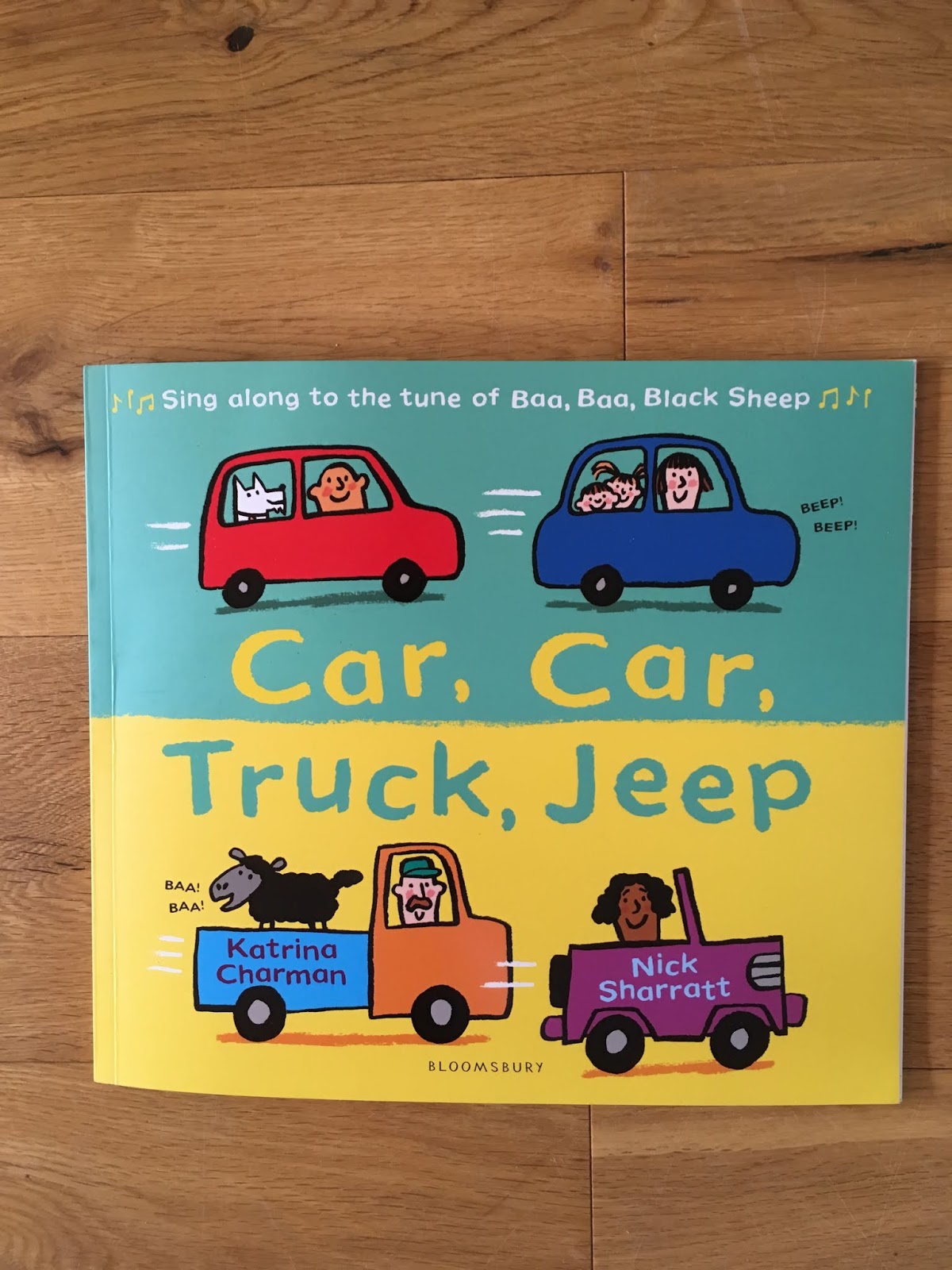
Brand new, bright and fun, full of vehicles and sounds, with a proper mix of people driving the many vehicles, is Car, Car, Truck, Jeep, written by Katrina Charman and illustrated by Nick Sharratt.  This whizz along with busy vehicles comes to a nicely sleepy end, and matches the pattern of rhythm and rhyme laid out in Baa Baa Black Sheep … ‘Baa baa black sheep, have you any wool?  Yes, sir.  Yes, sir, three bags full.  One for the master.  One for the dame.  One for the little boy who lives down the lane.’


Quieter, and more sophisticated, but wonderfully powerful, is This Is The Star, written by Joyce Dunbar and illustrated by Gary Blythe.  This tells the Christmas story, mirroring the cumulative rhyme that is This Is The House That Jack Built … ‘ This is the house that Jack built.  This is the malt that lay in the house that Jack built.  This is the rat that ate the malt that lay in the house that Jack built.  This is the cat that killed the rat that ate the malt … and so on for many more verses.’  The big problem with a cumulative story is that the text gets bulkier and the pictures more crowded, meaning that the finale can all look at bit small.  But Joyce Dunbar punctures that with a spread that breaks that pattern startlingly to give us, ‘This is the child that was born.’ 


Each Peach, Pear, Plum by Janet and Alan Ahlberg is, of course an old favourite. The original playground rhyme seems to go something like, ‘Each, peach, pear, plum, out goes Tom Thumb.  Tom Thumb won’t do so out goes Betty Blue. Betty Blue won’t go, so out goes you!’ It’s one of those rhymes for eliminating a child at a time in order to choose who will be 'It' for a game.  The Ahlbergs took the structure, and the idea of playing with familiar nursery rhyme or fairytale characters, from that rhyme, and made a classic of it.  

Image result for each peach pear plum images 
Image result for each peach pear plum images

Do you know of any other picture books based on well-known children’s rhymes?  Can you suggest a rhyme ripe for such picture book treatment?

Tuesday, 19 February 2013

Chicken or Egg? by Polly Dunbar

'Where do you get your ideas ?' is the first question I am asked, as an author and illustrator. The second is the eternal 'chicken or egg' question: which comes first, the words or the pictures?  I'll try to answer here. 

I am fascinated by the third element in the making of a picture book - the special space between the words and pictures into which a child is invited to fill the gap with their own imagination. If allowed, the reader plays an active part in the story, breathing  their own life into it;  when this happens successfully it's like a tiny explosion in the mind.

These little explosions can trigger all sorts of responses: they can be shocking; they can make you laugh; they can be intriguing. The important part is reaching a conclusion all by yourself rather than have it spoon-fed by the author.

Jon Klassen is a master of balancing words and pictures and leaving us a gap. Here is a picture from his new book THIS IS NOT MY HAT, with a fish that looks very much AWAKE - brilliant!

Because the ending isn't spelled out, the reader has to work out what happens to the narrator fish without being told. The ending you come to in your own mind might be hilarious or horrifying or perhaps it's a completely different ending to the one the author intended; it doesn't matter, what matters is the huge pleasure in getting there with your own imagination.


My first published book was a series of cartoons about being a teenager. I was interested in the work of Gary Larson - I loved the way he combines a picture that tells you one thing and a line of text that tells you another: bingo...something absurd...an explosion...usually of laughter! 


So I started writing/drawing my own cartoons - which turned out to be very good training for writing picture books. It's an exercise in paring down what you are trying to say to its absolute essence, allowing the words and pictures to come together creating a friction or a vibration, like forcing two magnets together that don't want to meet. Synergy.


An example of the connection between words and pictures is cleverly done in a series of HCBC adverts, putting different words with the same picture. It is startlingly effective - to have one's mind prompted into making so many different associations to the same picture, making it look or 'feel' different each time.


This power between words and pictures is for me what makes picture books so special, why they have a magic that is hard to capture in animation or apps. I'm all for telling stories in different ways using different formats - pictures that move and dance and sing, with buttons to press and things that squeak. Although I love all this, there is infinitely more pleasure in making those pictures dance and sing in one's own mind, to feel those synapses snapping to make it come to life in a way that is unique to you, giving power to the reader.

With my very first picture book 'FLY AWAY KATIE' I had decided I wanted to be an 'author' as well as an illustrator.  I set about writing a story that was about 4000 words too long, getting myself into a terrible muddle describing everything that was happening, how the character was feeling on each page. One day I sat down, threw out all the words and just drew the story in a series of pictures...and there I had it. I added a few words to help the story along and left it up to the reader to decide how Katie was feeling.


So back to the 'which comes first' question, writing or drawing? Capturing ideas and turning them into stories is an elusive business; the essential elements, of words, picture, idea, never seem to be in the same place twice.  I doodle in my sketch books, images, phrases anything that has caught my attention. Sometimes if I'm very lucky a drawing cross-fertilizes with another image or a phrase, and the juxtaposition of two things will create a spark and lead to a story. My book PENGUIN started with this sketch of a toothy penguin and the words 'bit hard very hard on the nose.'


The beauty of being an author/illustrator is that you can prune your own words and let the pictures do the work. Very young children are visually literate and can read body language far earlier than they can read words.  On this page in Penguin, I could have described the tantrum that Ben was having, but I didn't need to - , the pictures are enough.


At the end of the book Penguin says 'everything'  in pictures alone. At first my editor and I were a bit worried that readers might flounder on this page, with no words to guide them through the story. But rather than leaving the reader stumped, it gives the child a chance to be the storyteller, to bring it to life in their own words. 


Children's authors don't have to illustrate their own work, they just have to invite the illustrator to dance with them, being careful not to tread on their toes. I'm doing this dance at the moment with my Mum, Joyce Dunbar. She has written a text called PAT-A-CAKE BABY. Mum wrote some words, I did some doodles. Mum wrote more words and we danced chaotically, not sure who was leading until we learnt the steps, and now we're nearly ready to invite people to dance with us.

It doesn't matter which comes first, the pictures or the words, so long as when they come together you can hear an unexpected and wonderful fizzing in the mind of the reader.


To find out more about guest blogger, Polly Dunbar,


Sunday, 12 August 2012

Children's Books and the Olympic Ceremony - Joyce Dunbar (Guest Blogger)

To what two phenomena could the following words equally apply? Irreverent, idiosyncratic, mad, fantastical, unpredictable, bonkers, bizarre, beautiful, inventive, touching, chaotic, singular, funny, emotional, inspirational, anarchic, subversive .

And in what same two phenomena might you hope to catch a glimpse of an anthropomorphic Mole and Rat?


Olympic Park (Wikimedia Commons: Alexander Kachkaev)
The first, of course, is the Olympic Opening Ceremony. In the published responses, at home and abroad, most of these words were used.

The second is what we find in the best of children’s books - especially in that most visual form - the picture book. Only in stages of amazement did I recognize a shared sensibility and common intent.

But then, so did the whole wide world.

The run up to the Olympics was not promising: rain and more rain; big chain monopolies; rows about security; dubious sponsorship, tickets reserved for bigwigs; manned helicopters mounted on tower blocks; sausages arrested for forming into rings. I wasn’t looking forward to it at all. I don’t have the sport bit of brain. Somebody wins, most lose. I don’t know who they are so I can’t see how it matters. But it does matter, incredibly, to a great many people and I like watching them have a good time.


England's 'green and pleasant land' (Wikimedia Commons: Nick Webb)
So I sat down at the end of a dull day to watch the ceremony. I was on my own. What did that matter either? I expected the usual variety show turnout, a bit of tub thumping and marching, a fading nation’s last stand, bored disappointment and an early night. It didn’t turn out like that. The first few scenes were the very antithesis. Mythical England, maypole and morris dancing, cricket on the green, a bucolic blend of Tellytubby land and Betjeman’s middle England.


Industrial Age (Wikimedia Commons: Barney Moss)
But then, oh my goodness, from the moment that Kenneth Branagh, dressed as Isambard Kingdom Brunel, uttering the words of Caliban, given to us by Shakespeare, (a puzzle inside a riddle inside a mystery?) that the ‘isles are full of music, sounds and sweet airs that give delight and hurt not’, things took off with eye widening, heart thumping speed. Images rose out of seeming nowhere, disappeared and were replaced. Those towering chimneys, complete with smoke! Evelyn Glennie, a white witch with swishing hair and flowing robes (Beware, beware, the flashing eyes and floating hair), drumming her heart out, clicking her sticks; the river of molten steel rising up to be forged into the Olympic rings, the Queen jumping out of a helicopter only to reappear a moment later with her customary air of disapproval ....and on an on, one scene unfolding after another, each with a different mood - solemn, hilarious, touching, - totally surprising and utterly heartwarming. This magnificent panorama magically rolled out before us – the fine balance of chaos and technical wizardry – culminating in midnight birds on bicycles and copper petals rising sleekly upwards to form a flaming chrysanthemum of a cauldron.


Olympic Cauldron (Wikimedia Commons: Thomas Heatherwick)

There was sentiment, but no syrup. The NHS scene was idealised of course, but appealed to the childhood sense in all of us, the fear of nightmares, the longing to be tucked up safely in our own bed with our own light and our own nurse to guide us through night terrors. Deaf children singing a song they couldn’t hear, sick children bouncing and dancing on gigantic beds, a giant baby, so many children.

Amid this spectacle, Kenneth Branagh’s eyes glistened with wonder – which looked nothing to do with acting. I think this must have made more new patriots in an evening and more admirers abroad than anything we could have hoped for. And the medals were all to come.

For me, cracking open a bottle of fizz in sheer disbelief and excitement, tears rolling down my cheeks at the dance for the dead of 7/7 with that sweet rendering of Abide With Me, I had the most unfamiliar sense of belonging. This was the country into which I was born, its energy, its talent, its skills, its off-the-wall oddball genius.


"This is for everyone." (Wikimedia Commons: Nick Webb)
As a children’s writer, increasingly dismayed by the sidelining of picture books both in the book chains and in schools, it was immensely reassuring, coming as it did from the same imaginative seam – too rich and deep to disappear. The result was ‘a miracle of rare desire, a stately pleasure dome, with caves of fire.’ Quintessentially, it reflected the shared inner life and psyche of a nation. It was a picture book, writ VERY VERY BIG. To that world, I most definitely belong.

Thank you Danny Boyle and Frank Cottrell Boyce. Thanks also to Boris Johnson for the extra dollop of merriment a few days later in getting stuck on a zip wire flapping his union jacks, as if they might get him going again. (Did anyone hear ‘Poop! Poop!’?).


Thanks also to all those volunteers. I wish I had been one of them.


Team GB (Wikimedia Commons)

Guest blogger, Joyce Dunbar, is an award-winning children’s author with over eighty books published and her series, Mouse and Mole, has been animated for TV. Joyce’s many picture books include Tell Me Something Happy Before You Go To Sleep, Shoe Baby, This is the Star and Oddly. In October, look out for Joyce’s latest fun picture book: Puss Jekyll, Cat Hyde.


Find out more about Joyce Dunbar and her books at http://www.joycedunbar.com/