Showing posts with label Lantana Publishing. Show all posts

Monday, 11 July 2022

A story with a gentle voice by Yijing Li

This week, we invite debut picture book author-illustrator to talk to us about how the books she read as a child have influenced her and the type of stories she wants to tell.

Over to you, Yijing

Monday, 3 September 2018

When Science is the Fabric on which I Stitch Stories • Chitra Soundar


As a storyteller, I love retelling origin stories. I go looking for stories in my own culture and others where the nature is explained in a story full of wisdom. How the sun came to be or why the stars shimmer? Such stories are also full of emotions and life lessons.

When I wrote You’re Safe With Me, that was my underlying objective – I wanted to explain thunderstorms in a poetic way while also making it scientifically accurate because science has come a long way since origin stories. Teaching children something wrong like the earth is flat will backfire when a 4-year will demonstrate to me why I’m wrong.


But the science between rains and rivers (the water cycle), the thunder and lightning didn’t require much research, I was born in the land of monsoons and I grew up near rivers and oceans.

But when I came to write “You’re Snug with Me” which will be out in November 2018, the second book in the series, the story was set in the polar regions amidst a polar bear family. While keeping the words of wisdom of Mama Bear like an ancient storyteller, I also wanted to make sure that the science wasn’t wrong. But I didn’t grow up in a land of ice and snow. Even though the story is fictional and involves polar bears talking, Mama Bear needed to be poetic and factual (but not in an overt way). It would be weird to break the storyteller voice to say "And the world has risen in temperature and the snow is melting at the pace of...."


Here are the five things I learnt while writing a story that will not present any facts, but still needs to be accurate:

a)    The science of description – I needed to understand the colours of the polar region through day and night, through winter and spring. What trees might grow there and what colours do they exude? Otherwise even the simplest of descriptions would ring false.

b)    The science of sensory details - I needed to understand the touch, smell and sounds of the land above, the oceans beneath and the den in which these cubs spend their first few months. What does snug feel like for a cub that knows only the den?

c)     The science of habitat – who else lives along with polar bears and what is the food pyramid? What would be the little bears be afraid of and who will be afraid of them?

d)    The science of climate change – what are the threats to the bear cubs? What do they need to know about their world and in protecting their world?


e)    The science of growing up – when do the cubs learn to swim? When do they hunt themselves? And when do they leave their mother and lead an independent life? Because it’s a scary world out there and one day these cubs will have to find food and start a new family too.


Where did I go for research?
  • I read a lot of original research literature about pregnant polar bears in dens, how they hibernate and what they do inside. 
  • I watched videos of simulated dens that some zoos have created. 
  • I watched innumerable number of youtube videos and BBC Nature videos of polar bears and their cubs
  • I contacted scientists and researchers who work with these magnificent beasts to ask about their specific facts.

Here is a little treat - watch the apprehension of polar bear cubs emerging out of their den for the first time.


What was my approach to writing the story itself? 

a)    Do initial research about the topic – that would take me two days of solid reading, getting completely lost inside Google and wandering into research rabbit holes.

b)    Then I’ll write a storyboard to see if I know the scenes based on my research. Especially for this book where there is a pattern based on the first book, it was critical to know how many call and response patterns did the Mother and cubs have?

c)     More research to fill in the gaps if I don’t have the 15 spreads I need. (12 if UK books, but because Lantana Publishing targets UK and US simultaneously, they prefer 15 spreads)

d)    Then I will start writing the story. If I don’t know a detail, I will make a note and keep going. This is the stage where the rough draft of the text will happen and the structure will slowly emerge.

e)    Over the next two stages I’ll get the structure right – when is the refrain happening – every two spreads or three? Where do page-turns happen? Will I have sounds or specific patterns of text for each group of spreads?


f)      Then I go back to do specific research – I need to know about the specific animals I have used in the story or the colour of the sky or the sound of the snowdrift. This will help tighten the words and cut as many adjectives and adverbs I can.

Then finally when I’m happy, I send it to the editor, who then after a few edits, will send it to fact-checkers and her own science testers to make sure we have the facts right before we will finalise the text for illustration.

When you read the story you will hopefully not notice any science protruding like a jagged rock in the story. The aim is to create a seamlessly joyful story that works because of the science but the facts are woven into its fabric just like nature itself is.

Do you research for fictional picture books? What kind of research do you do? And how much of that is procrastination and how much of that is essential?

Chitra Soundar is an Indian-born British writer, storyteller and author of children’s books, based in London. When not writing stories or not visiting schools, Chitra fills her well with her nephews, taking photos of flowers and birds, going to museums and attending dancing classes. Find out more at www.chitrasoundar.com or follow her on twitter via @csoundar.

Monday, 16 April 2018

How to Help Children Deal with Fear - Chitra Soundar

While fear isn’t always a bad thing and it stops us from doing things that might harm us – like touching flames or approaching a tiger, all children as they understand the world around them go through fears.

Telling a child (or an adult) not to fear something is not going to fix the problem. But maintaining calm when a child is fearful, telling stories, singing to them will reduce the current and future anxiety associated with that specific fear.

In her article on WebMD, Annie Stuart points out that storms, sudden and loud noises are common childhood fears. And that is reiterated by this research that surveyed 1700 kids.

Dr Lagattuta quoted in the same article says that it takes the age of seven at least for children to be able to redirect their attention to something less fearful, to take their mind off things. So until then what children need is a deliberate redirection of their thoughts by adults and in my world that is storytelling.
In my latest book You’re SafeWith Me, little animals are afraid of the thunderstorm and its elements – wind, thunder, lightning, the river and darkness. The little animals are reassured by Mama Elephant calmly as she repeats “You’re Safe With Me” and at the same time, she distracts their thoughts into a happy place – she tells them why these elements are loud and how they are fascinating in their own way. The wind brings seeds from faraway places to make the forest, the lightning breaks into small stars.

That’s why the refrain in this story is important – it doesn’t reject the fears of the little animals. Mama Elephant acknowledges their fear and tries to deflect their worries into happy thoughts. That’s exactly what Pam Nicholson, a certified parenting educator says in her article here.
Lori Lite, a certified children's meditation facilitator quoted in this article says – to reassure young children and to reduce their worries, there is one simple technique – turn on a CD or a read a book.
Dr. Michele Borba too in her website recommends reading books about fears – bibliotherapy as professionals call it, will help deal with the worries.
Many of us in the book world know that books are a great way to address fears, have discussions with children about their worries. So I thought I'd list some books that deal with worries, fears and emotions that can be used when reassuring or distracting children from their fears.
Find a list of books that deal with fears, emotions of one’s own and others in this wonderful curated list at Empathy Lab - http://www.empathylab.uk/empathybookcollection
And here is a long list of books (from US predominantly) that deal with fears and worries.
And finally here is a list of helpful articles on handling children’s fears that you might want to read:


Chitra Soundar is the author of over 30 books for children. Find out more about You’re Safe With Me and all her new books at www.chitrasoundar.com and follow her on twitter @csoundar

Monday, 11 July 2016

From Syria to the UK, diversity and children's picture books by Nadine Kaadan (Guest Blogger)

Here at the Picture Book Den we're delighted that this week our guest blogger is Syrian author and illustrator, Nadine Kaadan. From a previous blog post, some of you may remember her Arab picture book on coping with the conflict in Syria. Now Nadine discusses her path into publishing, the influence of Damascus, and diversity in picture books.

Nadine Kaadan
I started writing and illustrating children’s books when I was 10 years old. I photocopied my stories, coloured them, and (tried) to sell them to whoever was interested (almost always at a 100% loss). I pretty much gave them away and just loved it. It was simply my passion, and after studying fine arts at the University of Damascus with a focus on children’s illustrations, here I am 20 years later still doing the same, as my full-time job.

My first book was published by a Jordanian publisher at the age of 21 years, and I then worked with various Arab publishers in Syria, UAE, Lebanon, Jordan, and Saudi Arabia. In 2011, because of the conflict at home, I travelled to London and completed a Masters in Illustration at Kingston University, and then an MA in Art and Politics at Goldsmiths College.

Looking back at the magazine I created at the age of 10, I realise that almost all of the characters in my stories had western names, although there weren’t foreign children around me. I think this was simply due to a lack of local Syrian children’s books at the time, and the fact that I was surrounded by French and English children’s stories. Growing up, I made it a point to develop more of an indigenous style inspired by local aesthetics and by my lovely city, Damascus.


I always found myself fascinated by the rosy side of the oldest capital in the world, especially the architecture and feel of the old city. By its courtyard fountains and their peaceful trickle – cool and fresh in the hot Damascus summer. By the beautiful contrast that the narrow alleyways make when walking between shadows and sun. And by the sweet scent of jasmine and rose, spreading everywhere in the summer nights. I found myself discovering and imagining thousands of tales hidden in every corner of the ancient city.

Illustration by Nadine Kaadan
The unique architecture of Damascus always features in my illustrations. An example of this is my book Answer me, Leila!, a story that starts like a Rapunzel fairy tale, but ends with a twist. When Prince Sami arrives at the high orange castle and calls for Leila to dangle her hair down from the window, she doesn’t answer him. He tries again and again, until he realizes that Leila can’t hear him because she’s hard of hearing and speaks a different language, called sign language. The book is dedicated to children with hearing difficulties.

From Answer me, Leila! by Nadine Kaadan
(Box of Tales Publishing House, 2011)

When conceiving the story, naturally I drew a local-looking princess, with long black hair, in a castle inspired by colourful Damascene tiles, and with roses and plants as reoccurring decorative motives. I portrayed Leila the deaf princess as an empowered female character (not a victim) who finds a creative solution to Sami’s struggle to reach her, by writing out words with her long hair to grab his attention and communicate with him in fun Arabic calligraphy. The motto of the tale is that there are many different ways to communicate… so let’s find them together!
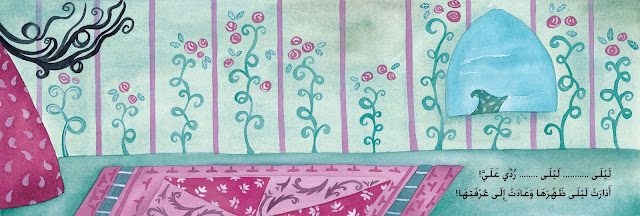
From Answer me, Leila! by Nadine Kaadan
(Box of Tales Publishing House, 2011)
Living in the UK for the past four years has been a wonderful learning experience, but I was surprised by the lack of topical diversity in the children’s book market. I didn’t feel that it was sufficiently reflected in a country that upholds and celebrates diversity and multiculturalism so well. This year I was part of a panel discussion at the London Book Fair under the title What works in translating children’s literature, and I argued that even when there is an attempt by UK publishers to publish more inclusive and diverse books, they still fall into the danger of the single story. For example, looking at UK children’s books that feature Arab or Middle Eastern culture, I feel that there is an exaggerated focus on ‘cultural differences’ (in the name of cultural richness). Too many of these books strike me as quite orientalist, and seem to depict overly stereotypical clichés about Arab culture, such as the typical camels in the desert and fasting in Ramadan. Although these elements are very much a part of our culture, and the stories are absolutely worthy of publication, the problem is that they only present one aspect of who we are.

I truly believe that stories should be chosen to be published or translated in the UK because they are strong, regardless of whether they are about themes of cultural diversity, or not. For example I would like to see books in the UK from the Arab world that address stories of single working mothers, or of talented artists, or of teenagers going through identity struggles. Stories such as these would better represent the diverse and more realistic representation of my region, and would indeed show more of what we have in common, and not just the differences.

The Jasmine Sneeze by Nadine Kaadan
(Lantana Publishing, 2015)

I was privileged to be able to publish a story here in the UK, The Jasmine Sneeze, by Lantana Publishing, and my first one in English. The Jasmine Sneeze is about Haroun, the cat, who likes nothing better than to spend his days sleeping in the sunlit courtyards of Damascus. But one thing always ruins his sleep: jasmine! Haroun can’t stand the sweet-scented flowers. Their pollen sends him into fits of sneezes! Haroun hatches a plan to fix the problem. But little does he know that in doing so he deeply angers the Jasmine Spirit who plans her revenge in her own crafty way.


From The Jasmine Sneeze by Nadine Kaadan
I chose jasmine for my story simply because Damascus is known as the City of Jasmine – the flowers are a much-loved feature of the city’s courtyards and alleyways and give the city its distinct odor, especially on cool summer nights. As part of their morning ritual, Damascenes will wake and collect fallen jasmine flowers and place the petals on their water fountains so that the smell can be carried all over the house.


Many people in my city like to believe that the jasmine plant reacts to and reflects what is happening in their homes and lives, in good times and bad. They often associate the drooping jasmine stems with grieving and loss, and when a member of their family passes, they believe that the jasmine mourns after him or her. The idea for this story came to me when I thought back on how often my mother used to tell me about her grandmother’s jasmine tree. My mother speaks of how, a day before her grandmother passed away, the jasmine in their courtyard suddenly became harsh and wild, as though in warning that something sad was about to happen. When my mother’s grandmother passed, the jasmine died the day after. This story stayed in mind and when I was young I always wondered: who lives inside the jasmine tree?

Who lives in the jasmine tree?
From The Jasmine Sneeze by Nadine Kaadan (Lantana Publishing, 2015)
I hope my story is a small beginning to more Syrian stories in the UK, especially during a time of devastating war, prejudice and misrepresentation of the Syrian people. Diversity and variety in picture books benefits everyone.

Nadine Kaadan
For more on Nadine and The Jasmine Sneeze (UK) and her 15 Arab picture books, please visit  www.nadinekaadan.com