Unlike many people in my line of work, I didn’t grow up
wanting to write for children. Don’t get
me wrong – I love my job and I love my readers – but I started writing picture
books only after years of doing other kinds of writing. I mention this partly because there are times
when I feel like the woman in the song – who wanted to go to Birmingham but
they’ve taken her on to Crewe – and partly because some of the things I learned
on the long and winding path to where I am now have proved very useful to me
and might be a help to others.
The theatre
(especially the musical theatre) was my first love and I often think of picture
books as little toy theatres. Open one
up, and it’s like the performance is about to start. There’s a sense of anticipation: you’ll have
to concentrate, but you know you’re going to have fun – and anything can
happen. Remember Max in his bedroom as
the forest grows in Where The Wild Things
Are (my favourite picture book of all time)? It always looks to me like
something that’s happening on a stage.
 |
The forest grows in Max’s bedroom in Where
The Wild Things Are, by Maurice Sendak
|
Tintin – another great love of my childhood that has
endured to this day – is different. A
bit more sophisticated perhaps, for slightly older readers and certainly
faster. Think of the mixture of angles,
points of view – the wide shots and close-ups – on a page of a Tintin book, the
fast cutting, the snappy dialogue: that’s not theatre, it’s cinema.
 |
A page from King Ottakar’s Sceptre by Hergé
|
Though in some ways, it’s true, writing a picture book can
be like writing a movie. As with a
movie, the writer is the first person on a project. He or she has often had the original idea and
works up the script alone, or with the help of an editor, but it’s the people
who join the project later – the illustrator especially – whose work is most
immediately apparent to the public. They
are the movie stars, they are the ones who attract the audience, who give the
story its face. Julia Donaldson apart,
most people would be hard pressed to name a picture book writer; it’s the
illustrator’s style that most often makes them take a book down from the shelf.
Who wrote Casablanca? I know, because I’m a writer. It was Julius and Philip Epstein, with Howard
Koch. All dead now and none of them
exactly household names even when they were alive because people remember
Bogart and Bergman instead and that’s as it should be. It means they were enraptured by the story;
it means the writers did their job well.
 |
Two thirds of the writers of Casablanca
|
Because in all forms of drama – and I’m including picture
books in that category – story is king. Of course you should have an eye-catching
premise, interesting locations and vividly-drawn and entertaining
characters. But if they aren’t all
serving a story that grips your audience from the beginning to the end, you
will be punished in the theatre with coughing, programme rustling and that
strange squeaky noise you get when restless bottoms shift in tip-up seats. Picture book stories are shorter than most
plays – the works of Samuel Beckett excepted – but children are even harder to
please than theatre audiences, and not wont to mince their words when they’re
bored.
So take note: the secret of a good story is telling your
audience the right things in the right order at the right speed. Tell them too much or too little and they’re
lost. Tell them things before or after
they need to know them, and they’re confused.
Tell them too slowly, and they’re bored; too quickly and they’re dazed.
How do you know if you’ve told your story successfully? I
hope you get better with practice, but – again, as in the theatre – your last
collaborator is the audience. We have
previews so we can try a show out in front of an audience, and if there are
things the audience doesn’t like or can’t understand, we change them. So try your story out – with children of the
right age, ideally – and listen to the advice and feedback from your
editor. It’s their job to let you know
if the story you’re telling is coming across or not.
But how do you come up with a good story in the first
place? I get my ideas in all kinds of ways.
My first book, Mungo and the
Picture Book Pirates (illustrated, like its successors, by Adam Stower),
was inspired by my reading a bedtime story for some kids, and them asking me to
read it “Again!” each time I finished.
After five or six readings, I found myself wondering how much more tired
than me the characters in the story must be.
After all, I’d just been sitting in a chair, saying words; they’d been
living the story – battling pirates and fighting sharks and all sorts. So what would happen if a boy read his favourite
book so many times that its hero became exhausted and went on holiday for a
bit?
 |
| Mungo and the Picture Book Pirates by Timothy Knapman and Adam Stower |
If that seems odd, I got the idea for my book Dinosaurs in the Supermarket when I was watching
a gory Stephen King horror movie called The
Mist. That’s about a bunch of
monsters that come out of a mysterious mist to devour some small town Americans
in a supermarket. It’s not, perhaps, a
situation that many people would associate with entertainment for small
children but I loved the way it mixed the extraordinary with the everyday – and
that is a staple of picture books. So my
monsters visit the supermarket too, but with mischief, not massacres, on their
minds.
 |
| Spot the difference? Dinosaurs in the Supermarket by Timothy Knapman and Sarah Warburton, and The Mist movie poster |
There’s another way in which picture books are like the
theatre: they’re written to be read aloud, to be performed. That doesn’t mean
you should go overboard with oratorical flourishes and Shakespearean fireworks. Most mums and dads reading your books to
their kids won’t be buddng Oliviers.
But, providing it’s doesn’t get in the way of the clear telling of the
story, a rich verbal texture can be great fun so treat yourself to the
occasional tongue-twister sentence, or poetic image.
And there are other theatrical tricks you can borrow
which will enliven your tale. The
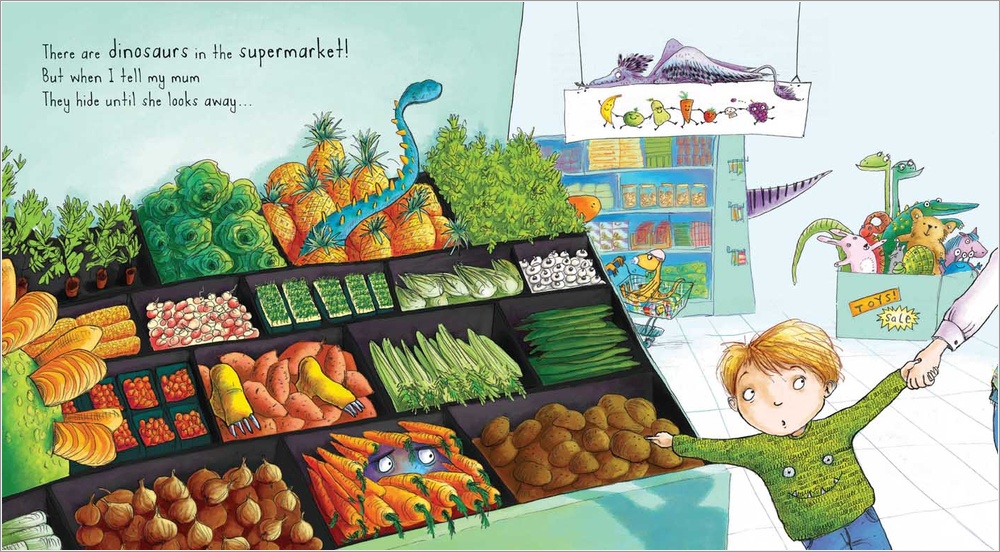
premise of Dinosaurs in the Supermarket
is that a boy is the only person who can see a mischievous gang of dinosaurs
that’s making a mess in a supermarket.
Every time the grown-ups turn round to look, the dinosaurs hide. But Sarah Warburton, the brilliant
illustrator, leaves lots of little clues in the pictures so that the children
reading the book can see what the grown-ups in the story cannot.
The result? The readers end up pointing to these clues
and crying out “It’s behind you!” They’re reading a book, but they might as
well be at the panto.
 |
Dinosaurs in the Supermarket by Timothy Knapman and Sarah Warburton
How many Stephen King inspired dinosaurs can you spot? |
I hope this is a new way of thinking about picture books,
and I hope it helps next time you start to write. Of course, writing picture books can also be
like many other kinds of writing - writing jokes, writing songs, writing poems…
But that – as they used to say on Jackanory – is a story for another time.