Showing posts with label Timothy Knapman. Show all posts

Monday, 27 May 2019

Why Are We Afraid of the Dark? by Timothy Knapman


The great writer and illustrator Tomi Ungerer died this year.  I was very fortunate to see him a few years ago at Waterstone’s in Piccadilly, launching a “treasury” of six of his books that Phaidon were publishing. He was in his mid-eighties but still as spry and as sly as ever.  

Gripping his walking stick and looking like an Old Testament prophet who had spent more than his fair share of time in the wilderness, he was full of firmly held and not-to-be-questioned opinions: principally, that anyone who wanted to write picture books should teach themselves to draw because it was imperative that they illustrate them as well.  I’m not sure I agree with him on that, but something else he said did resonate with me.  For years, he told us, he’d been trying to get his books republished but in vain (the Phaidon edition is excellent, but it’s large and expensive: more an exercise in nostalgia for those of us who read him years ago than a practical way to introduce him to younger readers).

I think I know why. I loved Tomi for his storytelling and for his visual style (the éclair-like fingers and pudgy, good-enough-to-eat limbs and faces looked almost like the work of an especially witty pâtissier) but most of all for what we would now call his “darkness”.

Zeralda’s Ogre by Tomi Ungerer

My favourite of his books – one of the few picture books I still own from my childhood – is called Zeralda’s Ogre.  Zeralda is a farmer’s daughter, a girl of pluck and resource who is also a wonderful cook.  One market day, her father falls ill so Zeralda elects to take the farm’s produce to the local town to sell it (the setting seems to be a fairy tale nowhere land in the vicinity of Ungerer’s native Alsace).  What Zeralda does not know is that the town has been living in fear of a terrible ogre who eats children.  Parents have taken to hiding their children away so that they won’t get carried off. Good news for the children, bad news for the ogre, who has had nothing to eat for a long time now.  So imagine his joy when he sees little Zeralda on her cart, heading heedlessly straight into town.  He waits until the right moment and pounces on her.  Only his senses have been dimmed by lack of food and he misses the cart, falling on the road and bashing his head.  Zeralda – not knowing he’s an ogre – takes pity on this apparently poor, injured man, bandaging his head and cooking up some of her farm produce as she nurses him back to health.


The first mouthful is a revelation to the ogre – there’s something that tastes even nicer than children! – so Zeralda cooks him a banquet of ever more wonderful dishes (for some reason, “Chocolate sauce Rasputin” and “Pompano Sarah Bernhardt” always stuck in my memory) until he gives up on the whole being-an-ogre business. The parents of the town let their children out to play safely in the streets again.  The ogre shaves off his beard and, when she is old enough, marries Zeralda.  On the last page, we see a picture of the happy family; proud parents Zeralda and her ex-ogre are surrounded by their offspring and Zeralda has a baby in her arms. One of her older children leans over his new-born sibling, apparently adoringly.  But behind his back – visible to us but not to his parents – he holds a knife and fork.


I don’t know why that image has stayed with me ever since.  I do remember thinking it was funny rather than scary.  I was a ghoulish child, I suppose.  But – more than that – it’s the subversiveness of the image, the feeling that “you’re not supposed to do that! How did he get away with it?” that was – and remains – truly thrilling.  It was a glimpse of a world beyond the safe and saccharine fare that comprised the bulk of what was on offer to children then, and is even more prevalent today.

Because - as Tomi Ungerer discovered - there is no way you could get a book like that published now. Public taste in children’s books has turned decisively against anything that might be thought to be in anyway scary or upsetting.  And that is a huge shame – and a great loss, I think, for the current generation of children.

Don’t get me wrong, I love my young readers (it may sound pretentious to say it, but writing is an act of love: it has to be or it’s not worth doing); I don’t want to give children nightmares and I don’t want to upset or traumatise them.  Of course I understand that loving parents want to keep bad and hurtful things away from them.  But it worries me that the books they are allowed to read nowadays deliberately avoid territory that used to be part of the landscape of children’s books, limiting the very important job that stories for the young are supposed to perform.

There’s no doubt that the folk and fairy story collections – by the Brothers Grimm and the rest – that stand behind modern children’s literature are full of robustly bloodthirsty stuff.  At the end of the original Snow White, the Wicked Queen is made to dance herself to death in red-hot iron shoes.  Hansel and Gretel only escape being the main course at a witch’s cannibal banquet by beheading the old woman before she can murder them.  And then there are all those big bad wolves waiting to devour you if you take a wrong turning off the forest path.


One of Arthur Rackham’s illustrations for Little Red Riding Hood

Of course, these stories were intended, in part at least, to be warnings.  When they were being told in the years before the Grimms started writing them down, the countryside was a dangerous place for children.  They needed to be taught to keep an eye out for the threats that lurked in the dark places of their world if they were going to stand any chance of making it to adulthood.  The perils of the time also accounted for the level of cruelty depicted.

It might be argued that such warnings are no longer needed.  Why ruin a child’s bedtime by telling her a story about ravening wolves if she is going to spend her early years constantly supervised by caring adults who’ll spend their lives driving her from home to school to birthday party to sleepover? And it is true that, while the world is still, for many, a dangerous place, the lives of my readers are (thank goodness) infinitely safer and more enjoyable than those of their many-times-great-grandmothers and fathers who grew up in the shadow of the wolf-infested forest.

But metaphorical wolves can be as dangerous as real ones.  I am writing this on the day of the European elections (which may explain the dark turn my thoughts have taken) and the polling station where I voted is my local primary school.  Its walls are plastered in warnings and exhortations about “school values” and the correct way children should behave towards one another.  You don’t have to study them for long to see that today’s children still have problems to confront – about learning to control their antisocial impulses and cope with those of others: about dealing with the darkness inside all of us – just as earlier generations did.  The difference is that fiction and the imagination are no longer seen as appropriate places to engage with those problems.  There should only be sweetness and light on the bookshelf, at which point the bookshelf becomes a kind of lie because life isn’t like that.

I’m not saying that the principal purpose of children’s books is to tell their young readers how to behave and I know that the time for a book such as Struwwelpeter, with its threat of amputation as a way of discouraging thumb-sucking, has come and gone. I don’t, in fact, like “cautionary tales” except when someone of a particular genius, such as Hilaire Belloc, is writing them, because then you’re not reading for instruction but for entertainment.  Art is art and doesn’t need to be useful to justify itself.  And that’s the thing about a lot of scary books – one of the reasons I think children should read them is because they’re fun!

Some of the fun is obvious, because a lot of scary books are also very funny.  That shouldn’t come as a surprise: fear and amusement are very similar – both provoke a physical response,  be it screaming or laughter.  Also, comedy is an intellectual process: it resists emotional identification and so makes scary things easier to deal with.  Just think of the comedy staple of a man tripping over a banana peel: it’s hilarious providing you remain at a cool intellectual distance from the man and his plight and don’t start to feel for him, and imagine his physical pain and his embarrassment.  As Horace Walpole said, “this world is a comedy to those that think, a tragedy to those that feel.”

Call me cool and distant but I think a house is not a home unless it contains a copy of Ruthless Rhymes For Heartless Homes (“Making toast at the fireside,/Nurse fell in the grate and died;/And, what makes it ten times worse,/All the toast was burned with nurse.”).  I’m equally certain that your family will be all the happier for spending time with the family created by Charles Addams.  One of Addams’ disciples at the New Yorker magazine, the appropriately named Edward Gorey, built brilliantly on his legacy.  If you’ve never encountered Gorey’s work, I recommend The Gashlycrumb Tinies, an alphabet of luckless children and how they died: “M is for Maud who was swept out to sea/N is for Neville who died of ennui.”  And in Gorey’s wake came Lemony Snicket and his Series of Unfortunate Events (who said Americans don’t do irony? That’s three generations of it).


The Gashlycrumb Tinies by Edward Gorey

Apart from Snicket (real name Daniel Handler, born 1970), those writers and illustrators belong to an earlier age, and it’s only because some of them are too big and canonical to ignore that modern children have a chance to read them.  On this side of the Atlantic, the great example of that is Roald Dahl.  A reclusive chocolate factory owner who carelessly tortures and punishes the children he disapproves of? A coven of witches plotting to turn children into mice so that their parents and teachers will stamp and poison them to death? Dahl had problems getting published in the 1960s and ’70s, but I think I can confidently say that no writer submitting similar material now would have any hope of having it accepted.  You only have to look at the books of the Dahl-lite David Walliams.  They’re designed and illustrated to look like Dahl, in a clear attempt to place Walliams in a line of succession, but there’s no way he would ever stray into territory as troubling as his infinitely superior precursor.


Quentin Blake’s picture of Roald Dahl’s Grand High Witch doing her worst

Which is, as I keep saying, a shame.  For not only can scary books be fun, I believe that they are also a necessary part of a child’s reading.  I believe that we are ineluctably drawn to the darkness as children – at least in our imaginations – despite the fact that we know bad things await us there.  It’s partly curiosity about the unknown – and human beings have always been unfailingly curious creatures.  But it’s mostly because in the world of the imagination, in the safe space provided by books, we have a chance to practise having emotions: joy and sorrow and envy and wonder, but also fear.  

I think it’s an evolutionary advantage, hard-wired into us, perhaps even the reason we have an imagination at all.  A self-conscious creature such as a human being wouldn’t last long if her first experience of fear was the first time she was confronted by actual danger.  The shock of the strangeness and power of the emotion would disable her and render her helpless in the face of the threat.  I believe that we are naturally disposed to imagine ourselves in many different kinds of danger, so that we can give fear a trial run and learn to master it.  That’s why there’s a strange comfort in seeking out the scary, a perverse feeling that we are actually doing something that we are supposed to when we are investigating that which is always forbidding and often forbidden.

I’m not suggesting that all children’s books should be scary.  Of course books should be places of joy, of course they should be refuges, sources of relief and reassurance.  But they should also help us to live our lives and prepare us for times that are not easy.  We may have left the forest far behind but the wolves will follow us forever.


Timothy Knapman has written lots of books that aren’t in the least bit scary.  There are funny ones, such as Dinosaurs in the Supermarket and Who’s Afraid of the Big Bad Bogey?; sweet ones, such as Soon, Big Digger Little Digger and What’s Next?; loving ones, such as Superhero Mum, Dad and Gran; adventurous ones, such as Captain Sparklebeard.  Those made of sterner stuff are invited to seek out his Little Ogre’s Surprise Supper and Please Said Percy.  


Monday, 10 December 2018

Christmas Mash-Up! by Pippa Goodhart

Bookshops are currently bright with selections of wonderful children’s Christmas books. Many of those books are picture books, and nearly all are books with pictures. There’s a brief but intense selling window for such books, and competition for sales is stiff.


How best to compete amongst the glitter and beauty and fun of it all? The Nativity story is there in multiple forms, of course. So too are many stories about Santa and snowmen and elves and Christmas trees and nativity trees and presents. But there’s a new trend that I’ve noticed particularly because I’ve played a part in it. I’m calling it ‘the Christmas mash-up book.’ 
We all know some key trigger children’s book character and story types which have appeal – unicorns, diggers, monsters, fairies, dinosaurs, underpants, witches, fluffy bunnies and more – and now some of those characters have crossed what used to be an invisible boundary into Christmas. 

So, for instance, here we have dinosaurs mixing with Christmas fun in Timonthy Knapman and Sarah Warburton's Dinosaurs Go Christmas Shopping 

Image result for dinosaurs go shopping image


Fred Blunt pairs the Easter Bunny with Father Christmas, mixing originally religious festivals which have become more general to society. Easter Bunny is furious that Santa Claus has elves to do all the work of making the presents he gives whilst Bunny has to make the chocolate eggs himself. So Easter Bunny hatches a dastardly plan ….  But of course it all ends in a funnily big-hearted way.
9781760634698.jpg 

I was asked to write a Christmas chapter book story about Winnie the Witch and her cat Wilbur. Mixing witches with Santa? Here’s James Brown’s new book, Jingle Spells


 Image result for jingle spells james brown image 
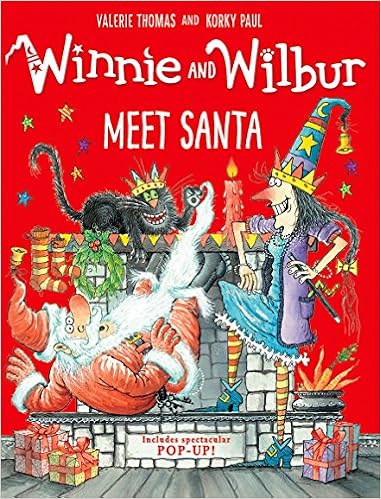
There’s even been a Winnie the Witch picture book done before. In this one Winnie gets to fly with Santa –
 Image result for winnie and wilbur meet santa image
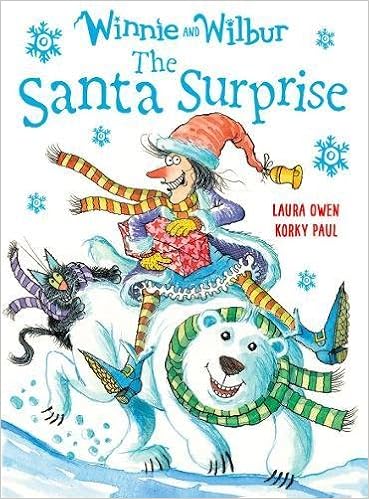
So I had to think of a story that didn’t have Winnie flying with Santa on his sleigh. In my story (written under the fake name of Laura Owen), Winnie suddenly realises that if Santa delivers presents to everybody, there will still be one person still left out; Santa himself. That’s not fair! So in this Santa Surprise story Winnie and Wilbur try to deliver a Christmas surprise to Santa, with inevitable daft disasters that culminate in success of a kind they hadn’t thought of. Korky Paul has turned it all into a wonderfully wild and whacky visual story, showing that ‘picture books’ can overlap with chapter books.

Image result for winnie and wilbur santa surprise image


So, what would you like to see mashed-up with Christmas on the bookshelves next year?

And if anybody would like to give a child in need a wonderful book gift this year, do visit the Book Trust's website where you can donate - https://www.booktrust.org.uk/support-us/donate-ten-pounds-and-make-a-child-feel-special-this-christmas/

Happy Christmas!   

Monday, 30 January 2017

The World of the Weird Versus The Weird in the World - Timothy Knapman

I don’t know about you, but I’ve never had much time for the kitchen sink.  By “kitchen sink”, I don’t mean the sink-shaped thing you find in a kitchen with taps, plughole and draining board attached.  I’m a writer, after all.  I drink tea.  Lots of tea.  From mugs.  Mugs that need – eventually – to be hosed down and scraped clean so they can contain yet more tea.

No, I mean naturalism, realism, whatever you want to call it: the attempt to create in art a faithful replica of the surface detail of real life - the sort of thing “kitchen sink” novelists and playwrights such as Alan Sillitoe, David Storey and John Osborne were doing in the 1950s.


John Osborne’s “kitchen sink” drama “Look Back In Anger” – though perhaps it’s better described as an “ironing board” drama

I admire the skill, of course - and the compassionate and campaigning impulses behind it - but a bit of me is always thinking: why should I go out to see a play about alcoholism, despair, poverty and unemployment? I can get all that at home. 

(I feel much the same about 3D movies.  Why should I pay extra for a 3D movie? I get 3D all the time! Life is in 3D! It’s 2D that’s the novelty! But I digress...)

As a child, I was always drawn to the strange, the funny, the macabre – in short, the weird.  I loved Doctor Who and Star Wars and Monty Python: aliens, robots and Terry Jones showing his bottom.  So when I started writing for children, of course, it was the fantastical, the odd, the bizarre, that I wanted to write about.

The anxiety of influence: Terry Jones’s bottom

And children are the perfect audience for fantasy because not only do they spend a lot of time in their own imaginative worlds, they are also untouched by the deadening effect of experience: the knowledge that things simply “aren’t like that”.  In a child – especially a child of picture book age – however much they might protest that some things “couldn’t happen”, there is a residual suspicion that, you know what, they just might.  The barrier between the real and the imaginary isn’t as clear, or as strong, as it is in grown-ups and so the potential to get lost in a created world is much greater.

It’s the haziness of that barrier that was the subject of my Mungo books.  In each one, Mungo is reading a different kind of story and then something goes wrong.  In Mungo and the Picture Book Pirates, for instance, he reads his favourite book so many times that the hero becomes exhausted from having to repeat his acts of derring-do so often and goes on holiday.  Without the hero to stop them, the book's villains start to take over the story, so Mungo has to jump into the book to save the day - and the book.

Mungo saves the day

But just because anything can happen in a picture book – anything a writer and illustrator can imagine, anyway – doesn’t mean that anything should.  I think total fantasy – fantasy that is completely unanchored in the details of lived experience – doesn’t work because it’s arbitrary.  There are no restrictions and it’s restrictions that create good art.  For fantasy to captivate the reader – especially if that reader is a young child – it needs to rub up against the solid fact of the real world in some way.  It’s that friction - between our world and the fantastical one - that strikes the spark of a really enjoyable story.

A writer has two ways of using fantasy.  She can either set her story wholly, or mostly, in a made-up environment – what I am calling The World of the Weird – or by she can introduce fantasy elements into familiar settings – what I am calling The Weird in the World

In general, The World of the Weird stories appeal more to children who are old enough clearly to delineate between the real and the fantastic, and who are therefore able to enjoy the detail of the imagination with which the stories are told.  Just think of the geekish glee with which fans of Harry Potter seize upon – and argue about – the minutiae of JK Rowling’s wizarding universe.  Part of the pleasure of her brilliant books comes from finding in them a place that has been so completely imagined by the writer that you can imaginatively occupy and explore it yourself. 

Hogwarts – a fantasy world full of imaginative detail

(It’s easier to do that sort of thing in books – where the writer has more space and time to lay out every detail of her world – than in, say, movies.  The reason why George Lucas’s Star Wars saga began in the middle – with “Episode Four” of a supposed six-part story – was so that he wouldn’t have to explain how everything in his “galaxy far, far away” worked.  Because movie-goers were coming in halfway through the story, Lucas reasoned, they would just have to pick things up as they went along.)

Tolkien and Lewis

The level of detail in the imagined world is important here.  Rowling spent years constructing hers, so did JRR Tolkien, whose Middle Earth exerts a similar fascination for its fans.  Compare that with Tolkien’s friend CS Lewis.  He jerry-built his Narnia books from pre-fabricated fantasy elements – Greek mythology, King Arthur, Christian allegory and the 1,001 Nights.  I don’t think is a coincidence that the Narnia books inspire far less immersive geekiness than the Middle Earth books – or that they are aimed at younger readers.

Because younger readers aren’t interested in fantasy worlds in the same way as more mature readers are: for one thing, they’re not old enough to enjoy the imaginative detail.  They want a story they can navigate without having to learn the rules of an alien world first.

“It went thataway!” The Kiss That Missed

Of course there are plenty of picture books that are set in imaginary places, but the picture book writer isn’t inventing an internally consistent other world that the reader can explore.  Instead, she is more often than not portraying our world dressed up in funny clothes.  Take David Melling’s wonderful The Kiss That Missed.  It may look like it’s set in a world of castles, knights and dragons, but we don’t need to know about any interesting or innovative “rules” this world might have because they’re not important.  This is a sweet, domestic tale, a clear metaphor for something that happens in our world, somewhere or other, every bedtime.  A busy father (in the story, the king) has been too preoccupied properly to say goodnight to his child (the prince).  His loving feelings (the runaway kiss) are true and powerful, but he has been too busy with other things to express them properly. 


The most common kind of World of the Weird picture book is the anthropomorphic animal story.  From Aesop to Mr Toad and on, animal stories aren’t about animals or their world; they’re about us.  One of my favourites, is Martin Waddell’s Farmer Duck, illustrated by Helen Oxenbury.  Not only is it about things that young children will instantly recognise – unfairness, and the need to put things right – it’s even a version of another animal story that is, itself, really about our world: George Orwell’s Animal Farm.  (Check out the last illustration, where the once put-upon duck is now in charge of the farm.  You’ll notice an imperious pointing of the wing: like the pigs in Orwell’s story, the duck is now the oppressor.)

 Meet the new boss, same as the old boss.

For all these reasons, I think fantasy works better in picture books if the stories are of the Weird in the World variety.  Like their World of the Weird counterparts, they can involve animals.  The most famous is probably Judith Kerr’s The Tiger Who Came To Tea.  But there’s a difference.  These are not always metaphorical stories.  Kerr herself has been very clear that the tiger – who consumes all the food and drink in a suburban home before disappearing, never to return – is not in any way a representation of Hitler, whose rise to power forced her to emigrate from her native Germany. The pleasure of her tale comes not from “decoding” it, from working out what she "really" means, but simply from its oddness.

The Tiger Who Wasn’t Hitler

Weird in the World
stories often use the juxtaposition of real and fantastic for comic ends.  Think of the elephant you can’t take on the bus in Patricia Cleveland-Peck’s book, illustrated by David Tazzyman.  Or Not Now Bernard, by David McKee – a funny, but very dark depiction of parental preoccupation in which a monster eats a neglected child and is unthinkingly pushed into taking his place by a mother and father who are too interested in other things to notice.

Monsters, children – what’s the difference when you're trying to read the paper?

Sometimes, picture book characters will pop in and out of fantasy worlds.  The most famous is Max, whose temper tantrum carries him “through night and day, and in and out of weeks, and almost over a year, to where the wild things are”.  But it’s the domestic details that bookend the story – the mischief of one kind and another at the beginning, the supper that’s still hot at the end – that makes his journey interesting.  By contrast, the arbitrary dream logic of Maurice Sendak’s subsequent In The Night Kitchen renders that story random and inconsequential.


Ten years ago, I wrote a book that was an attempt to mix a Weird in the World story with a World of the Weird one.  Guess What I Found in Dragon Wood was inspired by a picture the illustrator, Gwen Millward, had made.  It was a beautiful study of a boy and a dragon, playing together in the boy’s room.  The two were obviously friends but Gwen couldn’t find a story there.


My suggestion was that, instead of the dragon being in the boy’s world, the boy should be in the dragon’s – at least to start with.  So the book is told from the dragon’s point of view, and is all about his new discovery: a strange and magical creature called a “Benjamin”.  We’re in a weird world all right – the dragons eat worms and stinky fish, and go to school to learn how to sit on a volcano – but there’s something weirder still in that world: one of us.

Seeing the Benjamin through the dragon’s eyes, I hoped my young readers would understand (even if it was only without realising) how odd and fantastical – how weird - our world is.  And I hoped the story would help them enjoy the closely imagined fantasy that we call “real life”.

Monday, 26 September 2016

Picture Books: Theatres of the Imagination By Timothy Knapman

Unlike many people in my line of work, I didn’t grow up wanting to write for children.  Don’t get me wrong – I love my job and I love my readers – but I started writing picture books only after years of doing other kinds of writing.  I mention this partly because there are times when I feel like the woman in the song – who wanted to go to Birmingham but they’ve taken her on to Crewe – and partly because some of the things I learned on the long and winding path to where I am now have proved very useful to me and might be a help to others.

The theatre (especially the musical theatre) was my first love and I often think of picture books as little toy theatres.  Open one up, and it’s like the performance is about to start.  There’s a sense of anticipation: you’ll have to concentrate, but you know you’re going to have fun – and anything can happen.  Remember Max in his bedroom as the forest grows in Where The Wild Things Are (my favourite picture book of all time)? It always looks to me like something that’s happening on a stage.


The forest grows in Max’s bedroom in Where The Wild Things Are, by Maurice Sendak
Tintin – another great love of my childhood that has endured to this day – is different.  A bit more sophisticated perhaps, for slightly older readers and certainly faster.  Think of the mixture of angles, points of view – the wide shots and close-ups – on a page of a Tintin book, the fast cutting, the snappy dialogue: that’s not theatre, it’s cinema. 

A page from King Ottakar’s Sceptre by Hergé
Though in some ways, it’s true, writing a picture book can be like writing a movie.  As with a movie, the writer is the first person on a project.  He or she has often had the original idea and works up the script alone, or with the help of an editor, but it’s the people who join the project later – the illustrator especially – whose work is most immediately apparent to the public.  They are the movie stars, they are the ones who attract the audience, who give the story its face.  Julia Donaldson apart, most people would be hard pressed to name a picture book writer; it’s the illustrator’s style that most often makes them take a book down from the shelf.  Who wrote Casablanca? I know, because I’m a writer.  It was Julius and Philip Epstein, with Howard Koch.  All dead now and none of them exactly household names even when they were alive because people remember Bogart and Bergman instead and that’s as it should be.  It means they were enraptured by the story; it means the writers did their job well.

Two thirds of the writers of Casablanca
Because in all forms of drama – and I’m including picture books in that category – story is king.  Of course you should have an eye-catching premise, interesting locations and vividly-drawn and entertaining characters.  But if they aren’t all serving a story that grips your audience from the beginning to the end, you will be punished in the theatre with coughing, programme rustling and that strange squeaky noise you get when restless bottoms shift in tip-up seats.  Picture book stories are shorter than most plays – the works of Samuel Beckett excepted – but children are even harder to please than theatre audiences, and not wont to mince their words when they’re bored.

So take note: the secret of a good story is telling your audience the right things in the right order at the right speed.  Tell them too much or too little and they’re lost.  Tell them things before or after they need to know them, and they’re confused.  Tell them too slowly, and they’re bored; too quickly and they’re dazed.

How do you know if you’ve told your story successfully? I hope you get better with practice, but – again, as in the theatre – your last collaborator is the audience.  We have previews so we can try a show out in front of an audience, and if there are things the audience doesn’t like or can’t understand, we change them.  So try your story out – with children of the right age, ideally – and listen to the advice and feedback from your editor.  It’s their job to let you know if the story you’re telling is coming across or not. 

But how do you come up with a good story in the first place? I get my ideas in all kinds of ways.  My first book, Mungo and the Picture Book Pirates (illustrated, like its successors, by Adam Stower), was inspired by my reading a bedtime story for some kids, and them asking me to read it “Again!” each time I finished.  After five or six readings, I found myself wondering how much more tired than me the characters in the story must be.  After all, I’d just been sitting in a chair, saying words; they’d been living the story – battling pirates and fighting sharks and all sorts.  So what would happen if a boy read his favourite book so many times that its hero became exhausted and went on holiday for a bit?

Mungo and the Picture Book Pirates by Timothy Knapman and Adam Stower
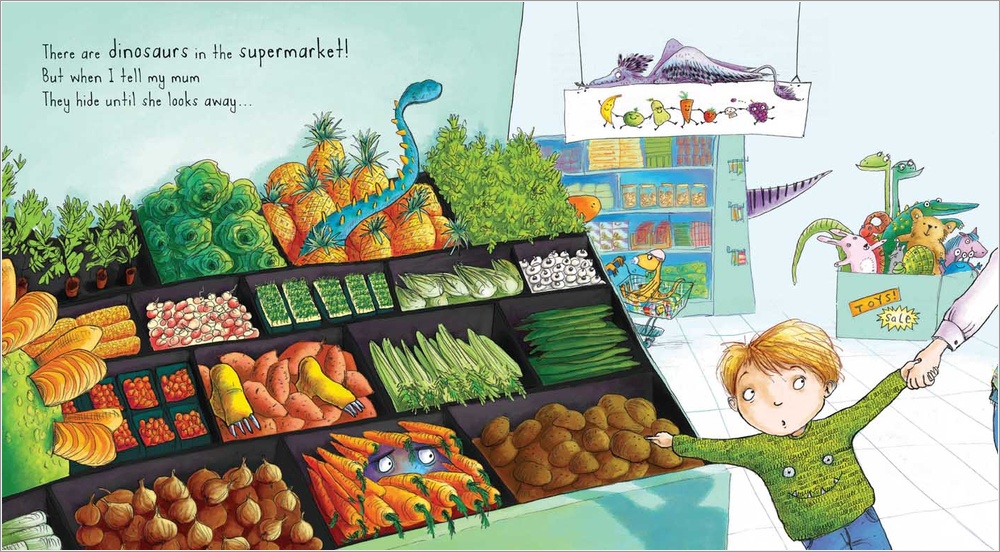
If that seems odd, I got the idea for my book Dinosaurs in the Supermarket when I was watching a gory Stephen King horror movie called The Mist.  That’s about a bunch of monsters that come out of a mysterious mist to devour some small town Americans in a supermarket.  It’s not, perhaps, a situation that many people would associate with entertainment for small children but I loved the way it mixed the extraordinary with the everyday – and that is a staple of picture books.  So my monsters visit the supermarket too, but with mischief, not massacres, on their minds.

Spot the difference? Dinosaurs in the Supermarket by Timothy Knapman and Sarah Warburton, and The Mist movie poster
There’s another way in which picture books are like the theatre: they’re written to be read aloud, to be performed That doesn’t mean you should go overboard with oratorical flourishes and Shakespearean fireworks.  Most mums and dads reading your books to their kids won’t be buddng Oliviers.  But, providing it’s doesn’t get in the way of the clear telling of the story, a rich verbal texture can be great fun so treat yourself to the occasional tongue-twister sentence, or poetic image.

And there are other theatrical tricks you can borrow which will enliven your tale.  The premise of Dinosaurs in the Supermarket is that a boy is the only person who can see a mischievous gang of dinosaurs that’s making a mess in a supermarket.  Every time the grown-ups turn round to look, the dinosaurs hide.  But Sarah Warburton, the brilliant illustrator, leaves lots of little clues in the pictures so that the children reading the book can see what the grown-ups in the story cannot. 

The result? The readers end up pointing to these clues and crying out “It’s behind you!” They’re reading a book, but they might as well be at the panto.

Dinosaurs in the Supermarket by Timothy Knapman and Sarah Warburton
How many Stephen King inspired dinosaurs can you spot?
I hope this is a new way of thinking about picture books, and I hope it helps next time you start to write.  Of course, writing picture books can also be like many other kinds of writing - writing jokes, writing songs, writing poems…

But that – as they used to say on Jackanory – is a story for another time.

Monday, 5 September 2016

Seven Brilliant Books about BIBLIOPHILES • Jonathan Emmett


Prince Ribbit, my latest picture book with the wonderfully talented Argentinian illustrator Poly Bernatene, has just been published in UK hardback and paperback.

Prince Ribbit’s heroine, Princess Martha finds inspiration in the Royal Library. 

Although Prince Ribbit is the fourth book that Poly and I have done together, it’s really a follow up to our second, The Princess and the Pig, in that both stories are set in a fairytale world populated by characters who love books.

The characters in The Princess and the Pig use the books they’re reading to interpret (usually mistakenly) what's happening to them in the the story.

As a book-lover myself, I’ve aways enjoyed reading stories about other bibliophiles. There’s something satisfyingly meta about reading a book about a character who is reading a book. So here are seven brilliant picture books about bibliophiles.


One of my favourite novels of recent years is David Mitchell’s Cloud Atlas which is effectively six books nested inside each other like a set of Russian dolls. Each book jumps forward in time and one of the ingenious connections between the stories is that characters featured in the inner books are reading the outer books. Julia Donaldson and Axel Scheffler’s Charlie Cook’s Favourite Book does something similar in picture book format. Each spread introduces a new character who is reading their favourite book, the inside of which is shown on the next spread. So the book starts with eponymous Charlie, who is reading a book about a pirate, who is reading a book of fairy tales, and so on. While Scheffler's spread layouts shift around as the reader jumps from genre to genre, Donaldson ties the whole bookshelf together with her perfectly-scanning rhyme.

The spread from Joust Joking, Sir Percy the knight’s favourite book.


Jane Blatt and Sarah Massini’s Books Always Everywhere features a diverse group of toddlers enjoying an equally diverse selection of books. Blatt’s simple but charming rhyming text combines beautifully with Massini’s cheerful, perfectly-composed illustrations to make this book an ideal gift for budding bibliophiles, especially in the board book edition. Published in 2013, this book deserves to become a pre-school classic.

The board book edition of Books Always Everywhere makes an ideal gift for budding bibliophiles


Timothy Knapman and Adam Stower’s Mungo and the Picture Book Pirates is one of three books in which young Mungo literally enters into the book he is reading to join in with the adventure. In this first outing Captain Fleet, hero of Mungo’s favourite pirate picture book, is so worn out after six back-to-back readings of his story, that he abandons his book leaving Mungo to take his place and rescue Admiral Mainbrace and cabin girl Nora from a crew of dastardly pirates. The second book in the series, Mungo and the Spiders from Space, was featured in one of my earlier PBD posts.

With the hero holidaying in another book, Mungo is obliged to take his place in the story.


In Lauren Child’s Beware of Storybook Wolves the traffic is going the other way, with characters leaving little Herb’s favourite bedtime book to join him in the real world. Published in 2000 (before many publishers developed their current anorexic obsession with diminished word counts) Child’s quirky, characterful 1,300 word text is accompanied by equally quirky and characterful illustrations in which a trio of villains (two hungry wolves and a wicked fairy) emerge to threaten poor Herb before being seen off by a fairy godmother.

When Herb’s mother leaves a book behind one night, he finds himself at the mercy of two hungry wolves.


Dog Loves Books by Louise Yates sees Dog pursuing the dream of many a bibliophile – opening their own bookshop! Sadly, the bookshop's "grand opening" is a disappointing anti-climax. However Dog is able to find solace in his stock until trade picks up. You can watch Alison Steadman reading the book here.

Dog shows his love of books by opening his own bookshop.


Ralfy Rabbit loves books so much, he ends up stealing them to feed his insatiable reading habit in WANTED! Ralfy Rabbit Book Burgular by Emily MacKenzie. But Ralfy’s book-burglaring days come to an end when young Arthur spots Ralfy making off with a favourite book.

Ralfy Rabbit’s love of books puts him on the wrong side of the law.


Henry, the title character of Oliver Jeffers’s The Incredible Book Eating Boy also has an insatiable appetite for books – only he likes to eat rather than read them. The more he eats, the smarter he gets. Eventually the strain on his digestive system proves too much and Henry finds a more conventional way to feed his love of literature.

Henry’s bibliophilia manifests itself in a rather unusual way.


I hope this post has whetted your own appetite for some bibliophilic picture books! If you have a favourite picture book about a book-lover that I haven’t mentioned, I’d love to hear about it in the comments section below.


Jonathan Emmett's latest picture book about bibliophiles is Prince Ribbit, illustrated by Poly Bernatene and published by Macmillan Children's Books.

Find out more about Jonathan and his books at his Scribble Street web site or his blog. You can also follow Jonathan on Facebook and Twitter @scribblestreet.


Monday, 7 March 2016

TO BOLDY GO: Picture books in space • Jonathan Emmett

As someone who grew up at the time of the Apollo Missions I’ve always found the idea of space travel hugely appealing and had a particular interest in stories that are set in space.

I've pitched several space-set stories to publishers over the years. However, while I’ve had some success getting space-set chapter fiction published …

The Captain Comet chapter fiction books illustrated by Andy Parker are set in space.

… none of the space-set picture books I’ve pitched have ever made it into print.

An art sample by illustrator Steve Cox for Invasion of the Botty Snatchers,
an unpublished space-set picture book we developed together.

Of course this could be because none of them were any good, but when another of my space-set picture book ideas was turned down last year, the publisher told me that one of the reasons was that, “picture books set in space generally don’t sell.”

If this is true, then I think it shows that the picture book market is currently catering to the tastes of a demographic that is relatively narrow compared to its potential readership. There are plenty of picture book age children that are interested in stories set in space. However these children are currently having this appetite fed by TV shows and films rather than books. My son and several of his friends were obsessed with the original U certificate Star Wars trilogy from the age of four and when I went to see the new Star Wars film over Christmas, I was struck by how many parents had brought small children to see it, despite its 12 certificate rating.

If publishers want to show these children that picture books are every bit as capable of matching the appeal of their favourite films and TV shows, they might consider “boldly going” into space a little more often. And I do mean “boldly”; it’s not just the setting that’s important. There is a market for gentler picture book stories set in space, but such books will not cut it with young readers with an appetite for dogfights and death stars. These children need picture books that can match the dastardly villainy, thrillingly perilous predicaments and sophisticated craft and weaponry evident in films like Star Wars.

Here are three space-set books that are a good deal “bolder” than most.


The King of Space written and Illustrated by Jonny Duddle is one of the best picture books of the last ten years and shamefully under-recognised by reviewers and awards judges alike. It’s a brilliantly illustrated, tech-tastic, action packed epic, filled with battling spaceships, menacing robots and a pint-sized megalomaniac.


The hardback edition comes with a dust-cover that unfolds to make this awesome poster of a 'warbot'.


Nuts in Space written and illustrated by Elys Dolan is a madcap space epic that's brimful of comic references to both Star Wars and Star Trek. Charged with transporting “The Lost Nuts of Legend” across the galaxy, the crew of Forest Fleet’s finest starship encounter a mischievous menagerie of creatures from little green men to ravenous Ewok-like bears, before falling into the clutches of Daft Monkey and his legion of simian stormtroopers.


The book is full of amusing in-jokes for sci-fi fans young and old, such as this encounter between Daft Monkey and Commander Moose.


Mungo and the Spiders from Space written by Timothy Knapman, illustrated by Adam Stower is part of an excellent series of Mungo stories in which Mungo, the young hero, enters the world of a favourite bedtime book. In this story it's a comic book adventure featuring a Dan-Dare-like space hero called Captain Galacticus.


Galacticus and Mungo join forces to thwart the villainous, Dr Frankenstinker, the "maddest scientist on Mercury".


Can you recommend any other picture books that "boldly go" into space? If so, we'd love to hear about them in the comments box below.


Jonathan Emmett's latest picture book is Fast and Furry Racers: The Silver Serpent Cup illustrated by Ed Eaves and published by Oxford University Press.

Find out more about Jonathan and his books at his Scribble Street web site or his blogYou can also follow Jonathan on Facebook and Twitter @scribblestreet.

See all of Jonathan's posts for Picture Book Den.