Showing posts with label Sydney Smith. Show all posts

Monday, 14 September 2020

CHATTER MATTERS: Picture books featuring characters with SLCN (Speech, Language and Communication Needs) by Lucy Rowland

During the school holidays, I noticed a few people tweeting to ask for recommendations of picture books that feature characters with Speech, Language and Communication Needs (SLCN).  Unfortunately, they weren’t always able to find exactly what they were looking for.

Children with SLCN are, I believe, quite under-represented within picture books and yet it is estimated that the prevalence of DLD (Developmental Language Disorder- where children have severe and persisting difficulties with their understanding and use of spoken language) is approximately 7.5% (Norbury et al. 2016).  Therefore, in each UK classroom, it is likely that there are, on average, two children who have DLD.   Usually there are also other children within the class who have communication needs as a result of different diagnoses e.g. ASD, Learning Difficulties, Down's Syndrome. 

Last week, ‘Wanda’s Words Got Stuck’ (written by me and illustrated Paula Bowles) was published by Nosy Crow.

As a Speech and Language Therapist, this book is very close to my heart.  It is dedicated to the brilliant NHS Speech and Language Therapy Team in Lewisham, where I used to work.  


'Wanda’s Words Got Stuck' isn’t about any one particular communication diagnosis.  Our little Wanda could have Selective Mutism? Or perhaps she has DLD and, therefore, has a reduced vocabulary, finds it hard to understand verbal information and struggles to express herself in sentences? She might have a Stammer- her words get stuck and don’t come out easily? Or perhaps she is just very anxious and feels shy about talking in class? 

Either way, I wanted to write about a character who finds talking tricky, who finds words sticky. And I wanted to write about how talking is not the only way to communicate and make friends. 

‘Some words are meant well but come out all wrong.

Some are important (and ever so long.)

Some words can be brave (even if they’re just small)

And sometimes you find you don’t need words at all’. 


I also knew that I wanted to write a blog post focusing on characters with SLCN in picture books but, I have to admit, that I couldn’t initially find very many! So I do have to say a big THANK YOU here to the twitter world and to everyone who responded to my call for help with their brilliant suggestions.  I haven't been able to include every single book here but thank you so much.  I really enjoyed researching them.

Talking is not my thing! by Rose Robbins

'The autistic sister in this sibling pair is non verbal, but she finds plenty of ways to communicate and have fun with her brother. Although she can't talk, this little girl understands everything, and has plenty to say, and lots of ideas. Through body language, drawing pictures, making gestures or using flash cards, she is able to contribute to their life together. Her brother and granny are able to understand her whether she needs help or is helping them!'

This is a lovely book highlighting alternative methods of communication. 


What the Jackdaw Saw- written by Julia Donaldson and illustrated by Nick Sharratt

'The jackdaw wants all his friends to come to his party, but when he calls out his invitation the animals just touch their heads. Why won't they answer? And what do their actions mean? Luckily a brown owl can help him with the puzzle!

This book about friendship and sign language was created by Julia Donaldson, author of The Gruffalo, with a group of deaf children in a workshop organized by the not-for-profit organisation Life & Deaf which helps deaf children to explore their identities through poetry, film, performance and art.'


The first time I read this book I knew I had to buy it.  I gave it to the Hearing Impairment Specialist in our Speech and Language Therapy Team. It's really great to see sign language being celebrated within a picture book.

Penguin- by Polly Dunbar

'This is the story of Ben, who couldn’t be more delighted to find a penguin friend inside his present. “Hello, Penguin!” he says. Penguin says nothing. Ben tickles Penguin, pulls his funniest face, puts on a happy hat, sings a silly song and does a dizzy dance ... but still Penguin says nothing. It isn’t until a passing lion intervenes that Penguin finally speaks – and, when he does, Ben discovers that some things are worth the wait. '

I love this picture book! It's a real classic and reminds me of some of the children I have worked with who can be so quiet and shy until you find the key (communication method, motivator, relationship or subject matter) that unlocks their voice!


I Talk like a River- written by Jordan Scott and illustrated by Sydney Smith

'When a boy who stutters feels isolated, alone, and incapable of communicating in the way he'd like, it takes a kindly father and a walk by the river to help him find his voice. Compassionate parents everywhere will instantly recognize a father's ability to reconnect a child with the world around him.'


This book isn't out until September but it looks absolutely beautiful and I have heard very good things about it! I thought the illustrations by Sydney Smith in 'Town is by the Sea' were stunning and these look totally wonderful too.  It is so important that children who stutter are able to see themselves and their experiences represented within the books they read.

Another recommended picture book, featuring a character with a stutter, was 'A Boy and A Jaguar' written by Alan Rabinowitz and illustrated by Catia Chien.


Boy- written by Phil Cummings and illustrated by Shane Devries

'The king’s battles with the dragon were always mighty and loud. Boy lived in silence and couldn’t hear the fighting. But Boy could see the fear around him… and how everyone would be much happier without it.'


A picture book featuring a boy who is deaf.  Unfortunately, I was not able to source this book from my book seller in the UK, but a few different people recommended this one and highlighted it as good for exploring communication breakdown.

El Deafo by Cece Bell

'El Deafo is a funny, deeply honest graphic novel memoir for middle graders. It chronicles the author's hearing loss at a young age and her subsequent experiences with a powerful and very awkward hearing aid called the Phonic Ear. It gives her the ability to hear--sometimes things she shouldn't--but also isolates her from her classmates. She really just wants to fit in and find a true friend, someone who appreciates her, Phonic Ear and all. Finally, she is able to harness the power of the Phonic Ear and become "El Deafo, Listener for All." And more importantly, declare a place for herself in the world and find the friend she's longed for.' 


The Bear who Stared- by Duncan Beedie


'There once was a bear who liked to stare... and stare... and STARE.

Bear doesn't mean to be rude, he's just curious but too shy to say anything. But nobody likes being stared at and it soon gets Bear into trouble. Luckily a goggly-eyed frog helps Bear realise that sometimes a smile is all you need to turn a stare into a friendly hello.'


Perfect for children who have difficulties knowing how to initiate conversation and play.  Sometimes the children I worked with just needed a bit of support to know how to join in and make friends. 

Duncan Beedie's new book 'Oof makes an Ouch', which I bought for the purpose of writing this blog post, is also about communication and has a lovely section about some of the behaviours that we sometimes see when children don't yet have the right words to communicate their emotions. 


I go quiet by David Ouimet

'I Go Quiet is the exquisite story of an introverted girl, struggling to find her place in a noisy world. Through the power of books, creativity and imagination, she begins to see possibilities for herself beyond the present, to a future where her voice will finally be heard.'

A book for older readers, the words read 'When I speak, I'm not understood. So I go quiet.'  This reminds me so much of some of the children I worked with in a specialist Language Resource Base in London. It is vital that there are books like this highlighting the difficulties that some of these children face. 


For this blog post, I also explored picture books which use alien characters as a way of dealing with those feelings that children with SLCN often experience- of not understanding, of not being understood and of not belonging.  These books are also good for exploring other methods of communication.  For example, use of non-verbal communication such as gesture, body language and facial expression.  Some of the books that fall into this category are:  

Krong by Garry Parsons 


The Cow Who Fell to Earth by Nadia Shireen (which I also treated myself to as part of the research for this blog post and it's great!) 


Beegu by Alexis Deacon


Of course, picture books don't have to use alien characters to explore these themes.  Chatterbox Bear by Pippa Curnick is the tale of Gary the Bear who is a real chatterbox until he finds himself on an island full of birds, who don't speak 'Bear', and must learn to communicate in other ways. 


All the Ways to be Smart written by Davina Bell and illustrated by Allison Colpoys

'Celebrates the myriad ways for kids to be smart--being empathetic, artistic, athletic, and inquisitive.

A tender, funny, and exquisitely illustrated picture book celebrating all the unique and wonderful qualities that make children who they are.'


Whilst this book does not explicitly feature children with SLCN, I wanted to include it because it has SUCH a wonderful message.  The children I worked with often focused on what they struggled with, what they couldn't do.  Some of the most important work that their therapists and specialist teachers did was to support them to focus on and celebrate their individual strengths.  This book reads....

Smart is not just ticks and crosses,
smart is building boats from boxes.
Painting patterns, wheeling wagons,
being mermaids, riding dragons...


I really hope that the books discussed in this post can be shared and enjoyed with children who, for whatever reason, are struggling to find their voice. 

Please do comment below with any suggestions of books I have missed. I would love to find more picture books featuring characters with SLCN.  Thank you.


Wanda's Words Got Stuck

written by Lucy Rowland

illustrated by Paula Bowles

published by Nosy Crow.

Monday, 11 February 2019

Illustrating Water in Children's Picture Books • Paeony Lewis

I adore staring out at the sea, but at this time of year in Norfolk (England) it's too cold to look for long at a grey North Sea (the lumps on the beach are seals, not afraid to bask in the frigid wind). So inside my warm home, I thought it would be intriguing to look at a few illustrations of sea and water in children's picture books, especially as I want to try illustrating the sea.


Looking harder at illustrations is always fun (in my opinion!), although sometimes I am stumped at how the artwork was created. For the first image, I'd never have known if the information hadn't been inside the book.

Excerpt from The Hidden Forest by Australian author and illustrator,
Jeannie Baker (UK: Walker Books, 2005)
The kelp was modelled with translucent artist's clay and the seawater is resin.

In The Hidden Forest I assume the lighting used in the photography mimics the natural reflection of light? However, sometimes simple paint can have the same impact, as seen below in Town is by the Sea.

From Town is by the Sea by Joanne Schwartz, illustrated by Sydney Smith (UK: Walker Books, 2018)
This is the bright, blinding, shimmering sea.
Throughout the book there are many gorgeous, deceptively simple, atmospheric renderings of the sea.
It can be easy to forget how much artistic effort goes into good picture books. I discovered a video where illustrator, Sydney Smith, ponders the illustration of this award-winning book and I thought some of you would be interested in the detail, so here goes…

From childhood, Sydney was familiar with the coast and for the book he visited the mining town of Glace Bay on the eastern tip of Nova Scotia, Canada, to “feel the size of the sea”. He viewed exhibitions too and for the water he absorbed the expressive brushwork of Turner, and the French Impressionists.


From Town is by the Sea, another illustration of the sea by Sydney Smith.
The quiet sea.
Sidney’s principal tip on painting the sea is to decide on the type of sea. In the book there is the bright, blinding, shimmering sea, a choppy sea, a quiet sea, and a dark sea. Then Sidney suggests becoming the motion of the sea with your brush, “dance with your brush,” and don’t worry about detail because the sea is always moving. Be expressive.

Traditional watercolour is used for Town is by the Sea, along with Pentel brush pens and gouache paint (akin to watercolour mixed with chalk) used dry for the white frothy tips of the waves and the light. Sidney paints multiple versions of the sea double-page spreads, and then he keeps the one that seems to be going best. I suspect this is because although a lot of advance planning is needed, the watercolour is fluid and fast-drying, and so much depends on the specific brushstrokes.


Here is detail from the bright, shimmering illustration by Sydney Smith.
You can see the individual expressive brushstrokes
and the white gouache applied over the watercolour.
For the next illustrator, I could only find out that she includes collage in her illustrations. Victoria Semykina is a Russian artist, currently living in Italy. Looking at her picture book illustrations in The Real Boat, I suspect this new illustrator creates her own papers to use in collage (rather like Eric Carle, creator of The Hungry Caterpillar, fills drawers with his painted paper and tissue, ready to be collaged in future books).  In addition, it looks like Victoria overpaints with watercolour or gouache and draws with oil pastels, but I am only guessing and I am sure she  manipulates the 'collage' digitally. Does anybody know more? For me, it's Victoria's stylised, patterned illustrations that make this book .

From The Real Boat by Marina Aromshtam,
illustrated by Victoria Semykina (UK: Templar, 2017)

From The Real Boat, illustrated by Victoria Semkina

A close look at an excerpt of waves by Victoria Semykina
(and see Hokusai's wave later in this post - more inspiration?!)
Does Victoria scan the painted collaged paper and then layer digitally,
allowing some translucency?

The next book is also the first by a new illustrator, and his award-winning book amazed me as it was all done with simple crayon, which gives it a contemporary retro look. If you saw my feeble efforts with coloured crayons, you'd understand my admiration.  It's the narrative non-fiction children's picture book, Shackleton's Journey by young artist, William Grill. Here the white froth of the wave crests and light is simply white, uncrayoned paper.

From Shackleton's Journey by William Grill (UK: Flying Eye Books, 2014)
More from Shackleton's Journey by William Grill
Churning, great waves, and we know they are enormous from the size of the boat..
If you linger and stare at the illustration above, you'll see how there is 'simply' white blank paper separating blue directional lines of crayoned blue, but it's really effective. In an interview William says, “I try to work as loosely as I would in a sketch book… I’ll do it again and again until I’ve got it right, so it looks like I’ve just sketched it quickly.”

Even if you are a world-renowned illustrator, sometimes you discover an Achilles heel, and drawing churning water flummoxed French-born artist, Tomi Ungerer. In a video Tomi talks about Fog Island (then called Fog Man), and near the end discusses his path to solving the problem of the waves.

Tomi Ungerer, talking about Fog Island.

From Fog Island by Tomi Ungerer (UK: Phaidon Press, 2013)
Tomi explains how all his life (born 1931) he had a hard time drawing waves, despite during his later life living by the sea in Nova Scotia, and then on an Irish island. It was with the above illustration for Fog Island that Tomi developed a new technique. When he first attempted the waves Tomi was inspired by Hokusai's wave, but he was told his interpretation lacked movement and looked frozen.

Hokusai's wave
So Tomi Ungerer persevered and developed another technique. You might be able to see in the video image that Tomi uses semi-translucent transfer paper and he explains how green pastel was applied to the back of the transfer paper and pencil and gouache to the front, with extra, darker pastel where necessary. I was a little confused with the explanation, but that doesn't matter because what is inspiring is that an acclaimed artist experimented until the problem was solved, even though he was in his eighties. It was the same with the fog; Tomi assumed covering the drawing with light grey pastel would give the effect of fog, but discovered it wasn't that simple because real fog plays with perspective and he adapted that technique too.


Poignantly, whilst researching Tomi Ungerer, I discovered this maverick, acclaimed artist had died the day before, aged 87 years. My heart lurched.


Another acclaimed, award-winning artist, Leo Lionni (also now departed), used a very different technique for water. I've only just discovered Swimmy by Leo Lionni, and it is now a new favourite, despite being first published in 1963. I first heard of this book through reading Eric Cale and Lane Smith praising the book and it has been recently reissued in the UK. Leo was an artist/graphic designer who didn't start producing children's books until his fifties.


Swimmy by Leo Lionni (UK: Andersen Press, 2015)
The cover is shown large so you can see the texture of the water.
I gather Leo Lionni used a variety of mediums and for this book he used different stamps and printing, wax resist and plastic wrap (clingfilm) on diluted blue tempera paint. It gives such a feeling of loose, liquid, spontaneity. And the seaweed made me grin: he printed it using the ornamental edge of a napkin or doily. Maybe it is a little messy, but there is an innovative joy to the images and it oozes wetness!

From Swimmy by Leo Lionni
Perhaps some of my enthusiasm for Swimmy comes from the fact I've been experimenting with illustrating water on my course and only a week before seeing this book I'd been playing with watercolour and clingfilm. Snap! OK, I know I'm only a beginner, but as has been seen, all the professional illustrators experiment too.


Paeony Lewis, having fun, experimenting.
And finally, here are a few more examples of water from different children's picture book illustrators. I know how the first was produced (expressive linocuts), but can you guess how the others were created (and do let me know!).


Extreme close up showing the linocut printing in The Little Black Fish,
illustrated by Farshid Mesghali, first published in Iran in 1967,
UK: Tiny Owl Publishing, 2015

Detail from Bear Hug by Katharine McEwen (UK: Templar, 2014)
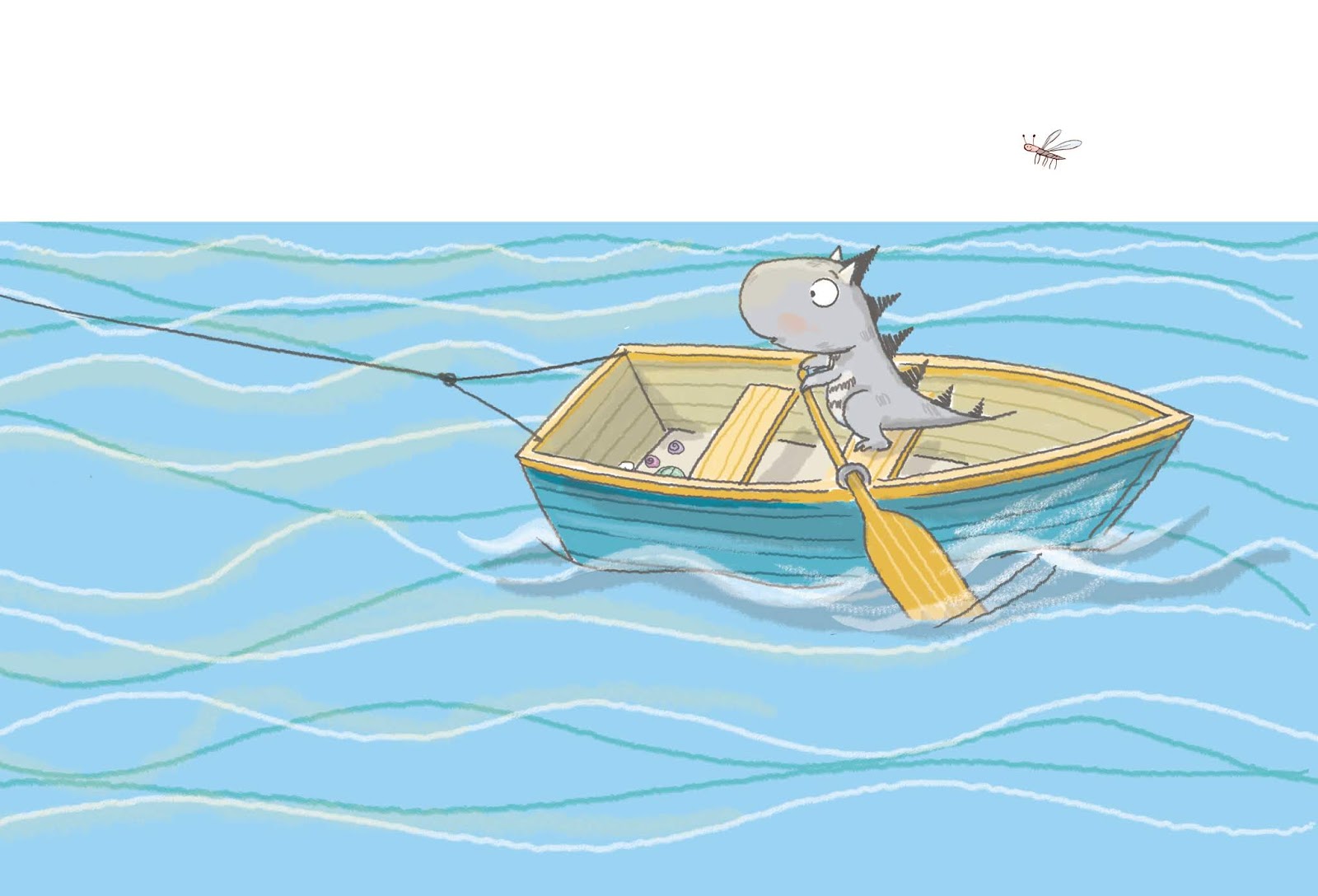
Excerpt from Roo the Roaring Dinosaur: Best Playday Ever!
by David Bedford, illustrated by Mandy Stanley (UK: Simon & Schuster, 2016)
Excerpt from The Journey by Francesca Sanna (UK: Flying Eye Books, 2016)
Excerpt from The Crocodile Who Didn't Like Water
by Gemma Merino (UK: Macmillan, 2013)
Close up from A River by Marc Martin (UK: Templar, 2016)
Close up from There is a Tribe of Kids by Lane Smith (UK: Two Hoots, 2016)
If you have any thoughts on illustrating water, or know of any great illustration examples, do share. Thanks!
 Paeony Lewis