Last week on Thursday, 11 February it was National Inventors' Day.
Who knew? The reason I found out is because Eileen, an Emmy Award-winner, professional ham and YouTuber at KidTime Storytime, contacted me to ask if she could do a new read-aloud of my book THE CRAYON MAN in her signature style with . . . puppets!
When I saw her videos, I couldn't resist. They are hilarious!
Since the book's publication, National Crayon Day on 31 March has been a great hook to promote it, but this got me wondering: what other 'days' are there even out there? As an experiment, I decided to investigate what occasions fellow Picture Book Denners could use to get the word out about their latest or upcoming picture books. How can we engage with new, unexpected audiences for our writing and illustrating through this kind of lateral thinking?
Of course, in true nonfiction writer style, I soon got sucked down the rabbit hole and began imagining all kinds of new books I could write based on some of these cool themes . . .
February 11 ... 'Day'
There is no end to how creative you can be! I mean . . . 'Don't Cry Over Spilled Milk Day'? 'National Make a Friend Day . . ', 'Cow Appreciation Day', and even 'National Lollipop Day'.
Celebrations are an important part of most cultures' yearly calendars.
We All Celebrate! by Chitra Soundar and Jenny Bloomfield
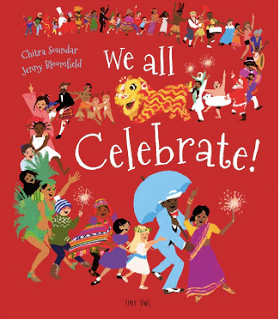
In their book, We All Celebrate!, Jenny Bloomfield and Chitra Soundar highlight celebrations from around the world grouped by season. Filled with colour, joy and new customs and traditions for young readers to learn about and discover, it is easy to engage with each one on its featured celebration day. The all-encompassing theme inspires and encourages young readers to connect with cultural holidays around the world.
Celebrate it also on World Day for Cultural Diversity on 21 May.
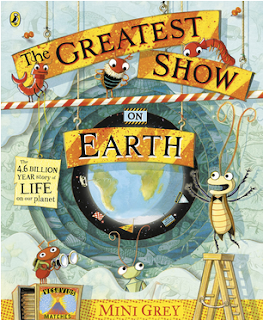
The Greatest Show on Earth by Mini Grey
The
Greatest Show on Earth by Mini Grey, which will be published
in April, raises the curtain on the 4.6 million year story of Planet Earth. This sumptuous feast of a book is narrated by a friendly troop of insects who put on the show of the evolution of life on Earth – a whistle-stop
tour from the birth of Earth, to the age of bacteria, the era of dinosaurs . .
. to present day.
Stop the Clock! by Pippa Goodhart and Maria Christania
Stop the Clock! by Pippa Goodhart and Maria
Christania, also published in April, tells the story of a boy who stops the clocks and goes
back in time to revisit a very busy and rushed journey to school. This poignant story reminds us to slow down,
take a breath and notice the small details in our busy everyday lives, and even to take time to paint them.
Celebrate it on World Sauntering Day on 19 June.
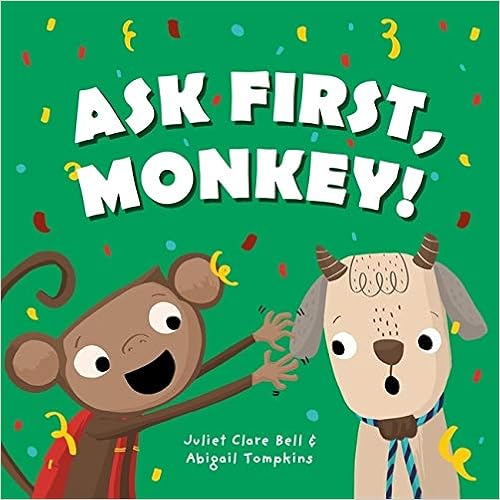
Ask First, Monkey! by Julie Clare Bell and Abigail Tompkins
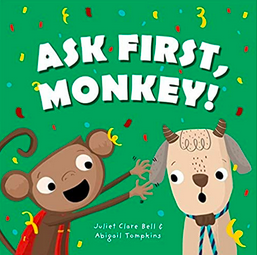
In Ask First, Monkey!, illustrated by Abigail Tompkins,Juliet Clare Bell tackles an important subject through story. Monkey is the best tickler in the world, ever; even his
mum says so. And there's nothing he loves more than tickling ALL his friends at
playtime! But what happens if some of his friends don't want to be tickled? This humorous picture book shows young children what consent is, how to consider others' feelings with respect and why it's so
important. It empowers young readers to realize that a reason for 'no' is never needed - it just needs to be respected.
Celebrate it on International Day of Consent on 30 November.
Tiptoe Tiger by Jane Clarke and Britta Teckentrup
For every imaginative
child still bouncing off the walls at the end of the day, Tiptoe Tiger by Jane Clarke and Britta Teckentrup is the perfect bedtime antidote. The interactive storytelling invites children to tiptoe round the jungle like the little tiger cub – or else scare away the beautiful butterflies and hooting owls – and to watch out for Snappy Crocodile! When at last it's bedtime, sleepy eyes will already be closing, whispering 'Night, night', just like Tiptoe Tiger.
Celebrate it on Pyjamarama Day on 13 May to promote bedtime stories for all, or even on International Tiger Day on 29 July.
Sing Like a Whale by Moira Butterfield and Gwen Millward
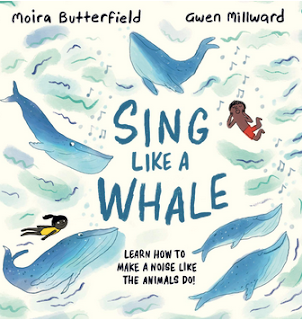
If you read Sing Like a Whale: Learn How to Make a
Noise Like the Animals Do! by Moira Butterfield and Gwen Millward, you will learn how to hoot like an owl, howl like a wolf and sing like a whale. Wow! Readers meet 12 animals from around the world and discover the sounds they make, and why – because animals, just like people, need to get their message and feelings across.
Fabulous Frankie by Simon James Green and Garry Parsons
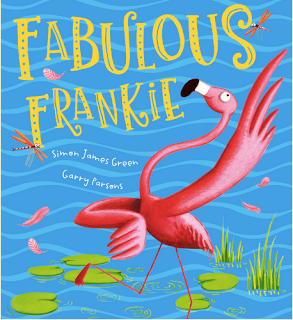
The hero in Fabulous Frankie by Simon James Green and Garry Parsons is a flamingo who just wants to be fabulous. But how? He's literally surrounded by so
many fabulous flamingos, how on
earth can he stand out from the crowd? Frankie's friends help
him to discover the most important thing of all: the best way to be fabulous
is to be YOU!
Celebrate it on International Being You Day on 22 May.
Artwork for International Book Giving Day by Viviane Schwarz
Will you be a book fairy or book ninja and leave a trail of enticing books around your neighbourhood for kids to pick up and discover? Along the school run, the dentist's waiting room, on the swings, on the walk to the library . . . You can tuck your bookmarks and bookplates inside. Join in the fun!
Natascha is the author of the award-winning The Crayon Man: The True Story of the Invention of Crayola Crayons,
illustrated by Steven Salerno, winner of the Irma Black Award for
Excellence in Children's Books, and selected as a best STEM Book 2020.
Editor of numerous prize-winning books, she runsBlue Elephant Storyshaping,
an editing, coaching and mentoring service aimed at empowering
writers and illustrators to fine-tune their work pre-submission, and is the Editorial Director for Five Quills. She is Co-Regional
Advisor (Co-Chair) of SCBWI British Isles. Find her at www.nataschabiebow.com
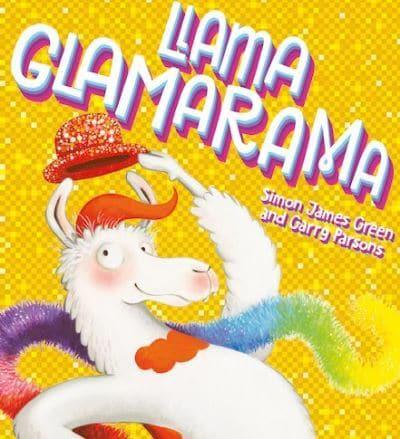
Llama Glamorama (Simon James Green and Garry Parsons, Scholastic, 2020)
Back in the 2016 post I looked at about thirty picture books which were great for encouraging empathy in young children, but what I
didn’t find was a single fictional picture book (looking like a typical picture
book) that specifically looked at consent. There were lots of recommendations from
other people in the comments about excellent picture books encouraging empathy
but the only ones about consent were very educational and formal-looking. The
final comment was from my agent: ‘Let’s discuss’. And we did (I was already plotting and scribbling).
Cut to four years later, and ASK FIRST, MONKEY! illustrated
by Abigail Tompkins and published by Jessica Kingsley is here. It’s a book I was
extremely keen to write (because I couldn’t find what I was looking for) but
also extremely nervous. I’d love to hear from other writers and illustrators
who are trying to create, or have created, picture books on tricky issues with
the issues you faced, but in case it’s of help to anyone, here are the some of
the issues I tried to grapple with…
ANIMALS AS CHARACTERS
Clare Helen Welsh posted here just last week about using animals as characters in picture books. It reminded me that this is my only
published book to date that uses animals –and it’s for a very specific reason.
Clare’s last point about using animals is that reason: safe spaces. Using
animals as characters creates a little bit of distance for the child reader so
that we can tackle tricky subjects in a gentler way.
(c) Juliet Clare Bell and Abigail Tompkins (Jessica Kingsley Publishing, 2020)
and whilst some like Monkey's tickles...
others don't:
(c) Juliet Clare Bell and Abigail Tompkins (Jessica Kingsley Publishing, 2020)
There are wonderful examples of using animals as characters, including one of my
favourites
Debi Gliori’s beautiful No Matter What about love and death.
(c) Debi Gliori
This doesn’t mean that we should always shy away from
tackling big issues with human characters. In fact, I very deliberately used
human characters in a book about death and dying (Benny's Hat, illustrated by Dave Gray)
(c) Juliet Clare Bell and Dave Gray
but for the subject of consent, I knew I wanted to use
animals and I was really inspired by Ed Vere and his books, like Grumpy Frog:
(c) Ed Vere
and others in that style, like Morag Hood's I Am Bat:
(c) Morag Hood
and Steve Antony's Please Mr Panda:
(c) Steve Antony
HUMOUR
Who is your book
aimed at? If you’re genuinely trying to get a message across to a specific
audience, it’s really important to honour that audience and create something
that will appeal to them (and not just the people who will be reading the book
to them). If there’s a really important point you want to get across, and you
can do it with humour and compassion, a child may be more likely to take on
board that message. If you're writing with a specific audience in mind, it doesn't mean that the book is not for other readers, too, but it really helps you focus on the best style for the story.
In ASK FIRST, MONKEY! I was aiming the story at children who
have not yet grasped, or not quite grasped, the concept of boundaries and consent
(Monkey in this story). I wanted for these young people to find Monkey funny and relatable –and not to be judging him. Consent needs to be taught and Monkey hadn't been taught. He's still going to have fun after he starts practising consent -and so will the reader. And the fun will not be at anyone else's expense. I really hope that by using humour,
young children will learn alongside Monkey and recognise themselves when he
gets it wrong and not feel shamed by their own actions but see a new way of
behaving.
SIMPLICITY
I love picture books that manage to do things apparently
simply. So often, they’re by author-illustrators
like David McKee's classic, Not Now, Bernard
(c) David McKee
and of course Ed Vere, Morag Hood, Steve Antony, above, and Mo Willems, etc.
I was really keen from the start for the book to be speech
only. This makes it easy to act out (at school or at home), you get even more
of a sense of character, perhaps, and it’s simple, with fewer words. Dan Santat pulls it off brilliantly with his The Cookie Fiasco:
(c) Dan Santat
(you can watch it being acted out with all the voices, here)
But there’s a certain amount of pride involved in letting go
of what you think would be funny and clever, versus what you think is right for
the story. My original name for the book was
Tickletastic Funky McMonkey Does Not Want An Ice Cream!
I loved Don’t Let The Pigeon Drive The Bus
(c) Mo Willems
It was a really fun and funny title and I wanted my book to be fun and funny, and what
better way than a funny, long title?
Well, clearly there was
a better way. The ice cream element of the story was dropped very quickly after
my agent, James Catchpole, thought it wasn’t relevant enough (I was
disappointed for a few days but he had a good point). Funky was dropped when
the publisher pointed out that Funky means smelly in American! McMonkey, well
that was too similar to a fast food chain, it turned out… and so on. I even
called one draft Tickles, Pies and Spinny Surprise (though the story changed
again after that)... It took a long time to get to it simply being called Ask
First, Monkey! It was simple and to the point but I fought against it (mostly with myself)–because of
pride. Wasn’t that too obvious? Too in your face? Too preachy? Not funny?
Fortunately other people who know the business better than I do were there to
do their job. This book came from a very strong desire to help young children
who don’t yet get boundaries and consent, get it, and to grow into adults who get
it. And that can mean taking a strong dose of getting over yourself to get it
into the hands of those you really
want it to get into the hands of.
Launching a book during summer 2020 is a strange (and often
deflating) thing as many writers and illustrators know. I was looking forward
to going into schools and doing lots of sessions with animal puppets (and
singing?!) to look at consent and boundaries in a fun, and safe, way. There
will be a song eventually but it’s been put back by a few months because it’s
hard to travel and work with the singer-songwriter at the moment, which was
disappointing, but it’s still going to happen. And I still hope to do some events with Abigail Tompkins, the illustrator who captured the expressions that were so critical to a speech only book so well. Consent is a subject very close
to my heart and we’ll get there with all the accompanying visits/songs/events
eventually.
But it’s not all bad –my daughter and her friend have been
able to make a stop motion animation of the story, using toys we found on
holiday in Orkney. Here’s the fruit of their labours:
If you're having trouble accessing the video, please clink on this link:
The book was written before the Me Too movement, but picked
up by a publisher after. With the massive and very welcome emphasis on consent
in the past few years, this means that there are now a few other picture books
on consent either just coming out or soon to be out, which I’m very much
looking forward to reading.
Which picture books do you think work really well
for dealing directly with a tricky topic? Please let us know in the comments
section. Many thanks, Clare.
Juliet Clare Bell is a children’s author of more than thirty
books already out or in press. In a former life (before children) she was a
research developmental psychologist.
“Even if the sentence is light, hopefully this will wake people up,” she said. “I want the judge to know that he ignited a tiny fire. If anything, this is a reason for all of us to speak even louder.”
I’m going out on a limb a bit today. I will bring it back to picture books at the end, because
"Reading fiction... gives us the ability to feel empathy for people we've never met, living lives we couldn't possibly experience for ourselves, because the book puts us inside the character's skin," Ann Patchett
but I want to talk about something I’ve been thinking about a lot this week: the powerful impact statement written and read out by a woman at the sentencing hearing for a young man in the US who sexually assaulted her. Found guilty of three serious offences and never admitting his guilt, the perpetrator was given a six-month sentence.
This is my attempt at speaking even louder, bearing in mind that this is a picture book site…
The story surrounding this case has really struck a chord with me. There were definitely some similarities between the woman’s story and my own. I too was subjected to “twenty minutes of action” (as the father referred to his son’s behaviour in the current case) which also turned my whole world upside down; I was rescued by two strangers who chased after and caught/helped the police catch the perpetrator even before I was picked up and taken off to The Rape Suite for a night of invasive examinations, blood tests, injections and endless questioning. And my attacker also claimed not to have any recollection of the incident (having been high on drugs). But the similarities end there.
People of my age can probably remember the Chris Morris Brass Eye black comedy sketch about ‘Good Aids’ (those who contracted HIV through infected blood transfusions) and ‘Bad Aids’ (from homosexual sex). Well, so it seems that for some people there’s ‘Good Rape/Assault’ and ‘Bad Rape/Assault’. ‘Good’ involves a stranger, the victim wearing dowdy clothes and having drunk no alcohol and taken no drugs. Oh, and definitely not being a prostitute. ‘Bad’, on the other hand, involves a woman having drunk alcohol/taken drugs, knowing or having at least met the perpetrator, the woman wearing ‘provocative’ clothes, and/or quite possibly, being sexual promiscuous or even a prostitute. But both the ‘good’ and the ‘bad’ involve a man raping/assaulting a woman (or man)...
My experience definitely fell into the ‘good’ category. Even whilst I was in shock and being examined by the police doctor that night, I was aware of the unfairness of the system as the doctor reassured me that it was a very good thing –as long as the tests backed up my statement, of course- as I’d not drunk any alcohol or taken any drugs. And I’d clearly been wearing dowdy clothes (including my great aunt’s unfashionable, but warm, coat) as I walked home –I could see they believed I hadn’t been ‘asking for it’. “Most of the women I examine are prostitutes,” said the doctor, conspiratorially. Even then, I felt the unfairness of being treated with a respect that other women probably weren’t getting.
Why should it have mattered if I had been drinking? (I might well have drunk –I’d been at a social event, but for some reason I can’t remember I happen not to have drunk anything that night.) Why should it have changed anything if I’d been dressed up? And why should someone attacking me have been less serious if I had been a prostitute?
Although my attacker entered a plea of not guilty whilst on remand (because he claimed he couldn’t remember the event), he changed his plea on the day of the court case. As a result, the judge reduced his sentence (for not putting me through the trauma of a court case -and also because of the defendant’s own traumatic childhood), from about nine years, to five. This is the judge for whom the police had a nickname because he was so lenient (they warned me in court when they saw who it was that the sentence would probably be much shorter than they’d predicted). So a substantially reduced sentence by a judge deemed to be lenient, of five years -compared with six months in the Stanford case. There were no family members arguing the case for my attacker (on the contrary, his step family came to the initial hearing and told my then boyfriend that he should ‘do him over’ for them, and at the final hearing, they clapped when he was sentenced), and he wasn't at university or a strong athlete (he was of no fixed abode and not athletic).
I could talk about the difference in our cases in terms of closure for me, and lack of closure for the woman in the current case –where I wrote to my perpetrator in prison (as did my brother) and he wrote back absolutely accepting full responsibility, saying ‘I was nothing more than an animal and I should have been put down for what I did to you’ and that he’d never cried till he read my letter, and how he’d since decided to take anger management courses in prison even though it meant he’d stay in longer; and how he’d requested to go to a half-way house on his release so he would be supervised. And that he promised that he’d never come back to the city in which he had attacked me so that I could be confident I would never bump into him. This, compared with the current case where the attacker has not accepted any guilt. The turn of events after the attack for me, down to my treatment by the police, the judge, even the defence barrister, as well as the perpetrator admitting full responsibility and being extremely remorseful, made it all much easier to move on from.
But that’s not what this post is about.
I wanted to say something about consent, which is what so much of this boils down to. No one was ever going to argue over whether I had consented –I was followed home by a stranger and he was caught literally red-handed (with mostly his own blood from the weapon he’d been holding). I had been asked loads of questions about my sexual history but as they’d established this was never going to be a case of whether I’d given consent or not, I’d not felt worried about those questions being used against me in court. But how grim that the same answers might have been used against another woman where consent could be questioned.
I know many women who have been sexually assaulted by men –almost all of them men that they knew –boyfriends, acquaintances, family members. As far as I know, I am the only one who actually went to the police –out of all the people I know who have been assaulted. And as well as fear, this has a lot to do with knowing how incredibly hard it is to get a conviction for someone when lack of consent may be questioned.
So, consent. There’s a great video used by Thames Valley police about consent
But this is not a video to show to young children. So what can we do as picture book authors and illustrators to help children understand about consent and taking responsibility, and empathy from a young age? (And I’m not saying that the man in question in the current case would have done anything differently had he read certain picture books as a child –I don’t know the man and I’m not going to comment on his family here.)
Research is clear that reading stories helps children become more empathic.
"Fiction is not just a simulator of a social experience, it is a social experience," writes psychologist David Comer Kidd, whose paper, Reading Literary Fiction Improves Theory of Mind was published in Science in 2013.
And again:
"Reading fiction... gives us the ability to feel empathy for people we've never met, living lives we couldn't possibly experience for ourselves, because the book puts us inside the character's skin," Ann Patchett.
We need picture books with diverse characters so that all people can see themselves in some books and all people can get a sense of how it might be to be someone else in other books.
So Much (c) Trish Cooke and Helen Oxenbury
Siddarth and Rinki (c) Addy Farmer and Karin Littlewood
We need strong female characters
That Rabbit Belongs to Emily Brown (c) Cressida Cowell and Neal Layton
(A video showing a reading of Emily Brown...)
The Kite Princess (c) Juliet Clare Bell and Laura-Kate Chapman
and strong male characters
Oliver Who Was Small But Mighty (c) Mara Bergman and Nick Maland
including ones who do not conform to male stereotypes
Marshall Armstrong is New to Our School (c) David Mackintosh
Morris Micklewhite and the Tangerine Dress (c) Christine Baldacchino and Isabelle Malenfant
We need good picture books about friendship and compassion;
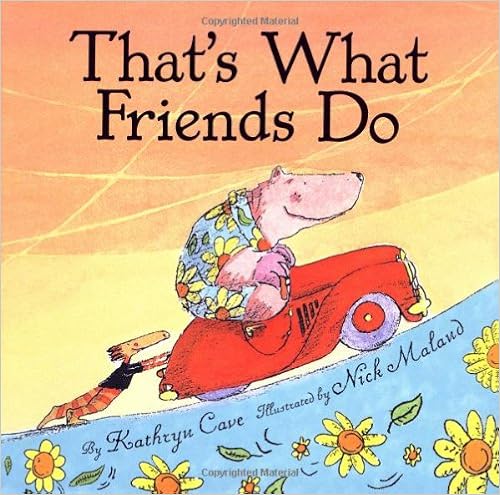
That's What Friends Do (c) Kathryn Cave and Nick Maland
(and a video reading of it)
about compromise
Best Friends or Not? (c) Paeony Lewis and Gaby Hansen
Simple kindness
Extra Yarn (c) Mac Barnett and Jon Klassen
Charlie is My Darling (c) Malachy Doyle and Stephen Lambert
How Kind! (c) Mary Murphy
(and a fab reading of How Kind!)
about unconditional love
No Matter What (c) Debi Gliori
and about accepting people for who they are.
Dandylion (c) Lizzie Finlay
We need picture books with LGBT characters
King and King (c) Linda de Haan and Stern Nijland
And Tango Makes Three (c) Justin Richardson, Peter Parnell and Henry Cole
We need books with children with disabilities that aren’t about their disabilities
The Unstoppable Maggie McGee (c) Juliet Clare Bell and Dave Gray
We need picture books about bullies and people who are being bullied; standing up to bullies and taking responsibility for your own bad behaviour towards other people...
Little Rabbit Foo Foo (c) Michael Rosen and Arthur Robins
(and a video of it)
Something Else (c) Kathryn Cave and Chris Riddell
(and a video of it)
and about doing the right thing even when it’s not the easy option
Those Shoes (c) Maribeth Boelts and Noah Z Jones
and about never taking advantage of your greater physical strength to get something from someone without their consent or permission...
only I can't think of a book that does this. Does anyone know of one I can add in here? Please let me know in the comments, below...
And we need books that show how even the small actions of one person can have big consequences for another person, good or bad (humorous over the top books that make us think about cause and effect are really valuable)...
Mouse Creeps (c) Peter Harris and Reg Cartwright
If You Give a Mouse a Cookie (c) Laura Joffe Numeroff and Felicia Bond
There Was an Old Dragon Who Swallowed a Knight (c) Penny Parker Klosterman and Ben Mantle
There Was a Wee Lassie Who Swallowed a Midgie (c) Rebecca Colby and Kate McLelland
And we need books that show the folly of a misguided sense of entitlement.
Louis I King of Sheep (c) Olivier Tallac
The Tiger Who Would be King (c) James Thurber and Jodhee Yoon
We need books that show children that teasing that is not actively being enjoyed by the subject of the teasing is neither funny nor ok –whether it’s coming from adults or other children. It is categorically not funny if the person in question does not find it funny. This is a really important lesson for understanding consent (can anyone think of a picture book that touches on this?). And we need books about inspirational people. In my author visits for Two Brothers and a Chocolate Factory: the Remarkable Story of Richard and George Cadbury (illustrated by Jess Mikhail), we look at what George and Richard did to improve the lives of other people in the community and we discuss what we can do, individually and collectively, to have a positive impact on the people around us.
Two Brothers and a Chocolate Factory: The Remarkable Story of Richard and George Cadbury (c) Juliet Clare Bell and Jess Mikhail.
-but let's keep making more. Moreover, we need for them to be read by people who may not be picking up these messages from their own environments. So we need our libraries and our librarians and our enthusiastic teachers and educators.
Books alone aren’t going to stop all terrible things happening to people at the hands of other people. But we can play our small part in helping children become more empathic, have more personal responsibility and understand that no means no.
Which picture books would you recommend for encouraging empathy/compassion/respect in the reader? Please leave any recommended books in the comments section below.