Showing posts with label picture book author. Show all posts

Sunday, 23 August 2015

What’s in it for the Adults? by Rebecca Colby, Guest Blogger


Hands up if you’ve ever done what I’ve done and hidden your child’s favourite picture book? This is the book they ask you to read over and over (and over!) to the point where you can’t bear to ever read it again. While I can’t see your hands, I’m willing to bet I’m not alone.

I admit this isn’t a kind thing to do, but neither is inflicting the same story on an adult every night for months on end—especially one that doesn’t appeal to them. And that is the trick to writing a good picture book—ensuring your book holds strong appeal for both children and adults.

So what elements help guarantee an adult reader will want to read your book more than once? In other words, what’s in it for the adults?

Humour
Regardless of age, everyone loves a good laugh. But humour is subjective, and certainly some forms of humour are more readily understood by an adult audience. One, in particular, is satire. Dr. Seuss did satire so well. 


As a young child I loved his book, The Lorax, for its nonsense words and fun rhymes. It never failed to bring a smile to my face and it was the one book I kept renewing from the library (and consequently asking my mother to read over and over).

However, it wasn’t until I reread this book as an adult that I appreciated Seuss’ wit and the satirical poke at environmental issues. Okay, so it isn’t laugh-out-loud funny, but there is a black humour to it that underlies a very important message, and as an adult this satirical humour makes me admire and appreciate Seuss’ work even more than I did as a child.

Humour can also come from intertextuality. This is when the author or illustrator makes references to other texts or images outside their book. For example in Margie Palatini and Guy Francis’ Mary had a Little Ham, the main character Stanley Snoutowski is a pig who seeks fame and fortune on Broadway. 


On one of the spreads, there are references to the shows Stanley performs in, like South Pigcific, The Pig and I, Pigmalion, Oinklahoma, The Pork Loin King, and Hamlet. Stanley even meets Broadway producers Hoggers and Hammerswine. While humorous for adults, these references often go over children’s heads.  

Symbolism
Here again, symbolism can also require readers to make connections to other books, artwork, etc. Anthony Browne’s Willy the Dreamer is a perfect example. 


As Willy dreams of being a film star, a sumo wrestler, a ballet dancer, etc, children look for the many ways Browne has seamlessly incorporated symbolic bananas into the illustrations. Adults may be looking for this also, but at the same time they will note visual references and symbols that children may not have been exposed to yet, including symbols and references to the work of Matisse, Henri Rousseau and Salvador Dali.

Sophisticated text
Picture books are aimed at our youngest of child audiences, but their language is anything but simple. In fact, picture books are often more sophisticated than early chapter books as they are intended to be read by fluent readers, rather than beginning readers.

Sophisticated text can be aimed at children as a means of extending their vocabulary, or to introduce them to literary devices. Or it can be employed to add something extra for the adults.


Here’s an example from Mini Grey’s book,The Adventures of the Dish and the Spoon, where she uses sophisticated language that could be interpreted both literally by children and figuratively by adults.

But the dish was broken and so was I. I let them lock me up and turned away from the moon.”

The dish is literally broken, and children can see that the dish is in pieces. Adults, however, are able to take further meaning from this sentence. They understand that the dish and the spoon have been defeated by life.

Another Margie Palatini book, Bad Boys, illustrated by Henry Cole, uses sophisticated language in the form of word play. 


Two wolves disguised as sheep try to fool three ewes into letting them join the flock with a view to eating them. Margie uses appropriate sophisticated language that only the adult audience will understand, but in a context that won’t detract from the story or confuse children. Some examples include:

On the lam.
Fleece the flock.
Pull the wool over their eyes.
The two were in clover.

Interplay of text and illustrations
This is a strong feature of nearly all picture books, and contributes to them working on more than one level. More often than not, the illustrations portray information that is not provided in the text. And because adults are better able to analyse the interaction between the text and illustrations, it’s an opportunity to add another layer to a book just for the adult audience.  

A relatable one for parents is Boss Baby by Marla Frazee. 


At one point, the text states that “He [Boss Baby] conducted meetings. Lots and lots and lots of meetings, many in the middle of the night.” What we wouldn’t get from the text without the illustrations is that the baby is actually throwing lots and lots and lots of tantrums, flanked by both parents as they attend to his needs of feedings, playtime, and nappy changes.

And let’s not forget the contradictory interplay of text and illustrations where the text tells one story, and the illustrations tell another diametrically opposed story. A great example is Bottomley Cattery by Peter Harris and Doffy Weir. 


Bottomley isn’t happy about being left at the cattery while his human family go on holiday, but he tries to make the best of it. Or so he says. He claims to have made lots of friends and not to have caused a fuss. But the illustrations, of course, paint a very different picture. 

One more book I’d like to mention here is Battle Bunny by Jon Scieszka, Mac Barnett and Matthew Myers. 


It’s two books in one, with the second story drawn and written over the top of the first. The main character, Alex, is given a book called Birthday Bunny, which he soon defaces and rewrites. In the new story, Battle Bunny is unleashing an evil plan which only Alex can stop. This new story is hand-written and hand-drawn in pencil over the top of the original. The interplay between the two texts and the two sets of illustrations makes for a brilliant concept that most adults will appreciate far more than children. Not to mention the fact that it is nearly impossible to read this book aloud. You end up reading only one story at a time, whereas by reading it silently, you can read the stories simultaneously.  

Strong emotional pull
Whatever you do, make your reader feel something! Engage them emotionally, be it through humour, joy, fear, or even sadness. Readers are less apt to forget a book—or want to put it down—if it has pulled at their heart strings or touched their inner core. Adults are no different this way. I may hide my children’s books on occasion, but I’d never hide Debi Gliori’s book, No Matter What


And that’s because it speaks to my soul. It has a powerful message about unconditional, never-ending love that elicits a strong feeling from me. Admittedly, that experience is one of tearing up—but that’s exactly why I pick it up as an adult over and over again. I want to relive that same powerful experience. 

Challenge readers’ expectations
There are lots of ways to do this. Two I’m going to mention are twist endings and using non-traditional story structures. Do you want to keep your adult reader engaged? Then surprise them. Keep them guessing the outcome of your story until the end. Children enjoy predictability to a certain extent but even they will probably prefer a book that surprises them with an unexpected ending.

A story that does just that is Waking Beauty by Leah Wilcox and Lydia Monks. 


It’s a fractured fairy tale and we all know roughly how the story is supposed to pan out--with the prince waking his beauty with a kiss. But although the prince gets his kiss, the ending is anything but predictable. (And because I want you to be surprised when you read it, I’m not going to spoil the ending here.)

Another way to challenge reader’s expectations is to give them a story structure they’ve not seen before. Most picture book writing advice recommends the use of the standard story structure with a beginning, middle and end, but as with so many writing rules, once you know them, you can start breaking them. And here are two that break them so well:

The Day the Crayons Quit by Drew Daywalt and Oliver Jeffers (structured as a series of letters from crayons)


and Shark vs Train by Chris Barton and Tom Lichtenheld (structured as a series of competitions between a shark and a train without a decisive winner).


Before I wrap up, I want to thank the Picture Book Den for hosting me today! It’s been fun finding examples to share. And if there are any examples you’d like to share, or elements I’ve missed (I’m sure there are plenty!), please feel to tell me about them in the comments.

The bottom line is great picture books hold universal appeal. Make sure your own books offer something for everyone, regardless of their age. And bear in mind, your books need to hold a reader’s attention over repeated readings. Like this one…

Oops! That’s strange. I seem to have mislaid my favourite picture book. I just had it out last night reading it to my kids a few times. I was going to tell you about it and explain why it’s my favourite and perhaps read it to my children again tonight but it’s not where I normally keep it on the bookshelf. I wonder if they’ve seen it?!


Rebecca is a picture book author and poet. Her books include: It’s Raining Bats & Frogs (Feiwel & Friends/Macmillan, 2015) and There was a Wee Lassie who Swallowed a Midgie (Floris Picture Kelpies, 2014).


Before writing for children, Rebecca inspected tights, taught English in Taiwan, worked for a Russian comedian and travelled the world as a tour director. Learn more about Rebecca at www.rebeccacolbybooks.com or follow her on Twitter at @amscribbler.


Friday, 24 July 2015

Picture Book People - 1: Laurence Anholt


This is the first in an occasional series of blogs about their lives by some of the people whose work we here at the Den very much like and admire.  We're delighted to welcome super-talented Laurence Anholt, whose work has been published all over the globe. He's written us a fascinating piece about his life story, which is one of great creativity and commitment, very influenced by fine art through the years. He's also sharing with us his surprising and intriguing new direction. 

Here he is! Laurence Anholt with hat - Copyright: Julia Mear

Im generally a cheerful person so Id like to think I didnt make too much fuss when I was born on 4th August 1959 in Barnet. In theory that makes me a Norf Lundnerbut its a bit more complicated than that because my dad was a Dutchman with family roots stretching all the way back to Persia.
My siblings and I spent our early years in Holland and we went to little Dutch schools. Sadly I lost the language but what I retained is that celebrated Dutch liberalism along with a passion for Dutch art, especially van Gogh.


Me in my little Dutch Montessori School aged about 5

Our family returned to the UK in time for part two of my education which became increasingly shambolic. I went to a mixed outward bound school where - so it seemed to me - you could choose whether you went to lessons or notI chose not! I left school at 16 with almost no qualifications and a general sense of bewilderment.

My father had many good qualities but he was haunted by some devastating wartime experiences. To give some idea, he was amongst the group that liberated Bergen Belsen - not something you get over in a hurry. Perhaps it was understandable that he wasnt a great mentor; but growing boys need male mentors and when they dont have them they tend to drift into little gangs of other disaffected boys - I must admit I went a little wild in my teenage years and there are gaps in my CV where even Im not sure what happened! I travelled; I worked in factories and kitchens and I had many fine adventures along the way. My most bizarre job was working as a bricky on a model village in Southern France. I laid tiny bricks and I think the wages were minuscule too! My main interests had always been English and Art and eventually I stumbled into the Foundation Course at Epsom School of Art where I grew my hair and threw some paint around.

At 19 I was passing through Oxford when I met a beautiful Irish girl, who became my best friend and partner for the next 35 years. Cathy was one of eight siblings; a student nurse who dreamed of becoming an artist. We had heard about the legendary Degree course at Falmouth School of Art, so the two of us assembled portfolios and hitchhiked to Cornwall. This was the late 1970s and there were only 175 students in that hothouse of creativity. It was an amazing opportunity for self-discovery.

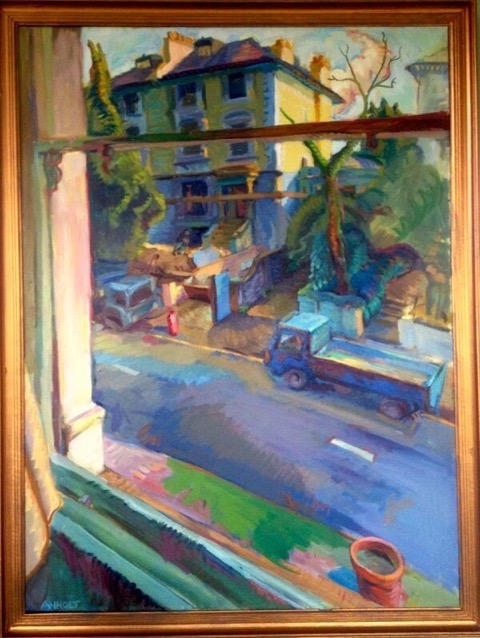
When we qualified we moved to London to take our Masters. Cathy went to the Royal College of Art and I studied Fine Art for three years in the scruffy splendour of the Royal Academy. 
'Houses on Haverstock Hill' - an example of the paintings I was doing at the Royal Academy.

We had not a penny between us, but I discovered a knack for carpentry and spent weekends and holidays building kitchens all over London. Around this time, my parents had settled in Dorset and whenever we visited, Cathy and I felt rejuvenated by the woods and the hills. It was the start of a love affair with the Westcountry - the Blue Lias of the Jurassic Coast gets right under your fingernails!

When our first daughter, Claire was born in 1984 I was over the moon. But I wanted to be a different kind of dad and began to think of ways in which I could work from home. Thats when we started looking at those lovely things called childrens books. Perhaps this could be a way of combining my passions - writing, drawing and inspiring kids.


My lovely wife Cathy with our daughter Claire, on Charmouth Beach.

At the time I was working as an art teacher and I entertained my class with stories about maverick characters such as Picasso, Cézanne and Matisse. This led me to write and illustrate Camille and the Sunflowers, a picture book about the friendship between Van Gogh and Camille Roulin, son of the famously bearded postmaster in Arles.


It was the first in what eventually became the Anholts Artists series published by Frances Lincoln in the UK and Barrons in the U.S. In the last 25 years my series has translated into many languages and sold several million copies around the world.


These books are a first introduction to great artists, seen from the perspective of a real child.  They are fascinating to work on and I have met many relatives and acquaintances of the artists, such as Sylvette David, Picassos iconic Girl With A Ponytail in the 1950s who has become a family friend.


Sylvette David by Picasso portrait. Copyright: collection of Sylvette David

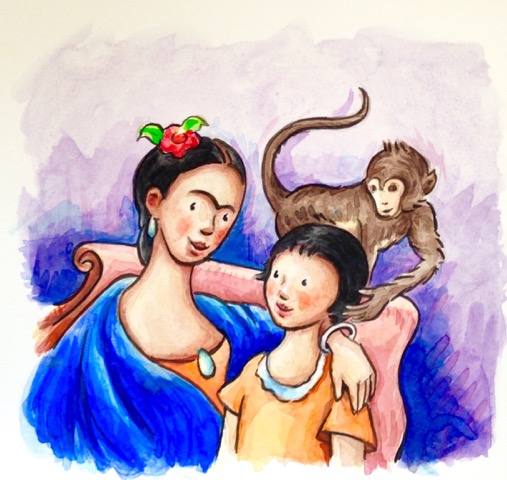
 Im currently putting the final touches to the tenth story in the series, about that great feminist icon, Frida Kahlo and another real child. My working title is Frida Kahlo and the Bravest Girl in the World.

Two watercolour illustrations of Frida Kahlo. Copyright: Laurence Anholt. 

 In 1987 our beautiful twins, Tom and Maddy were born. Here they are face to face in their pram -


 And it was at this time that we discovered our Willy Wonka ticketin the countryside near Lyme Regis, we stumbled upon a rambling semi-derelict house with acres of tangled jungle, various crumbling outbuildings, a walled swimming pool filled with something resembling vegetable soup, and breathtaking views across the valley to the sea. The place was like a dream or a magical fairy tale (although the mortgage felt real enough!) Old Woodhouse had been long abandoned and it took years to put it straight - I lost count of the evenings I spent on the roof with a hammer, but for sixteen happy years this was our family home.

Making a living as an author or illustrator requires huge tenacity, but slowly our business grew. Weve always worked without an agent - negotiating directly with publishers and with the wonderful Society of Authors at our side. Being agentless wasnt a plan, weve just never made that connection, although its something I would consider for the future. One way or another, we were unbelievably fortunate to be working in the late 80s and early 90s. That was a Golden Time in childrens publishing, when the UK led the world with an astonishing range of imaginative picture books. It was possible to make a really good living by sitting in your studio, listening to Van Morrison and dreaming up weird and wonderful ideas for childrens stories. It felt like it would go on forever and barely a day went by without another Foreign Rights deal or an exciting offer from a publisher. Alongside my artist series I wrote the Seriously Silly Stories (illustrated by my good friend, Arthur Robins), Chimp and Zee and eventually more than 200 childrens titles, many illustrated by Cathy.


 Our books were translated into 30 or more languages and they won several big awards. Here I am with Arthur Robins receiving the Smarties Gold Award with Konnie Huq from Blue Peter and two authors called Julia Donaldson and J.K. Rowlingwhatever happened to them!


 I took part in book events in Indonesia, Singapore and all around the world. Once Cathy and I travelled to South Korea to launch a full-scale stage musical of my Van Gogh book.

The Korean stage musical of Camille and the sunflowers. Copyright: Laurence Anholt

 In those days, editors had the authority to accept a manuscript on the spot, but with the advent of Amazon and e-books, the threat to independent bookshops and the appalling cuts to public libraries, there has been an earthquake in childrens publishing. Now it feels as if publishing houses have erected forcefields around themselves armed by accountants! I know that many editors, authors and illustrators feel very sad about the commercialisation of this lovely industry and it must be horribly difficult to be starting out as an author or illustrator in 2015.

But back to that Golden timeIve always liked a little project and in 2005 I spotted a small shop for sale in Lyme Regis. Together with a group of friends, we constructed Chimp and Zee Bookshop by the Sea.

Chimp and Zee, Bookshop by the Sea. Copyright: Laurence Anholt


It was a little wonderland for children with a full-sized copper-leaved oak tree inside and a monkey (called Mumkey) who rode her bicycle endlessly around the window. This was the UKs first author-owned bookshop and it was even shortlisted for an HSBC Small Business Award. Chimp and Zee was a magical place, but what we liked less were the nuts and bolts of retail and when the UK fell into recession, we sold the shop and set Mumkey free!

I am embarrassingly proud of the kind, funny and courageous adults that our kids have become. Claire graduated from Cambridge and works at a senior level in the UN Secretariat in New York. She does amazing work with climate change, Human Rights, and campaigning against child soldiers. Her lovely French husband, Adrien works in Disaster Relief.

Claire and me 


Maddy is an actor, writer and radio presenter who has taken her one-woman show, Maddys Many Mouthsto the Edinburgh Fringe.

Maddy and me. There's a link to Maddy's website below. 

Tom is an artist working in Berlin and his gorgeous paintings sell as fast as he can produce them, in galleries in Germany, Denmark, Italy and America.

My son Tom. There's a link to Tom's website below. 

The downside of being a home-parent is how much you miss them when they are gone. The solution is usually a little project, and in recent years Cathy and I have restored another neglected gem of a house. This haven of peace and creativity has light-filled studios overlooking the shimmering Axe Estuary near Colyton in Devon. We have wildflower meadows and beehives and we feel incredibly blessed to live in this magical place.

At the bottom of the blog there's a link to an article about our renovation of Sunflower House. 


My mother, Joan Pickford, was a wise and wonderful woman who died too young. Joan was a teacher of English Literature, especially Hardy and Wordsworth and although she was a Christian, she was fascinated by Eastern philosophy. It must have influenced me because I became a member of the friendly Buddhist community in this area. If I had more pages I would gleefully expound on the benefits of mindfulness and meditation (such a wonderful tool for writing), but one central concept of Buddhism is that our thoughts become our reality - a person who thinks negative or prejudiced thoughts creates a dark claustrophobic world for themselves; conversely those who train themselves to be positive and open-hearted find the world opening around them. Life is challenging, but life is beautiful too. We are profoundly privileged to walk briefly on this extraordinary blue-green planet, revolving slowly in space.


A couple of years ago, something wonderful happened - Ive always been an avid reader of fiction and I cherish that hour before sleep when one can explore another country or another mind from the comfort of ones bed. Ive always longed to write full-length fiction and I decided to take a year out to write two novels: The Hypnotistand Love Letters. If picture books are hard, a novel is like building a house single-handed! But to my amazement, both books were accepted by the newly merged Penguin Random House. Its been an incredible privilege to work with the legendary publisher, Annie Eaton and editor, Ruth Knowles - their enthusiasm for my work has been heartwarming. So here I am at 55 launching on a new adventure as a novelist. The Hypnotist is about prejudice and tolerance - In essence I have transposed DickensGreat Expectations to the Deep South of America in 1963. My protagonist is a young black orphan making his way against the background of Segregation and the dreaded Ku Klux Klan; (sadly, more topical than ever.) Because Ive got a funny old brain, the book is a little stranger than a straightforward historical drama - all the events are seen through the very strange eyes of an outsider: an Irish hypnotist, Dr Jack Morrow, who has started work at a new university. Theres a slice of history, a sprinkle of magic realism and a twist of humour. The Hypnotist created a bit of a buzz at Bologna, although US publishers seem nervous of the subject matter! Im so excited about this project and Im already thinking about a third novelI do like a little project, you know! The Hypnotist will be published by Penguin Random House in March 2016.

The cover of The Hypnotist


If youd like to chat about bees, books or Buddhism say hello on the Twit 
@LaurenceAnholt

Visit the Anholt website: http://www.anholt.co.uk
Paintings by Catherine Anholt: http://www.catherineanholt.com
See our old shop herehttps://www.youtube.com/watch?v=1eEnIwFttD8
Maddy's site:  http://www.maddyanholt.com 


Catherine and Laurence Anholt in studio. Copyright: Alun Callender/Psychologies Magazine