
When crafting picture books, I’m always delighted when the end product looks seamless. All that agonizing over the details of story, character, plot, pacing, word and image choices, layout, design, format, typography and so much more is ready to be launched into the big wide world, bound into pages of promise.
 |
| All Are Welcome by Alexandra Penfold and Suzanne Kaufman |
Promise because there is something else that must now happen – when the book lands into the hands of young readers, it must connect.
For a book to deliver that magical, immersive, transportive reading experience that lingers and resonates, the picture book must become more than the sum of its parts, more than just the literal elements on the page. To do this, it needs something key – the reader.
Now, that delicately crafted balance between the words and pictures on the page (seamless, we hope) plays out to make something synergistic – because when the reader gets involved, the child creates the ‘more’.
 |
| "We share stories from the heart." From All Are Welcome by Alexandra Penfold and Suzanne Kaufman |
The reader is
tasked with actively encoding the words and the pictures, listening and
looking, making connections and filling in the gaps to make meaning.
To do this, authors and illustrators need to leave SPACE for the reader:
In the PICTURES
 |
| Rosie's Walk by Pat Hutchins is a classic example of where a visual narrative allows space for readers to participate and add to the story narrative. |
 |
| The minimal text tells one story, while the pictures tell another . . . |
 |
| . . . creating lots of humour! |
In the WORDS
 |
| Love by Matt de la Peña and Loren Long |
 | |||
| The open-ended, lyrical text allows young readers to imagine each moment and add to an individualized interpretation of what 'love' is: ". . . everything smells new, and it smells of life." In this instance, the illustrator depicts a boy sharing a hotdog with a man on a bench, but the reader might interpret these words in many different personal or imaginary ways. |
In the MESSAGE
 |
| Last Stop on Market Street by Matt de La Peña and Christian Robinson |
 | |||
| The boy in this story is going on a bus journey with his grandmother - where? The vivid details included in text and illustrations encourage the reader to join in in creating the meaning, in building up the sense of the characters and their community, and filling in the special relationship between CJ and Nana. |
 |
| Building on this, in the poignant final scene, CJ is glad to be with his community of familiar faces – the words & pictures allow space for readers to figure out where they are and why it matters without needing to be told in an overt message. |
Even in the FORMAT.
 |
| Where's Spot? by Eric Hill is a pre-school classic! |
 | ||||
| A lift-the flap guessing game format is delightful fun to share with the youngest readers and leaves lots of space for dialogue and for the reader to imagine possibilities while interacting with and adding to the story. |
 |
| Surprise! The SNAKE is in the clock, not Spot! |
HOW do authors
do this? (And how can you do it if you’d like to write amazing picture books?)
WELCOME the reader in
 |
| One Smart Fish by Chris Wormell |
 |
| This spread at the beginning of the book introduces the main character, one 'Smart Fish', who looks so ordinary - how could he be a hero? the reader might wonder. I wonder WHY he's amazing? The author invites the reader to engage with the story and welcomes them into the narrative to go on a journey together. |
Invite readers in to be part of and even engage in creating the story.
 |
| Winged Wonders: Solving the Monarch Migration Mystery by Meeg Pincus and Yas Imamura |
 |
| In this story, Pincus invites readers to participate in the question of who solved the age-old mystery of where the monarch butterflies go every year? In a series of spreads, the open-ended questions allow readers space to engage with the narrative, accumulating facts as they turn the pages to come to their own conclusion – more than the sum of its parts. |
 |
| A Bit Lost by Chris Haughton |
 |
| Squirrel is trying to help Owl find Mummy. In each sequence, Owl describes Mummy: "My mummy is VERY BIG. Like THIS!" The author allows space for the reader to be part of the story and imagine how Mummy might look with these attributes. The pictures also allow space for the reader to imagine both Mummy's appearance and guess what might come next. And because the reader is part of the narrative, when they turn the page to find . . . |
 |
| . . . a bear (!) it's instantly funny. The pictures here allow space for the reader to reconsider their guess and delight in the joke when Squirrel mistakenly asserts, "Here's your mummy!" - since young readers will know an Owl's mum looks nothing like this - but also readers will empathise with Owl's disappointment at still not being reunited with Mummy. |
Can you create an OPENING IN THE NARRATIVE where young readers can find meaning?
AVOID over describing: the delicate balance between words and pictures takes
craft to achieve – the story must stand on its own when read aloud, but also
leave space for the pictures and for young readers’ interpretation. The choice
of what to include is just as important as what to leave out. It may take some often-frustrating
tinkering.
 |
| Bob Goes Pop! by Marion Deuchars |
 |
| In this story that explores the theme of what makes a good artist, Bob is an artist who gets into a argument with a famous sculptor called Roy. Bob says Roy's art is just everyday objects except bigger. Roy bets Bob he couldn't even make a sculpture if he tried! In this scene, every time Bob creates a work of art, Roy's is seemingly better. The author allows space in the pictures for readers to look closely and intuit this. Bob's splodgy rough round the edges artwork gives an impression that it is less slick than Roy's, even through the text doesn't tell readers this. Looking closely at Bob's body language in the pictures also allows space for the reader to connect with Bob's emotions and understand how the main character's frustration is building until his desperation leads him to cheat. |
It is important to know the backstory of your narrative and your characters’ world and, above all, your character’s motivation, but then to choose carefully what you will include. Use specific, vivid details, but only share those that will give meaning to the story.
 |
| The Iridescence of Birds by Patricia MacLachlan and Hadley Hooper |
 |
| In this nonfiction picture book about the artist Henri Matisse, the author poses one long question - why do painters paint what they do? Carefully choosen details in the words and pictures on each spread illustrate vivid and specific everday experiences that influenced the artist to eventually produce his colourful collage artwork. The narrative is filled with spaces, where the reader must fill in the gaps to make the sum of the whole to arrive at the inspiring 'a-ha' moment at the end. |
Conversely, avoid
the pitfall of including too little information. If there isn’t enough context,
emotion, or details, readers have nothing to hold on to so they won’t be invested
enough in the story to add meaning. It's key to set up the action to arrive at a satisfying ending.
AVOID overstating
the story’s theme or message. This leaves no space for the reader! If the
author has done their job well, there is no need to tell readers what the
take-away is, because the plot and character’s emotional journey to overcome
the plot problem and navigate high stakes will serve to create a feeling and a take-away meaning
that the reader is able to intuit.
Invite the reader to
PREDICT what will come next
 |
| Neon Leon by Jane Clarke and Britta Teckentrup |
 |
| Neon Leon is a chameleon who doesn't fit in. Throughout the story, the author creates space for young readers to interact with the main character's actions and empathize with how he's feeling. In this spread, Neon can see something that might be a hint of something the same colour as him. Is this the answer he's been looking for? The text ends with an ellipses (ooh, I wonder...), which when combined with the page turn, adds space for the reader to engage and predict what might come next. |
OBSERVE the pictures for narrative clues that will advance the plot and
your characters’ motivation story arc.
 |
| If You Give a Mouse a Cookie by Laura Joffe Numeroff and Felicia Bond |
 |
| All day long, the boy has been following the mouse, making sure it has what it needs. The simple words underline a multi-layered visual narrative in which the mouse goes from one thing to the next, starting with a cookie that needs a glass of milk that needs a straw and so on, all the way full-circle to the ending, where the mouse is thirsty and needs . . . |
 |
| . . . . a glass of milk! The narrative leaves space for the reader to look closely at the pictures, and add depth, nuance and humour to the interpretation of the story. The emotional journey of both the mouse and the boy and their relationship is largely apparent in the pictures. |
And importantly, leave space for ‘I WONDER . . . “ so readers can have the pleasure of that a-ha moment and of working stuff out for themselves, filling in the meaning.
 |
| Old Rock (is not boring) by Deb Pilutti |
 |
| Old Rock has been sitting on the same spot at the edge of a forest for a long time. Tall Pine, Hummingbird and Spotted Beetle are sure it must be very boring. But Old Rock has surprisingly actually had a very interesting and exciting life! Here, Old Rock tells them he's pretty good at doing somersaults. It seems inconceivable given how Old Rock looks on the page here. The page turn is a powerful tool to create space. This pause allows young readers wonder and imagine what Old Rock might look like doing somersaults. |
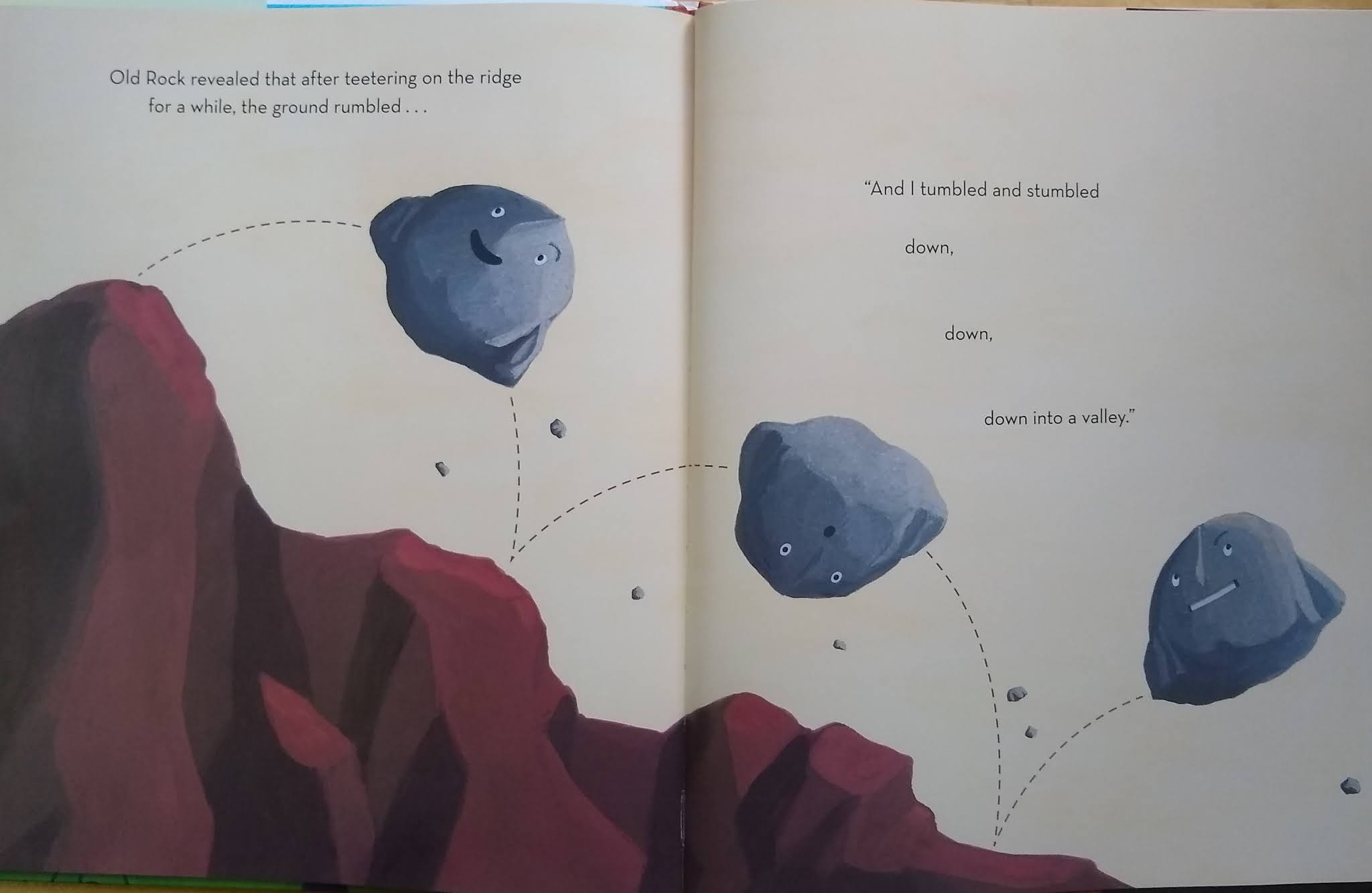 |
| A bit like this perhaps . . . |
 |
| . . . but perhaps unexpectedly landing like this! In this spread, the reader can use the space left by the minimal words to imagine how rock might have felt when he landed here after his exciting somersault adventure, and what it would have been like living during the time mastodons roamed the Earth. Importantly the reader might say, "I wonder . . . where Old Rock might go next and where he might end up after that?" |
That wonderful synergy that you get in an excellent picture book must come from the fine balance between the words and the pictures, but also from the SPACE creators allow for the reader.
What examples from your favourite picture books and those you’ve created can you share with our blog readers?
__________________________________________________________________________________________
 Natascha Biebow, MBE, Author, Editor and Mentor
Natascha is the author of the award-winning The Crayon Man: The True Story of the Invention of Crayola Crayons, illustrated by Steven Salerno, winner of the Irma Black Award for Excellence in Children's Books, and selected as a best STEM Book 2020. Editor of numerous prize-winning books, she runs Blue Elephant Storyshaping, an editing, coaching and mentoring service aimed at empowering writers and illustrators to fine-tune their work pre-submission, and is the Editorial Director for Five Quills. She is Co-Regional Advisor (Co-Chair) of SCBWI British Isles. Find her at www.nataschabiebow.com


