Showing posts with label Journey of a picture book. Show all posts

Monday, 25 June 2018

Writing an accidental Picture Book Series • Chitra Soundar


I didn’t start out to write a series of picture books. But now I realise I’ve one successful series and another one edging in that direction.
 
I’ve always been a fan of series fiction – whether as chapter books or as picture books. When I fall in love with a character, be it Elmer or Lulu, I love to read other stories about them. I want to see them do different things.

 But as a writer, I always knew that a series is something you can plan for, but actually getting to publish one, is not up to me. So even though I never intended to write one, I stumbled on to a series.

The Farmer Falgu series originated in India and is now available worldwide in many languages. And this is how it started.

I wrote a story about silence and the joyfulness of noise set in an Indian farmer’s life. I wanted the story to have musical elements and I wanted my farmer full of positivity. I didn’t have an idea that I was creating a friend for myself.

After I submitted the story and it was accepted, I happened to realise another one of my story ideas will fit this character. So I asked the publisher if they would accept another story for the same character. Now this was even before an illustrator was chosen for the first. While the first one focussed on sound, the second one was all about food.

It was a gamble but the editor said yes and to my delight both Farmer Falgu Goes on a Trip and Farmer Falgu Goes to the Market is available in many different languages – from French to German to Japanese and American English.

The success of the first two books both in India and abroad, triggered a commission of two more stories. And a series was born.

But the thing about series is, especially one that has become popular is, there’s more at stake. I wrote so many different stories for the same character, trying to find the third and the fourth I was commissioned.

But the 3rd and 4th book would not have been possible if I wasn’t doing extensive research on both Farmer Falgu and India in particular looking for stories.

Farmer Falgu was completely a product of imagination and a series of accidental events. So after I created the character, I did a lot of research on his back story. I had chosen a name that happened to have historical significance. And that was a happy accident. The illustrator had set him in Rajasthan and that was another happy accident for me (although she would have made a conscious choice).

So I researched the background of the state, created resources and activities for kids. This led to my researching the kite festival, which then turned into an idea for Book 4.

Researching India and having a discussion with the publisher gave me another idea – the Kumbh Mela – the biggest festival on earth. I loved that it had all the elements I love in a story and in life – rivers, trains, food, elephants and a Farmer Falgu who couldn’t catch a break. Or did he?

So as I wrote Book 3 and 4, I learned some key things about writing an unplanned, accidental series.

a)    The character now has a life of his own. And therefore the story has to fit this life.
As the illustrator Kanika Nair made him a Rajasthani farmer, the new stories needed to fit his new life in Rajasthan and what happened there.

b)    The throughline – the first two stories had unconsciously created a personality, a theme and an ethos for my character. He was a glass-half-full guy and therefore any new story needed to fit his ethos.

c)     The Economics: Three or four books of the same character, the same author-illustrator duo is an investment for a small independent publisher from India. They had to be really sure that the 3rd book and the 4th book would work. So there was a lot more scrutiny, review and discussion before these stories were even written.

d)    The expectations: These stories showcased India in a small way and with the first two books having sold in many foreign territories, a need to show some wonderful events or places in India within Farmer Falgu’s life was tempting. We zoomed back from his farm out into a bigger world for Book 3 and 4.

e)    Series guidelines: These weren’t written down – but there was a sense of how long the book would be, the pattern, the setting and the title. The first two titles had “Farmer Falgu Goes…”. So I had to make him go somewhere in each story.

As a writer, suddenly I had to work within a framework. Sometimes it felt as if the story didn’t come first, the series guidelines did. But then pushing the story to the forefront and making the character centre-stage helped me plot Book 3 and Book 4.


Available in the UK soon through Red Robin Books


As much as there is a pre-defined framework when you work on a series, there are benefits too. If parents and teachers like one of the books in the series, they’re more likely to buy the others. The characters turn into friends. I have Farmer Falgu talking to me at odd times when he sees something through my eyes. But also as a writer I start seeing the world through his eyes.


Available in the UK soon through Red Robin Books


And now I’m standing on the edge of another series. Fingers crossed!

You’re Safe With Me (illustrated by Poonam Mistry) was met with so much love even before it was published that the publisher, Lantana Publishing, commissioned a companion story, You’re Snug with Me. Although it is not the same characters in the second book, a pattern has emerged. Whether there’s a third book, only time will tell.
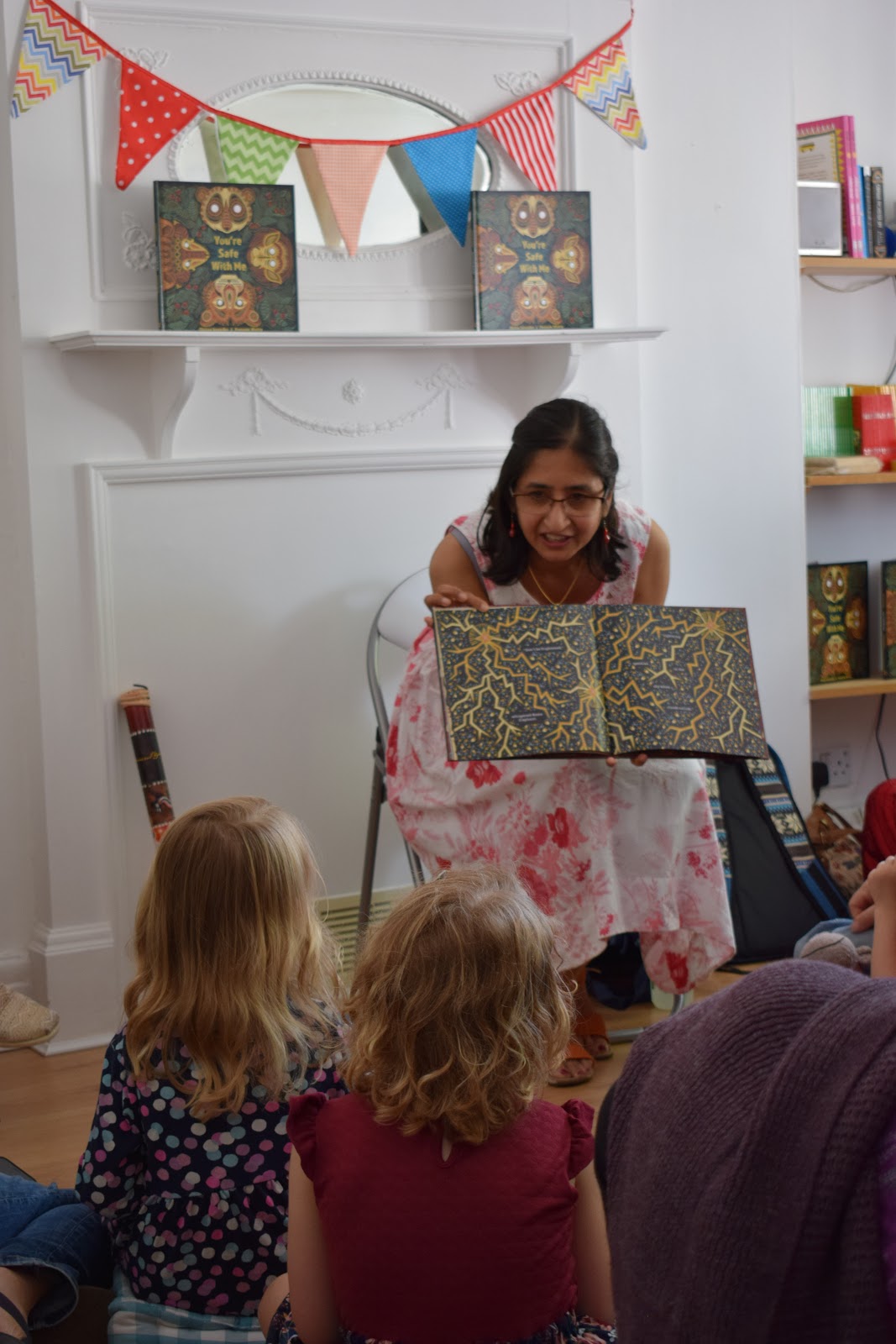


Chitra Soundar is an Indian-born British writer of picture books and junior fiction. When she's not writing stories, she can be seen telling them to both children and grown-ups across libraries, festivals and schools in the UK and worldwide. Find out more at www.chitrasoundar.com or follow her on Twitter at @csoundar.


Monday, 20 November 2017

A FIREBIRD’S JOURNEY - a guest post by Saviour Pirotta


A picture book’s journey from idea to publication is somewhat different from that of a chapter book or a novel, especially if you’re a writer rather than a writer/illustrator.

With chapter books, you usually write a treatment or a synopsis and the first three or four chapters of the story. Some writers include notes about the main characters and the setting but it’s not essential. If you’re a first-time author, or you’re known for another kind of book, you might have to write a first draft before your agent can submit your book to editors. But there’s enough there for the publisher to decide in favour or against the project. Your book lives or dies on the strength of your ideas and your writing.


I find the process is much trickier with picture books if you’re a writer who doesn’t illustrate his own books. Your proposal is hauled up in front of a busy editor with the most important ingredients missing: the visuals. When submitting picture books early on in my career, I always assumed that my carefully chosen words would project the same images in an editor’s mind as in mine. I quickly learnt that this was way off the mark. Everyone ‘sees’ words differently and very often, what I thought would appeal, didn’t. I’ve given up counting the times I had a project turned down, only to see a very similar story published successfully by someone else. Nearly always that picture book was the work of an author/illustrator who could submit text and illustration roughs.

As I gained confidence in my writing, I turned to anthologies. They were still heavily illustrated but the stories did not depend on the illustrations to work. An editor could see the potential in my work without the pictures. Most of these books were commissions anyway, and the publishers had an illustrator in place before I was even asked to come on board.  I do very well with them so  I decided that I’d only attempt another picture book if asked by publishers to write something about a specific subject, and then I would not limit myself to perceived ideas of what a picture book should be. I would follow my own instincts and push the envelope.


The opportunity came when Templar asked me to adapt The Firebird as a celebration of the ballet’s centenary. They had an illustrator attached to the project already, the wonderful Catherine Hyde who’d just done an incredible job on Carol Ann Duffy’s The Princess’ Blankets. The sample pictures I was sent had a sophisticated, hypnotic quality to them. They looked earthy and mysterious. The characters in them looked almost posed, like people in a play. I thought they would appeal to adults as well as children, and I wanted to provide a text that would have the same expressionist quality.

The ballet is adapted from several Russian folktales. I chose one to work with, Prince Ivan and the Grey Wolf. Amanda Wood, who at the time headed the Templar team, is a fearless editor. She let me break so many rules. My text stretched to 3000 words rather than the customary 800 or under. I used difficult words, hard-to-pronounce names, and I changed the ending of to include an anti-hunting ‘message’.

Critics loved it but very few shops stocked it.  They complained that the book was too big to fit on the shelves. It didn’t look like a normal picture book; they didn’t know which shelf it should go on. Was it aimed at adults or kids?


For a few years, it looked like the poor Firebird was going nowhere in a hurry. There was no talk of a paperback edition. The US edition went out of print. I consoled myself with the fact that the book won an Aesop Accolade in the States, that the few people who had seen it, totally got it.  I moved on, producing more anthologies and writing, my first middle grade novel.

But somewhere along the line, things started to change for the Firebird. I started to get emails from teachers who were using it in class with upper KS2 kids. I’d walk into a school and there would be a display of the children’s own firebirds, inspired by Catherine’s work. I started offering free Skype visits to classes who were using the book. Before I knew it, the Firebird had risen from the ashes. Sales picked up and recently the Literacy Trust produced teaching notes to go with the book. I now get more emails and letters about Firebird than any other picture book I’ve written. In February I am visiting a school that is dedicating two whole weeks to activities based on it.

It just goes to show that you should always follow your heart and your instincts, not the market and certainly not received wisdom about what a picture book should be.  After all, that’s why we’re writers. To push the envelope of creativity, and to broaden people’s horizons.


Saviour Pirotta’s latest middle grade novel, Secret of the Oracle, is published by Bloomsbury and available now. His next picture book, The Unicorn Prince, illustrated by Jane Ray and will be published by Orchard Books in September 2018. Follow him on Twitter at @spirotta.