Showing posts with label collaboration. Show all posts

Monday, 31 July 2023

Accidental Route into Making Picture Books by Nadia Shireen

 Nadia Shireen is an award-winning author and illustrator of picture books and chapter books. We asked Nadia about how she started out and her advice for those who are starting out now. Enjoy!


My route into becoming a picture book maker was offbeat and almost accidental. After a few years of working in magazine publishing, I started to take evening classes in illustration. This was mainly because I was constantly doodling over the sheets of paper I was supposed to be editing (distracting for all concerned.) 

Anyway, these evening classes led to me eventually undertaking a part time MA in children’s book illustration at Anglia Ruskin University in 2008. I was, to be blunt, a bit of an oddball on the course. Trying to juggle a career as a freelance journalist with no formal art training meant that I found it a bit of a struggle, and I got heroically behind with the coursework. A career in picture books wasn’t something I was even contemplating at this point.

But the course was invaluable in so many ways. For a start, thanks to the tutelage of experts and practitioners (such as Martin Salisbury, John Lawrence, Pam Smy and James Mayhew) I learnt to love picture books and appreciate how word and image can collide to create magic.

However, there were also the dreaded regular group crits, when everyone would take it in turn to nervously share their works-in-progress to the rest of the group. You could expect to: 

1) Receive tentative feedback from friendly peers    

2) Receive constructive feedback from informed tutors

3) Try not to cry

And someone would always, always cry. The many caring, generous and encouraging compliments seemed to bounce off the surface of our brains like hail on a tin roof. The criticisms? Now those guys would burrow into our souls, destined to stay there forever. 

To make things even more complicated, the next month we would maybe get a different kind of constructive feedback from a different tutor, which sometimes totally contradict the previous critique. This cause a bit of a tailspin. Whose feedback should you believe? Whose opinion could you trust?

Though it didn’t feel like it at the time, we were learning an invaluable lesson. As a picture book maker, you soon realise that the best projects are a collaborative effort. With a bit of luck, the team you are working with share the same end goal – to make the best book possible. I work closely with fantastic editors and art directors, who add immense value to every book I make.


This means that you need to learn to park your ego at the door and take critique on board. It also means you need to develop and trust your own judgement. Because inevitably down the line, people will not agree. There may be a difference of opinion over a sentence, or a page layout, or the colour of a bear’s nose. 

Now, to further expose myself as a bit of a twerp, my knee-jerk reaction to any proposed editorial or art change might be “No way! These are MY perfect words and MY beautiful pictures and nobody else is going to change them! So there.”

This is not a helpful reaction.

A wiser reaction might be to ask oneself why does something need to change… and is this particular solution the best one? If you’re able to really easily articulate exactly why something needs to be the way it is, then you’re probably right. It’s all about being able to explain the reasons behind that gut instinct. 


Yes this can sometimes be tricky, but it is a skill that can be developed and honed. And really, it’s about learning to cut through the noise of many opinions and trust your own judgement.

If, on the other hand, you can’t really drum up much of a reason as to why a particular sentence/drawing/bear nose cannot be changed, it may be a sign that you need to loosen your grip and allow things to evolve with the guidance of smart people who want to help. 

I’ve definitely felt sad about losing drawings or plot beats that I was really attached to. But pretty much every time I have done so, taking on board someone else’s feedback has resulted in a much better book. 

Everyone’s experience of making a picture book is different, of course. But in mine, any success I have had is shared with the editors and art directors I have collaborated with. 

So my advice would be to try not to be scared or discouraged by thoughtful critique. Instead try to embrace it, gently grapple with it where necessary, and high-five your ego for waiting politely outside. 


Nadia Shireen is a picture book author and illustrator. Her books include Good Little Wolf, The Bumblebear, Billy and the Beast, Barbara Throws a Wobbler and most recently, Geoffrey Gets the Jitters. 

She also writes and illustrates the Grimwood series for older children. 

Find out more at https://www.nadiashireen.org/ and follow her on Twitter (or X as some people call it now) and Instagram here.



Monday, 6 June 2022

The (Lost) Spark of Back-and-Forth Collaboration? • by Natascha Biebow


Once acquired by a publisher, picture books are made by collaboration – a whole team behind the scenes, including the illustrator, the author, the editor, designer and production team works closely together to share their expertise and to build upon the creator's initial ideas. Once made, picture books look seamless: all those collaborative discussions are evident in the polished book. Now, there will be people championing it in the publisher’s marketing, sales, rights and publicity departments.


Many hands collaborate to make a picture book that shines

Sometimes, a collaboration is established in a particularly inspired author illustrator pairing that will go on to endure and delight countless young readers.


But what of the collaboration between the creative and the first point of contact – usually the editor at the publishing house? The kind that takes time and a special kind of eye to see the seed of something special and commercial and then time and effort to let it ‘cook’ till it shines. Is it a lost art?


In the US, recently several junior editors quit their roles citing being overworked and lack of proper recognition for their creative contributions to the business of making bestselling books. Increasingly we hear reports of submissions going unacknowledged in overflowing ‘slushpiles’ and overtasked editors. It stands to reason, then, that editors would want book proposals to arrive on their desks as polished projects that they can immediately envision in terms of potential. These they can effectively ‘run’ with as they pitch them in-house for acquisitions.


But what if . . .?


Editors once again had a bit of time and space to connect and collaborate back-and-forth, to nurture artists and authors at all levels of their career?


What if . . .?


Writers, editors, illustrators and art directors could meet in a kind of ‘writer’s room’ scenario like teams creating movie and TV series do?


What if . . . ?


Authors (and illustrators) with talent received encouragement and direction to work collaboratively with editors to help them take their ideas to the next level rather than just receiving no response or even an outright rejection to a project that has a seed of promise? Could it elicit a spark that later led to great works?


What if . . .  editors had more time and space . . .
to reach out, to nurture a spark,
to collaborate in a conversation . . .?


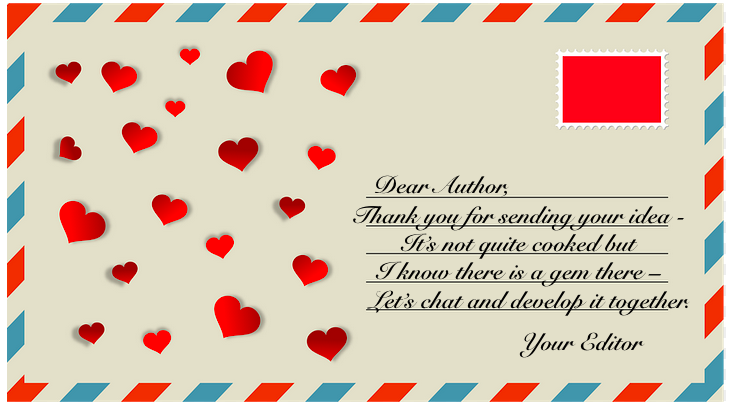
Writing letters may be a lost art, and emails are often at best short and business-oriented – everyone is so busy and short of time - but knowing that an editor is in your corner can mean the difference between being able to create the next big masterpiece or not.


Take for example the pivotal role legendary editor Ursula Nordstrom (1910–1988) played in bolstering Maurice Sendak at a key time in his early career, eventually leading him to believe in himself enough to go on to create the enduring classic Where the Wild Things Are.

When Sendak expressed his self-doubt in being able to stack up to the genius of Tolstoy and illustrate his work, Ursula wrote:


Sure, Tolstoy and Melville have a lot of furniture in their books and they also know a lot of facts (“where the mouth of a river is”) but that isn’t the only sort of genius, you know that. You are more of a poet in your writing, at least right now. Yes, Tolstoy is wonderful (his publisher asked me for a quote) but you can express as much emotion and “cohesion and purpose” in some of your drawings as there is in War and Peace. I mean that. You write and draw from the inside out — which is why I said poet.


You are growing and getting better all the time. I hope it was good for you to write me the thoughts that came to you. It was very good for me to read what you wrote, and to think about your letter.

….

You may not be Tolstoy, but Tolstoy wasn’t Sendak, either. You have a vast and beautiful genius.” *


According to HarperCollins' website, 'Nordstrom had a simple philosophy regarding new authors. As one colleague said, “Anyone who called, anyone who got off the elevator, anyone who wrote in, could be seen and heard.” She always answered her own phone, and on hearing another ringing, would cry out, “Answer that! That might be the next Mark Twain.”'

Dear Genius The Letters of Ursula Nordstrom
Collected and Edited by Leonard S. Marcus


I wonder if some of our great children’s picture books would have even come to fruition and evolved in quite the same way without the space and support to experiment and collaborate with editors and art directors?


Having the


friendship and support of a

teacher and mentor and listener to

bolster creative confidence


sounds like a real gem in this day and age. That TRUST and FAITH! Hopefully it isn’t too elusive and the ways can be found to bring back that back-and-forth collaborative spirit in a new, and perhaps even better, guise? We can but dream . .  .


Thoughts on a postcard, please.

_____________________________________________________________________


* letter excerpted from Dear Genius: The Letters of Urusla Nordstrom, Collected and Edited by Leonard S Marcus


Ursula Nordstrom was the editor-in-chief of juvenile books at Harper & Row, who helped nurture many talented authors, such as Margaret Wise Brown, author of Goodnight Moon, EB White, author of Charlotte’s Web, Shel Silverstein, author of The Giving Tree, and Maurice Sendak, illustrator and author of Where the Wild Things Are.


_________________________________________________________________


Natascha Biebow, MBE, Author, Editor and Mentor

Natascha is the author of the award-winning The Crayon Man: The True Story of the Invention of Crayola Crayons, illustrated by Steven Salerno, winner of the Irma Black Award for Excellence in Children's Books, and selected as a best STEM Book 2020. Editor of numerous prize-winning books, she runs Blue Elephant Storyshaping, an editing, coaching and mentoring service aimed at empowering writers and illustrators to fine-tune their work pre-submission, and is the Editorial Director for Five Quills. Find out about her new picture book webinar courses! She is Co-Regional Advisor (Co-Chair) of SCBWI British Isles. Find her at www.nataschabiebow.com