
The art of writing a
picture book is deceptively difficult. (It can be tempting to take a good long nap when you're stuck or in need of inspiration and fortitude when submitting . . .)
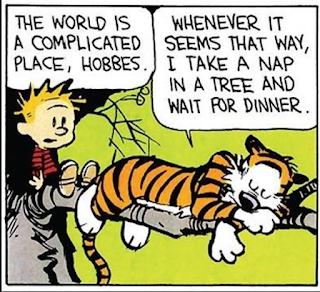
Summed up perfectly in this cartoon by Calvin and Hobbes by Bill Waterson
Here's why:
Most picture books start with an idea.
IDEA – the initial inspiration for the story. The reason why the book is being written.
Yay! An idea is top-notch. Now, you can dive right in and write your picture book. You've made a good start, you might argue . But wait . . . there's a catch – picture books written in this way often lack both emotional resonance and cohesive narrative flow.This is because many ideas have been done as
books before. This is also why you might be getting rejection letters that say your
book 'feels too familiar' and 'doesn't stand out in the competitive
marketplace'.
More experienced creators will write out an outline and figure out key elements in the PLOT.
PLOT – is just what happens in the story.
This is a great start too, however it still often leads to books that aren't compelling enough. Why? Because the author hasn't addressed a key factor - WHY should anyone care about this story?
Waiting to plot out the book until after you've figured out what makes the book tick can save you a lot of time!
So how do you develop that initial idea into something that will make editors, agents, and most importantly, young readers take notice?
You need a Rock-Solid Premise!
 |
| If you figure out your rock-solid premise first, you'll stay on course and not go walkabout as you figure out how to fix your picture book that just isn't resonating or selling. As inspired by Calvin and Hobbes (by Bill Waterson), artfully balancing their way to the other side of the stream. Don't make the mistake of falling in or getting lost in the woods! |
PREMISE — The unique way YOU are going to develop that idea into a compelling, marketable picture book with resonance and impact.
This is a KEY step that many picture book creators miss when developing their idea. By taking the time to work out a solid premise, you can take your picture book to the next level by making it unique, memorable and powerful.
To give you an idea of how this can work, let's look at a bestselling picture book that is celebrating 20 years:
DON'T LET THE PIGEON DRIVE THE BUS by Mo
Willems

Premise: a child-like pigeon wants to drive the bus, but the driver has left the reader with strict instructions to mind the bus and not let the pigeon drive it. The pigeon begs, wheedles and negotiates, trying all the tactics that young readers might recognize from when they are trying to get grown-ups to do what they want. The pigeon gets increasingly frustrated and angry, but the readers keep on telling him "NO!"
 |
| From Don't Let the Pigeon Drive the Bus! by Mo Willems |
When the driver returns and thanks them at the end of the story, the pigeon is sad, but still hopeful. Now, he's dreaming bigger with his sights set on driving . . . a truck!
 |
| From Don't Let the Pigeon Drive the Bus! by Mo Willems |
In an interview on CBS Mornings, Mo Willems said, "I think of my audience, but I never think for my audience."
In the first book of his bestselling series, the author places the child firmly in the driver's seat. The interactive dialogue format itself encourages creativity and imagination. The book is something kids can play with. It is also a springboard for imagining new adventures for the pigeon character.
The reason this premise is so strong is that the role-reversal resonates with both children and adults alike. Willem's child-centred plot, character motivation and humour are seamlessly interwoven to create a very simple, but unique and compelling story that resonates.
Crafting a strong PREMISE is a powerful (and often missed) pro skill. It is the core concept that gives your book a reason to exist. It's what takes an idea that many other writers may have had, and makes it uniquely yours. It takes craft and skill – and sometimes 'cooking time' – to develop a solid premise that will make your book stand out in the competitive marketplace. It's well worth spending some time to consider your premise before you start writing.
_________________________________________________________________
 Natascha Biebow, MBE, Author, Editor and Mentor
Natascha is the author of the award-winning The Crayon Man: The True Story of the Invention of Crayola Crayons, illustrated by Steven Salerno, winner of the Irma Black Award for Excellence in Children's Books, and selected as a best STEM Book 2020. Editor of numerous prize-winning books, she runs Blue Elephant Storyshaping, an editing, coaching and mentoring service aimed at empowering writers and illustrators to fine-tune their work pre-submission, and is the Editorial Director for Five Quills. Find out about her new picture book webinar courses! She is Co-Regional Advisor (Co-Chair) of SCBWI British Isles. Find her at www.nataschabiebow.com


