Monday, 9 January 2023

How NOT to Write a Rhyming Picture Book by Juliet Clare Bell


Having received countless rejections (above) for unpublishable rhyming picture books before finally writing a publishable one, I thought I might share my top tips on how *not* to do it...


[1] Decide to have a go because you’ve seen lots of badly rhyming books out there and you’re sure you can do better.

It’s true. There are less than brilliantly-rhyming books out there…
BUT they are often written in-house by staff at the publisher’s, in order that a series can be made quickly, with an illustrator they already have in mind, and without having to pay an author. (Check out the copyright details in the book. Does it say Text © X-Publishers rather than Text © Author’s name?) I once received a rejection from a publisher saying “We like your rhyming story, but it’s the kind of thing we can do in-house”. You are not competing with these stories (or with stories published twenty years ago and no longer in print. Check when your 'competition' was written: publishing practice has changed). Give the publisher a rhyming story that no one else can write better than you. Yours needs to be as worthy of being published as one by Julia Donaldson or Jonathan Emmett (see his Someone Bigger, below).


[2] Let the rhyme dictate the story. 

It’s great to play around with a story and get carried off in unexpected directions (and you can have a lot of fun with a good rhyming dictionary –I love the Chambers Rhyming Dictionary, with a foreword by Benjamin Zephaniah). BUT if your story is taken hostage by the rhyme (your sweet little rabbit heroine turns into a nun because 'habit' is the only rhyme you can come up with), it probably won’t be a very satisfying story –even if your rhyming is great. If you write your story out in prose, you will soon see if it’s substantial enough as a story or whether the rhyme is carrying it. The plot and characters need to be as strong as for one written in prose. Clever rhymes can be fun to read once or twice but the book won’t stand up to endless repetition if there’s no substance to the story.


Would you want this poor rabbit changed into a nun because of the constraints of the rhyming picture book? (And you can see why I'm a writer and not an illustrator.)

[3] Use sentence structure like old nursery rhymes, or lyrics from a song. It was good enough for Old King Cole…

What’s wrong with Old King Cole calling for his fiddlers three (because a merry old soul was he)? Or with having five little snowmen fat (because each had a funny hat)? It’s easier to find a rhyme for three than fiddlers, and having fat at the end of the line scans better than ending with snowmen. So why not rearrange sentence structure wherever it suits you in order to make the rhyme work? Because… it’s lazy rhyming, it’s not how people speak and publishers don’t like it. If you have to make your sentence structure sound forced and unlike real-life speech, it’s not working. Old King Cole is great (and you can forgive a lot for a good tune), but it is of its time and it wouldn’t get a second glance from a 21st Century editor. 


These days, with his fiddlers three, Old King Cole would be published not.

[4] Don’t worry about meter and length of lines. Your readers will learn how to read it after they’ve tried it out five or six times. And then they’ll be able to enjoy it for years to come.

Except they won’t. No one’s going to work hard at reading your picture book, not a potential reader in a shop and certainly not an editor. Picture books are created to be read aloud. They have to sound right, and it’s especially true of a rhyming picture book. So read it aloud –LOUDLY, with feeling. Even if it is embarrassing. (I’ve even cut out a manuscript of mine and blue-tacked the lines of text onto someone else’s picture book where I thought they should go and then recorded myself reading it, to hear what it really sounded like with the breaks for page turns.) 

But even when you’ve read it aloud and feel happy with the rhythm and rhyme, you know how it should sound. Which also means you can read some words more quickly than others in order to fit everything into that line and scan it perfectly. So let other people (preferably not family and friends who are either going to love it –good or bad- because it’s written by you, or not love it and upset you –I’ve had both). (For hints on joining or setting up a critique group, click here.) If other people read it and bits of it don’t scan for them, you need to work on the scansion-even if you can make it scan perfectly. 


Scene from an SCBWI open critique meeting in Birmingham, UK

[5] Write a poem and call it a picture book. No need to think about the picture element and page turns. 

You’ve written a great poem. You want to get it published and you could submit it to a poetry anthology or you could send it to a picture book editor. Much better to get a whole book out of one poem, right…? Except that picture books are about the interplay of words and pictures. Readers will slow down to look at the pictures –you need to take this into account. It can work –with a brilliant poem, a fantastic illustrator and a great publishing team (see Jim by Hilaire Belloc and Mini Grey, below). But it will need all the elements of a great picture book (with exciting page turns and changes in pace, etc.).


[6] Don’t read other rhyming stories before you start to write because they might curb your creativity and you might be too influenced by them.

Much better to write straight off without reading what’s already out there. You’ll end up with something much more original… Except that you will learn a lot by reading a lot –the good and the bad (and think about why the bad is bad). I actually type out stories that I really like so I can look even more closely at the structure, words/syllables per line, internal rhyme, etc. Ones I’d definitely recommend are: Room on the Broom (Julia Donaldson and Axel Scheffler), Someone Bigger (Jonathan Emmett and Adrian Reynolds) and my personal favourite, When a Zeeder Met a Xyder (Malachy Doyle and Joel Stewart, below. When a Zeeder Met a Xyder actually uses rhyme more playfully –but you can use it more playfully once you really know how to use it). 


[7] Write in rhyme just for the sake of it.

It’s fun to rhyme and children love it, so why not write your story in rhyme? Well, it’s true, children do love it, when it’s done really well. But… you have to realise that you’re significantly limiting your choice of publisher by doing it. If you write out your rhyming story in prose, does it actually work better? Very often, removing the rhyming constraints opens up exciting possibilities and improves the story. If it’s not the very best way to tell that particular story, perhaps you should opt for prose? Never write in rhyme just for the sake of it. If you’re going to write in rhyme, do it because…
you can do it really well and you’re going to get feedback before you send it off; because it’s great and fun and good rhyming books are brilliant for children. Do it because you can’t not do it as it’s the very best way to tell that story.


Juliet Clare Bell’s rhyming picture book, The Kite Princess (see title page roughs, above) is illustrated by Laura-Kate Chapman and published by Barefoot Books and is out in autumn, 2012, in the UK and the US (with an accompanying CD of the story read by Imelda Staunton). www.julietclarebell.com

Monday, 2 January 2023

An acrostic of patience by Chitra Soundar


Welcome to 2023 at Picture Book Den.

Our Den is cosy and warm and no gas and electricity bills to pay. We have stacks of picture books, wise authors and illustrators who absolutely love the medium of picture books. 

For the last few years, I’ve been the posting the first blog post of each year. That’s like coming out of hibernation after we posted our final post of 2022 and prepare for it, in the lazy stupor between Christmas and New Year.


Over these years, I’ve grown as a writer (I really hope so). And I have gotten used to being patient. Patience as you know is the key to being a writer. More so, as a picture book writer. While chapter books and novels can be published in a year from signing a contract, picture books take longer. 


I’m someone who loves instant gratification simply because I had to wait for everything as a child. A trip to the movies had to be budgeted weeks away, an ice-cream treat had to be saved up for. So as an adult, when I became financially independent, I gave myself the luxury of instant gratification.

And then I became a writer! As a writer, as much as you want to see your words in print, in book form in a child’s hand, the manuscript goes through a long journey. Sometimes it ends up as envisaged. Sometimes it gets stuck in the dark corner of my hard-disk called ARCHIVE. 

Some of my stories took years in the making. Here is an example of I patiently wrote and rewrote one story and willed it into publication. 

Another example of a story I edited over many years, and never gave up is this one! I wrote it as a picture book but when the opportunity arose, I submitted it as an early reader and it worked. 
Illustrated by Hannah Marks and Published by Bloomsbury Education


For someone who is impatient in life – if I think of something I have to do it, I’ve also learnt the art of being patient. So I thought I'd share some of my hard-learned wisdom on patience with you through an ACROSTIC. 

Pput it away. After you write your text, don’t send it to anyone. Put it away and re-read it after a few weeks. Edit and put it away for a few days. The more you let it stew, better your perspective. 

AAvoid submitting it too early. Make sure you’ve got a peer to read it – someone who is also writing picture books, someone you trust who will give you good feedback. Read this post by Michelle Robinson on the balloon analogy.

T Take the story out for a walk. Read it aloud. Read it to a group of children, not all your own. See if you can find a local nursery or Reception class in your local school who might let you read it to their class. Read the story with voices. Act out the characters. As an oral storyteller, I’ve found that telling the story aloud, reading it aloud many times and making someone else read your story aloud helps. It helps to see what’s wrong with it and what works.

IIdentify what’s wrong with the text. This is a craft thing – learn your own flaws. Do you use too many “was”? Do you tell more than show? Are you over-writing? Make a list of things to look out for and identify them in every rewrite. 

Eelevate your text. Always aim to write at the level of the best picture books written for children. Don’t pick one that’s so-so and think you can write as good as that. Aim high! A common example in manuscripts I review is the word count. Most UK published picture books are around 300 words. Challenge yourself to tell the story in 300 words, instead of pointing at decade-old examples of picture books with 1000 words in them. 

N Find that niggle. When you’re reading that text, you know a word or a line or even the plot is not working for some reason. But you think no one will notice. The whole text might fall apart if you pick at it. But believe me, someone will notice it. A trained eye of the editor will definitely pull that one piece bringing the structure down. So, it’s better you fix it before you show an agent or an editor.

C Find a critique group or a critique partner. If you already have one, listen to their critiques, notes and feedback. You don’t have to change your text to satisfy every critique. But you must listen to the note under the note. You don’t even have to use the ideas of your critique group to fix the problems in your text (my critique group is awesome and they help with a lot of ideas). It’s ultimately the call of the writer. But if everyone’s saying spread 5 has a problem – then spread 5 perhaps has a problem. Ignoring it will not make it go away. Defending it will not help because when you submit to an agent or an editor, you won’t be there in person to defend it. 

EKnow when to end. Both the story and the process. Knowing when to end a picture book is as important as when to start it. Younger picture books, especially fun ones, end with a twist, a joke or a surprise after the last page. Find out if your text lends itself to a quirky ending – satisfying and leaving the reader with a chuckle. 

However, knowing when to end the writing process is a trickier. Sometimes we pick at it so much for months together that the life in the story gets killed. Sometimes a story isn’t going to work. It wasn’t an idea for kids or it wasn’t idea that you can make it work as a picture book. Let it go. 

But you know what will work? Putting it away… So back to the first step of PATIENCE. 


Now that you’ve heard me rant about patience, here is a story tip! 

There are not that many books about “being patient” for young picture book readers. Perhaps you can learn the art of patience by writing a story about it? That’s your new year’s challenge from Picture Book Den!


Monday, 19 December 2022

Picture Book Den Celebrates - Christmas Trees!

'Tis the season to be merry and we would like to say a big thank you to all our readers and supporters this year. 

To celebrate, we have each chosen a picture book that features a TREE!

Natascha Biebow


This beautiful cloth-bound Christmas story is magical! It's Christmas Eve and ten little angels are busy helping people on Earth.  With each kind, thoughtful, compassionate act, the Angels turn around and join the choir (the angel heads are cut-outs along the top of the book). Until . . .

From The Christmas Angels by Else Wenz-Vietor

"The tenth angles is the first to see (the tree for all the angels who do good things),
and lights the candles on the tree."
(From The Christmas Angels by Else Wenz-Vietor)

In my family, which is originally from Northern Europe, we always had real candles like these on our tree. Even in Brazil where I grew up, where it's baking hot at Christmas time! The family tradition has kept on going. The warm candle-lit glow is a reminder of the spirit of Christmas family time and gratitude for small acts of kindness. Wishing you a happy festive season wherever you are!


Mini Grey

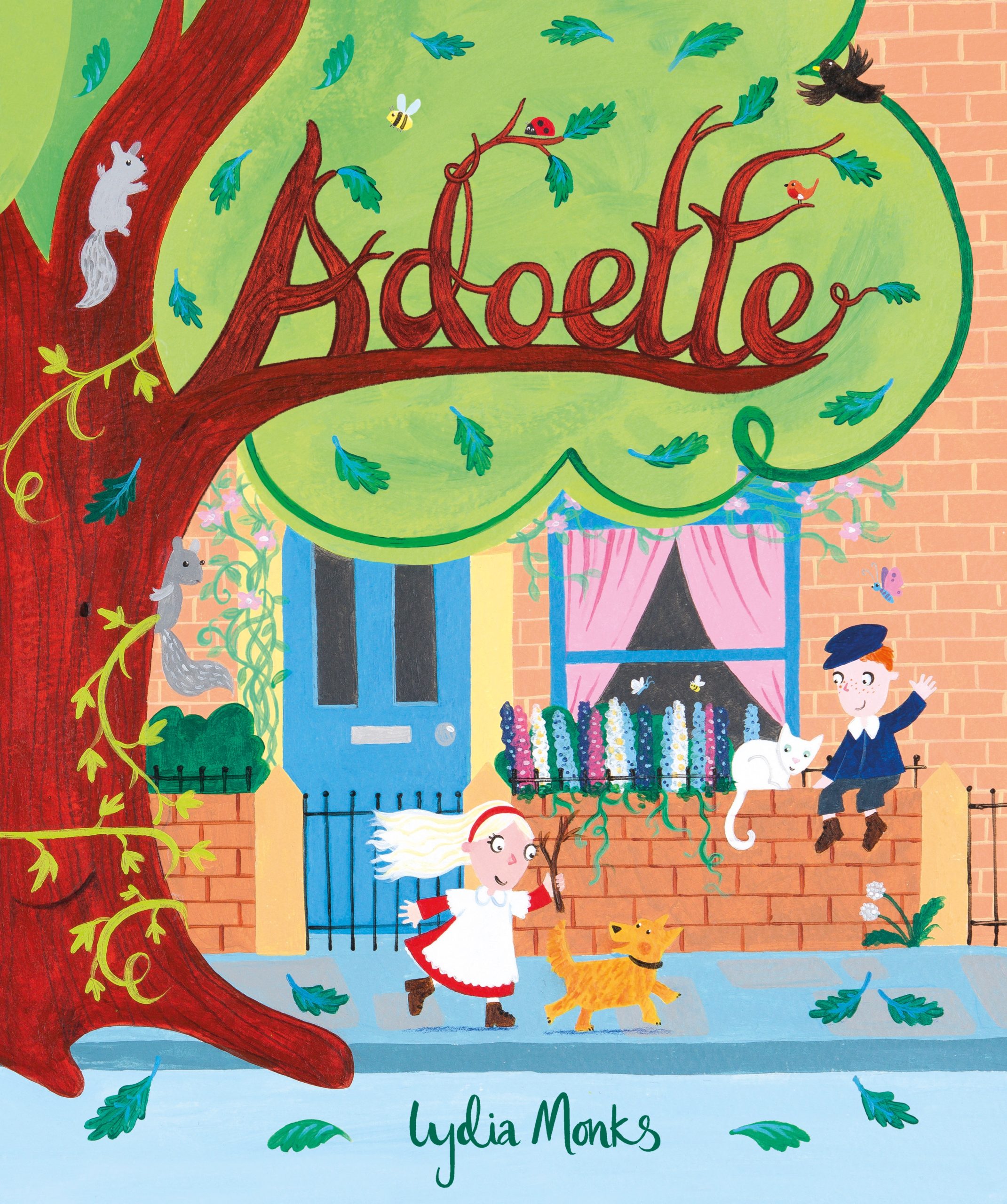
I'm choosing Adoette by Lydia Monks. It's not a Christmas tree, but a street tree who is celebrated in this book. 

Lydia Monks was inspired to write the story of Adoette (whose name means 'large tree' in Native American) by the rampant tree-felling that went on in her home city of Sheffield from 2014. Adoette is a 100 year old tree. 

When she was a sapling, she stood in a field, but then a city grew around her and she became a street tree. (How excellent that the Victorians retained existing trees when they built cities; there's a tree in Sheffield who was also originally in a field called Vernon Oak - you can follow this tree on twitter at @SAVEDORETREES) Adoette becomes a large mature street tree...but then people start to wonder if she's getting in their way....


I love street trees - they're our city forests. One big old tree can be a home to a vast number of organisms. Where people and nature come together, nature often seems to be considered inconvenient. Adoette is a plea to cherish our street trees. Let's give midwinter thanks for them!


Pippa Goodhart

What more important tree could there be at Christmas than The Family Tree, whether that family is created by blood or friendship, people or creatures or ... sticks?


Julia Donaldson's Stick Man story is (and I don't say this lightly) perfect; funny, exciting, heart-rending, heart-mending, with a glow of Christmas at the end. Axel Sheffler's pictures bring the story to visual life, endowing sticks with such character we are them as we read words and pictures.

'Stick Man lives in the family tree
With his Stick Lady Love and their stick children three.


But disaster befalls poor Stick Man, and he is taken further from home and more into danger to a point where it seems all is lost ... until he and Father Christmas save each other, and ...


Lynne Garner

I've chosen Be A Tree written by Maria Gianferrari and illustrated by Felicita Sala. 

Before I started writing picture books I was, am still am a non-fiction writer. So, I love a good non-fiction picture book. Especially one that has such an important message. The book starts with the lines "Be a tree! Stand tall. Stretch your branches to the sun." In my minds eye I  can see a room of kids taking part in the story. Stretching their arms out and being a tree.


The book continues in this vein linking our bodies to the parts of a tree. It also touches on the wonder of nature and that fungi and trees live successfully together, supporting one another and allowing trees to communicate. 


It explores how important trees are and that they, like us are stronger together than alone. Perhaps my favourite lines in the entire book is "a family, a community, a country, a cosmos. There is enough for all."

So, if you're looking for something to educate and entertain a child in your family do add this book to your list.

Clare Helen Welsh


Those who know me and my picture book tastes, know I have a fondness (ok, let's call it an obsession!) for books that merge the line between fact and fiction. Whether you refer to them as narrative non-fiction, faction or something else, there's so much inspiration in the real world. 

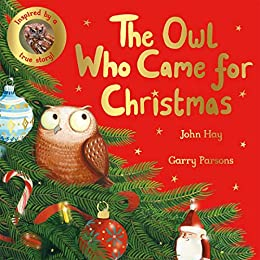
The Owl Who Came For Christmas, written by John Hay and illustrated by our very own Picture Book Denner - Garry Parsons - is a great example of a picture book whose roots began in an incredible true life event. 


Christmas is coming, and the decorations are going up…
But one family is about to discover an unexpected visitor snuggled up in their Christmas tree…
A little owl called Rosie!


This picture book is a sweet and heart-warming tale about a family who find a little owl nestled in their Christmas tree! It is based on the true story of an owl who was sleeping in a tree when it was cut down and taken to the city! Children will love the inclusion of 'The story of the real Rosie the Owl' at the back of the book. I personally love to hear what inspires creatives in their works of fiction.


I fell in love with this little owl from the cover alone! But inside, the charming characters and a wonderful story continue - an excellent picture book for young families, especially at Christmas time, that may also spark a conversation about conservation with a gentle reminder that our trees were once living in the wild.

Garry Parsons

The picture book I have chosen is Melrose and Croc by Emma Chichester Clark. A wonderfully tender story of kindness and friendship set in a palm tree lined coastal town, which you know would be gloriously hot and sunny in the summer. 


Melrose, the yellow dog, has just moved into a smart apartment in the centre of town and Little Green Croc has arrived to visit Santa at the department store there. 
Unfortunately for Croc, he is too late to see Santa, "It is Christmas Eve" the store manager reminds him. Feeling foolish, Croc wanders the town until he comes across skaters enjoying the ice around a huge Christmas Tree. Hoping to find a new friend to spend the holidays with, Melrose also ends up at the ice rink. The two collide, Crash!, into each other and the spark of a new friendship is born. 


The tree in this book is truly wonderful, as is the Christmas atmosphere. I know I share a love of this book with fellow Den member, Juliet Clare Bell.


Happy Christmas! 

Monday, 12 December 2022

The Picture Book Den team Celebrate the Career of Author Jane Clarke

 Jane Clarke has written over 100 books for children and has been a valued member of the Picture Book Den since it started.

Jane's picture books include Gilbert the Great, illustrated by Charles Fuge, the popular Neon Leon series with Britta Teckentrup, and her latest title for Walker Books, A Small Persons Guide to Grandmas, illustrated by Lucy Fleming.

In October Jane announced her retirement from writing, so with that in mind, the remaining members of The Picture Book Den have dedicated this week's blog post to celebrate Jane's wonderful career in children's publishing.


Natascha Biebow

I was fortunate enough to edit and publish Jane's first book (Sherman Swaps Shells, illustrated by Ant Parker, in the Flying Foxes young fiction series) and collaborate on many others over the years, including G.E.M. illustrated by Garry Parsons, and Dippy's Sleepover, illustrated by Mary McQuillan. Right from the start, Jane's stories struck me for their VOICE. She created such vivid, fun, child-centred worlds on the page! I would love to pay tribute to a particularly fun collaboration to create what became a bestselling and award-winning book.

Knight Time started out as a wordless book. But Sales didn't think they could sell a wordless book - parents would have to figure out the story . . . Also, the story required two points of view as a central theme. How could we do this for very young children without it being confusing? There was something intriguing here, a nugget of a great picture book idea, but we were stuck.

I took the train to see Jane and we spent the afternoon at her kitchen table with sellotape and scissors. We cut up the book and put it back together again. We made a dummy!

Now, readers could see both the Little Knight and Little Dragon's stories building side-by-side until the climactic turning point where their worlds collide - and the age-old expectations are challenged. The reveal? Despite what they've been told about each other, Little Knight and Little Dragon both have teddies and blankies!

I pitched the book to Sales as 'Theatre in a Book', and matched it up with Jane Massey to create the adorable characters and gorgeous world. We managed to get it to cost out with foil on the cover and the die-cut shapes and flaps.


Since then, I've had so much fun collaborating with Jane fairy tale detective picture books (Sky Private Eye series, illustrated by Loretta Schauer) and inventive young fiction books with factual graphic novel elements (Al's Awesome Science and Lottie Loves Nature series, illustrated by James Brown) on the Five Quills list. Best of all, we've become friends and it was Jane who first invited me to be part of the Den, for which I'm so grateful! Working with Jane is an editor's joy - such a talented lady! I hope she really does keep writing, even if it's an archeological adventure for grown-ups. She is far too young to retire! 

Pippa Goodhart

Jane's books speak straight to young children's real lives, revelling in exactly what young children enjoy. I'm going to keep this thank you from the Picture Book Den simple by showing a spread from Jane's How To Tuck in Your Sleepy Lion board book, illustrated by Georgie Birkett, which just seems to sum-up that kind of book that gets requested again and again and again, and even appropriately references a den!


Clare Helen Welsh

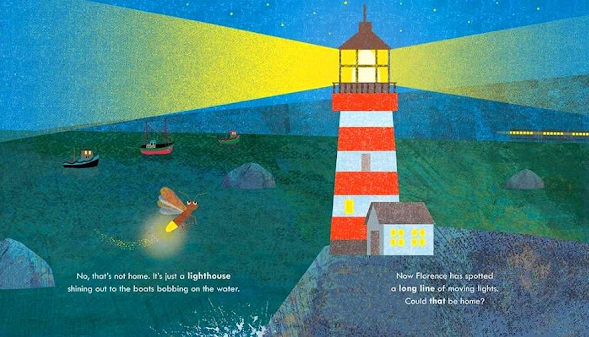
Jane has such a talent for combining engaging stories with awe and wonder of the world around us. This is evident in her Neon Leon series, illustrated by Britta Teckentrup and published by Nosy Crow. In Firefly Home for example, children learn about fireflies and different kinds of light sources. The story is gently interactive, inviting children to help Florence on her journey home. As well as being enjoyable and educational, Firefly Home ends with a suitably snuggly ending making it the perfect bedtime read. 

Thank you for sharing your books and picture book insights with us, Jane, and for being a beacon of light in Picture Book Den. 


Garry Parsons

I have been lucky enough to illustrate three books Jane has written but what an unbelievable thrill it was to watch Dolly Parton read 'Stuck in the Mud' on CBeebies Bedtime Stories on New Years eve 2017. 


Thank you Jane for making a wild dream come true. Yeehaw!

Watch Dolly Parton reading Stuck in the Mud by Jane Clarke here https://www.bbc.co.uk/cbeebies/watch/cbeebies-bedtime-stories-dolly-parton-stuck-in-the-mud


Lynne Garner

Sometime in 2011 (where have the years gone?) I had this daft idea that I wanted to blog about picture books, and it would be nice to be part of a team. So, I put the word out and to my amazement others felt this was a good idea. Jane became part of that first team and her first post appeared on the 15th of March 2012 (click here to read). 


So it’s hard to say goodbye to Jane but at least this post gives me the chance to explain why Jane is such a gifted writer.     


My choice is Creaky Castle – to see Jane reading this book click here.


Now, one of the first lessons I learnt when I started writing picture books only write in rhyme if you are good at it. The reasons being that writing in rhyme for an entire story is hard work. Also, your story must be strong. This is because many picture books are translated and if the story isn’t strong enough this can’t happen. So basically, you must be a great picture book writer to get a rhyming picture book published, especially one that on Amazon has 4.9 stars out of five. So if proof is needed to show Jane's skills as a writer then this is at the top of my list. 


Jane – thanks for being a valued member of the team for the last ten and bit years. We all wish you well and should you get the urge please pop back and write a guest post. We’d love to have you back even if for just a post. 


Monday, 5 December 2022

Cumulative Christmas picture books, by Pippa Goodhart

On the first day of Christmas my true love sent to me 

A partridge in a pear tree.

On the twelfth day of Christmas my true love sent to me

Twelve drummers drumming

Eleven pipers piping

Ten lords a-leaping

Nine ladies dancing

Eight maids a-milking

Seven swans a-swimming

Six geese a-laying

Five gold rings

Four calling birds

Three French hens

Two turtle doves

And a partridge in a pear tree! 


                      This image by George Buchanan


That English Christmas folk carol dating from at least the C18th is a fun game of a rhyme, testing our memories as we go through the ever-lengthening list of ever-dafter items. It’s been made into numerous picture book versions over the years, nicely fitting the standard twelve spreads. There’s a lovely Alex T Smith version in which Grandma has got carried away giving her granddaughter almost, but not quite, the traditional list of presents. ‘Seven snorkling squirrels’, or ten rhinos racing, for example, fit the bonkers nature of the original, and makes for a glorious images! 


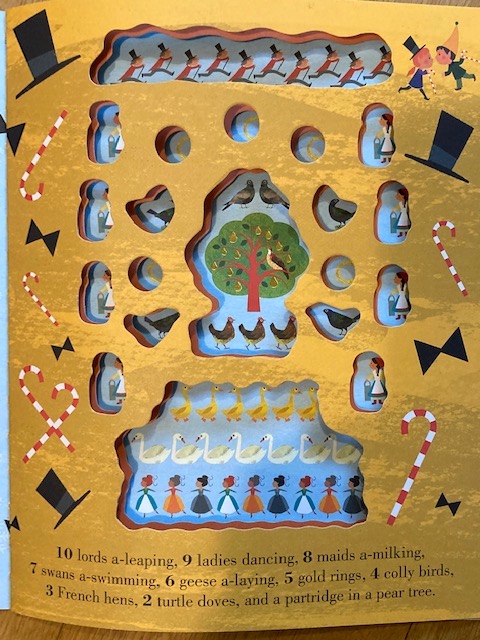
I also love this Britta Teckentrup version with cut away windows in the pages that reveal more and more.


            But there was (its sadly now out of print) a cumulative Christmas picture book story that played brilliantly with the verbal and illustrative rhythm and build-up to play the Nativity story to best story effect.  


Joyce Dunbar’s This is the Star has a text based on the format of traditional rhyme story, This is the House that Jack Built.


This is the star in the sky.

These are the wise men come from afar

Who also saw and followed the star,

Bearing the gold, and fragrant myrrh

And frankincense, the gifts that were

Placed by the manger warm with hay

Wherein a new-born baby lay.

This is the ox and this the ass

Who saw these wonders come to pass

At the darkened inn where the only room

Was a stable out in the lamplit gloom

For the donkey and his precious load

Who trudged the long and weary road,

Looked on by the angel shining bright,

Who came to the shepherds watching by night

That saw the star in the sky.


But then, with shock and focus and clarity, the next spread gives us starkly and clearly …

This is the child that was born.


… before the book gives us another spread even more full of text, and then, again, going for the minimal …


Still shines the star in the sky.


That’s such a thought-provoking truth! Gary Blythe’s stunningly realistic illustrations, giving us a newborn baby who actually looks newborn, and wise men properly pondering the sight of this child, are as powerful and moving as the text.


I hope that your Christmas cumulates loveliness of all sorts around you. Would your own twelve days of Christmas make a picture book?! Happy Christmas!  


Monday, 28 November 2022

Sometimes You Have To Try On Different Trousers: How to Revamp Nonfiction Picture Book Ideas


I’ve Been Trying on Different Trousers  . . .


In the past few years, I’ve written four new nonfiction books.


I began them with gusto. I love true stories. Those nuggets of facts that make you go ‘wow, really?!’ have me dancing round the house to find someone who will listen to my latest discovery. I also love detective work, even if it means going to great lengths to fact-check and dig for missing links or get in touch with an expert.


But then those manuscripts didn’t sell. So I went back to the drawing board.


I read. I did more research.  


I was searching for a new way to grip the reader (and editor). One that would ‘fit’ the story in a different way.


I asked myself:


Was there another way in to tell this story? Could I change the point of view? Could I include different facts? Could I change the style of nonfiction or the target age group?  Could I make it longer, shorter, with sidebars, more back matter or . . .?


According to bestselling nonfiction author, Melissa Stewart, I was shopping for a new text structure. It’s like shopping for a pair of trousers (pants, if you’re American), she says.


“When we shop for pants, we usually know what purpose we want them to serve. Are they for playing sports? Relaxing around the house? Going to a fancy party?”


Authors have to figure out what they’re most excited to share with readers.  They have to rule out pants that are the wrong colour, size or fit. Pants they don’t like. Pants that are not fit for purpose.


Text structures are patterns that help us to arrange and connect ideas so young readers can “access, understand and remember information more easily.”

In the case of narrative nonfiction, they are an important part of the voice and way IN to the story.


Melissa Stewart has identified seven structures:


Description:

Sequence /Chronological Sequence

List

Compare & Contrast

Cause & Effect

Problem- Solution

Question & Answer


Finding the right text structure is like building
the right frame for a house - it can really make a book!

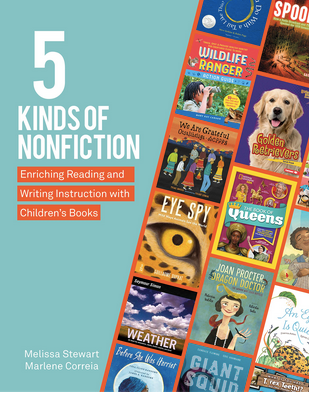
Once you rule out some structure types that instantly don’t seem like a good fit, you eventually get to the point where you have to try them on to see which fits best. That’s where mentor texts can really help. Looking at other picture books with a critical eye and acting like a detective can be useful to reassess what kind of structure would work best on your book. In their book, 5 Kinds of Nonfiction: Enriching Reading and Writing Instruction with Children’s Books by Melissa Stewart and Marlene Correia, the authors suggest looking at the same topic with different text structures. For instance FROGS. When you do this, it's amazing how many different approaches you can find for exploring just one topic in a children's nonfiction book! Lots of different structures, lots of different lenses.


Kinds of Nonfiction: Enriching Reading and Writing Instruction with Children’s Books
by Melissa Stewart and Marlene Correia
 

Sometimes, you need another element as well – a personal connection to the story, an a-ha! nugget that will really hook young readers and make them take notice. You have to write and rewrite to figure out and understand what your book is really about and why it matters. Is it surprising to you? Does it make you think in a new way?


When even when I finally find the right fit, the right pants, I also need to personalize them – I need to check: why am I writing this story?  


Melissa points out that there are other structures that imaginative authors have invented to fit the topic. For example, in SWIRL BY SWIRL: SPIRALS IN NATURE by Joyce Sidman and Beth Krommes, the text starts with examples that are small and snug; these get bigger and spiral outward and finally curl up again for the ending – just like a spiral. 


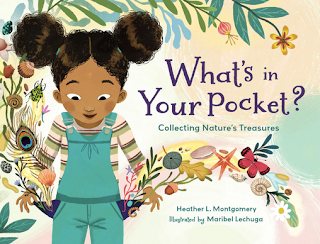
In one of my favourite recent nonfiction picture books, WHAT’S IN YOUR POCKET? COLLECTING NATURE’S TREASURES by Heather Montgomery and Maribel Lechuga, Heather tells stories of what famous scientists’ collected and kept in their pockets as children – and links how these later led them to make important discoveries as grown-ups. 


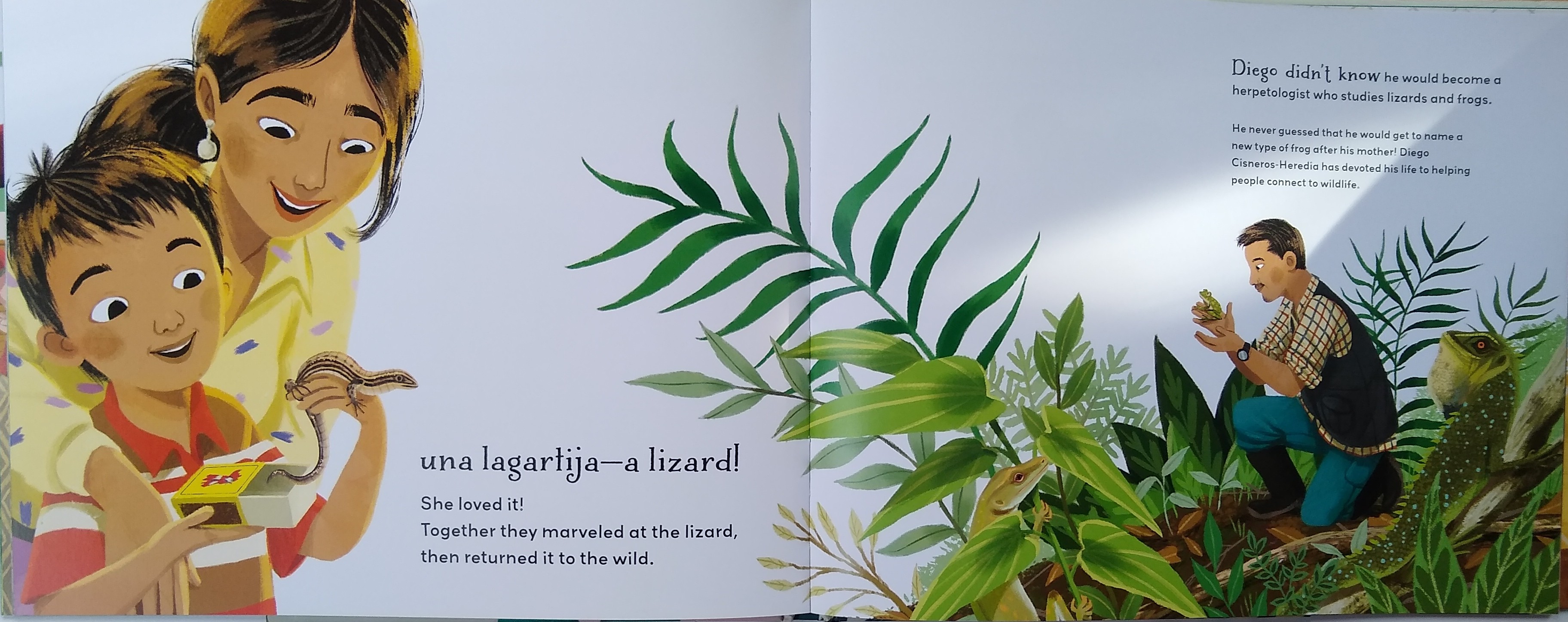
For instance, Diego Cisneros-Heredia, kept snails, slugs, scorpions and lizards in his pockets – and later discovered more than thirty new species of frogs. And Bonnie Lei collected tide pool creatures and later studied sea slugs and even found a new kind!


From What's In My Pocket? by Heather Montgomery and Maribel Lechuga

From What's In My Pocket? by Heather Montgomery and Maribel Lechuga

Heather Montgomery cleverly makes each figure relevant to young readers by tapping into a universal childhood love for collecting and outdoor play – and cleverly links this to how they were growing science skills that would lead to a lifelong passion working in the field.


This is what I am hoping to somehow create for each of my nonfiction book ideas. But how?


LOOK really closely at your topic. Look for:


• patterns

• key vocabulary words

• how do you want to make the reader FEEL?

• links to children’s lives and interests!


The hardest part? Keeping it SIMPLE and not being tempted to jam in everything!


I am inspired by Melissa Stewart’s tales of how it can take a long time to find the right structure and sell a book to an editor. For instance, it took her from December 2010 to December 2014 to get the manuscript for Can an aardvark BARK? accepted.  In this time, she experimented with four different structures!


https://www.melissa-stewart.com/timelines/timeline_aardvark/timeline_aardvark.html

Perhaps there is hope for my ideas and revised stories yet. I’m not giving up!


_________________________________________________________________


Natascha Biebow, MBE, Author, Editor and Mentor

Natascha is the author of the award-winning The Crayon Man: The True Story of the Invention of Crayola Crayons, illustrated by Steven Salerno, winner of the Irma Black Award for Excellence in Children's Books, and selected as a best STEM Book 2020. Editor of numerous prize-winning books, she runs Blue Elephant Storyshaping, an editing, coaching and mentoring service aimed at empowering writers and illustrators to fine-tune their work pre-submission, and is the Editorial Director for Five Quills. Find out about her new picture book webinar courses! She is Co-Regional Advisor (Co-Chair) of SCBWI British Isles. Find her at www.nataschabiebow.com