Showing posts with label endings. Show all posts

Wednesday, 11 March 2015

Endings that Stay With You • Natascha Biebow


Wouldn’t it be great if there were a magic ‘ending machine’? You’d write your picture book and then feed it in and POOF! – out pops a spectacular ending!


Endings can be one of the most frustrating and nigglesome aspects of writing picture books. But when you’ve cracked it, a great ending can make the difference between that book that children ask for again and again, and the one they aren’t really fussed about ever reading again.


So, what makes a great ending?


• the main plot problem set up in the opening of the story must be resolved in a satisfactory way – the character’s hopes, wants and needs are met and realized.


• your characters must grow and change by the end of the book – they should have learned something and will be bigger, better people as a result of their journey. So, by implication, will the reader.


readers must feel satisfied and not be left hanging, wondering about unresolved plot points or sub-plots. All loose ends should be tied-up or dealt with.

Here are some examples where the reader can clearly see that the main character has gone on a journey and grown as a result of the action in the story:


What other kinds of endings?


Dark endings: The ending of Jeanne Willis and Tony Ross' Tadpole's Promise is controversial, but true to nature. The caterpillar turns into a butterfly and gets eaten by her true-love, the Tadpole–turned frog. Some grown-ups may wonder: what will children make of this realistic and not at all happy ending?! It is memorable, though – and it works!


From Tadpole's Promise by Jeanne Willis and Tony Ross

Circular endings: In A bit Lost by Chris Haughton, we see the classic ending that is the story starting all over again, with a slight twist. The story begins with Little Owl falling out of the nest and his quest for his mummy. Finally, reunited with her at last, Mummy invites his rescuers up to the nest, only for Little Owl to fall asleep again . . .
The first and last spreads from A Bit Lost by Chris Haughton

Unexpected endings: In Flora's Flowers by Debi Gliori, there is a delightful surprise in store for young readers who believed in little Flora as she plants a small brick and declares, "I'm growing a small house." Her brothers and sisters all made fun of Flora while the seasons changed from Spring to Autumn and Winter to Spring again, but look what grew!
From Flora's Flowers by Debi Gliori

The Baddie gets eaten up and everyone lives happily ever after: In traditional tales, the baddie often gets his comeuppance at the end of the story and meets a dastardly end, like the Troll in this retelling by Irene Yates of The Three Billy Goats Gruff:


From The Three Billy Goats Gruff, illustrated by Ailie Busby

Twists: sometimes, the ending is a twist that is a delicious visual joke or surprise reveal, as in these two examples:


Or the twist is an unexpected plot turn, as in this example:


P.S. endings: Sometimes, the ending is not quite the end. When Kes' son read Billy's Bucket, he was concerned for the whale, who came out of the bucket onto the street when Billy's dad borrowed his bucket to clean the car without asking. How would the whale survive? So we added a postscript on the back endsheet, in which the whale was safely shoe-horned back into the bucket:

From Billy's Bucket by Kes Gray & Garry Parsons
In another example: when Garry's son read The Dinosaurs are Having a Party by Garreth P Jones, he wondered: wouldn't the baby dinosaur who hatches out of the party bag egg miss his Daddy? Here is the solution on the back endsheet of the book:
From The Dinosaurs are Having a Party
by Garreth P Jones & Garry Parsons

The endings I like best are those that make me laugh or leave me with a warm feeling inside. They bring closure and a kernel of truth about life. Like these two:

What kinds of endings do you like?

_________________________________________________

Natascha Biebow
Author, Editor and Mentor

Blue Elephant Storyshaping is an editing, coaching and mentoring service aimed at empowering writers and illustrators to fine-tune their work pre-submission. Check out the NEW small-group coaching courses!

Natascha is also the author of Elephants Never Forget and Is This My Nose?, editor of numerous award-winning children’s books, and Regional Advisor (Chair) of SCBWI British Isles.  www.blueelephantstoryshaping.com

Thursday, 6 November 2014

Plot Twists that Zing! - by Natascha Biebow


So you’ve written a picture book and it’s got a beginning, middle and an end, but it doesn’t yet zing . . .  You’re still left asking, "So what?"

What can you do?


Lately, I’ve been noticing that the picture books that tickle my fancy are those that have something extra – a twist.


Remember I blogged about creating a breakout premise? Well, if you can surprise the reader and add some humour or unpredictability to your premise, you are definitely on your way towards creating a premise that is extraordinary.


Children love extraordinary flights of the imagination. They relish the unpredictable!
Here are some ways to add a twist to your book:


1. Give your premise a twist:


If you can turn the predictable on its head, you are headed for a premise that equals a distinctive USP (unique selling point). Editors, sales people, booksellers, librarians, children and all kinds of readers just love that!


Aliens that love underpants . . .

Aliens Love Underpants by Freedman & Cort


Pirates that are . . .

Captain Flinn and the Pirate Dinosaurs by Andreae & Ayto


                                                                                         . . . dinosaurs!


from Captain Flinn and the Pirate Dinosaurs by Andreae & Ayto

2. Give your characters a twist:


The Gruffalo really does exist . . .
from The Gruffalo by Donaldson & Sheffler

. . .  plus the tiny mouse is cleverer and braver even than this fierce-looking beastie!

The Gruffalo by Donaldson & Sheffler


This is Goldilocks’ story . . .

Goldilocks and the Three Dinosaurs by Mo Willems

. . . but no bears live here!

from Goldilocks and the Three Dinosaurs by Mo Willems

This crocodile . . .

I Really Want to Eat a Child by Donnio and De Monfreid

. . . needs to eat bananas to get big and strong after all – not a child!

from I Really Want to Eat a Child by Donnio and De Monfreid

3. Give your plot a twist:


Two families plan to swap houses for their holiday . . .


Pirate House Swap by Longstaff & Chambers
But one is not quite what they expected . . .

Pirate House Swap by Longstaff & Chambers

Grandma mustn’t find out about the lion . . .

How to Hide a Lion from Grandma by Helen Stephens


 . . . but she has a secret too – she's hiding a bear in her bedroom!


from How to Hide a Lion from Grandma by Helen Stephens
4. Give your ending a twist:


Daisy doesn’t like peas!

Eat Your Peas by Gray & Sharratt


But she will only eat her peas if her mum eats her Brussels. 
And Mum doesn't like Brussels . . .  
from Eat Your Peas by Gray & Sharratt
But they both like pudding!

from Eat Your Peas by Gray & Sharratt
 The mammoth actually belongs to the boy . . .

A Mammoth in the Fridge by Escoffier & Maudet


. . . and he's not the only animal in the boy's bedroom!

from A Mammoth in the Fridge by Escoffier & Maudet
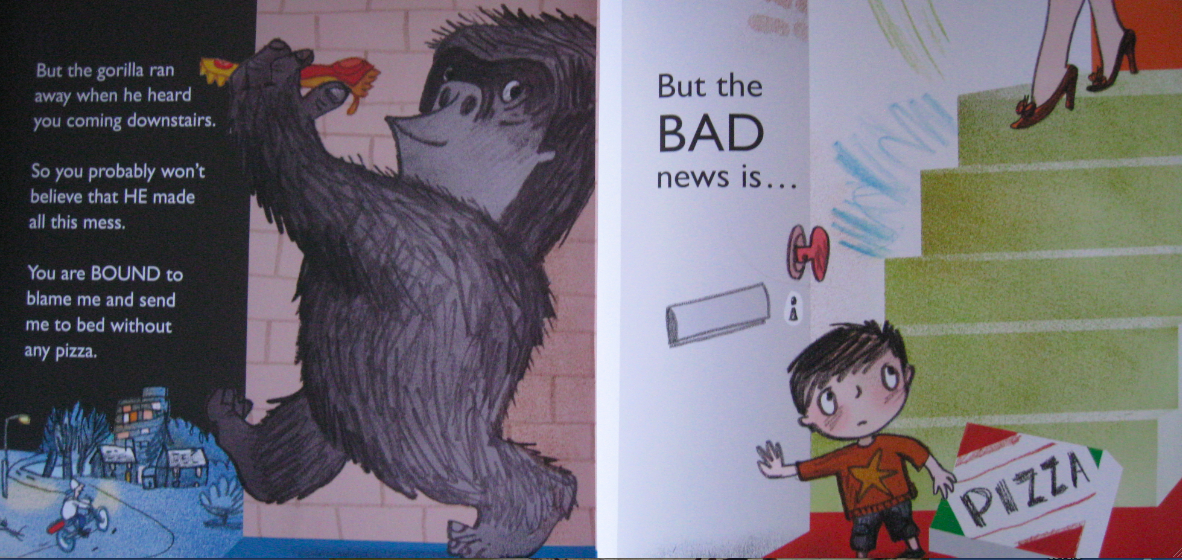
 A gorilla has come to visit . . .

Ding Dong Gorilla! by Robinson & Lord

. . . but not only did he make the mess – he left with the last of the pizza!

from Ding Dong Gorilla! by Robinson & Lord
Billy warned Dad that there were all kinds of sea creatures in his birthday bucket . . .

Billy's Bucket by Gray & Parsons
. . . but Dad borrowed it to clean the car anyway . . .
from Billy's Bucket by Gray & Parsons

What others can you think of?


Give it a twist and it will zing!
_________________________________________________

Natascha Biebow
Author, Editor and Mentor

Blue Elephant Storyshaping is an editing, coaching and mentoring service aimed at empowering writers and illustrators to fine-tune their work pre-submission. Check out my NEW small group coaching courses!

Natascha is also the author of Elephants Never Forget and Is This My Nose?, editor of numerous award-winning children’s books, and Regional Advisor (Chair) of SCBWI British Isles.  www.blueelephantstoryshaping.com


Thursday, 11 October 2012

The End by Paeony Lewis

It was a cute kitten video clip (just 28 seconds) that got me thinking about the endings in picture books. I watched it and thought, hey, that’s a perfect picture book ending . And I challenge you not to squeal, ‘Ahhh…’! Click here for the YouTube link.


Long ago, I remember an editor asking me to add more of an ‘Ahhh…’ ending to a picture book (using that exact phrase – and I think it’s a good one). I suspect we all know picture books that make us go ‘Ahhh…’ When my children were small, as a mum I’d choke up when I read the last line of Martin Waddell’s Owl Babies: “I love my mummy,” said Bill. I've heard it took the author a long time to come up with that line, but it was worth it (in the context of the story). An ‘Ahhh…’ emotion resonates with the adult reader.

Excerpt from final page,
Big Bear, Little Bear by David Bedford,
 illus by Jane Chapman (Little Tiger Press)

For the child who listens to the picture book, perhaps it’s  not so much an ‘Ahhh…’ as a comforting reassurance that all is right with the world. Most young children need that before they go to sleep. Here’s a perfect goodnight “Ahhh…”  image from the end of  Big Bear, Little Bear (and it reminds me of the kitten video).


Of course, no ending will save a below-average book. However, a good story won’t work if the ending isn't right. Sometimes an author will know the ending before anything else has been written. Sadly, sometimes we haven’t a clue how it will end and we scratch our heads for days, weeks and months (and no, it’s not because we have nits!).


Paeony Lewis, practising
scratching at a young age (no nits)
A picture book is read many times, so the ending is heard many times. This means it has to satisfy again and again, even though the adult and child know the story. So a trick, clever ending that relies solely on being a surprise won’t be enough, unless it’s a satisfying surprise that can be enjoyed night after night.

When I first wrote Hurry Up, Birthday, I thought the ending should be the birthday. After all, the entire story had been building up to this. A couple of editors suggested adding something extra to the end, but at first I wasn't convinced. Off and on, I thought about this for months and then out of the blue it came to me.

The story was about an excited bunny who bounced extra fast in an attempt to hurry time and make his birthday arrive quicker. So, when his birthday finally arrived, why not turn things around? Therefore, on the final page I had the bunny bouncing slowly because he didn't want to hurry his birthday. That might sound obvious and simple (as so much does in picture books), but it took me a long time to come up with that ending. Far too long!

Adding a little twist to an ending is popular in picture books. It makes the story fun and is less predictable (especially when it’s obvious that everything will turn out fine). Twists make us smile at the surprise or encourage a discussion about the story. At the end of my No More Yawning, the little girl finally falls asleep (after too much yawning), but then she’s woken by Mum’s loud yawn. That’s a little twist, and it also makes gentle fun of the naughty mum (children grin when they come out on top – not adults!).


Occasionally the twist is just a question, encouraging parent and child to interact.
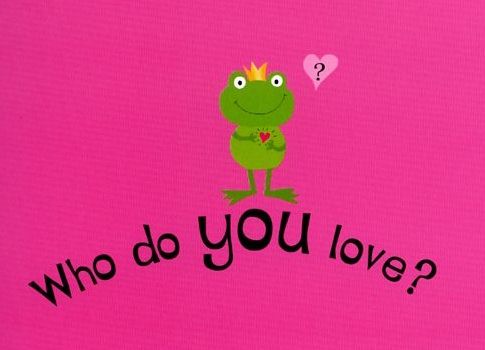
Who Do You Love? by Mandy Stanley is a good example. All the way through the book we discover who the animals love, and then on the last page the question is directed at the reader.


Excerpt from final page,
Don't Let the Pigeon Drive the Bus
 by  Mo Williems (Walker Books)
Picture book endings aren't only about clever ideas and twists. We have to think about the emotional needs of the child who’ll be listening to the story. Most picture books are read at bedtime, so almost all are reassuring and end happily with a satisfying resolution (remember the cute kitten video). In Don’t Let the Pigeon Drive the Bus, although the pigeon is thwarted and isn't allowed to drive the bus (phew!), his disappointment is tempered with hope. He spots a truck and on the last page we see him imagining a pigeon driving a truck. Hope is a powerful and positive emotion. Plus the story comes full circle and once more the pigeon dreams of driving a vehicle.

Driving buses is one of the many things a child can’t do and it frustrates them. Adults are always taking control. Therefore in picture books it should be the child character that solves the ‘problem’ in the story (sometimes with a little help). Adults shouldn't just take over and solve the problem for the child. As in real life, a child will have to learn to overcome difficulties. Plus it’s more satisfying for the child to see another child work things out (or even get one up over the adults). In The Gruffalo, the mouse (the child?) foils all the big threatening animals (the adults?) and finally gets to eats his nuts, rather than let himself be the snack.

Even if the child solves the problem, that doesn't mean the adult reader is ignored. An ending can be on more than one level, so it’s enjoyed by the child whilst including something extra for the adult. All parents will relate to the ending of Jill Murphy’s classic, Five Minutes’ Peace, whilst a child will just see it as funny. Mummy elephant finally gets some peace: “And off she went downstairs, where she had three minutes and forty-five seconds of peace before they all came to join her.”


Jane Clarke’s Gilbert the Great is another story that may be read on several levels. To a child, the book is about a friend leaving and a new friendship. To an adult it’s about death and new beginnings. Plus at the very end is a lovely little joke that an adult can explain, or simply enjoy. Illustrated by Charles Fuge,  it’s the perfect image to end this blog.
The End.


_______________________________________
Paeony Lewis is a children's author and writing tutor. www.paeonylewis.com