Showing posts with label craft. Show all posts

Friday, 6 March 2015

What's your Other Life? - post by Jonathan Allen

As I've been at this job for a good thirty years or so, I think I can use the pompous phrase "In my long and varied career. ." without any exaggeration.

So, In my 'long and varied career' as a writer and illustrator, I have always had other interests bumping along in the back of the van, as it were. I suppose that, because I have never had what could be called a 'proper job', nothing that required travel to a place of work and a commitment to eight hours of labour of any kind, I don't compartmentalise my time. By which I mean that I don't feel I have to be doing any particular thing at a particular time of day. I am constrained by deadlines, but have free choice about when I do what in order to meet said deadlines.

I have lived long enough to realise that this is very unusual, and how lucky I am to be able to earn a living (of sorts) doing what I like and am good at. Basically I draw funny animals and get paid for it. . . Ridiculous. . .

A Fat Cat - but you knew that.


As what time I spend on what, is determined by me, I have been able to pursue other creative avenues in a fairly intensive way, deadlines permitting.

How about you? What interests do you have running parallel to your life a an author or illustrator?

I think creative people are inclined to use their creativity in all areas of life, after all it is a mindset rather than a 'hat' you put on from time to time. It would be interesting to know what strong interests other writers and illustrators have or have had in their lives alongside their writing and Illustrating careers, and how they feel it might feed back into their 'work'.

My list starts with music. I played bass in a band at art school, art school being one of the traditional places bands emerge from. We never got anywhere, but really wanted to for a while. From that I got interested in recording, and had a small studio in a house I lived in, with a couple of mates. I lost interest, as I hadn't got the level of commitment needed to spend long and antisocial hours in a darkened room with a rock band from Croydon (for instance). . .

Status Shark, 5 string, passive electronics. Ho yes.

I got interested in computer related music tech and electronic music. Sampling etc, but again, didn't pursue it to any tangible end. (story of my life. .)
That led to an interest in computer generated landscape software, fractal based forms and how to make 'realistic' textures and patterns using them.

This kind of thing - computer generated landscape from a good few years ago now. . .


I still mess with that stuff, but I now make abstract patterns and print the images onto ceramic tiles. Getting the patterns out onto real objects led me to polymer clay, which in turn led me to making beads and jewelry of a particular 'rustic' kind. I've started selling them online. . . (under another name so as to avoid confusion. .) I could never have predicted that one!

'Rustic' Image Transfer beads, antiqued up to high heaven - fun to do


I think it feeds back into what I do in that the same process of refining a rough idea into something finished goes on. (Well, obviously!) What I mean is that the process of structuring a good pop song, or bass line, or idea for a pendant etc is comparable to that of putting together good picture book. It's the same mindset at work, getting stuck in to the complex work that goes into producing something simple but solid in concept and execution.
Anyway, enough about me. What is and what has been your creative passion outside writing or illustrating, and has it been an inspiration or a distraction? (I think mine have been both at various times. . )


Thursday, 6 November 2014

Plot Twists that Zing! - by Natascha Biebow


So you’ve written a picture book and it’s got a beginning, middle and an end, but it doesn’t yet zing . . .  You’re still left asking, "So what?"

What can you do?


Lately, I’ve been noticing that the picture books that tickle my fancy are those that have something extra – a twist.


Remember I blogged about creating a breakout premise? Well, if you can surprise the reader and add some humour or unpredictability to your premise, you are definitely on your way towards creating a premise that is extraordinary.


Children love extraordinary flights of the imagination. They relish the unpredictable!
Here are some ways to add a twist to your book:


1. Give your premise a twist:


If you can turn the predictable on its head, you are headed for a premise that equals a distinctive USP (unique selling point). Editors, sales people, booksellers, librarians, children and all kinds of readers just love that!


Aliens that love underpants . . .

Aliens Love Underpants by Freedman & Cort


Pirates that are . . .

Captain Flinn and the Pirate Dinosaurs by Andreae & Ayto


                                                                                         . . . dinosaurs!


from Captain Flinn and the Pirate Dinosaurs by Andreae & Ayto

2. Give your characters a twist:


The Gruffalo really does exist . . .
from The Gruffalo by Donaldson & Sheffler

. . .  plus the tiny mouse is cleverer and braver even than this fierce-looking beastie!

The Gruffalo by Donaldson & Sheffler


This is Goldilocks’ story . . .

Goldilocks and the Three Dinosaurs by Mo Willems

. . . but no bears live here!

from Goldilocks and the Three Dinosaurs by Mo Willems

This crocodile . . .

I Really Want to Eat a Child by Donnio and De Monfreid

. . . needs to eat bananas to get big and strong after all – not a child!

from I Really Want to Eat a Child by Donnio and De Monfreid

3. Give your plot a twist:


Two families plan to swap houses for their holiday . . .


Pirate House Swap by Longstaff & Chambers
But one is not quite what they expected . . .

Pirate House Swap by Longstaff & Chambers

Grandma mustn’t find out about the lion . . .

How to Hide a Lion from Grandma by Helen Stephens


 . . . but she has a secret too – she's hiding a bear in her bedroom!


from How to Hide a Lion from Grandma by Helen Stephens
4. Give your ending a twist:


Daisy doesn’t like peas!

Eat Your Peas by Gray & Sharratt


But she will only eat her peas if her mum eats her Brussels. 
And Mum doesn't like Brussels . . .  
from Eat Your Peas by Gray & Sharratt
But they both like pudding!

from Eat Your Peas by Gray & Sharratt
 The mammoth actually belongs to the boy . . .

A Mammoth in the Fridge by Escoffier & Maudet


. . . and he's not the only animal in the boy's bedroom!

from A Mammoth in the Fridge by Escoffier & Maudet
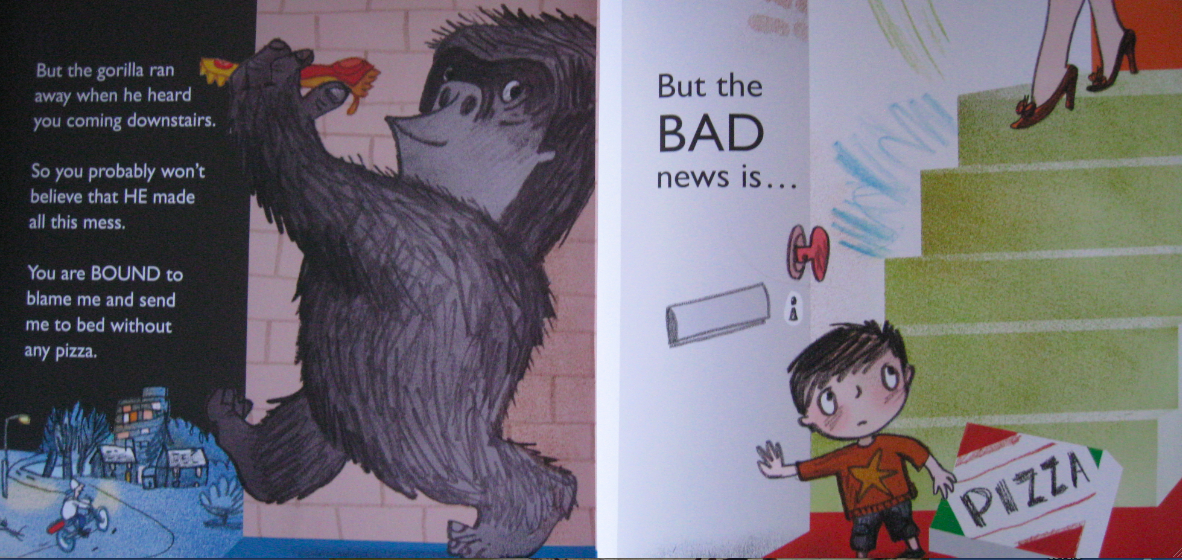
 A gorilla has come to visit . . .

Ding Dong Gorilla! by Robinson & Lord

. . . but not only did he make the mess – he left with the last of the pizza!

from Ding Dong Gorilla! by Robinson & Lord
Billy warned Dad that there were all kinds of sea creatures in his birthday bucket . . .

Billy's Bucket by Gray & Parsons
. . . but Dad borrowed it to clean the car anyway . . .
from Billy's Bucket by Gray & Parsons

What others can you think of?


Give it a twist and it will zing!
_________________________________________________

Natascha Biebow
Author, Editor and Mentor

Blue Elephant Storyshaping is an editing, coaching and mentoring service aimed at empowering writers and illustrators to fine-tune their work pre-submission. Check out my NEW small group coaching courses!

Natascha is also the author of Elephants Never Forget and Is This My Nose?, editor of numerous award-winning children’s books, and Regional Advisor (Chair) of SCBWI British Isles.  www.blueelephantstoryshaping.com


Sunday, 31 March 2013

A picture is worth a thousand, no, make that three hundred words. . . By Jonathan Allen

Picture books are nothing special. 300 words? Some childishly simple pictures of cute kids or funny animals? A doddle. How hard can it be? Anyone could do it. . . 
Picture books are EASY.


Yeah right.

I may be preaching to the choir here, but plenty of people confuse simple with easy. And, as any fule know, they are not the same at all.

Being as I am, at the simple, 'cartoony’ end of things illustration style wise, I am perhaps somewhat touchy about this.
Picture books are hard! (well, good ones are)

It's really interesting, reading the wonderful posts on this blog, to discover other authors’ and illustrators’ fascination with the mysterious process that is picture book creation.

I share their fascination. I also share the frustrations and rewards that come with the task of trying to choreograph the delicate dance performed by words and pictures in such a way that the result adds up to more than the sum of its parts. It’s certainly a deeply mysterious bit of chemistry, or possibly an equally mysterious bit of quantum mechanics mixed with a dash of chaos theory. . .


The analogy of a picture book with a piece of music, which James Catchpole posited in an earlier post is a good one. (It struck a chord with me. . . struck a chord. . get it? Oh never mind.)

My take on it is that a good picture book is like a perfect three chord pop song. Nothing you could add would improve it, and nothing you could take away would improve it. It is perfect as it is in its simplicity. And like a perfect three chord pop song, a good picture book is a hard thing to pull off.


OK, more than three chords but the principle still applies ;-)

So, to put my own oar into the mix, as The Poet said (he wasn't a very good poet). . . As an author/illustrator, how do I approach picture book creation? Which comes first in my creative process, words or pictures?

Well, as I’m an illustrator who at first, only took to writing in order to have something to illustrate, (and to get bigger advances, obviously) you might be surprised to hear that in my case pictures don't always come to me first. But when they do, it goes like this -

The process starts with a character, my Potential Picture Book Protagonist. I start to draw him or her to see if that sparks any further inspiration. For me, for it to spark a fully-fledged picture book idea, a character drawing has to have the potential for a story contained within it somehow. I can’t just foist a generic story (even if I could think of one) onto a character. That never works, for me at least, and I've quite often had to drop what I thought were some great visual characters because I couldn't nail down what they would actually do. I couldn't prize a viable story out of them.

I never did know quite what to do with Small Bear here. . .


For me, a story has to emerge from, or become apparent as a kind of by-product of the picture. There has to be a fit. I have to be able to say. “Ah, so that's what was going on!”

This is best explained visually. I saw a great photo of a puffin on a website I was a member of a while back. It was walking along with one leg in the air. I thought it was really funny in an endearing sort of way and had serious children's book character potential.

(I'd post a link here but it's not on that site any more it seems)

So I drew a puffin character in a similar silly-walk sort of pose. Just for fun, I drew him looking out of the corner of his eye as if he had just noticed something happening behind him. He looked slightly pompous and silly, caught in mid stride.


I liked the drawing very much and was sure that there was a story in there somewhere. Nothing came to me straight away so I left it to ferment for a while. I did email it to David Bennett at Boxer Books as he is a visual person and would respond if he liked it. He really liked it, which was encouraging, so I gave the drawing further consideration.

Then, an idea that was funny, had a connection to a child and parent's life experience, (this is important) and that worked really well with the drawing, came into my head.

It was this - The puffin was being followed. Not by something nasty, but by three baby gulls, who were imitating him for a silly game as he set out on his morning walk. This scenario explained puffin’s quizzical backward glance and at the same time allowed his pomposity to play a part, as the baby gulls were busy puncturing it.

“Ah, so that's what was going on!”


The idea developed into a book called 'Don’t Copy Me!' In which three baby gulls follow Little Puffin around, copying everything he does. The book documents his attempts to get them to stop. (I sent the photographer a copy btw).

But a picture book idea doesn't have to come from a fully formed drawing. I often find that my best ideas involve a character and a scenario, both of which arrive on the same wave of inspiration. Often as more of a concept than as a particular narrative or story. A short phrase can be the trigger, in conjunction with a drawing. The phrase can trigger the idea or loose concept, which immediately gets visualised in my head. From that, a character is drawn, roughly at first, and from that character, the character of the story itself emerges. This can all happen in about ten minutes! Then the real work starts...

My Baby Owl character, the star of my 'I’m Not' series (I’m 'Not Cute!', 'I’m Not Scared' et al) arrived in this way. His sixth book, 'I’m Not Reading!' is out now, folks. . .


I'll document Baby Owl’s journey from fluffy blob to much loved character for you another time if I'm allowed. I’ve gone on too long as it is. . .

I hope that the above has provided some useful insight into the picture book creation process as pertains to me at least. My approach may resonate with somebody, somewhere anyway. So if you are that somebody, or even if you're not, do let me know your thoughts.

At least you now know that a picture is sometimes worth a thousand words, though three to four hundred, with the action split dynamically over twelve spreads (self ends) is preferable.

Cheers,
Jonathan
You can find out more about Jonathan Allen at his website  and his blog (just click).