Showing posts with label picture book characters. Show all posts

Monday, 25 March 2019

Behind the Scenes of a Picture Book Character by Chitra Soundar


A typical conversation I have with teachers at schools:

Teacher: How do you choose an illustrator?
Me: I don’t. Publishers choose.
Teacher: Do you get to tell them how to illustrate?
Me: Nope!

Most often, especially when a writer is starting out, they don’t get to choose an illustrator or give stage directions or write illustrator notes into manuscripts. At least that has been my experience on the 20 picture books I’ve published so far and with the next few coming out soon.

I recently was part of a twitter conversation where some people said their stories appear as words in their mind. But for me it’s scenes, visuals, characters who appear and talk. When I write, I visualise the story in my head. 

So when I get to see my story fully illustrated, it will be nowhere near what I’ve imagined for the following reasons:

a)    The illustrator has a different mind. Their experiences have created a vision in their minds. 

b)    A picture book has inputs from many experts. The words of the story is the north star, but those words can still be interpreted differently by the editor, the designer and the illustrator.

c)    It is a multi-creative process. When a story has been written, it then transforms into pictures in an independent creative process and that varies from illustrator to illustrator, just like no two writers will write the same story in the same way.

More recently I’ve been more interested in thinking about how characters are formed. When I wrote the first story for Farmer Falgu, I didn’t have a specific farmer in mind. From the name, it might have been obvious to an Indian reader that he might be north Indian (as there is a river called Falgu in the north) and in the south, the names are more Dravidian and we don’t have the consonant F in our languages. 


But Kanika Nair who illustrated the first book and the series of 4 titles, had grown up in Rajasthan. So she brought her life experience to the story and made him a farmer from Rajasthan. This was not in my text and something I had not imagined. Read her interview here.

She said, "Farmer Falgu Series has been one of my favourites. While reading the script for illustrating I felt an interesting connection between the story and my hometown. Thus, decided to set the story in Rajasthan, a state in northern India that is rich in historical significance and famous for its vibrant colourful culture."

The first two stories for this farmer were already written and now he had a specific personality as created by the illustrator.  What does that mean to me as a writer then? 

For the third and the fourth book, I decided to embrace this aspect of Farmer Falgu a bit more. So when I was thinking of a plot line for Book 3 (read about how to write a series here), I decided to bring the cultural aspects of Rajasthan into the story – and hence he goes kite flying. Read more about how this story came about here.


Does this happen to all writers and characters? Does the illustrator bring out a different aspect of the character that the writer hadn’t visualised? I went hunting to find out about some famous characters and their creators.


Here is an interview by Julia Donaldson and Axel Scheffler on creating the Gruffalo and the animals in the forest. Read how Julia had a different colourful image in her mind and when Axel finally settled on how Gruffalo looked, she was happy with it. And then came of course other stories for Gruffalo and Gruffalo’s child and they all had to follow Axel’s portrayal of the forest and the animals.

Another famous collaborator is Quentin Blake and he too talks about how his pictures came to be to bring life to Roald Dahl’s words. 

In an interview published here in the Guardian, this is what Quentin Blake says – 

"What was so wonderful to me was that so many of Roald's stories were fantastical, unrealistic, so I was free to do what I wanted. I could let my style develop. Think of The Twits or the BFG - they don't really take place in a realistic world. They come from my head."

In another interview for the BBC Quentin Blake recalls visiting Dahl and Sophie and redrawing the illustrations for BFG after that. 

And that’s a rare thing indeed because after 20 picture books, I’ve had dinner with only two of my illustrators and I haven’t even met most of them.

Whether Blake’s illustrations then in turn influenced Roald Dahl or not when he wrote the next story, I don’t know. But as children and adults who read these books, the characters like Matilda, BFG and the Twits are visualised in our heads are from Blake’s illustrations. Aren't they?

Do you write picture books? What are your experiences working with an illustrator? Share below in comments. Are you an illustrator? How do you go about making up a character from someone else's words?

Chitra Soundar is an Indian-born British writer, storyteller and internationally published author of children’s books, based in London, England. Chitra writes picture books, poetry and fiction for children and often visits schools, festivals and libraries to run writing workshops and tell stories. Find out more at www.chitrasoundar.com. 

Follow her on Twitter @csoundar.

Thursday, 6 November 2014

Plot Twists that Zing! - by Natascha Biebow


So you’ve written a picture book and it’s got a beginning, middle and an end, but it doesn’t yet zing . . .  You’re still left asking, "So what?"

What can you do?


Lately, I’ve been noticing that the picture books that tickle my fancy are those that have something extra – a twist.


Remember I blogged about creating a breakout premise? Well, if you can surprise the reader and add some humour or unpredictability to your premise, you are definitely on your way towards creating a premise that is extraordinary.


Children love extraordinary flights of the imagination. They relish the unpredictable!
Here are some ways to add a twist to your book:


1. Give your premise a twist:


If you can turn the predictable on its head, you are headed for a premise that equals a distinctive USP (unique selling point). Editors, sales people, booksellers, librarians, children and all kinds of readers just love that!


Aliens that love underpants . . .

Aliens Love Underpants by Freedman & Cort


Pirates that are . . .

Captain Flinn and the Pirate Dinosaurs by Andreae & Ayto


                                                                                         . . . dinosaurs!


from Captain Flinn and the Pirate Dinosaurs by Andreae & Ayto

2. Give your characters a twist:


The Gruffalo really does exist . . .
from The Gruffalo by Donaldson & Sheffler

. . .  plus the tiny mouse is cleverer and braver even than this fierce-looking beastie!

The Gruffalo by Donaldson & Sheffler


This is Goldilocks’ story . . .

Goldilocks and the Three Dinosaurs by Mo Willems

. . . but no bears live here!

from Goldilocks and the Three Dinosaurs by Mo Willems

This crocodile . . .

I Really Want to Eat a Child by Donnio and De Monfreid

. . . needs to eat bananas to get big and strong after all – not a child!

from I Really Want to Eat a Child by Donnio and De Monfreid

3. Give your plot a twist:


Two families plan to swap houses for their holiday . . .


Pirate House Swap by Longstaff & Chambers
But one is not quite what they expected . . .

Pirate House Swap by Longstaff & Chambers

Grandma mustn’t find out about the lion . . .

How to Hide a Lion from Grandma by Helen Stephens


 . . . but she has a secret too – she's hiding a bear in her bedroom!


from How to Hide a Lion from Grandma by Helen Stephens
4. Give your ending a twist:


Daisy doesn’t like peas!

Eat Your Peas by Gray & Sharratt


But she will only eat her peas if her mum eats her Brussels. 
And Mum doesn't like Brussels . . .  
from Eat Your Peas by Gray & Sharratt
But they both like pudding!

from Eat Your Peas by Gray & Sharratt
 The mammoth actually belongs to the boy . . .

A Mammoth in the Fridge by Escoffier & Maudet


. . . and he's not the only animal in the boy's bedroom!

from A Mammoth in the Fridge by Escoffier & Maudet
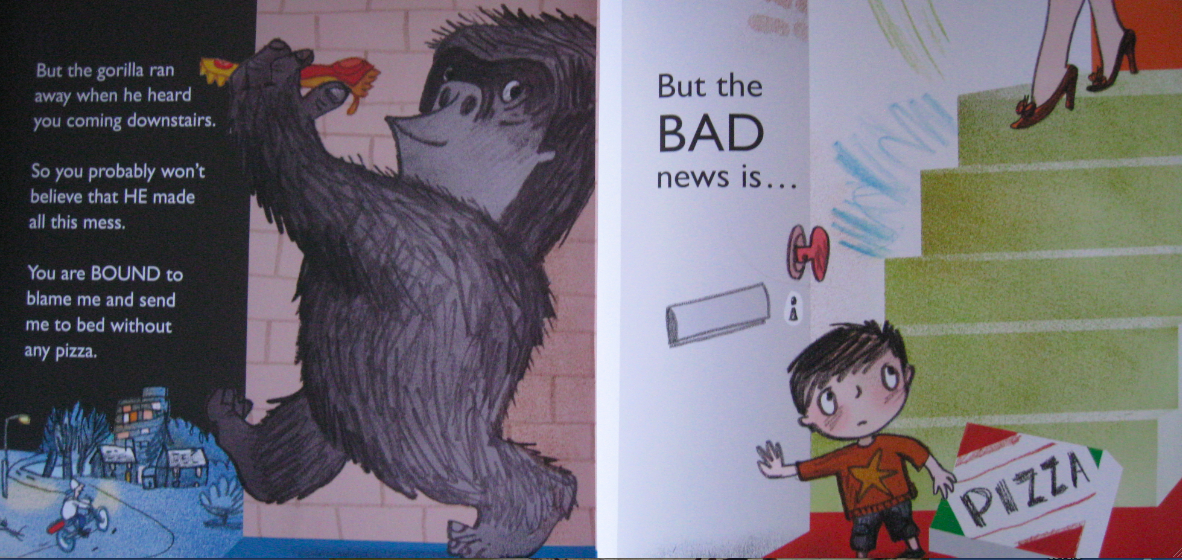
 A gorilla has come to visit . . .

Ding Dong Gorilla! by Robinson & Lord

. . . but not only did he make the mess – he left with the last of the pizza!

from Ding Dong Gorilla! by Robinson & Lord
Billy warned Dad that there were all kinds of sea creatures in his birthday bucket . . .

Billy's Bucket by Gray & Parsons
. . . but Dad borrowed it to clean the car anyway . . .
from Billy's Bucket by Gray & Parsons

What others can you think of?


Give it a twist and it will zing!
_________________________________________________

Natascha Biebow
Author, Editor and Mentor

Blue Elephant Storyshaping is an editing, coaching and mentoring service aimed at empowering writers and illustrators to fine-tune their work pre-submission. Check out my NEW small group coaching courses!

Natascha is also the author of Elephants Never Forget and Is This My Nose?, editor of numerous award-winning children’s books, and Regional Advisor (Chair) of SCBWI British Isles.  www.blueelephantstoryshaping.com


Friday, 25 April 2014

Ten Really Cool Picture Book Openings and Why They Matter By Natascha Biebow


I bet you are reading this first line thinking where is this blog post going and is it worth my while reading on? 

I know. I’m the kind of person who picks up a book, glances at the back cover and flips right to the opening page. Once I’ve read the opening lines, I can tell right away if I am hooked, whether I want to read on. Because the opening line gives me a really clear idea of the journey that the author is proposing. 

I quickly decide: is this a journey upon which I want to spend my precious time?

For instance, here's an opening I love, from Olivia Saves the Circus by Ian Falconer: 

"Before school, Olivia likes to make pancakes for her new
little brother, William, and her old little brother, Ian.

This is a big help to her mother."

Olivia Saves the Circus © Falconer


It sets up right away that Olivia is quite a character –- one that I'd like to spend time with! Also, I am intrigued by the voice which uses phrases like "old little brother". Importantly, the opening sets up that Olivia unwittingly equals trouble and, as a reader, I want to find out what she'll get up to next. (She goes on to do amazing circus acts with cool aplomb).

Editors and agents, who receive hundreds of submissions, are the same -- they have got to love the opening of a book to want to publish it.

But picture book openings  are notoriously difficult to get right. They are so few words for a start . . . Plus how will a story grab so many different people -– children, parents, elusive editors and agents -- at once?!

Importantly, a fantastic opening contains the premise and situation of the whole book. In the classic We're Going on a Bear Hunt by Michael Rosen and Helen Oxenbury, the opening line states right off the bat: "We're going on a bear hunt". Then, the author invites readers on an adventure that appeals to children and grown-ups alike. 


We're Going on a Bear Hunt ©  Rosen & Oxenbury


Almost immediately, we encounter our first challenge -- long wavy grass. Oooh, we've got to wade through it . . . We want to join in! This opening also sets out the mood, tone and authorial voice. Do we want to go on this adventure? Of course we do -- we want to find out what the bear is like! 

There are three key elements to every good opening: who, what and where?

1. Who? introduces the main character and tells readers who's going on the journey

In Penguin by Polly Dunbar, the book opens with the main character, Ben, receiving a penguin as a present. Why does Ben get a penguin, we wonder? What if this were us? What will happen next? 

Penguin © Dunbar
The opening in The Pig Who Wished by Joyce Dunbar and Selina Young is equally intriguing. Though the phrasing is more traditional  ("Once ..."), it quickly sets up that the main character is a pig with a difference, plus it promises a story with magic!

The Pig Who Wished © Dunbar & Young

2. Where? sets the scene for the story, including the setting and the circumstances of the main action.

In the classic The Very Hungry Caterpillar by Eric Carle, readers are enticed into the world of the little egg. We know we are in the natural world, full of promise and wonder.


The Very Hungry Caterpillar © Carle
By contrast, the setting in Goodnight Moon by Margaret Wise Brown and Clement Hurd is very domestic, but filled with interesting details. The rhythm of the voice is quickly established and the familiarity of the child's world promises a comforting journey with this narrator.

Goodnight Moon © Wise Brown & Hurd

3. What? sets up the main conflict and motivation of the character (what do they need?) that is going to drive them forwards.

In the first spread of Eat Your Peas by Kes Gray and Nick Sharratt, we meet Daisy and her mum at loggerheads over dinner -- how will they resolve their differences?

Eat Your Peas © Gray & Sharratt
Similarly in the opening lines of Fix It Duck by Jez Alborough, we meet the main character, Duck, who has a pressing problem -- a leak in the roof -- and whose fixing prowess, we later discover, is decidedly dodgy. Readers are immediately drawn into the rhythmical storytelling of this author's voice. 

Fix It Duck © Alborough

Often, authors will employ a few spreads to set up the story, but the really clever openings can do this in just a couple of lines and even on one page. Here are five great ways to grab readers in the opening lines:

1. Give a hint of things to come

Emily Brown and the Elephant Emergency © Cowell & Layton

In the first spread of Emily Brown and the Elephant Emergency by Cressida Cowell and Neal Layton, we meet Emily, Stanley and their friend Matilda. We jump right into an exciting adventure (one of many to come) and are intrigued to find out what will happen next.
 
2. Start in the middle of the action


No Matter What © Gliori

In this opening from No Matter What by Debi Gliori, the reader is thrown right into the middle of a situation -– Small is feeling grumpy. We want to know why he is grumpy and how will it be resolved. More than likely, we have been there ourselves, too, so we can empathise!

3. get readers’ attention so they want to know what’s next

The Tiger Who Came to Tea © Kerr


In The Tiger Who Came to Tea by Judith Kerr, readers are invited into a comfortingly ordinary scenario, but the promise of someone at the door (and the hint in the title) are intriguing enough to get readers to want to read on.


4. allude to familiar situations (we’ve all been there type scenarios)

Mr Bear's Picnic © Gliori

Debi Gliori is a master at capturing domestic situations in a light-hearted and poignant way that appeals to adults and children alike. In Mr Bear's Picnic, the prospect of a sunny day with children is a great opportunity for a picnic. But Mrs Bear, who has two little ones, is determined to catch some extra shut-eye. The role of Mr Bear as the adult leader and the source of humour is set up in just a few lines. 

5. introduce really intriguing characters and situations
If You Give a Mouse a Cookie © Numeroff & Bond


Laura Numeroff and Felicia Bond's bestselling classic If You Give a Mouse a Cookie sets up straight away a set of unusual characters in an intrguing situation.

Why would you offer a mouse a cookie and what would happen if you did?


Well, the mouse would want a
If You Give a Mouse a Cookie © Numeroff & Bond
glass of milk, which would lead to a whole host of other things and back to a cookie. The circular structure of the story is skillfully crafted and really satisfying, but what really grabs you is the premise.


So, with just a few words (and great illustrations!), picture book authors can create openings that make readers want to read on. But what all these openings do is pique readers' curiosity. If readers are saying 'so what?' then the author has lost them . . . Now, about that blank page staring at you . . . What will its opening lines be?

Natascha Biebow
Author, Editor and Mentor

Blue Elephant Storyshaping is an editing, coaching and mentoring service aimed at empowering writers and illustrators to fine-tune their work pre-submission. Natascha is also the author of Elephants Never Forget and Is This My Nose?, editor of numerous award-winning children’s books, and Regional Advisor (Chair) of SCBWI British Isles. www.blueelephantstoryshaping.com